CPT 99495 & 99496: TCM Billing Guide for 2026
Master TCM billing for CPT 99495 & 99496 in 2026. Rhythm360 helps cardiology practices avoid denials with automated compliance workflows.

Key Takeaways for 99495 and 99496 in 2026
- TCM codes 99495 and 99496 reimburse 30-day post-discharge care and require strict timing for contact, face-to-face visits, and medication reconciliation. Missing any core requirement disqualifies the entire episode.
- Code 99495 requires moderate-complexity MDM and a visit within 14 days, with a 2026 non-facility rate of $220.11. Code 99496 requires high-complexity MDM and a visit within 7 days, with a 2026 non-facility rate of $298.60.
- The visit that fulfills the TCM face-to-face requirement is bundled into TCM payment and cannot be billed as a separate office E/M service.
- TCM and CCM can both be billed in the same month when each service independently meets its requirements, but only one TCM code can be submitted per discharge episode.
- Rhythm360 automates discharge tracking, contact logging, and medication reconciliation so cardiology practices stay compliant and capture every eligible TCM reimbursement. Schedule a demo to see the workflow in action.
How 99495 and 99496 Compare Side by Side
TCM codes 99495 and 99496 share a 30-day service period and a 2-business-day contact requirement. They differ on visit timing, MDM complexity, and 2026 Medicare payment rates.
| Requirement | CPT 99495 | CPT 99496 |
|---|---|---|
| Interactive contact after discharge | Within 2 business days | Within 2 business days |
| Face-to-face visit window | Within 14 calendar days | Within 7 calendar days |
| Medical decision-making complexity | At least moderate complexity | High |
| 2026 non-facility Medicare rate | $220.11 | $298.60 |
| 2026 facility Medicare rate | $128.14 | See current PFS |
| Face-to-face visit billed separately | No, bundled into TCM payment | No, bundled into TCM payment |
| Service period | 30 days beginning on discharge date | 30 days beginning on discharge date |
Revenue risk of a missed visit window: If a high-complexity patient’s face-to-face visit occurs after day 7 but within day 14, the claim must be billed as 99495. That downgrade reduces reimbursement for the episode.
Billing TCM and Office E/M Without Bundling Errors
The required face-to-face visit is bundled into the TCM payment and cannot be billed separately as an office E/M service. A separate, distinct E/M visit on a different date during the 30-day period may be billable, depending on payer rules, but the visit that satisfies the TCM face-to-face requirement is not separately reportable.
2026 checklist for TCM and E/M compliance:
Follow this sequence to keep TCM compliant while avoiding E/M bundling mistakes.
- First, confirm interactive contact with the patient or caregiver within 2 business days of discharge. Voicemail alone does not qualify.
- Next, document the qualifying discharge setting in the record, such as inpatient acute care, inpatient psychiatric, observation status, SNF, IRF, LTCH, or partial hospitalization.
- When you schedule the TCM face-to-face visit, remember that this visit is bundled into the TCM payment and cannot be billed as a separate office E/M on the same claim.
- If the face-to-face visit is furnished via audio-video telehealth, append Modifier 95 when payer rules allow.
- Finally, confirm that the patient is returning to a community setting, because discharges to another inpatient facility do not qualify for TCM billing.
Coordinating TCM and CCM in the Same Month
Before 2020, Medicare prohibited billing CPT 99495 with CCM codes 99490 or 99491 in the same month and triggered edits. Since 2020, both services may be reported for the same patient when each service independently meets its requirements. Practices should confirm that both TCM and CCM meet their respective criteria before billing in the same month.
2026 checklist for TCM and CCM billing:
- Confirm that the patient qualifies for both services and that all requirements for TCM and CCM are met independently.
- Document the discharge date and TCM services separately from the CCM services.
- Confirm that care plan oversight, home health certification (G0180 or G0179), and other care management services are not billed by the same practitioner during the TCM period.
- Review payer-specific rules. Medicare Advantage plans generally follow Medicare TCM rules, while commercial payers may apply additional restrictions.
Key CMS TCM Rules for 2026
Medicare’s TCM requirements for CPT 99495 and 99496 remain largely stable in 2026, with updates focused on documentation guidance and clarified telehealth rules for the required face-to-face visit. Payment rates for 99495 and 99496 reflect the CY2026 Physician Fee Schedule conversion factor of $33.57 for QP clinicians, with a separate non-QP factor.
2026 CMS TCM guidelines checklist:
Use this list to confirm that your TCM workflows match current CMS rules.
- The 30-day TCM service period begins on the discharge date and covers the next 29 days.
- TCM services can be furnished via telehealth, and geographic and originating-site flexibilities for home telehealth run through December 31, 2027.
- The date of service on a TCM claim must be the date of the required face-to-face visit. The claim may be submitted once that visit has occurred without waiting for the full 30 days.
- Only one TCM code, 99495 or 99496, may be billed per patient per 30-day service period.
- Only one provider or practice can be reimbursed for TCM for a single patient discharge, and duplicate billing by multiple clinicians is a common denial risk.
Documentation Checklist for 99495 and 99496
Required documentation elements for 99495 and 99496:
- Discharge date and qualifying facility type from the discharge summary.
- Date, time, method, and outcome of initial interactive contact within 2 business days, including who initiated contact.
- Medication reconciliation documentation that includes the completion date, comparison of pre-admission, inpatient, and discharge medication lists, identified discrepancies, resolutions, and the credentialed provider who performed the reconciliation.
- Medication reconciliation completed on or before the face-to-face visit date, because reconciliation after the visit places the claim out of compliance.
- Face-to-face visit note within 14 days for 99495 or 7 days for 99496 that supports the appropriate MDM level.
- MDM documentation that covers number and complexity of problems addressed, amount and complexity of data reviewed, and risk of complications or mortality.
- Care plan review, patient education, and coordination with other providers such as specialists, SNF staff, or home health agencies when applicable.
- Complete, legible documentation that is signed and dated by the physician or clinician.
7-Step TCM Billing Workflow for 2026
- Identify eligible discharges. Flag patients discharged from inpatient acute care, inpatient psychiatric, inpatient rehabilitation, LTCH, SNF, hospital outpatient observation, or partial hospitalization who are returning to a community setting. Rhythm360’s bi-directional EHR integration surfaces discharge notifications automatically and removes the need for manual tracking across portals.
- Obtain and document patient consent. Confirm that the patient or caregiver agrees to TCM services and document consent in the medical record before the 30-day episode begins.
- Complete interactive contact within 2 business days. Missing this window disqualifies the 30-day TCM episode from billing, even when other care is provided. Rhythm360’s integrated communication hub, powered by Twilio, logs every call attempt with date, time, method, and outcome, creating an audit-ready trail inside the patient record.
- Schedule and complete the face-to-face visit. For 99495, the visit must occur within 14 calendar days, and for 99496, within 7 calendar days. Scheduling alerts tied to the discharge date help prevent missed visit windows.
- Perform and document medication reconciliation on or before the visit date. Vague notes such as “medications reviewed” without specific discrepancies or confirmation that none existed frequently cause TCM denials and audit flags. Rhythm360’s automated data capture pulls discharge medication lists directly from the EHR and prompts clinicians to complete reconciliation within the required timeframe.
- Complete the 30-day care management period and finalize documentation. Record care plan review, patient education, and coordination with specialists or post-acute providers throughout the service period. Confirm that no overlapping CCM or care plan oversight codes are billed for the same patient in the same month.
- Submit the claim and manage denials. Report the date of the face-to-face visit as the date of service, and submit the claim once that visit has occurred. If a denial occurs, review the 2-business-day contact log, medication reconciliation timestamp, MDM documentation, and discharge setting eligibility before resubmitting.
2026 CMS Updates and Payer Variations to Watch
Telehealth flexibilities: TCM services can be furnished via telehealth, and geographic and originating-site flexibilities for home telehealth extend through December 31, 2027. The face-to-face visit may be delivered via two-way audio-video technology within the required window, as long as documentation meets in-person standards. Modifier 95 may be appended to 99495 when the face-to-face visit is furnished via audio-video telehealth, subject to payer rules.
E/M bundling clarifications: The face-to-face visit that satisfies the TCM requirement remains bundled into the TCM payment and is not separately reportable. Practices that bill a distinct E/M on a different date during the 30-day period should confirm payer-specific guidance before submitting claims.
Non-Medicare payer differences: Medicare Advantage plans follow Medicare TCM rules, and many commercial payers also reimburse 99495, often at favorable rates. Verify prior authorization requirements and documentation standards with each commercial payer, because coverage policies vary and some payers apply extra limits on telehealth delivery of the face-to-face visit.
Schedule a demo to see how Rhythm360 captures the documentation required for 99495 and 99496 compliance across your cardiology population.
Denial-Prevention Reference Table
| Common Denial Reason | Root Cause | Required Documentation Element |
|---|---|---|
| Missing 2-business-day contact | Failure to track discharge notifications or document call attempts with date, method, and outcome | Logged contact record with date, time, method, outcome, and initiating party |
| Incomplete medication reconciliation | Note states “medications reviewed” without recording discrepancies or confirming none existed | Dated reconciliation note comparing pre-admission, inpatient, and discharge lists with discrepancy resolution and credentialed provider signature |
| Medication reconciliation completed after face-to-face visit | Reconciliation timestamp falls after the visit date, which places the claim out of compliance per MLN908628 | Reconciliation date on or before the face-to-face visit date, documented in the medical record |
| Face-to-face visit outside required window | No scheduling alerts tied to discharge date for the required visit | Visit note dated within 14 days for 99495 or 7 days for 99496, with MDM documentation |
| Overlapping CCM billing | Billing CCM and TCM in the same month when each service does not independently meet its requirements | Documentation that both TCM and CCM requirements are satisfied when both are billed |
| Insufficient MDM documentation | Visit note fails to detail multiple diagnoses, data review, or medication reconciliation | MDM note that covers problem complexity, data reviewed and analyzed, and risk of complications or mortality |
| Duplicate billing by multiple providers | Cardiologist and PCP both submit TCM for the same discharge episode | Coordination confirmation that only one practice is submitting TCM for the discharge episode |
| Wrong code based on MDM level | Selecting 99496 when documentation supports only moderate MDM or when the visit occurred after day 7 | MDM level explicitly documented and matched to the billed code, with downgrade to 99495 when the visit falls between days 8 and 14 |
Frequently Asked Questions
What is the difference between CPT 99495 and 99496?
Both codes cover a 30-day transitional care management period following a qualifying discharge and require interactive contact with the patient or caregiver within 2 business days. CPT 99495 requires medical decision making of at least moderate complexity and a face-to-face visit within 14 calendar days of discharge, reimbursed at $220.11 in the non-facility setting under 2026 Medicare rates. CPT 99496 requires high medical decision making and a face-to-face visit within 7 calendar days, reimbursed at $298.60 in the non-facility setting. If a high-complexity patient’s visit occurs after day 7 but within day 14, the claim must be billed as 99495, which lowers reimbursement for that episode.
What happens if the 2-business-day contact requirement is missed?
Earlier sections noted that missing the 2-business-day interactive contact window disqualifies the entire episode. The contact must be interactive, which means a telephone call with a live response, a secure electronic message exchange, or a direct face-to-face interaction. A voicemail alone does not satisfy the requirement. Practices should log the date, time, method, and outcome of every contact attempt to demonstrate compliance during an audit.
Can TCM and Chronic Care Management be billed in the same month?
Yes, when requirements are met. Prior to 2020, Medicare prohibited billing CPT 99495 with CCM codes 99490 or 99491 in the same month and triggered edits, but since 2020 both may be reported for the same patient when each service independently meets its requirements. When a patient enrolled in CCM is discharged from a qualifying facility, the practice should confirm that both services meet requirements before billing both in the same month. Billing systems and workflow tools should flag potential conflicts but still allow compliant dual billing.
What qualifies as a valid discharge setting for TCM billing?
CMS recognizes several discharge settings as qualifying for TCM billing under 99495 and 99496. These settings include inpatient acute care hospital, inpatient psychiatric hospital, inpatient rehabilitation facility, long-term care hospital, skilled nursing facility, hospital outpatient observation, partial hospitalization, and partial hospitalization at a community mental health center. The patient must return to a community setting such as home, domiciliary care, nursing facility, or assisted living. Discharges to another inpatient facility do not qualify for TCM billing under current Medicare rules.
How does Rhythm360 help cardiology practices avoid TCM claim denials?
Rhythm360 targets the most common TCM denial sources with automated workflow support and bi-directional EHR integration. The platform surfaces discharge notifications automatically so practices do not miss the 2-business-day contact window, logs all patient communications with a full audit trail through its integrated Twilio-powered messaging framework, and pulls discharge medication lists directly from the EHR to prompt timely medication reconciliation documentation. The administrative dashboard provides a real-time view of each patient’s TCM episode status, including contact completion, reconciliation documentation, and visit scheduling, so billers and administrators can fix compliance gaps before claim submission. Practices using Rhythm360 have reported up to a 300% increase in revenue generation through improved CPT code capture and stronger documentation workflows.
Automate TCM Compliance With Rhythm360
TCM underutilization remains a significant revenue gap for cardiology practices. Only a small percentage of eligible Medicare fee-for-service discharges are billed for transitional care management, and TCM utilization remains low across many patient populations. At the same time, TCM services correlate with meaningfully lower 30-day readmission rates. A retrospective review of more than 27,000 patients with chronic conditions found that TCM utilization was significantly associated with lower odds of 30-day rehospitalization. Capturing this revenue while meeting 2026 CMS documentation requirements requires a system that tracks every timing window, logs every patient contact, and integrates directly with the EHR, rather than a manual spreadsheet or disconnected portal.
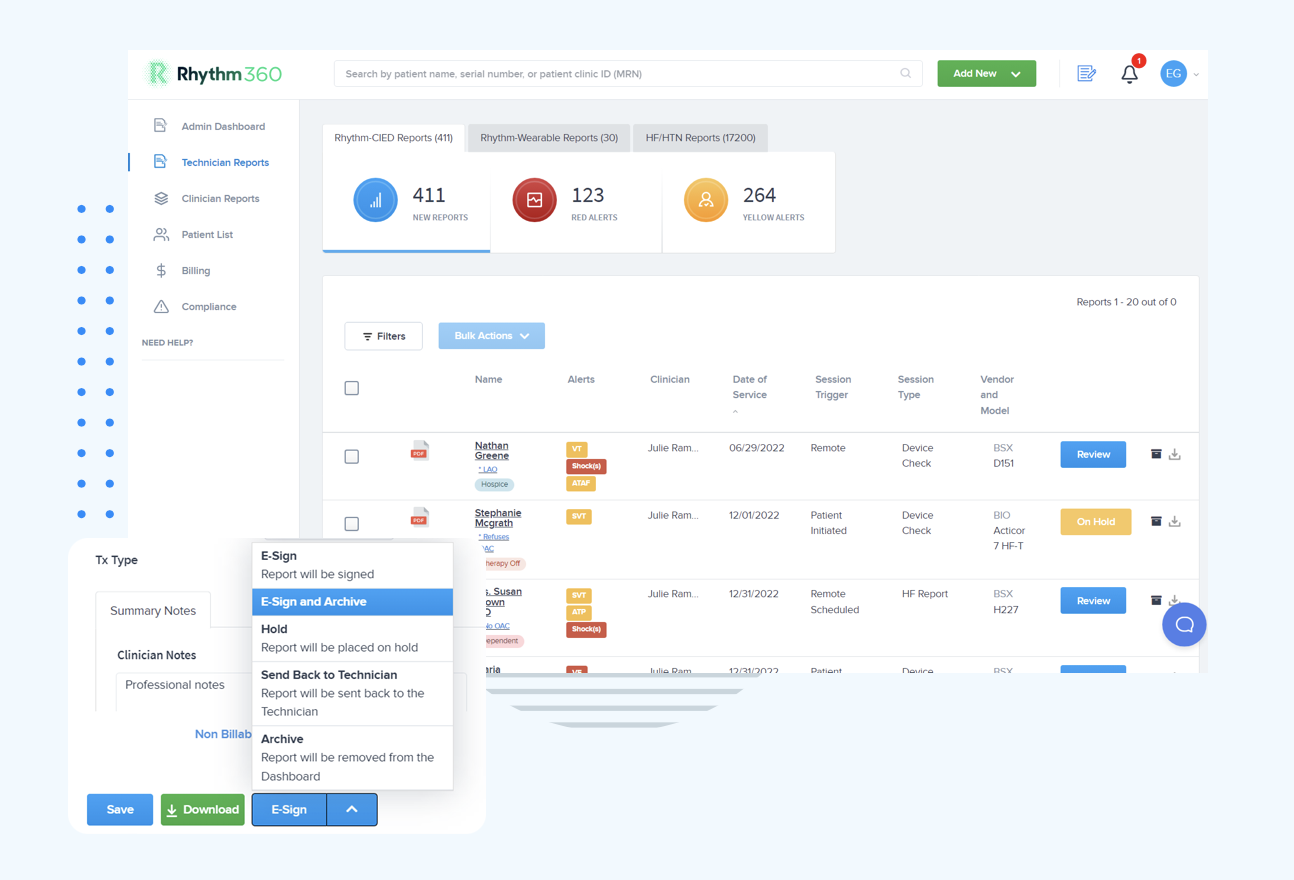
Rhythm360 is a vendor-neutral, HIPAA-compliant platform built for cardiology practices that manage complex post-discharge populations. Its bi-directional EHR integration, automated communication logging, and real-time compliance dashboard give administrators, billers, and cardiologists the documentation infrastructure needed to bill 99495 and 99496 confidently and capture the full reimbursement each episode earns.
Schedule a demo and see how Rhythm360 replaces manual tracking that leads to denied TCM claims and lost revenue for cardiology practices.