

Last updated: September 22, 2026
Talk to Rhythm360 About Your CIED Workflow
The platforms below are the ones cardiology practices most often shortlist when they evaluate vendor-neutral CIED software. Use this list as a starting point, then apply the criteria in the sections that follow to compare them.
See Rhythm360’s Multi-OEM Ingestion in Action
Vendor neutrality describes ingestion architecture and data handling, not a marketing slogan. A genuinely vendor-neutral platform ingests CIED data through multiple technical pathways: direct API connections, HL7 v2.6 feeds as defined by the Implantable Device Cardiac Observation (IDCO) profile, XML parsing, and computer-vision PDF parsing as a fallback. Each method has documented limitations.
HL7 v2’s event-driven messaging model, with optional segments and extensive local customization, produces semantic incompleteness and inconsistencies across healthcare environments. Raw HL7 v2 feeds therefore require normalization before they are clinically reliable. FHIR-based exchange addresses many of these gaps but introduces its own conformance variability.
PDF-only ingestion is a red flag. The HL7 CardX CIED Diagnostic Report profile designates the structured DiagnosticReport.result element, referencing Implantable Device Cardiac Observation resources, as the primary structured-data path. The presentedForm PDF attachment is only a document-fidelity fallback. A scanned PDF attached as a document cannot be read by a rules engine, cannot be trended or alerted on, and limits downstream billing automation. A scanned document sets the ceiling on how far a device clinic can scale.
The HL7 CardX CIED implementation guide carries a Trial-use standards status with a Maturity Level of 2. Vendors implement it inconsistently. Buyers should test conformance against a live patient record rather than accept a vendor’s claim of compliance.
Ingestion architecture only matters when it covers the manufacturers your patients actually have. True vendor neutrality requires ingesting data from Medtronic, Abbott, Boston Scientific, Biotronik, and MicroPort without separate logins for each portal. The 2026 JHRS Expert Consensus Statement documents that Abbott’s Merlin.net, Biotronik’s Home Monitoring, Boston Scientific’s LATITUDE, Medtronic’s CareLink, and MicroPort’s SmartView all support export to electronic medical charts and describes manufacturer-specific differences in transmission characteristics such as real-time IEGM duration and communication methods.
That inconsistency is the operational problem a vendor-neutral platform solves. Staff logging into five portals, reconciling five report formats, and manually transcribing data into the EHR represents the status quo a real platform eliminates.
When you evaluate a vendor’s multi-OEM claim, ask which ingestion method they use for each manufacturer: API, HL7, XML, or computer-vision PDF. The answer determines which downstream automation and analytics are realistic.
Vendors typically collapse four distinct integration levels under the label “EHR-integrated”. These levels are a one-way HL7 feed landing as a PDF or flowsheet note, bidirectional sync over FHIR APIs with discrete, filable observations, an embedded SMART on FHIR app launch, and single sign-on via SAML or OAuth 2.0. SSO provides authentication convenience, not data integration. A platform can have single sign-on and still write nothing discrete to the chart.
The distinction between discrete data exchange and PDF filing is clinically and financially material. Discrete data is a coded, queryable field, for example an HL7 FHIR Observation resource carrying a LOINC code and a UCUM unit, that feeds trending, flowsheets, and decision support. A scanned PDF attached as a DocumentReference cannot be read by any rules engine and limits automation and downstream billing usability.
For Epic, Cerner, Athenahealth, and eClinicalWorks, six data elements should land as discrete structured data:
Require vendors to demonstrate discrete write-back live against your own test patient in your specific EHR. A slide deck does not prove integration.
Billing automation is where platform selection directly affects practice revenue. The relevant CPT codes and their cycles are:
93297 and 93298 are device-specific codes. Each applies to a different device type and is billable once per 30-day period. Applying CPT 93298 to a loop recorder or CPT 93297 to a physiologic monitor produces a device-type mismatch denial, because 93297 is specific to implantable loop recorders and 93298 is specific to implantable hemodynamic monitors such as CardioMEMS.
CMS Billing Article A56602 governs cardiac rhythm device evaluation coding under Medicare and requires a monitoring period of at least 30 days. An audit of 61,400 cardiology claims found that 9% of device interrogation and remote monitoring claims were denied for frequency, with an average denied charge of $94 per claim. Tracking a monitoring interval start date per patient, and releasing claims only after the monitoring period closes, eliminates most frequency denials in this code family. A platform that tracks billing by calendar month rather than by patient-specific monitoring interval start date creates avoidable frequency denials.
Data portability during procurement separates vendors who rely on product value from those who rely on switching costs. A vendor that exports data as a proprietary binary file or a PDF dump has technically complied with a portability requirement but given the buyer something largely unusable.
A strong export clause should define four elements precisely:
Exit terms should be negotiated at the first signature and revisited at every renewal while the buyer still has leverage. Best practice is to require a tested export at least once during the contract term, rather than attempting the first export when leaving the vendor. A vendor unwilling to agree to a tested mid-contract export signals that the export process does not work reliably.
Three operational models exist, and clinic size and staffing determine which fits best:
Platform-only software costs $80–$200 per patient per month before devices, staffing, and billing operations. Full-service models typically charge $40–$80 PPPM. Staffing ratios run 1 FTE per 150–200 patients for standard chronic care, 1 FTE per 100–125 for high-acuity monitoring, and 1 FTE per 200–300 for AI-assisted exception-based workflows.
Use the following questions directly in vendor demos and contract negotiations to separate real platforms from portals:
Those seven criteria form a practical filter. Applied to the platforms most practices shortlist, Rhythm360 by RhythmScience is the one that meets all of them in a single platform: vendor-neutral, HIPAA-compliant, and cloud-based.
Rhythm360 by RhythmScience is a vendor-neutral, HIPAA-compliant, cloud-based platform that unifies all implantable and wearable cardiac device data into one AI-powered dashboard. It ingests data from Medtronic, Abbott, Boston Scientific, and Biotronik via API, HL7, XML, and computer-vision PDF parsing. Redundant data feeds and AI-powered extrapolation achieve the transmissibility figure shown in the table below. Bi-directional EHR integration covers Epic, Cerner, Athenahealth, eClinicalWorks, and Greenway Health. Automated CPT documentation tracks device-specific code pairings across 90-day pacemaker and ICD cycles (93294, 93295, 93296) and 30-day physiologic monitor and loop recorder cycles (93297, 93298), preventing device-type mismatch denials and unbilled technical components.
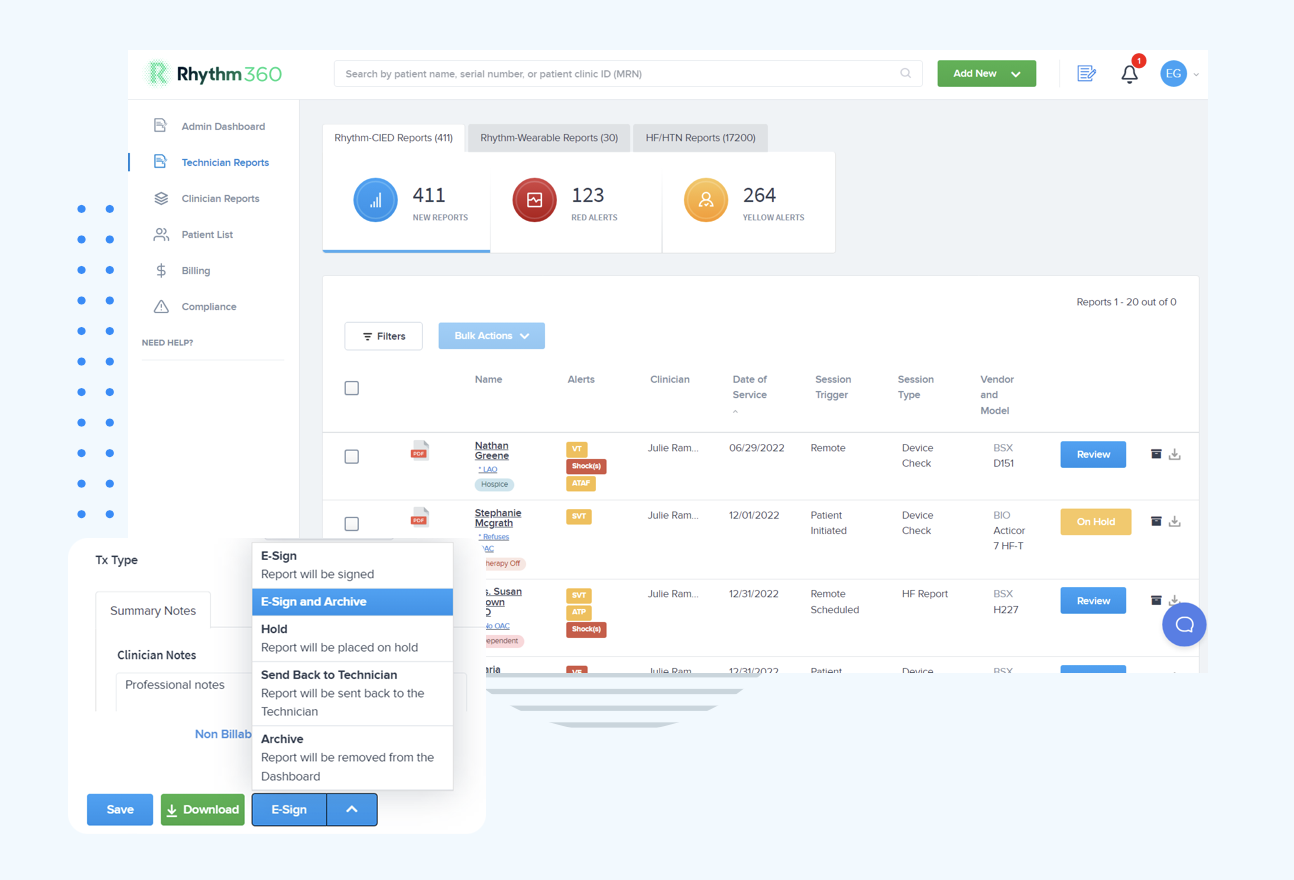
The table below highlights the performance attributes that matter most in an RFP: data transmissibility, alert response, revenue capture, integration breadth, and scale. You can compare these directly against the criteria in sections 1 through 7.
| Attribute | Rhythm360 (RhythmScience) |
|---|---|
| Data Transmissibility | >99.9% via redundant data feeds, computer vision, and AI-powered extrapolation |
| Critical Alert Response Time Reduction | Up to 80% |
| Revenue Capture Improvement | Up to 300% increase in revenue capture/profitability |
| Annual Report Volume (University of Chicago Medicine, 2025) | More than 73,000 reports annually, averaging more than 18,000 reports per quarter |
| EHR Integration | Bi-directional; Epic, Cerner, Athenahealth, eClinicalWorks, Greenway Health, and others via HL7 |
| OEM Coverage | Medtronic, Abbott, Boston Scientific, Biotronik, MicroPort |
| Onboarding Timeline | A few days to a few weeks, including EHR integration |
Evaluate Rhythm360 Against Your RFP Checklist
Rhythm360 supports vendor-neutral ingestion across the five major CIED manufacturers without requiring separate logins for each OEM portal. It ingests data from Medtronic, Abbott, Boston Scientific, and Biotronik via API, HL7, XML, and computer-vision PDF parsing. The 2026 JHRS Expert Consensus Statement confirms that Merlin.net, Home Monitoring, LATITUDE, CareLink, and SmartView all support export to electronic medical charts and describes manufacturer-specific differences in transmission characteristics. Rhythm360 normalizes data from these OEM sources into a single dashboard so staff avoid logging into multiple portals and manually reconciling conflicting report formats.
Data portability depends on the export clause you negotiate, not on a default feature. Section 5 outlines the four elements a strong export clause should define: scope, format, delivery method, and time window. The key point is timing. The time to negotiate exit terms is at first signature, when the vendor wants the business, and to verify them with a test export during the contract, not at renewal when the vendor already holds all the data.
Software-only, software-plus-technician, and fully outsourced models differ in who handles triage and monitoring. Section 6 explains which clinic profiles fit each model and provides typical staffing ratios for chronic care, high-acuity monitoring, and AI-assisted workflows. Use those benchmarks to estimate internal staffing needs before you choose a model.
Remote CIED monitoring uses 90-day cycles for pacemakers and ICDs and 30-day cycles for physiologic monitors and loop recorders. Section 4 covers the specific codes in detail. In short, 93294–93296 are the 90-day pacemaker and ICD codes, and 93297–93298 are the 30-day device-specific codes for physiologic monitors and loop recorders. Tracking a monitoring interval start date per patient and releasing claims only after the period closes prevents most frequency denials.
Fragmented OEM portals, PDF-only ingestion, undocumented billing cycles, and weak contract terms that trap patient and device data cost cardiology practices revenue and clinical response time. The criteria that separate vendor-neutral platforms from OEM portals include multi-OEM ingestion via API, HL7, XML, and computer-vision PDF across Medtronic, Abbott, Boston Scientific, Biotronik, and MicroPort; bi-directional EHR integration with discrete data write-back into Epic, Cerner, Athenahealth, and eClinicalWorks; automated CPT documentation for 93294, 93295, 93296, 93297, and 93298 with patient-level monitoring interval tracking; and a contract that defines export scope, format, delivery method, and timeline before the first signature. Rhythm360 is a vendor-neutral CIED platform with documented results at scale, including the University of Chicago Medicine results cited earlier.
Discuss Rhythm360 for Your Device Clinic





