Last updated: July 13, 2026
Workflow-automation RPM functions as a cloud-based backbone for cardiac monitoring. It ingests cardiac device and physiologic data from all manufacturers, applies AI-driven triage to surface only clinically actionable alerts, auto-generates compliant billing documentation for 2026 CPT codes, and pushes structured data in and out of the EHR, all accessible from a mobile device. For cardiovascular practices in 2026, the non-negotiable capabilities are clear and tightly connected.
Each additional device manufacturer a practice implants introduces a separate, non-interoperable login. Staff toggle between Medtronic CareLink, Boston Scientific Latitude, Abbott Merlin.net, and Biotronik Home Monitoring to retrieve data that should live in one place. Three compounding pain points follow and build on one another.
Administrative overload. Manual data retrieval and transcription consume hours that trained device technicians and nurses should spend on clinical decisions. Burnout from this overhead is a documented driver of staff turnover in electrophysiology programs.
Beyond staffing strain, fragmented portals create direct patient-safety exposure. Missed critical events occur when alerts sit unreviewed in a queue no one monitors on weekends. A ventricular tachycardia episode or lead fracture flagged on a Saturday morning may not reach a clinician until Monday, which creates a patient-safety gap that a unified, AI-triaged platform closes.
The operational and clinical costs then show up on the balance sheet. Revenue leakage occurs when practices lack automated tracking of transmission days and clinical-staff time. They routinely miss the thresholds required to bill CPT 99454, 99457, and the new 2026 codes 99445 and 99470. Manual workflows lose 15–30% of billable minutes in time logs, which translates directly to uncaptured revenue.
Other platforms exist, yet many still mirror OEM fragmentation. Rhythm360 by RhythmScience is built to unify CIED and chronic-condition monitoring, AI triage, and billing documentation in a single vendor-neutral environment.
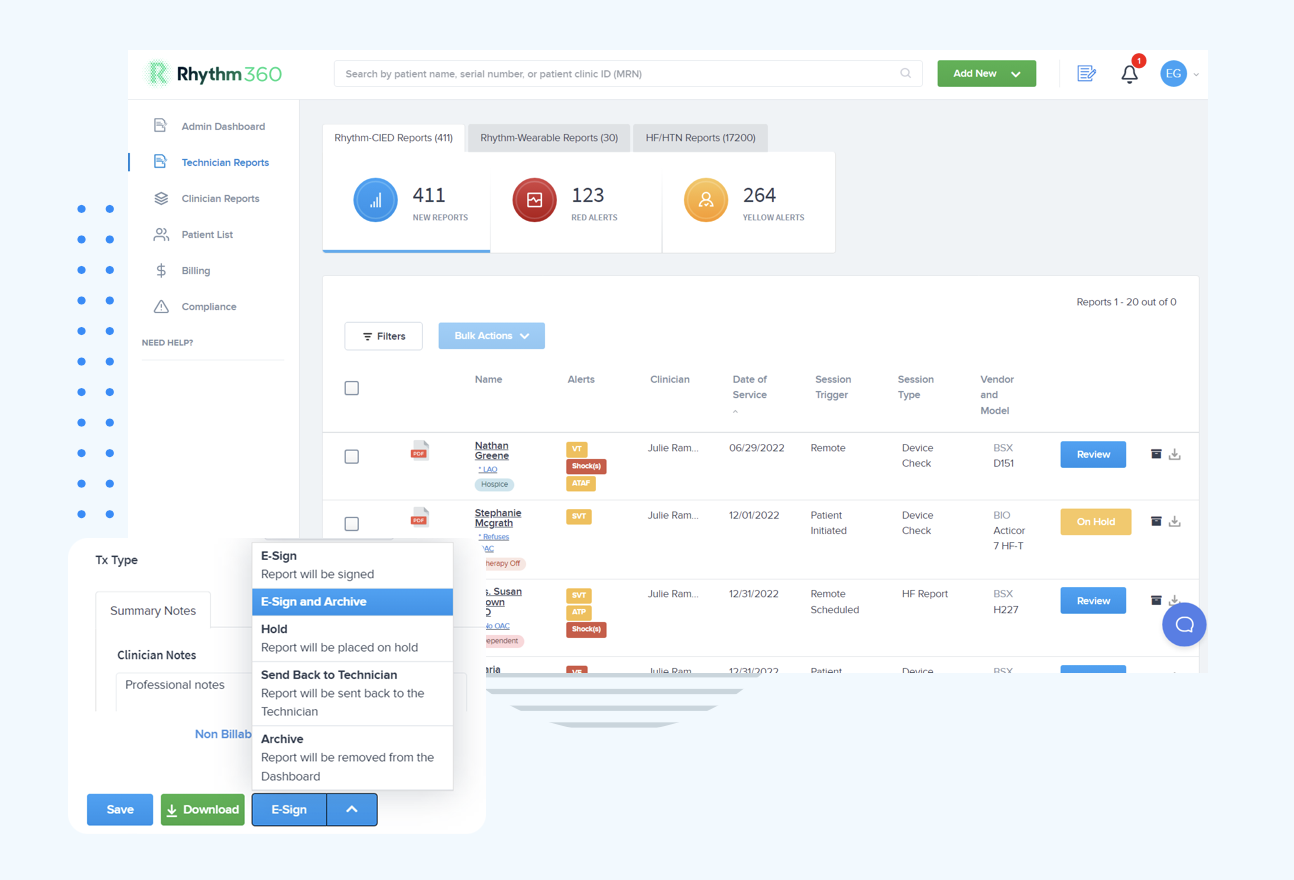
Operational burden from fragmented portals often makes practices wary of switching platforms, because leaders fear implementation disruption. Rhythm360’s streamlined onboarding process typically takes a few days to a few weeks from contract signature to go-live, which is a fraction of the many months large health systems require when building custom multi-device RPM–EHR integrations from scratch.
The Rhythm360 implementation sequence follows a structured path.
Bi-directional EHR integration functions as a core deliverable, not an optional add-on. Data flows from device transmissions into the EHR chart automatically, which eliminates duplicate documentation and satisfies the FHIR interoperability baseline required under the 21st Century Cures Act.
Alert fatigue has measurable clinical consequences. A 2026 retrospective study at Brigham and Women’s Hospital found that machine learning alarms reduced alarm burden compared with traditional threshold alarms and achieved higher positive predictive values for clinically important events. In CIED monitoring, high volume without intelligence creates conditions for missed events.
Rhythm360’s AI-powered alert triage filters non-actionable transmissions and surfaces only clinically significant events such as new-onset atrial fibrillation, ventricular tachycardia, lead malfunction, ERI or RRT indicators, and significant weight changes in heart failure patients. This design produces the 80% reduction in critical-alert response times highlighted earlier.
The University of Chicago Medicine (UCM) validated this approach at scale. UCM reviewed more than 73,000 reports annually through Rhythm360 in calendar year 2025, averaging more than 18,000 reports per quarter. Andrew Beaser, MD, Associate Professor of Medicine at UCM, observed, “We are able to address these issues earlier; rather than waiting for a 3-month visit, we can call patients in for evaluation.” He also noted, “Decision support, including AI-assisted decision support, will become increasingly important as data volumes grow.”
Rhythm360 maintains data transmissibility above 99.9% through redundant data feeds, computer vision OCR for unstructured PDF parsing, and AI-powered extrapolation to fill connectivity gaps. This combination ensures that no transmission disappears silently.
The 2026 Medicare Physician Fee Schedule introduced two new RPM codes that expand billable opportunities for cardiovascular practices. CPT 99445 covers device supply for patients who transmit readings on 2–15 days per month (national average about $47), and CPT 99470 covers the first 10–19 minutes of RPM treatment management with at least one interactive communication (national average about $26). These codes remove the prior 16-day and 20-minute minimums that caused practices to forfeit reimbursement for real clinical work.
The full 2026 RPM billing stack for a heart-failure program includes the following codes.
Rhythm360 automates tracking of transmission days and clinical-staff time against each threshold, generates audit-defensible documentation, and flags billing opportunities before the calendar month closes. Gaurav A. Upadhyay, MD, at UCM confirmed, “We have improved billing and accountability for our patients after the integration.” Practices that implement automated billing workflows have captured up to 300% more revenue compared with manual processes.
Mobile access directly affects how quickly clinicians respond to critical arrhythmias. A typical scenario involves a serious arrhythmia flagged at 7 a.m. on a Saturday. Without mobile access, the alert waits until Monday. With Rhythm360’s HIPAA-compliant mobile application, the on-call electrophysiologist receives a prioritized notification, reviews the transmission, signs the report, and coordinates anticoagulation or device reprogramming before noon.
Dr. Beaser at UCM described the practical reality: “I am more likely to sign off on these while in meetings because I can easily access them on my phone.”
Rhythm360’s mobile capabilities include the following features.
Rhythm360 is architected to scale from solo electrophysiology clinics to large integrated delivery networks. The platform’s SaaS pricing model adjusts based on clinic size and usage, which avoids rigid per-seat fees that make enterprise software prohibitive for independent practices.
Procurement teams should evaluate cardiac RPM platforms against six criteria that directly shape clinical, operational, and financial outcomes. The following checklist summarizes what to require and how Rhythm360 aligns with each area.
Vendor-neutral CIED support. Require native ingestion from Medtronic, Boston Scientific, Abbott, and Biotronik without manual export. Rhythm360 provides this through API, HL7, XML, and computer vision PDF parsing so staff work in a single environment.
AI alert triage. Require machine-learning–based filtering that reduces alarm burden while preserving sensitivity for critical events. Rhythm360’s triage engine delivers the validated response-time reduction noted earlier while maintaining data transmissibility above 99.9%.
Automated billing documentation. Require automated tracking of transmission days and staff time against 2026 CPT thresholds, including 99445, 99454, 99470, 99457, and 99458. Rhythm360 supports the full 2026 CPT code set and has helped practices increase captured revenue by up to 300%.
Bi-directional EHR integration. Require data to flow into and out of Epic, Cerner, Athenahealth, and eClinicalWorks without manual transcription. Rhythm360 delivers native integrations via HL7 and API, with performance confirmed at UCM.
Mobile app access. Require HIPAA-compliant smartphone review, report signing, and critical-alert notification. Rhythm360 offers a full mobile workflow validated in daily use by clinicians such as Dr. Beaser at UCM.
Implementation speed. Require go-live in weeks, not months, with no disruption to existing clinical workflows. Rhythm360 typically completes implementation, including EHR integration, within a days-to-weeks window and scales through a SaaS model that fits different practice sizes.
Rhythm360’s implementation process minimizes disruption to active clinical workflows. Most practices reach go-live within a few days to a few weeks from contract execution. The timeline includes platform configuration, OEM data-feed activation, EHR integration setup via HL7 or API, staff training, and billing workflow customization. Practices with straightforward single-site environments typically complete the process faster, while larger health systems with multiple EHR environments may use the full several-week window. This pace is substantially faster than building or migrating to a custom RPM infrastructure, which industry benchmarks place at 9–18 months for large multi-device deployments.
Rhythm360 supports bi-directional integration with Epic, Cerner, Athenahealth, eClinicalWorks, Greenway Health, and additional systems via HL7. Bi-directional integration means device transmission data, alert notifications, and signed reports flow automatically into the correct sections of the patient’s EHR chart, while patient demographic and scheduling data flow back into Rhythm360. This approach eliminates duplicate documentation and satisfies FHIR interoperability requirements under the 21st Century Cures Act. The University of Chicago Medicine confirmed improved billing accountability following integration, which reflects the downstream revenue benefits of clean, automated data exchange.
Rhythm360’s HIPAA-compliant mobile application delivers prioritized push notifications for critical events, including ventricular tachycardia, ventricular fibrillation, new-onset atrial fibrillation, lead malfunction, ERI or RRT indicators, and significant physiologic changes in heart-failure patients, directly to the on-call clinician’s smartphone. The clinician can review the full transmission, access the patient’s device history, sign the report, and initiate care coordination without returning to a workstation. For practices that require additional coverage, Rhythm360 offers optional 24/7/365 oversight by certified cardiac technicians supervised by physicians, which ensures that no critical alert goes unreviewed regardless of time or day.
Rhythm360 automates documentation and threshold tracking for the full 2026 RPM billing code set. This includes the two codes new for 2026, CPT 99445 for device supply when patients transmit readings on 2–15 days per month and CPT 99470 for the first 10–19 minutes of RPM treatment management, as well as existing codes 99453, 99454, 99457, and 99458. The platform tracks transmission days and clinical-staff time in real time, flags patients approaching billing thresholds before the calendar month closes, and generates audit-defensible documentation. Practices also use Rhythm360 to support CIED-specific codes such as 93296, 93297, 93298, and 93299. The platform does not manage the revenue cycle directly, yet its automated documentation capabilities help practices capture billing opportunities that manual workflows routinely miss.
Rhythm360 serves the full spectrum of cardiovascular providers. For solo electrophysiologists and small cardiology groups, the platform’s SaaS pricing scales with clinic size and usage, and its automation reduces dependence on a single administrative “super-user,” which is a common vulnerability in small practices. A single device technician can manage the entire CIED population from one dashboard without logging into separate OEM portals. For large integrated health systems, the platform’s redundant data infrastructure and AI triage have been validated at volumes above 73,000 reports annually. The implementation process remains the same regardless of practice size and typically completes within a days-to-weeks window, with support provided throughout.
Fragmented OEM portals, manual billing processes, and workstation-tethered alert review now have a practical alternative. Rhythm360 delivers a vendor-neutral, AI-powered platform that unifies CIED and chronic-condition data, improves critical-alert response times, maintains data transmissibility above 99.9%, and supports the full 2026 CPT billing code set, with implementation measured in days to weeks.
The University of Chicago Medicine processed more than 73,000 reports annually through Rhythm360, with clinicians intervening earlier and billing more accurately as a direct result. Your practice can pursue similar operational and financial outcomes with a structured rollout.
Ready to achieve comparable results in your own program? Connect with our team to discuss your practice’s specific needs.