

The National Correct Coding Initiative (NCCI) Procedure-to-Procedure (PTP) edits prevent payment for code pairs that represent overlapping services. When both codes of an edit pair appear on the same date of service, the Column One code is eligible for payment while the Column Two code is denied unless a clinically appropriate NCCI PTP-associated modifier is allowed and reported. These edits apply to practitioner services, outpatient hospital services, and ASC claims, but do not apply to facility claims for inpatient services.
In cardiology remote monitoring, PTP edits most often affect CIED interrogation codes (93294–93299) and RPM supply and management codes (99453, 99454, 99457). Each edit includes a modifier indicator. Indicator "1" permits a modifier to bypass the edit when clinical documentation supports separate billing. Indicator "0" cannot be bypassed by any modifier. Misreading this indicator frequently causes unrecoverable denials in remote monitoring billing.
A service is bundled when it represents the standard of care for a comprehensive procedure, is necessary to accomplish that procedure, or does not represent a separately identifiable procedure unrelated to the comprehensive procedure. Separate billing applies only when the second service is clinically distinct, performed in a different session, involves a different organ system, or is not integral to the primary code.
Unbundling is incorrect coding if a single HCPCS/CPT code exists that describes the services performed. For example, interpretation of cardiac rhythm is an integral component of electrocardiogram interpretation, so a rhythm strip is not separately reportable. Billers must confirm that no comprehensive code covers both services before they append any modifier.
CMS defines Modifier 59 as indicating a "Distinct Procedural Service" performed on the same day that should not be bundled. Services must meet one of these conditions: different session or encounter, different site or organ system, separate incision or excision, separate injury or area, or a procedure not ordinarily performed on the same day.
CMS introduced the X{EPSU} modifiers, XE, XP, XS, and XU, as more specific alternatives to Modifier 59 for Medicare claims and prefers them because they describe exactly why services were distinct. Modifier 59 remains acceptable for non-Medicare payers that have not adopted the X framework. In cardiology remote monitoring, XE applies when a CIED interrogation and an RPM management service occur during separate encounters on the same calendar day. XS applies when procedures involve separate organs or device systems.
Adding Modifier 59 or an X modifier without documented clinical justification supporting why the services were distinct creates a compliance violation and repayment liability. The OIG has identified Modifier 59 as an area of concern in multiple work plans, and practices with unusually high usage rates relative to specialty peers may face targeted audits. The following examples show how these rules apply to high-volume cardiology code pairs.
| Code Pair | Bundled Rule | Modifier Allowed | Documentation Needed |
|---|---|---|---|
| 93298 + 99454 | Bundled when implantable loop recorder monitoring and RPM device supply occur in the same 30-day period under a single monitoring episode | XS if separate device systems are monitored (e.g., ILR and a separate RPM wearable) | Device manufacturer, model, transmission date, interrogation summary, physician interpretation, clinical action taken, and separate device supply order for the RPM sensor |
| 93294 + 99457 | Bundled when pacemaker remote interrogation and RPM interactive management occur on the same date without a distinct separate encounter | XE if a separate RPM management encounter is documented on the same day at a different time | Time-stamped encounter notes for each service, independent medical necessity statement for RPM management, and 20-minute interactive communication log |
| 93295 + 99454 | Bundled when ICD remote interrogation and RPM device supply are reported for the same monitoring period without a distinct physiologic monitoring program | XS if the RPM program monitors a separate condition (e.g., heart failure weight and fluid status) using a distinct sensor | Separate RPM enrollment documentation, distinct clinical indication for physiologic monitoring, device supply order, and transmission log separate from ICD interrogation record |
| 93298 + 93294 | Mutually exclusive when both ILR monitoring and pacemaker interrogation are reported for the same 30-day period on the same patient without distinct device systems | Not bypassable (indicator "0") if the patient has a combined device, XS may apply if two physically separate implanted devices are monitored | Implant records confirming two distinct devices, separate transmission reports for each device, and individual physician interpretation for each system |
Modifier Use Decision Flowchart
Step 1: Confirm whether an NCCI PTP edit exists for the code pair. If no edit exists, bill both codes without a modifier. If an edit exists, move to Step 2.
Step 2: Check the modifier indicator. If the edit carries indicator "0," the Column Two code cannot be billed, so remove it. If the edit carries indicator "1," move to Step 3.
Step 3: Determine whether services occurred in separate encounters on the same day. If they did, append XE. If they did not, move to Step 4.
Step 4: Determine whether different practitioners performed distinct services. If they did, append XP. If not, move to Step 5.
Step 5: Confirm whether services involve separate organ systems or device structures. If they do, append XS. If they do not, move to Step 6.
Step 6: Review the record for documented clinical distinctness that does not fit XE, XP, or XS. If such distinctness exists, append XU. If it does not, do not append Modifier 59 or any X modifier, because billing both codes without valid justification constitutes unbundling.
Documentation for Modifier 59 or X{EPSU} must specify the exact anatomic site or organ system for each procedure, include time stamps for separate encounters on the same day, independently justify medical necessity for each service, and detail separate incisions or operative fields when applicable, because vague descriptions such as "multiple areas" are insufficient. For remote monitoring, each billable period requires a distinct transmission report, a signed physician interpretation, and a log of any clinical response, stored in a format retrievable on audit demand.
Scenario 1, missing transmission date: A practice billed 93298 for ILR monitoring without documenting the specific transmission date in the clinical note. The MAC denied the claim for insufficient documentation. The practice implemented a structured template that required transmission date, device model, and interpretation signature before claim submission. The corrected claim was accepted on resubmission.
Scenario 2, unsupported XS modifier on 93295 + 99454: A biller appended XS to 99454 assuming the RPM program was automatically distinct from ICD monitoring. The payer audited and found no separate RPM enrollment documentation or distinct sensor order. The practice created a separate RPM enrollment workflow with a distinct clinical indication and device supply order, which generated the documentation trail required to support XS on future claims.
Scenario 3, incorrect bypass of indicator "0" edit: A coder appended Modifier 59 to a Column Two code on a pair with modifier indicator "0," believing any modifier would override the edit. The claim was denied and flagged for review. The billing team mapped all active NCCI edit pairs for their remote monitoring codes and tagged indicator "0" pairs as non-bypassable in their billing system, which prevented recurrence.
These scenarios reflect a broader pattern. The average cardiology practice loses 5% to 10% of total earnings to billing inefficiencies, with denial rates between 8% and 15%, well above the 5% threshold that defines a healthy revenue cycle.
Manual remote monitoring workflows create documentation gaps at every step, from transmission retrieval across multiple OEM portals to physician sign-off and claim generation. Cardiology practices using manual RPM workflows can lose a large share of available RPM revenue to administrative overhead, missed transmission days, and incomplete records.
Automated platforms reduce these losses by centralizing transmission data, enforcing documentation templates at the point of care, and flagging code pairs against current NCCI edits before claim submission. This approach reduces modifier errors, lowers denial volume that requires manual rework, and creates a complete audit trail for every billable event. Better handling of NCCI edits has been associated with meaningful annual revenue recovery for cardiology clients.
See how Rhythm360 enforces NCCI compliance in real time by scheduling a demo.
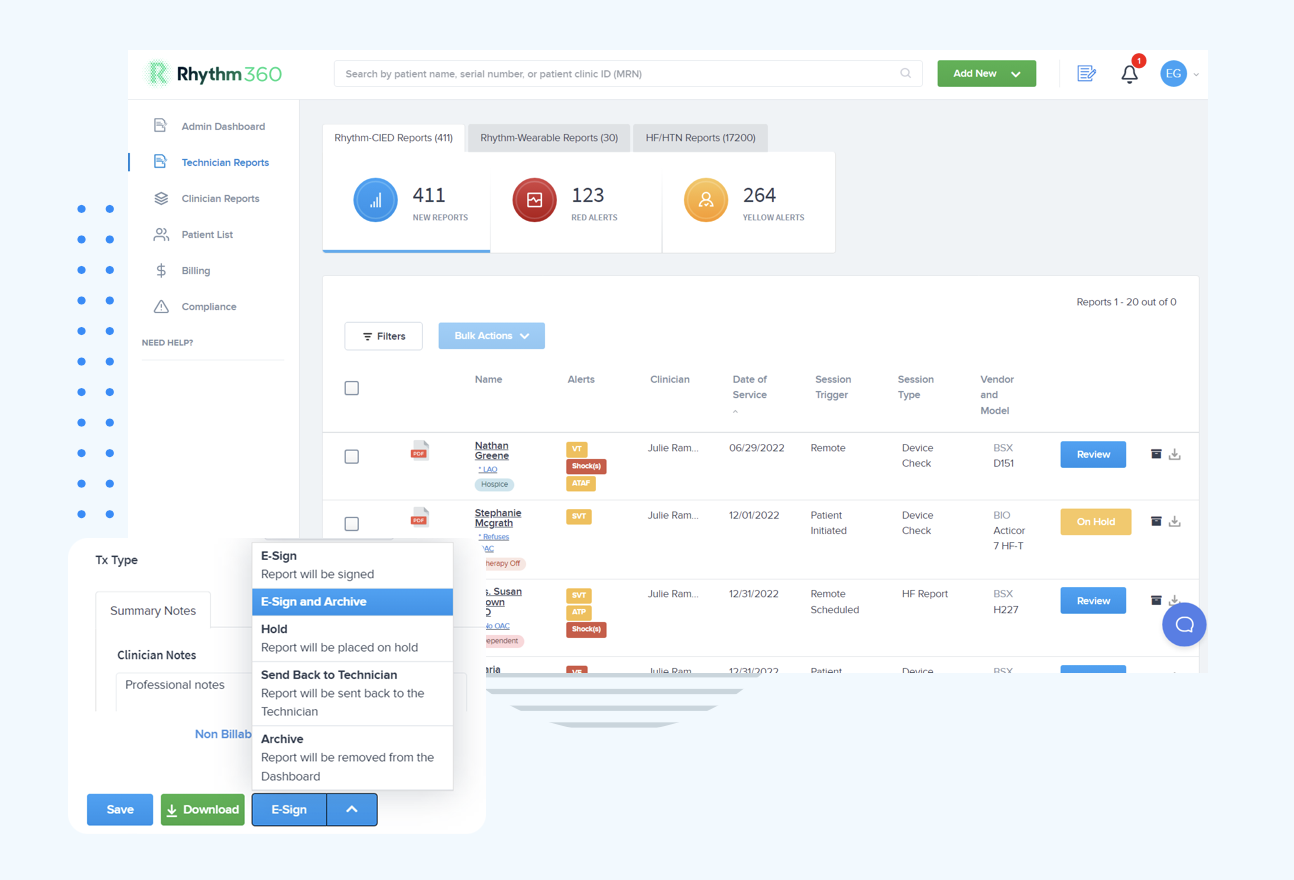
Cardiology practices that manage high volumes of CIED and RPM patients face compounding compliance risk when billing decisions rely on manual review. CMS updates the NCCI PTP edits quarterly, so edit pairs and modifier indicators that were accurate in January may change by October. Practices without a systematic update process eventually apply stale rules to live claims.
Revenue exposure extends beyond denials. When practices incorrectly unbundle high-frequency code pairs such as 93294/99457, repayment liability accumulates across billing cycles and creates a second layer of financial risk. This repayment exposure compounds revenue already lost to under-capture, which occurs when RPM and CIED services are never billed because documentation gaps prevent claim submission. Together, these two sources of leakage, money paid back and money never captured, can create significant annual revenue loss per provider.
Practices can reduce this risk with a quarterly audit of their top ten remote monitoring code pairs against the current NCCI PTP edit table. Teams should verify modifier indicator status for each pair and confirm that documentation templates capture every field required by CMS LCD policy. These steps lower denial rates and audit exposure without adding clinical staff.
Close your revenue leakage gap by scheduling a Rhythm360 demo.
Bundled billing reports a single comprehensive CPT code that covers all services integral to one procedure or monitoring episode. Unbundled billing reports two or more codes separately when the services are clinically distinct, meaning they involve different device systems, separate encounters, or independently justified medical necessity. In cardiology remote monitoring, bundling is the default when a CIED interrogation code and an RPM management code overlap in the same monitoring period for the same device. Separate billing is appropriate only when the second service meets a documented clinical distinction, such as monitoring a separate physiologic parameter with a distinct sensor under an independent RPM program.
Modifier 59 applies when no other modifier more precisely describes why two services are distinct, and it remains acceptable for non-Medicare payers that have not adopted the X{EPSU} framework. For Medicare claims, CMS prefers the X{EPSU} modifiers because they specify the exact basis for distinctness: XE for separate encounters on the same day, XP for different practitioners, XS for separate organ systems or device structures, and XU when none of the other X modifiers apply but a modifier is still warranted. In practice, most cardiology remote monitoring unbundling scenarios involving CIED and RPM codes will use XE or XS. Neither Modifier 59 nor any X modifier can override an NCCI edit with modifier indicator "0," and those Column Two codes cannot be billed regardless of documentation.
Separate billing of pacemaker remote interrogation (93294) and RPM interactive management (99457) on the same date requires two clear encounter records. The medical record must contain a time-stamped note for the pacemaker interrogation that includes device manufacturer, model, transmission date, interrogation data summary, physician interpretation, and any clinical action taken. It must also contain a separate time-stamped note for the RPM interactive management encounter that documents at least 20 minutes of interactive communication with the patient or caregiver, the clinical topics addressed, and an independent medical necessity statement for the RPM service. The two encounters must be clearly distinguishable in the record. Vague or combined notes that do not separate the two services by time and clinical purpose will not satisfy audit review and will expose the practice to denial and repayment risk.
Cardiology practices can reduce NCCI PTP denial rates by combining structured documentation templates, an updated code-pair reference, and automated claim checks. Templates should enforce required fields at the point of care. The code-pair reference should map remote monitoring codes against the current NCCI PTP edit table. Automated pre-submission claim scrubbing should flag modifier errors before claims reach the payer.
Practices that rely on manual review across multiple OEM portals and disconnected EHR workflows remain vulnerable to missed transmission days, incomplete documentation, and stale modifier rules. Centralizing remote monitoring data into a single platform that integrates with the EHR and applies billing logic at the time of documentation removes many manual handoffs where errors occur. Quarterly internal audits of the top remote monitoring code pairs, cross-referenced against current modifier indicator status, further reduce denial rates without additional headcount.
Correct bundling and unbundling decisions in cardiology remote monitoring depend on three verifiable facts for every claim. Teams must know whether an NCCI PTP edit exists for the code pair, whether that edit carries a modifier indicator that permits bypass, and whether the medical record contains documentation that independently satisfies the required clinical distinction. The 2026 CMS NCCI Policy Manual provides the controlling framework, and quarterly updates to the edit table make compliance an ongoing operational requirement.
Practices that manage high volumes of CIED and RPM patients face the greatest exposure because the same code pairs recur across hundreds of claims each billing cycle. A single documentation gap or misapplied modifier, multiplied across a patient population, produces the denial rates and revenue leakage that define the current cardiology billing environment. Rhythm360 offers one method to apply these rules at scale by automating documentation capture, centralizing transmission data across all device manufacturers, and applying NCCI compliance logic before claims are submitted, so revenue protection becomes a function of the platform rather than a burden on clinical or billing staff.





