Last updated: August 24, 2026
The eight steps below walk through a complete 2026 workflow for managing alerts from cardiac implantable electronic devices (CIEDs) and heart failure or hypertension remote physiological monitoring (RPM) programs.
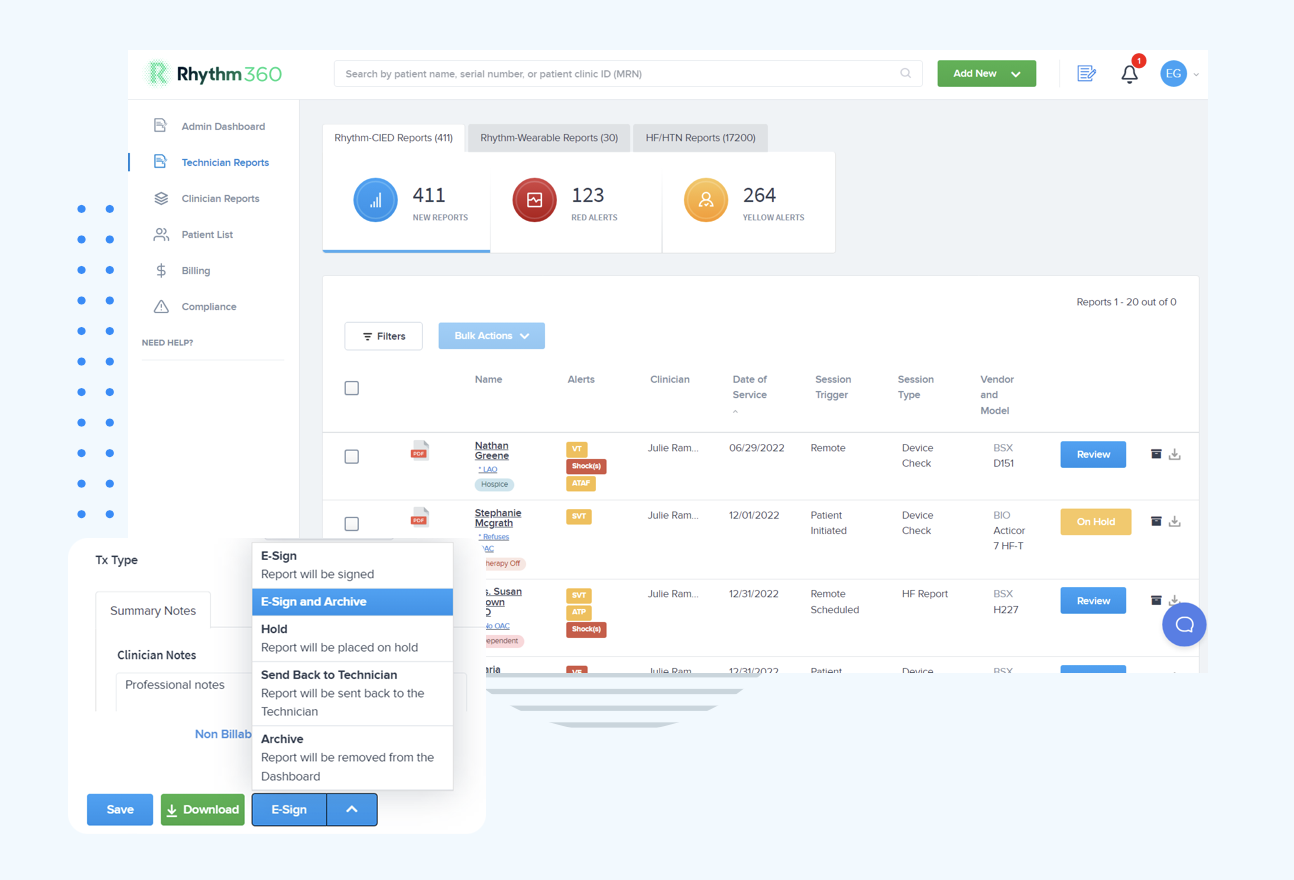
Schedule a demo to see all eight workflow steps in a live Rhythm360 environment.
CMS expanded the remote monitoring code set effective January 1, 2026, which fills gaps for shorter monitoring episodes that previously fell below billing thresholds. The list below summarizes the full code set relevant to cardiac alert management programs.
CPT parentheticals prohibit reporting general home monitoring supply codes 99453 and 99454 alongside more specific cardiac monitoring codes such as 93296, 93297, or 93298 in the same period. Practices therefore segment patients by code family before enrollment. Rhythm360’s automated CPT capture engine enforces these parenthetical rules, tracks data-day and clinician-time thresholds in real time, and generates audit-ready documentation for every claim.
The 2026 Medicare Physician Fee Schedule and related CMS guidance define specific documentation and operational requirements for compliant remote cardiac monitoring programs.
Rhythm360 addresses these requirements through automated data-day tracking, built-in response-time SLA monitoring, non-transmission flagging, and a comprehensive audit trail embedded in every patient record.
Remote patient monitoring delivers measurable clinical and financial benefits, yet manual or fragmented workflows create several recurring challenges.
| Workflow Dimension | Rhythm360 (Vendor-Neutral Platform) |
|---|---|
| Data ingestion | Single ingestion layer via API, HL7, XML, and PDF/OCR across all manufacturers, with greater than 99.9% transmissibility supported by redundant feeds. |
| Alert triage | AI-powered prioritized worklist with optional 24/7/365 CCT oversight and up to 80% reduction in critical response times. |
| EHR integration | Bi-directional integration with Epic, Cerner, Athenahealth, eClinicalWorks, Greenway Health, and others via HL7. |
| CPT code capture | Automated tracking of data-day counts, monitoring-period dates, and clinician time, with parenthetical rule enforcement and audit-ready documentation per claim. |
| Scalability | UCM managed more than 73,000 reports annually with stable dismissal rates on Rhythm360. |
| Mobile access | HIPAA-compliant mobile app for transmission review, report signing, and care coordination from any location. |
| Onboarding timeline | EHR integration and full platform setup typically completed in days to weeks. |
At 7:14 a.m. on a Saturday, Rhythm360 receives an automatic transmission from a 68-year-old patient’s dual-chamber ICD. The AI triage engine classifies the event as a red alert for new-onset atrial fibrillation with a rapid ventricular response and immediately sends a prioritized notification to the on-call nurse practitioner’s HIPAA-compliant mobile app. The NP reviews the transmission, the patient’s medication list, and the structured EHR-integrated report within minutes, without logging into a separate OEM portal or waiting for Monday’s manual review cycle.
She initiates an anticoagulation protocol and contacts the supervising electrophysiologist, who co-signs the clinical note remotely. By 1:30 p.m. that same Saturday, the patient has received anticoagulation therapy, the event is fully documented with an audit trail, and the corresponding CPT codes are queued for billing. Without a unified, AI-powered workflow, pre-implementation workflows described at UCM were "a major challenge and incredibly difficult," and this event could have remained undetected until the next scheduled clinic visit, with potentially catastrophic consequences.
Schedule a demo to walk through a live escalation scenario with the Rhythm360 team.
A vendor-neutral cardiac alert management workflow ingests and normalizes data from all major device manufacturers through a single platform rather than separate OEM portals. Most cardiology practices manage patients with implants from multiple manufacturers simultaneously, which creates data silos when each OEM requires its own login. When staff reconcile data across disconnected portals, alert response times increase, billing windows close unnoticed, and critical events risk going undetected. Rhythm360 achieves vendor neutrality through API, HL7, XML, and PDF parsing via computer vision, which delivers a unified dashboard that removes data silos regardless of device brand.
Rhythm360 applies an AI-powered triage engine that filters non-actionable transmissions before they reach the clinician worklist and prioritizes events by clinical severity. Optional 24/7/365 oversight by certified cardiac technicians supervised by physicians adds a human safety net for after-hours and weekend alerts. The platform’s redundant data feeds maintain greater than 99.9% transmissibility, so the reduction in alert volume reflects genuine noise filtering rather than missed transmissions. Practices using Rhythm360 have reported up to an 80% reduction in critical alert response times, and the University of Chicago Medicine managed more than 73,000 reports annually with stable dismissal rates, which shows that high sensitivity and reduced fatigue can coexist.
The applicable code family depends on device type and monitoring duration. CIED programs use codes 93294–93298, with 93294 and 93295 covering professional interpretation of pacemaker and ICD transmissions respectively, and 93296 and 93298 covering the technical components. RPM programs for heart failure and hypertension use 99453, 99454, 99457, and 99458, plus the two new 2026 codes, 99445 for 2–15 days of data and 99470 for 10–19 minutes of management time. Rhythm360 tracks data-day counts, monitoring-period dates, and clinician time automatically, enforces CPT parenthetical rules to prevent claim denials, and generates audit-ready documentation for every billable episode. Practices segment patients by code family before enrollment to avoid prohibited code combinations.
CMS requires documented patient consent, use of an FDA-defined device with automatic data transmission, and a clinician interpretation note for each billing period that addresses device function, programmed parameters, and actionable findings. Claims must include patient demographics, device type and manufacturer, and monitoring-period dates. Red alerts must receive a clinician response within one business day per the 2023 international consensus statement. Non-transmission reports are required when a device fails to transmit within the expected window. Audit trails must log when each alert was triggered, who received it, and the outcome of the review. Rhythm360 automates these documentation requirements within a single HIPAA-compliant platform, which reduces compliance risk and administrative overhead.
Rhythm360’s implementation process, including EHR integration setup, typically takes from a few days to a few weeks depending on practice size and existing infrastructure. The platform integrates bi-directionally with Epic, Cerner, Athenahealth, eClinicalWorks, Greenway Health, and additional systems via HL7. Bi-directional integration means device reports post directly to the patient chart and EHR-based patient data flows back into Rhythm360, which eliminates duplicate documentation. The SaaS-based pricing model scales with clinic size and platform usage, so the investment remains proportional to program volume from day one.
Fragmented OEM portals create alert fatigue, missed critical events, and revenue leakage that compound as device populations grow. An eight-step, AI-powered cardiac alert management workflow anchored by vendor-neutral data ingestion, intelligent triage, bi-directional EHR integration, and automated CPT code capture addresses each of these issues. Rhythm360 delivers the response-time and revenue improvements documented throughout this guide, as demonstrated at scale by the University of Chicago Medicine and practices across the country. Schedule a demo with the Rhythm360 team today.