

Last updated: July 14, 2026
The CIED ecosystem spans manufacturers including Medtronic, Boston Scientific, Abbott, Biotronik, and others, each operating proprietary remote monitoring portals with distinct data formats, nomenclature, and communication protocols. The Heart Rhythm Society's white paper on CIED interoperability identifies that each manufacturer has developed proprietary nomenclature, technical standards, and communication protocols despite similar basic device capabilities across vendors, and that traditional EHRs are not well suited to managing CIED data natively.
The practical consequence for cardiology practices is significant. As soon as a clinic implants devices from more than one manufacturer, staff must log into multiple non-interoperable portals to retrieve patient data. This creates administrative overload, increases the risk of missed critical alerts such as new-onset atrial fibrillation or ventricular tachycardia, and generates revenue leakage from incomplete CPT documentation. Standards-based interoperability addresses these problems at the data layer, enabling normalized ingestion regardless of the originating OEM.
Rhythm360 approaches this problem through vendor-neutral ingestion that combines API connections, HL7 messaging, XML parsing, and AI-powered computer vision for PDF extraction, maintaining the transmissibility rate described earlier via redundant data feeds. The following table compares the four core interoperability standards that enable this vendor-neutral approach and shows how each supports normalized data exchange and compliant billing documentation.
| Standard | Purpose | Data Format | CPT Billing Relevance |
|---|---|---|---|
| IHE IDCO (TF Rev 10.0) | Transfers interrogation data from implantable cardiac devices to information management systems via the PCD-09 transaction | HL7 v2 OBX segments with IEEE 11073-10103 terminology | Supports structured documentation for 93294–93298 remote interrogation codes |
| HL7 v2 | Established messaging standard for EHR data exchange, widely deployed across hospital and ambulatory settings | Pipe-delimited HL7 message segments | Enables EHR receipt of device observations to support billing documentation for 93294–93298 and 99454 |
| HL7 FHIR (R4/R5) | Modern REST API-based exchange standard, with Device and Observation resources representing CIED data elements | JSON/XML via RESTful API | Emerging pathway for real-time EHR integration supporting automated CPT documentation workflows |
| IEEE 11073-10103:2025 | Defines discrete nomenclature terms for pacemaker, ICD, CRT, and implantable cardiac monitor interrogation data | Standardized MDC terminology codes with UCUM units of measure | Enables cross-vendor normalization of device observations required for compliant 93294–93298 documentation |
The IHE Implantable Device – Cardiac – Observation (IDCO) profile is a Final Text (stable) integration profile that transfers information from an interrogated implantable cardiac device to an information management system. It is defined within the IHE Devices (DEV) Technical Framework and uses the PCD-09 transaction to communicate CIED observations.
The IHE Devices Technical Framework Revision 10.0, published November 4, 2024, governs the current IDCO specification. The most recent approved changes incorporated into TF Rev 10.0 include CP-DEV-009-00, which removes 'N' as a valid value for OBX-11 in IDCO messages, and CP-DEV-010-00, which clarifies OBX and ED segment usage. Several additional change proposals remain under review. The next major framework revision (TF Rev 11.0) has no published timeline.
The IDCO profile and PCD-09 transaction carry OIDs under the IHE DEV domain. For cardiology practices, IDCO provides the message structure that allows interrogation data from any compliant device to be received by an EHR or device clinic management system in a standardized format.
HL7 v2 remains the dominant messaging standard in deployed cardiology and EP clinic environments. Its pipe-delimited message structure is the transport layer used by the IHE IDCO profile's PCD-09 transaction, making it the current standard for structured CIED observation exchange into EHRs. Rhythm360 supports bi-directional HL7 integration with Epic, Cerner, Athenahealth, eClinicalWorks, Greenway Health, and others.
FHIR adoption is accelerating globally. The 2025 State of FHIR survey, conducted by Firely and HL7 International across 82 experts in 52 countries, found that over 70% of countries report active FHIR use for at least a few national use cases, with 54% of respondents expecting a strong increase in adoption over the next three years. However, version fragmentation between R4, R4B, and R5 complicates interoperability even in high-adoption markets. Within FHIR, the Device resource represents physical devices such as implantable defibrillators, while the Observation resource captures individual measurements from cardiac monitoring devices.
For practices planning EHR integration strategies, the practical recommendation is to maintain HL7 v2 for current CIED data exchange while building toward FHIR-capable infrastructure as implementation guides mature for device-specific use cases.
EN ISO/IEEE 11073-10103:2025, published October 2025, extends the base nomenclature in ISO/IEEE 11073-10101:2020 to define discrete terms for conveying a clinically relevant summary of data from pacemaker, ICD, CRT, and implantable cardiac monitor interrogations. This second edition introduces significant nomenclature extensions relevant to cross-vendor CIED data normalization.
Key additions in the 2025 edition include:
These standardized MDC terminology codes, paired with UCUM units of measure, allow platforms like Rhythm360 to normalize observations from Medtronic, Boston Scientific, Abbott, Biotronik, and other manufacturers into a single, semantically consistent data model for EHR consumption. To understand what this normalization delivers in practice, it helps to look at the specific categories of clinical observations these standards carry.
When CIED interrogation data is transmitted using IHE IDCO, HL7 messaging, and IEEE 11073-10103 terminology, the following categories of observations are normalized for EHR consumption. Together they form the clinical picture required for patient safety and compliant billing.
[Architecture diagram placeholder: OEM manufacturer servers (Medtronic, Boston Scientific, Abbott, Biotronik) → normalized ingestion layer (API / HL7 / XML / PDF via AI computer vision) → Rhythm360 cloud platform → bi-directional EHR integration (Epic, Cerner, Athenahealth, eClinicalWorks) → clinician dashboard and HIPAA-compliant mobile app]
This architecture illustrates a vendor-neutral pipeline that keeps CIED data flowing reliably into clinical workflows. Rhythm360 ingests data from OEM servers through multiple parallel pathways. Structured data arrives via direct API connections and HL7 messaging where manufacturer feeds support them. Unstructured PDF reports are processed through AI-powered computer vision and OCR to extract discrete data elements and map them to the IEEE 11073-10103 nomenclature.
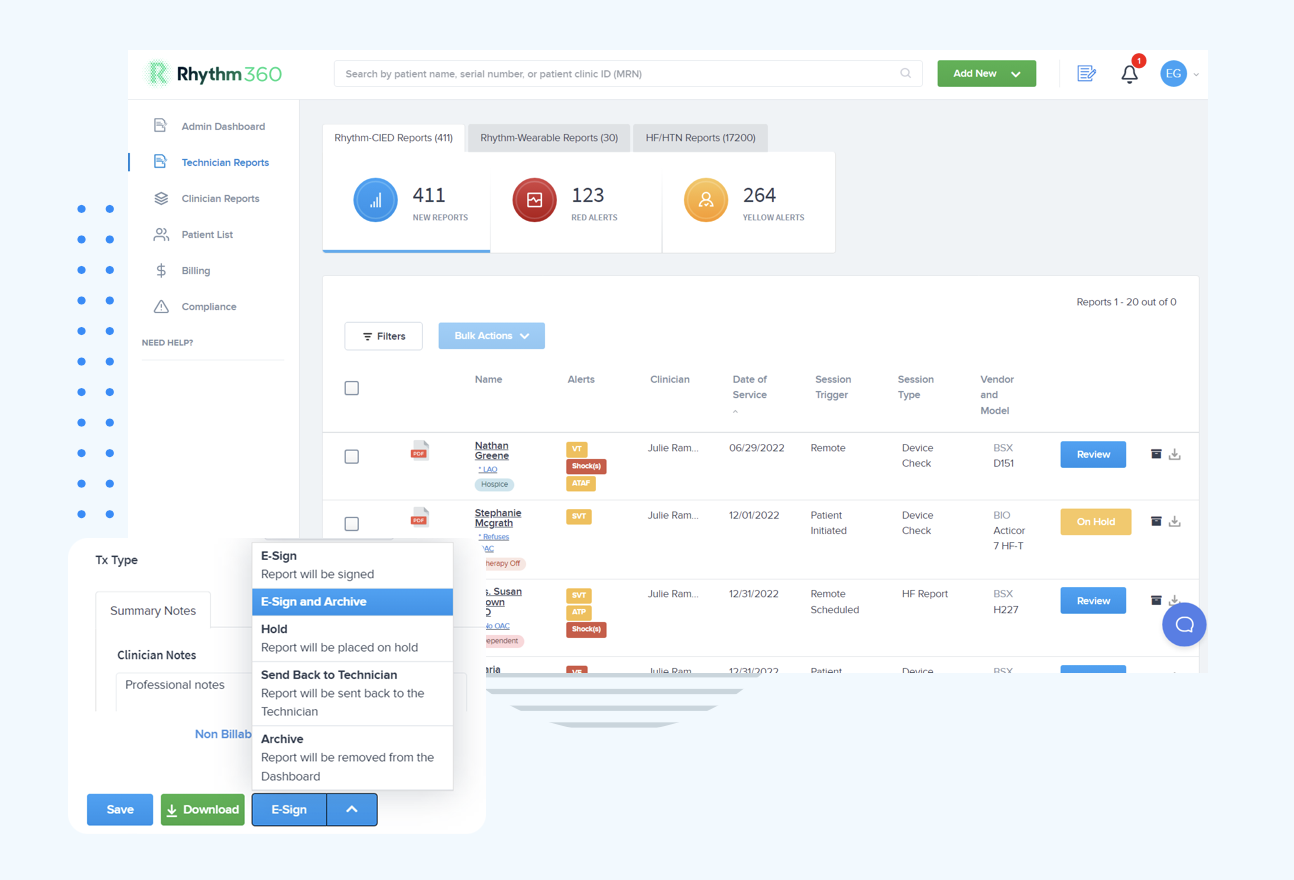
A redundant data feed architecture ensures continuity when any single OEM server experiences downtime, supporting the platform's high transmissibility. Normalized data then flows bi-directionally into the connected EHR, populating structured fields that support clinical documentation and billing workflows. Clinicians access the same data through a HIPAA-compliant mobile application, which enables alert review and report sign-off from any location.
Standardized CIED data flowing into the EHR directly supports compliant documentation for the remote monitoring CPT codes that represent recurring revenue for EP and cardiology practices. The relevant code families include:
Without a centralized system tracking transmission days, alert responses, and clinical review time, practices routinely miss billable events or submit incomplete documentation that results in claim denials. Rhythm360's automated CPT documentation tools track all required data points and generate audit-ready records aligned to each code's specific requirements.
In March 2026, HL7 International launched the Caliper FHIR Accelerator to create standardized FHIR profiles for real-time device data from critical care equipment and patient-facing technologies, aligning HL7 FHIR with IEEE 11073 device communication standards and IHE integration profiles. This initiative represents the most significant structural step toward device-specific FHIR implementation guides since the publication of the base FHIR Device and Observation resources.
Despite broad enthusiasm, the 2025 State of FHIR survey found that only 20% of countries with a national FHIR implementation guide report it as widely used, and advanced tooling such as SMART on FHIR and CDS Hooks remains limited to digitally mature ecosystems. For cardiology practices, this reality means HL7 v2 remains the practical integration standard for now while FHIR infrastructure and tooling mature.
AI-driven alert triage is the parallel development reshaping clinical workflows. Platforms that apply machine learning to filter non-actionable transmissions and surface only clinically significant events reduce alert fatigue and accelerate response times. Rhythm360 delivers this capability through its AI-powered alert prioritization engine.
Rhythm360 translates the standards described in this guide into concrete clinical and financial results. The platform ingests data from all major CIED manufacturers through API, HL7, XML, and AI-powered PDF parsing, normalizing observations against IEEE 11073-10103 terminology and delivering structured data bi-directionally to connected EHR systems.
Practices implementing Rhythm360 have achieved:
The platform's optional 24/7/365 oversight by certified cardiac technicians (CCTs) supervised by physicians provides an additional clinical safety layer for practices that require it. The HIPAA-compliant mobile application ensures clinicians can review transmissions, sign reports, and coordinate care from any location.
Schedule a demo to see Rhythm360's vendor-neutral CIED platform in action.
Before initiating a standards-based CIED interoperability implementation, practice administrators and clinical leads should evaluate readiness in a sequence that moves from technical fit to workflow impact.
Rhythm360's implementation process, including EHR integration setup, typically completes within a few days to a few weeks, which minimizes disruption to existing clinical workflows.
Practices pursuing CIED interoperability improvements encounter several common failure modes that undermine both clinical and financial goals.
Implementation complexity depends primarily on the number of OEM manufacturers represented in the patient population and the EHR system in use. Practices with a single-manufacturer device population and a major EHR like Epic or Cerner can typically complete integration within days. Multi-manufacturer environments require a vendor-neutral ingestion layer that normalizes data from each OEM's proprietary format before it reaches the EHR. Rhythm360's implementation process, including full EHR integration, is designed to complete within a few days to a few weeks, with onboarding support provided throughout.
Most practices begin seeing operational improvements such as reduced portal logins, faster alert response, and automated report generation within the first billing cycle after go-live. Financial improvements from optimized CPT documentation, including more complete capture of 93294–93298 and 99454/99445 codes, typically become measurable within the first 30 to 90 days as previously missed billable events are captured systematically. The 80% reduction in critical alert response times and up to 300% improvement in revenue generation reflect outcomes achieved by practices using Rhythm360 across their full CIED patient population.
Rhythm360 is a HIPAA-compliant, cloud-based platform with full audit trail documentation for all data ingestion, clinical review, and patient communication events. All data in transit and at rest is encrypted. The platform's integrated communication hub, powered by Twilio, logs all patient interactions, including automated messages and manual calls, within the patient record, supporting both compliance documentation and care coordination. The HIPAA-compliant mobile application extends secure access to on-call clinicians without creating uncontrolled data pathways outside the platform.
HL7 v2 is the established messaging standard currently used in the IHE IDCO profile's PCD-09 transaction for CIED observation exchange. It is widely supported by EHR systems and remains the practical standard for structured device data integration in 2026. FHIR is the modern REST API-based successor that uses Device and Observation resources to represent CIED data, but device-specific FHIR implementation guides are still maturing. The Caliper FHIR Accelerator launched in March 2026 is the primary initiative developing these profiles. Practices should ensure their current platform supports HL7 v2 bi-directional EHR integration while selecting a vendor with a clear FHIR migration roadmap.
The CPT codes most directly affected are the remote interrogation codes 93294 through 93298, which cover pacemakers, ICDs, and implantable cardiac monitors on 30- or 90-day cycles, and the RPM supply and management codes 99454, 99445, 99457, and 99458. Each of these codes has specific documentation requirements such as transmission day counts, monitoring periods, and clinical review time that are difficult to track manually across multiple OEM portals. A unified platform that automatically logs transmission events, flags billing triggers, and generates audit-ready documentation eliminates the manual tracking burden and reduces the claim denials that result from incomplete records.
Cardiac device data interoperability standards, including IHE IDCO, HL7 v2 and FHIR, and IEEE 11073-10103, provide the technical foundation for eliminating the fragmentation that costs cardiology practices time, clinical accuracy, and revenue. The 2024–2026 updates to these standards, including TF Rev 10.0 for IDCO and the second edition of IEEE 11073-10103, have strengthened the normalization layer available to platforms that implement them fully.
Rhythm360 translates these standards into a vendor-neutral, AI-powered platform that consolidates CIED data from all major manufacturers, integrates bi-directionally with leading EHR systems, automates compliant billing documentation, and delivers the alert response-time improvement described earlier. Implementation completes within days to weeks, and the financial impact described in the Key Takeaways is measurable within the first billing cycle.





