

Transmission failures arise from multiple, often simultaneous failure points across the monitoring chain.
Technical and connectivity causes. The ongoing 3G network sunset and the uneven rollout of 4G LTE and 5G coverage leave older home transceivers unable to complete a handshake with OEM servers. Patients in rural or low-signal areas face persistent dropped transmissions regardless of device function. OEM server outages or scheduled maintenance windows create additional gaps that legacy single-feed architectures cannot compensate for.
Hardware causes. Transceiver firmware that has not been updated, depleted transceiver batteries, and physical damage to the bedside communicator all interrupt the data path before a single byte reaches the portal. Device-side issues, including approaching elective replacement indicator (ERI) or recommended replacement time (RRT) thresholds, can alter transmission behavior and further reduce reliability.
Patient-related causes. Patients who sleep outside transceiver range, travel internationally, or forget to keep the communicator plugged in generate gaps in scheduled transmission windows. Low health literacy around device maintenance compounds adherence challenges, particularly in older populations managing multiple chronic conditions.
2026 context. The accelerating 4G-to-5G infrastructure transition has introduced compatibility challenges for some older transceivers. Practices managing mixed-vintage device populations face a widening reliability gap without a platform that detects and routes around these failures automatically.
Understanding why transmissions fail only solves part of the problem, because the real impact appears when those failures reach patients and finances. A missed transmission is not merely an administrative inconvenience. When a ventricular tachycardia episode, new-onset atrial fibrillation, or lead impedance alarm fails to reach the clinical team, the window for timely intervention closes. Large real-world data associate consistent remote monitoring use with lower risks of death and cardiovascular hospitalization, fewer outpatient visits, and overall cost reductions driven by fewer admissions. Inconsistent transmission directly undermines those outcomes.
Operationally, staff at practices running multiple OEM portals spend disproportionate hours on manual data retrieval. Gaurav A. Upadhyay, MD, FACC, FHRS, Director of the Pacing & Defibrillation Device Clinic at the University of Chicago Medicine (UCM), noted, “Staffing was always an issue for our center, because our device clinic — like many other medical centers — had struggled with technician turnover and timely weekend coverage.” That burden accelerates burnout and attrition among the specialized technicians practices depend on most.
Financially, every unreviewed transmission represents a potential missed billable event. CPT codes 93298, 93299, and 99454 require documented, timely review. Transmission gaps break the documentation chain, which produces rejected claims and unrecoverable revenue. Practices that have moved to unified cardiac monitoring platforms report revenue increases such as a doubling of cardiac monitoring revenue through streamlined workflows and consistent billing continuity.
Each major CIED manufacturer, including Medtronic, Boston Scientific, Abbott, and Biotronik, operates a proprietary portal with its own login, data schema, alert taxonomy, and export format. A practice implanting devices from three manufacturers requires staff to maintain three separate workflows, three alert queues, and three billing documentation processes. Andrew Beaser, MD, Associate Professor of Medicine at UCM, described pre-implementation workflows as “a major challenge and incredibly difficult.”
Legacy portals also lack redundancy. When an OEM server experiences downtime, no failover mechanism exists. Transmissions queue, time-sensitive alerts are delayed, and the billing documentation window may lapse. No single OEM portal has an incentive to solve interoperability with a competitor system, so the fragmentation remains structural and will not self-correct.
A platform that can eliminate transmission failures needs specific, concrete capabilities.
AI-powered normalization, a key component of the >99.9% reliability threshold mentioned earlier, resolves the data heterogeneity problem at ingestion. When a transmission arrives as an unstructured PDF, which remains common for older devices, computer-vision OCR extracts the relevant fields and maps them to the platform unified data model. AI extrapolation fills gaps where partial data is received and flags the incomplete record for clinical review rather than silently dropping it. As Dr. Beaser noted earlier, AI-assisted decision support becomes increasingly important as data volumes grow, a reality underscored by UCM management of more than 73,000 reports annually through Rhythm360 in 2025.
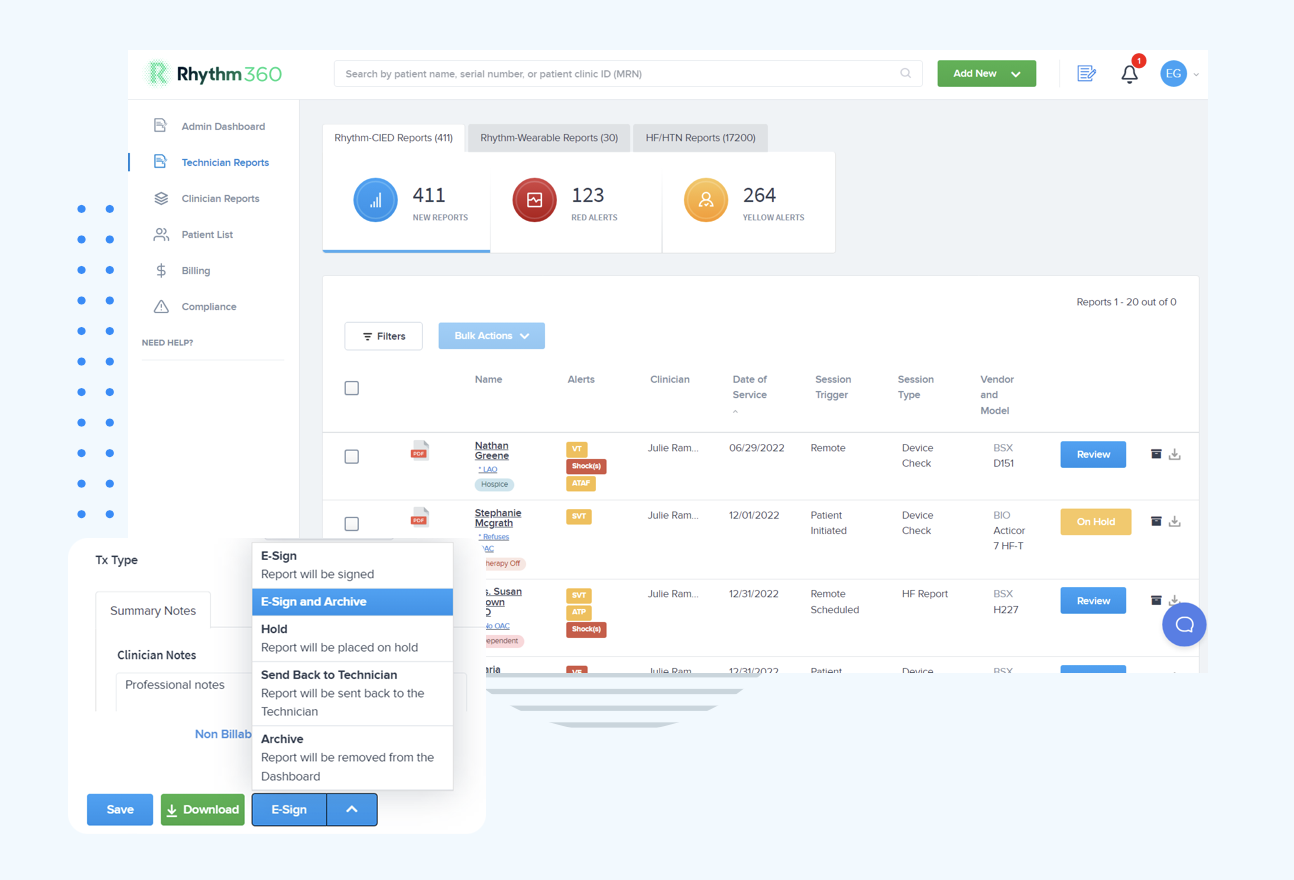
Redundant feeds stabilize the connectivity layer. When an OEM server is unavailable, the platform secondary data pathway maintains continuity. This approach prevents the queue buildup that causes alert delays and billing gaps.
| Metric | Legacy Multi-Portal Workflow | Unified Vendor-Neutral Platform | Source |
|---|---|---|---|
| Transmissibility | Typically lower (legacy multi-portal workflows) | >99.9% | RhythmScience platform specification |
| Critical alert triage time | Baseline (manual, multi-portal review) | Up to 80% faster | RhythmScience outcomes data |
| Staff hours on data retrieval | High, proportional to number of OEM portals | Significantly reduced via single dashboard and automated ingestion | UCM implementation white paper |
| CPT capture rate improvement | Baseline (manual documentation, fragmented audit trail) | Significant increases, such as a doubling of cardiac monitoring revenue | University of South Florida white paper |
CPT codes for remote CIED monitoring, including 93298 and 93299, and RPM codes such as 99454 and 99457 require documented evidence of timely transmission review within defined calendar periods. Manual workflows across fragmented portals create documentation gaps that result in claim denials. Automated CPT tracking closes that gap by flagging billable events at the moment of review, generating compliant documentation in real time, and surfacing unbilled opportunities before the billing window closes.
Dr. Upadhyay also observed that “we have improved billing and accountability for our patients after the integration.” The revenue improvements described earlier, including cases where practices doubled their cardiac monitoring revenue, can reach up to 300% when practices also add new RPM service lines for heart failure and hypertension management alongside the core transmissibility and documentation improvements.
Practices can move from a multi-portal legacy workflow to a unified platform within days to weeks by following a clear sequence.
Rhythm360 onboarding specialists manage integration setup throughout this timeline and reduce the burden on internal IT resources.
Transmission failures are a solvable infrastructure problem that requires the right architecture and workflow support. Ready to eliminate transmission failures at your practice? Connect with our team to discuss your implementation timeline.
What is the most common cause of cardiac device monitoring transmission failures?
The most common causes are connectivity-related issues. Patients may sleep out of transceiver range, use outdated communicator hardware that is incompatible with current cellular networks, or experience OEM server outages. Practices managing multiple OEM device types face compounded risk because each portal operates independently with no cross-system failover. A vendor-neutral platform with redundant data feeds addresses all three failure modes simultaneously.
How do transmission failures affect CPT reimbursement for remote CIED monitoring?
Remote monitoring CPT codes such as 93298, 93299, 99454, and 99457 require documented, timely review of transmitted data within defined calendar periods. A transmission failure breaks the documentation chain and makes it impossible to satisfy the billing requirement for that period. Automated CPT tracking within a unified platform flags billable events at the point of review and generates compliant documentation in real time, which prevents revenue loss from documentation gaps.
What is a vendor-neutral cardiac monitoring platform?
A vendor-neutral platform ingests and normalizes data from all major CIED manufacturers, including Medtronic, Boston Scientific, Abbott, Biotronik, and others, into a single unified dashboard, regardless of the proprietary format each OEM uses. This approach removes the need for separate portal logins and allows clinical staff to manage the entire device population from one interface with consistent alert taxonomy and billing documentation.
How does AI improve transmission reliability in cardiac remote monitoring?
AI contributes at two points in the data pipeline. At ingestion, machine learning models and computer-vision OCR normalize heterogeneous data formats, including unstructured PDFs, into a unified schema and recover data that would otherwise be lost or require manual transcription. At the alert layer, AI-driven triage filters non-actionable notifications and prioritizes clinically significant events, which reduces alert fatigue and accelerates response times for critical findings such as ventricular tachycardia or new-onset atrial fibrillation.
How long does it take to implement a unified cardiac monitoring platform?
Implementation timelines for platforms like Rhythm360 range from a few days to a few weeks, depending on EHR complexity and the number of OEM data feeds being connected. The process includes EHR integration via HL7, OEM feed configuration, patient roster migration, alert rule setup, and staff training. Parallel operation alongside legacy portals during the final validation phase ensures no transmission data is lost during the transition.





