Last updated: July 14, 2026
Device clinics process thousands of transmissions each year, and many of those transmissions are clinically non-relevant. Staff who log into separate, non-interoperable portals for Medtronic, Boston Scientific, Abbott, Biotronik, and other OEMs face redundant data entry, inconsistent alert thresholds, and no consolidated view of a patient’s status. Growing CIED device populations push these manual workflows past the breaking point and strain already limited staff capacity.
The downstream impact includes missed critical events, rejected CPT claims, and clinician burnout. A well-designed automation platform addresses these problems by consolidating data, standardizing workflows, and supporting consistent clinical decision-making.
See how Rhythm360 eliminates portal fragmentation, and schedule a demo.
Vendor Neutrality and OEM Coverage
A viable platform ingests data from every major device manufacturer without separate logins or manual reconciliation. Practices that implant devices from more than one OEM inherit a multi-portal problem immediately if their software is manufacturer-specific or limited in scope.
Evaluate whether a platform supports Medtronic, Boston Scientific, Abbott, Biotronik, and emerging OEMs through direct APIs, HL7 feeds, XML parsing, and PDF extraction. Gaps in OEM coverage translate directly into data silos and missed transmissions, so before signing a contract, confirm that the vendor maintains active data agreements with each OEM and has a documented process for onboarding new device types as your implant mix evolves.
AI-Powered Alert Triage and Data Reliability
Alert fatigue remains one of the most cited barriers to safe CIED monitoring. AI-driven triage reduces alert fatigue while maintaining high data reliability and consistent clinical oversight. Research shows that AI-assisted review can achieve high sensitivity for clinically relevant events compared with human readers alone.
Rhythm360 achieves greater than 99.9% transmissibility through redundant data feeds, computer vision OCR, and AI-powered extrapolation that fills gaps when an OEM server is unavailable. Its intelligent alerting layer filters non-actionable noise and surfaces prioritized, clinically significant events in near real time.
Implementation consideration: Ask vendors for documented sensitivity and specificity metrics from real-world deployments, not synthetic test sets, and confirm that a certified clinical oversight layer is available for after-hours triage.
Scalability Across Practice Sizes
A sustainable platform supports a solo electrophysiologist and also scales to a multi-site health system managing thousands of devices. University of Chicago Medicine reviewed more than 73,000 reports annually through Rhythm360 in calendar year 2025, averaging more than 18,000 reports per quarter. This volume demonstrates that the platform sustains high-volume monitoring without degrading performance or dismissal-rate stability.
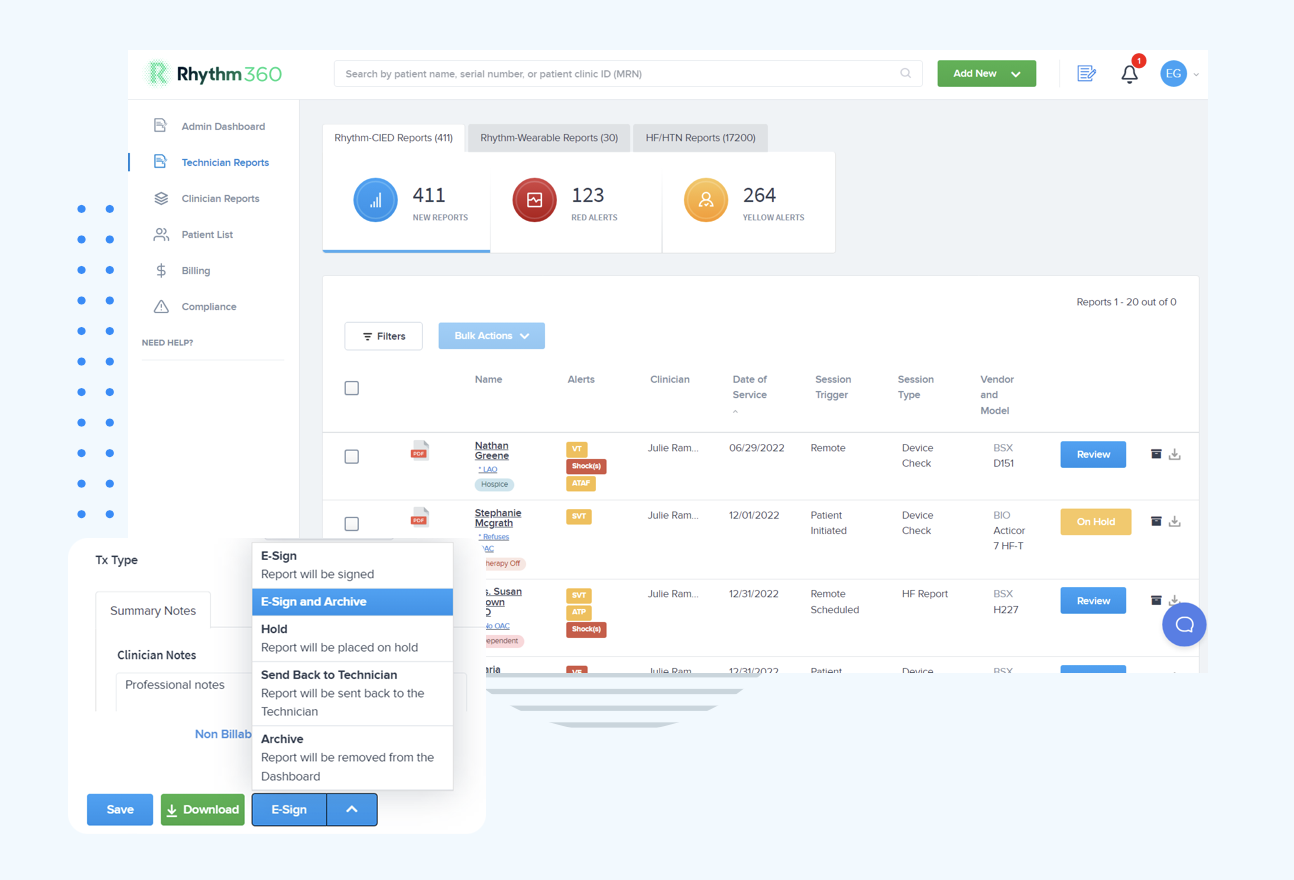
Small clinics should confirm that pricing scales proportionally with usage instead of locking them into enterprise-tier contracts. Large systems should verify that the platform supports centralized or distributed device clinic models and multi-site user permissions that match their governance structure.
Implementation consideration: Request a reference site that matches your practice size and ask specifically about staffing ratios before and after implementation.
Automated CPT-Compliant Billing Documentation
Revenue leakage from missed or improperly documented CPT codes, particularly 93298, 93299, and RPM codes such as 99454, represents a major financial risk in CIED management. Manual billing workflows introduce errors, create audit exposure, and routinely result in undercaptured revenue as payer requirements evolve.
Rhythm360 automates CPT code capture and generates auditable documentation at the point of clinical activity, which helps practices recover previously lost revenue. University of Chicago Medicine reported improved billing and accountability for patients after integrating Rhythm360. Practices implementing Rhythm360 have documented revenue increases of up to 300% through more complete CPT capture and improved staff efficiency.
Implementation consideration: Verify that the platform’s billing documentation is payer-agnostic and that audit trails are exportable for compliance reviews.
EHR Integration Depth and Bidirectionality
Unidirectional data pushes from a cardiac device platform into an EHR create documentation gaps and force staff to reconcile records manually. Bidirectional integration, where patient demographics, encounter data, and device reports flow in both directions, eliminates redundant entry and supports closed-loop clinical workflows.
EHR integration timelines range from 4–8 weeks for single-system FHIR R4 API integrations to 6–18 months for multi-system enterprise deployments. Platforms that already completed Epic App Orchard or Cerner Ignite marketplace listings reduce the per-site activation burden and shorten time to value.
Implementation consideration: Confirm support for both HL7 v2.x, which is used by approximately 95% of U.S. healthcare organizations, and FHIR R4 for modern EHR surfaces.
Unified Multi-Condition Monitoring (CIED + RPM)
Cardiology patients rarely present with a single condition, so a platform that handles CIED monitoring but not heart failure or hypertension RPM forces practices to maintain separate systems. That separation recreates the fragmentation clinics are trying to eliminate and complicates both clinical review and billing.
Rhythm360 offers integrated service lines for Rhythm-CIED and HF/HTN remote physiological monitoring within a single dashboard. Practices can launch a new RPM service for heart failure and hypertension patients with minimal logistical overhead, generating recurring revenue while providing proactive, continuous care. UCM clinicians noted the ability to address issues earlier, calling patients in for evaluation rather than waiting for a 3-month visit.
Implementation consideration: Evaluate whether the platform’s RPM service line includes patient onboarding checklists, automated patient messaging, and billing support for RPM-specific CPT codes.
Mobile Access and HIPAA-Compliant Communication
On-call clinicians need remote access to device data to avoid delaying critical decisions or driving to the office unnecessarily. A secure mobile application that supports transmission review, report signing, and care coordination functions as a patient safety requirement rather than a convenience feature.
Evaluate whether the platform’s mobile application maintains full HIPAA compliance, supports push notifications for critical alerts, and logs all communications, including automated patient messages and call records, within the patient record for audit purposes.
Implementation consideration: Test the mobile application under real on-call conditions before go-live, including weekend critical alerts that require immediate anticoagulation or device reprogramming decisions.
Of the seven decision criteria outlined above, AI-powered alert triage has the most immediate impact on daily clinical operations. Reducing non-actionable alerts requires configurable alert thresholds, AI-driven triage logic, and certified clinical oversight, not simply muting notifications. As one cardiac device specialist noted, accommodating the influx of information is essential to avoid bottlenecks and prevent clinically relevant events from being missed.
Platforms that apply machine learning to distinguish routine transmissions from urgent events such as ventricular fibrillation, lead malfunction, or new-onset AFib allow clinical staff to focus on alerts that require immediate action. Rhythm360’s AI-powered alert triage layer filters non-actionable noise and prioritizes events by clinical severity in near real time.
An optional 24/7/365 oversight layer staffed by IBHRE-certified cardiac technicians (CCTs) supervised by physicians provides an additional safety net, particularly for practices without after-hours clinical coverage. This combination supports an 80% reduction in critical alert response times while preserving the sensitivity needed to catch life-threatening events.
CPT codes 93298 and 93299 cover remote interrogation and monitoring of implantable cardioverter-defibrillators and pacemakers, and accurate documentation is a prerequisite for reimbursement. Manual documentation workflows introduce errors, create audit exposure, and routinely result in undercaptured revenue. Practices that automate CPT documentation at the point of clinical activity, rather than reconstructing it retrospectively, consistently capture more billable events per patient per quarter.
Rhythm360 generates CPT-compliant documentation automatically as transmissions are reviewed and reports are signed, creating a continuous, auditable billing record. This real-time capture feeds into the platform’s administrative dashboard, which provides a live view of captured versus potential revenue by CPT code and enables practice administrators to identify and close billing gaps before the end of each billing cycle instead of discovering them during retrospective audits. The combination of automated capture and proactive gap closure explains why practices using Rhythm360 have reported revenue increases of up to 300%.
Small cardiology clinics carry the same regulatory and clinical obligations as large health systems but operate with fewer staff and tighter margins. A platform that requires a dedicated IT team or charges enterprise-tier pricing regardless of volume does not work for a solo practitioner or a two-physician EP clinic. The right solution for a small clinic scales pricing with usage, onboards quickly, and reduces administrative burden from the first day of use.
Rhythm360’s SaaS-based pricing model scales with clinic size and platform usage, and its implementation timeline ranges from a few days to a few weeks depending on integration complexity. The platform’s centralized dashboard reduces reliance on a single “super-user” and supports business continuity when key staff are unavailable. Small clinics gain access to the same AI triage, automated billing documentation, and bidirectional EHR integration available to large health systems, without enterprise overhead.
Find out if Rhythm360 fits your clinic’s size and budget, and schedule a demo.
Epic remains the most widely deployed EHR in U.S. health systems, and its FHIR R4 implementation supports both patient-facing and clinician-facing launch patterns using SMART on FHIR authorization. For cardiac device platforms, Epic integration must support bidirectional data flow by pushing device reports into the patient record and pulling demographics and encounter context back into the monitoring platform. Epic App Orchard listing approval alone can take 4–9 months, so pre-built integrations create a significant time-to-value advantage.
Rhythm360 offers bidirectional integration with Epic, Cerner, Athenahealth, eClinicalWorks, Greenway Health, and other systems via HL7. The platform’s onboarding process, including EHR integration setup, typically completes in a few days to a few weeks, which is substantially faster than building a custom integration from scratch. All data flows are HIPAA-compliant, and the integration supports the full range of clinical documentation workflows required for CIED and RPM reporting.
The following table summarizes how the seven decision criteria translate into different implementation priorities for small clinics and large systems. Use it to identify which features matter most for your specific practice size and growth plans.
| Decision Factor | Small Independent Clinic (1–5 Physicians) | Large Multi-Site System (6+ Physicians / Health System) |
|---|---|---|
| Pricing Model | SaaS, usage-scaled; no enterprise minimums | SaaS, volume-tiered; enterprise agreements with multi-site licensing |
| Implementation Timeline | Days to a few weeks for single-site EHR integration | 4–8 weeks for single-system FHIR R4; up to 6–18 months for multi-system enterprise deployments |
| EHR Integration Priority | Athenahealth, eClinicalWorks, single Epic instance | Epic + Cerner bidirectional; HL7 v2.x and FHIR R4 both required |
| Alert Oversight Model | AI triage + optional CCT oversight for after-hours coverage | AI triage + dedicated CCT team + physician supervisor layer |
| Scalability Requirement | Supports growth from hundreds to thousands of devices without re-platforming | Proven at 73,000+ reports annually with stable dismissal rates |
How much can a cardiology practice reduce critical alert response times with automation software?
Practices implementing Rhythm360 have documented an 80% reduction in response times for critical patient alerts. This improvement results from AI-powered triage that filters non-actionable transmissions and surfaces urgent events such as new-onset AFib, ventricular tachycardia, or lead malfunction in near real time. Optional 24/7/365 oversight by certified cardiac technicians provides an additional layer of clinical vigilance, particularly for after-hours and weekend events that would otherwise wait until the next business day.
What revenue lift is realistic after implementing cardiac device report automation software?
Practices using Rhythm360 have reported revenue increases of up to 300%. This figure reflects automated CPT code capture that recovers previously missed billable events, reduced claim rejections from improved documentation accuracy, and the ability to launch new RPM service lines for heart failure and hypertension patients without adding administrative staff. The administrative dashboard provides a real-time view of captured versus potential revenue by CPT code, which allows practices to identify and close billing gaps proactively.
What does vendor-neutral mean, and why does it matter for CIED monitoring?
Vendor-neutral means the platform ingests and normalizes data from all major device manufacturers, including Medtronic, Boston Scientific, Abbott, Biotronik, and others, without separate logins or manual reconciliation between OEM portals. This capability matters because most cardiology practices implant devices from more than one manufacturer. A platform tied to a single OEM or limited in its device coverage forces staff to maintain multiple workflows, creates data silos, increases error risk, and prevents a complete view of a patient’s device history in one place.
How long does it take to implement cardiac device report automation software?
Rhythm360’s implementation timeline, including EHR integration setup, typically ranges from a few days to a few weeks for most practices. The exact timeline depends on the number of EHR systems involved, the complexity of existing workflows, and IT team availability. Practices integrating with a single Epic or Cerner instance generally go live faster than multi-site health systems that require enterprise-level HL7 and FHIR R4 configurations. Rhythm360 manages onboarding end-to-end, including workflow configuration, training, and go-live readiness.
Can cardiac device automation software support both CIED monitoring and chronic disease RPM in the same platform?
Yes. Rhythm360 provides integrated service lines for Rhythm-CIED, which covers implantable devices including pacemakers, ICDs, implantable loop recorders, CRT/CCM devices, and CardioMEMS monitors, and HF/HTN remote physiological monitoring within a single dashboard. Practices can manage rhythm disorders, heart failure, and hypertension from one centralized workspace, eliminating the need for separate platforms and the administrative overhead of reconciling data across systems. Patient onboarding checklists and automated billing support for RPM-specific CPT codes are included.
Fragmented OEM portals, manual alert triage, and undercaptured CPT revenue are operational problems with a documented solution. Rhythm360 delivers a single, vendor-neutral source of truth for CIED and RPM data, AI-powered alert prioritization that reduces critical response times by up to 80%, automated billing documentation that supports revenue increases of up to 300%, and bidirectional EHR integration with Epic, Cerner, and other major systems, all within an implementation timeline measured in days to weeks instead of months.
Schedule a demo and see how Rhythm360 transforms your cardiology practice’s device workflow.