

See How Rhythm360 Streamlines Your Monitoring Workflow
Cardiac implant monitoring data security protects patient-identifiable data across the full CIED data chain. It spans governance, access controls, audit logging, vendor agreements, and workflow design at every stage of transmission and storage, and encryption at a single point is only one part of it.
Security breaks down at four distinct points in the data chain, and each one requires its own controls:
Effective cardiac implant monitoring data security starts with a clear map of each hop in the data chain and the exposure at that stage.
The implanted device communicates via radiofrequency or Bluetooth Low Energy to a home transmitter or programmer. A 2026 peer-reviewed study published in Frontiers in Digital Health found that 5 of 18 FDA cybersecurity safety communications issued between 2013 and 2025 concerned implantable cardiac devices such as pacemakers and defibrillators. Legacy firmware with a 10-year device lifespan and a limited patch path creates the core exposure. Once a device is implanted, the manufacturer’s ability to push security updates is constrained by regulatory requirements and hardware design.
The home transmitter or patient smartphone is the first network-facing node. A March 2019 FDA safety alert found that the wireless telemetry system used for Medtronic ICDs, CRT-Ds, CareLink Programmers, and home monitors lacked encryption, authentication, and authorization mechanisms, allowing unauthorized interception or manipulation of communications. Default or weak passwords and unencrypted local Bluetooth or RF links remain the most operationally accessible attack surface in most practice populations.
The manufacturer cloud receives transmissions from home monitors and makes them available through proprietary portals. An expert consensus statement on implantable devices notes that patients should be informed that personal information is transferred to a server operated by a company affiliated with the CIED manufacturer. Third-party data handling and multi-OEM portal sprawl mean that a single practice may have ePHI distributed across several manufacturer environments at the same time.
The EHR is the final destination. The path from manufacturer cloud to EHR often involves manual transcription. Manual entry introduces transcription errors and incomplete audit trails. The data exists in the OEM portal but may never be reliably reconciled with the clinical record.
In a typical practice environment, the most likely security risks include:
A practice managing patients with devices from Medtronic, Boston Scientific, Abbott, and Biotronik must log into four separate portals to retrieve transmission data. Each portal authenticates users differently and logs activity in its own format, so no single audit trail spans the practice’s cardiac data. That fragmentation, not a sophisticated actor breaking encryption, is the biggest risk in most practices. Security in this context becomes a workflow problem that requires unified access and logging.
Fragmented portals create inconsistent authentication strength, uneven session handling, and different logging standards across systems that should be governed as one access ecosystem, making it harder to prove who accessed what, under which policy, and whether exceptions were justified. Each portal develops its own identity lifecycle and authorization model, and an auditor cannot trace one identity standard across every portal when the environment is fragmented.
CISA’s ICS Medical Advisory ICSMA-26-148-01, issued May 2026, warns that cardiac monitoring devices can contain critical Bluetooth vulnerabilities allowing unauthenticated read and write access to critical GATT characteristics without requiring device pairing or authorization. Wireless attack surfaces in cardiac monitoring remain active and evolving.
The operational transmission pathway follows a predictable pattern. The implanted CIED communicates with a home transmitter or patient smartphone via radiofrequency or Bluetooth Low Energy. The transmitter forwards data to the manufacturer cloud via cellular or internet connection. The manufacturer cloud makes data available to the clinic through a proprietary portal or, where integration exists, through a direct feed to the monitoring platform or EHR.
Storage occurs at each layer. The manufacturer cloud retains transmission records under the manufacturer’s data governance policies. The clinic’s monitoring platform or EHR stores the clinical interpretation and documentation. When data moves from the OEM portal to the EHR through manual transcription, the audit trail breaks. No system-level record links the original transmission to the clinical note. Automated normalization that ingests OEM data directly via API, HL7, XML, or PDF parsing preserves a continuous, auditable chain from device to record.
Telemetry from pacemakers, ICDs, loop recorders, and remote monitors is ePHI and must be protected throughout the full data journey from device to practice. That obligation starts at the point of transmission from the implanted device, not at the EHR.
The FDA maintains two primary guidance documents that govern medical device cybersecurity. The FDA’s final guidance “Cybersecurity in Medical Devices: Quality System Considerations and Content of Premarket Submissions,” updated June 27, 2025, frames device cybersecurity as a quality management system consideration integrated into premarket submissions across the total product lifecycle. The companion final guidance, “Postmarket Management of Cybersecurity in Medical Devices,” issued December 28, 2016, addresses cybersecurity after a device is on the market.
For practice administrators evaluating vendors, the FDA guidance translates into concrete questions to ask:
The FDA’s premarket cybersecurity guidance identifies cybersecurity controls manufacturers should assess in premarket submissions, including authentication, authorization, cryptography, confidentiality, event detection and logging, resiliency and recovery, and updatability and patchability. Practices cannot enforce these controls directly. They can require manufacturers to demonstrate compliance and document compensating controls where gaps exist.
A 2026 study in Frontiers in Digital Health analyzed FDA cybersecurity safety communications from 2013 to 2025 and found that 5 of 18 concerned implantable cardiac devices, with roughly 94% of the identified vulnerabilities classified as high-risk, enabling unauthorized remote access, device malfunctions, remote code execution, and data breaches. That figure underscores why vendor accountability for postmarket patching is a practice-level compliance concern as well as a manufacturer obligation. FDA requirements govern what manufacturers must build, and practices still must decide whether their own monitoring workflows satisfy HIPAA.
Remote cardiac monitoring can meet HIPAA requirements when practices apply controls across all four layers of the data chain. The HIPAA Security Rule’s audit controls standard at 45 CFR 164.312(b) requires regulated entities to implement hardware, software, or procedural mechanisms that record and examine activity in information systems containing or using ePHI. In a multi-OEM portal environment, that standard is difficult to meet because each portal generates its own access logs in its own format and no unified audit trail exists across the full data chain.
The core HIPAA Security Rule obligations for cardiac implant monitoring data include:
A compliance officer or risk committee asking whether the practice is exposed should receive a documented answer that covers all five elements above and not only a statement that the EHR is encrypted.
See How Rhythm360 Closes Your Audit Gaps
Remote monitoring systems for CIEDs function as one-way data collection channels. The home transmitter reads data from the implanted device and transmits it to the manufacturer cloud. It does not send programming commands back to the device. Reprogramming a pacemaker or ICD requires an in-person visit with a manufacturer-specific programmer operated by a trained clinician in a clinical setting.
This architecture matters for cardiac implant monitoring data security because patient questions about remote control often conflate monitoring capability with programming capability. The practice’s role is to clarify that distinction and to explain that the security obligation runs in the other direction. The focus is on protecting the data that flows out of the device, not on preventing commands from flowing in over the remote monitoring channel.
The January 9, 2017 FDA safety communication on St. Jude Medical’s implantable cardiac devices and Merlin@home Transmitter confirmed a channel-accessible-by-non-endpoint (“man-in-the-middle”) vulnerability identified by MedSec Holdings that could be exploited remotely by a high-skilled attacker, allowing an unauthorized user to remotely access a patient’s RF-enabled implanted cardiac device by altering the Merlin@home Transmitter and potentially modify programming commands to cause rapid battery depletion and/or inappropriate pacing or shocks; St. Jude Medical validated the vulnerability and released software version 8.2.2 to mitigate it. The practice’s responsibility is to ensure that home transmitters are obtained from healthcare providers, that firmware updates are applied, and that patients understand the monitoring-only nature of the home transmitter.
Home monitoring for ICDs, pacemakers, and implantable loop recorders now represents standard of care. The TRUST study found that the remote monitoring group experienced a 50% reduction in scheduled and unscheduled hospital visits, with median time to arrhythmia detection shortened to 1 day versus more than 30 days for in-person consultations. Patients should understand that the home transmitter collects device data on a scheduled or event-triggered basis and sends it to the manufacturer’s secure server, from which the practice retrieves and reviews it.
Practices should communicate the following to patients:
Documenting that this conversation occurred and that the patient understands the monitoring workflow supports both clinical and compliance objectives.
A defensible vendor evaluation for cardiac implant monitoring data security should cover the following areas:
Vendor-neutral consolidation strengthens security because every additional OEM portal a practice logs into adds an identity surface, an audit log that cannot be correlated with others, and another BAA to maintain and review. Consolidating multiple OEM portals into one HIPAA-compliant platform reduces the attack surface, closes audit gaps, and reduces the compliance burden on practice staff.
Rhythm360, developed by RhythmScience, is a vendor-neutral, HIPAA-compliant platform that unifies all implantable and wearable cardiac device data from Medtronic, Boston Scientific, Abbott, Biotronik, and others into a single source of truth. The platform ingests data via API, HL7, XML, and PDF parsing through computer vision, normalizing disparate OEM data formats into a consistent, auditable record. Bi-directional EHR integration with Epic, Cerner, Athenahealth, eClinicalWorks, Greenway Health, and others via HL7 removes manual transcription from the workflow.
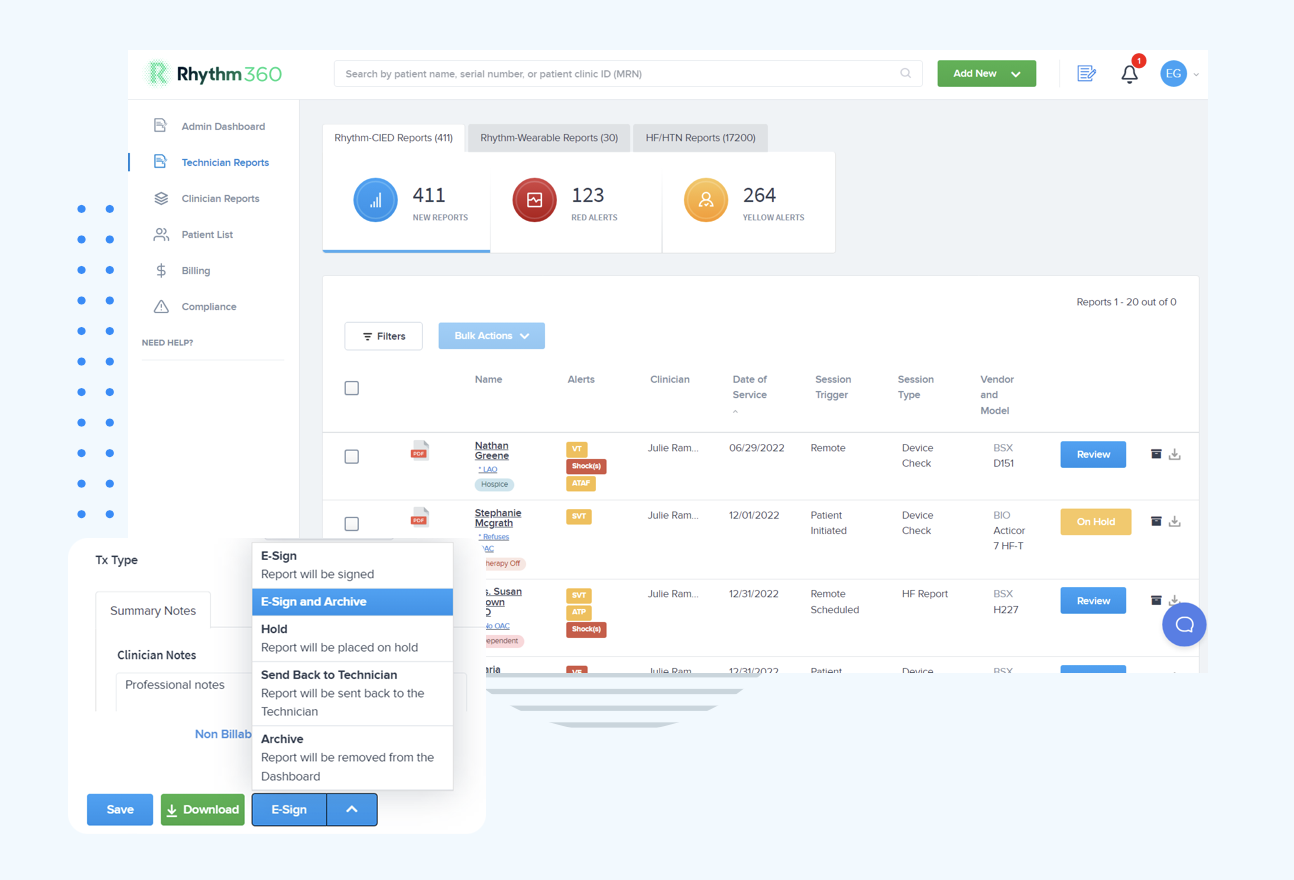
One identity provider, one access control policy, one audit log format, and one BAA make a single platform materially more defensible than four OEM portals with four separate authentication systems and four separate logging environments. The University of Chicago Medicine, which manages more than 73,000 CIED reports annually, selected Rhythm360 as its centralized remote monitoring platform, with Gaurav A. Upadhyay, MD, FACC, FHRS citing integrated review by trained personnel as a decisive factor in vendor selection and reporting improved billing and accountability after implementation.
Practices implementing Rhythm360 have achieved up to an 80% reduction in critical alert response times and up to a 300% increase in revenue capture. Other platforms in the cardiac monitoring space include Murj, Implicity, Rhythm Management Group, and Octagos.
See How Rhythm360 Consolidates Your OEM Portals
CIED cybersecurity responsibility is shared across the data chain. Device manufacturers handle secure device design, firmware patching, and postmarket vulnerability management under FDA guidance and Section 524B of the FD&C Act. Monitoring platforms and OEM cloud vendors secure the data they receive and store and execute HIPAA-compliant Business Associate Agreements with the practice. The practice conducts a HIPAA Security Risk Analysis that covers all vendors handling cardiac ePHI, maintains BAAs with each, enforces access controls and audit logging within its own systems, and trains workforce members on security policies. The HIPAA Security Rule designates a security official who develops and implements these policies at the practice level.
The HIPAA Security Rule requires periodic technical and non-technical assessments of how well policies and procedures meet the Security Rule’s requirements and calls for new evaluations when the security environment changes. In practice, this means a formal reassessment at least annually and after material changes such as a new OEM portal integration, a vendor ownership change, a firmware update affecting data transmission, or a newly disclosed vulnerability in a device or platform component. High-risk or critical vendor relationships warrant more frequent review. BAAs should be reviewed annually and whenever services or data flows change. Practices should also subscribe to manufacturer security advisories and FDA safety communications to receive timely notice of newly identified vulnerabilities in devices already implanted in their patient population.
A BAA for a cardiac monitoring platform should define permitted uses and disclosures of ePHI, required security safeguards, and breach notification timelines stated in specific hours rather than vague terms. It should include subcontractor flow-down requirements that ensure any subprocessor handling ePHI is bound by equivalent obligations, right-to-audit provisions or the right to receive updated assurance reports, minimum encryption standards for data in transit and at rest, cybersecurity incident cooperation requirements, and termination provisions specifying how ePHI will be returned or destroyed at contract end. Practices should also confirm that the BAA addresses remote vendor access, specifying who can initiate it, whether vendor staff can view patient data during a support session, and how those sessions are logged.
Cardiac implant monitoring data security is a chain-of-custody problem that runs from the implanted device through the home transmitter, the manufacturer cloud, and the EHR, with a compliance obligation at every hop. Encryption alone does not address the most common and most operationally significant risk in most practices, which is fragmented multi-OEM portal workflows with no unified audit trail, inconsistent authentication standards, and BAAs that do not match current data flows.
The evaluation lens for any monitoring vendor should be the checklist above: encryption in transit and at rest, authentication and access controls, patch cadence, audit logging, BAA terms, and vendor-neutral data consolidation. A platform that consolidates all OEM data into a single auditable record, integrates bi-directionally with the EHR, and executes a comprehensive BAA reduces attack surface, closes audit gaps, and gives practice administrators a defensible answer when a compliance officer or risk committee asks whether the practice is exposed.
See How Rhythm360 Strengthens Your Cardiac Data Security





