Last updated: September 26, 2026
Explore Rhythm360 for Your Device Clinic
CIED remote monitoring remains split across four major manufacturer ecosystems: Medtronic, Abbott, Boston Scientific, and Biotronik. Each portal holds only its own raw device transmissions. A device clinic that manages patients across all four effectively runs four separate systems with four different alert formats and reconciles them manually.
The consequences are well documented. Staff log into multiple non-interoperable portals to retrieve patient data and then manually transcribe findings into the EHR. Duplicate work re-entering demographics, stale medication lists, missed billing when encounters and signed reports fail to flow back automatically, and audit risk from reconstructing who saw what and when all stem from this fragmentation. The American Heart Association projects that more than 12.1 million patients will receive an arrhythmia diagnosis by 2030, so CIED data volumes will grow faster than clinical staff can manage manually.
Inbound clinical transmissions such as fax, Direct Secure Messaging, and document uploads also need more than a shared inbox. A single inbox still leaves the underlying workflow fragmented. Normalization, intelligent classification and routing, and write-back into the patient chart complete a unified intake workflow.
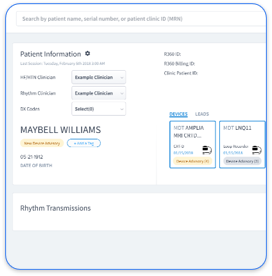
Rhythm360 acts as a vendor-neutral platform that ingests and normalizes data from all major OEMs into a single source of truth. It then synchronizes that data bi-directionally with the EHR so documentation, alerts, and billing move without manual intervention. For a deeper look at the vendor-neutrality principle, see our post on Vendor-Neutral Cardiac Device Integration.
Cardiac monitoring relies on multiple specialized standards rather than a single universal device API. These standards include IEEE 11073-10406 for basic electrocardiograph (ECG) devices (1- to 3-lead ECG), which the FDA recognizes as a consensus standard for medical devices. Each OEM exposes different data formats, transmission schedules, and alert logic, and publicly available documentation for each portal reveals meaningful gaps in third-party interoperability.
The table below shows what each major OEM portal exposes and how Rhythm360 normalizes that data into a consistent model.
Rhythm360 uses a combination of API connections, HL7 messaging, XML parsing, and PDF parsing via computer vision to normalize these disparate feeds into a single canonical data model. Redundant data feeds act as a fail-safe when an OEM server is down, so transmissions remain complete across the patient population.
See How Rhythm360 Unifies OEM Data
Once OEM data enters Rhythm360, the platform maps it to a normalized internal structure that supports clinical review, EHR write-back, and billing compliance. This canonical model has four layers.
Layer 1 — Patient and Device Identity: Layer 1 of the CardX CIED FHIR implementation guide (v2.0.0) covers patient and device identity, including the CIEDPatient/CIEDPatientIdentifier profiles and the Device resource's udiCarrier (UDI), serialNumber, modelNumber, and manufacturer elements. Studies estimate that 10–20% of patient records in a typical health system are duplicates. Identity matching is the most dangerous part of device integration, because a minor name discrepancy can produce orphaned data or a duplicate medical record. Rhythm360 automatically matches most incoming reports to the correct patient and device before the report is assigned to the patient's profile. When inconsistent data prevents a clear match, the report is flagged as a Device Conflict and must be manually reviewed and resolved before assignment.
Layer 2 — Transmission Metadata: Layer 2 of the CardX CIED data model includes the session date and time (MDC_IDC_SESS_DTM), the session type (MDC_IDC_SESS_TYPE, such as scheduled or alert-triggered), and the monitoring period start and end dates (MDC_IDC_MSMT_DTM_START/END). This layer underpins CPT period tracking, because a claim cannot be submitted until the monitoring period has fully elapsed and the transmitted data has been reviewed and documented.
Layer 4 — Workflow State: Reviewed, signed, billed, and archived. This layer drives the bi-directional write-back to the EHR and ensures that every transmission has a documented disposition for audit purposes.
The platform stores both the normalized data and the original vendor report. The normalized data powers downstream workflows. The original report preserves clinical fidelity and supports audit review. Rhythm360 uses AI and computer vision to map data, fill gaps caused by OEM connectivity issues, and identify transmission failures.
Rhythm360 offers deep, bi-directional integrations with Epic, Oracle Health (Cerner), athenahealth, eClinicalWorks, and Greenway Health. Onboarding, including integration setup, typically takes from a few days to a few weeks.
Bi-directional integration means data flows both ways. Demographics and diagnoses sync into Rhythm360, while device data and signed reports push into the EHR chart. Charges drop in real time, so billing capture stays clean without manual chart updates or portal juggling.
The standards layer for CIED integration involves three primary specifications:
Large enterprise EHRs like Epic and Oracle Health require rigorous certification through programs such as App Orchard/Showroom and CODE, involving security review, privacy attestation, and architectural validation before connections can go live. Rhythm360 has completed this certification work so that practices can connect without managing that process themselves.
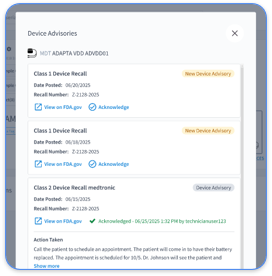
Even with clean EHR integration in place, the volume of alerts that integrations carry can overwhelm staff. Each OEM applies its own alert logic, thresholds, and transmission schedules, producing a volume of notifications that overwhelms clinical staff when aggregated without filtering. A peer-reviewed study of 384,796 CIED transmissions found that 57% were non-actionable and dismissed, 31% were routine billable transmissions, and 13% were critical alerts requiring immediate attention. Without intelligent triage, every CIED transmission enters the same queue and requires review, documentation, and workflow processing regardless of clinical urgency. AI-assisted triage filters non-actionable transmissions before they reach staff, forwarding only 22.8% of transmissions to clinics compared to 38.5% under standard technician review.
Rhythm360's AI-powered alert triage filters non-actionable transmissions and prioritizes clinically significant events, including:
Rhythm360 reduces critical alert response times by up to 80%. For practices that require around-the-clock coverage, Rhythm360 also offers optional 24/7/365 oversight by certified cardiac technicians (CCTs) supervised by physicians. This coverage ensures that a critical arrhythmia flagged on a Saturday morning reaches the right clinician before the end of the day.
A transmission becomes a billable CPT event through a defined sequence. The OEM transmits data. Rhythm360 ingests and normalizes it. A clinician reviews and signs the interpretation. Rhythm360 then writes the signed documentation, encounter data, and billing information back to the EHR chart automatically.
The CPT code family for remote CIED monitoring separates by device type and monitoring interval.
90-Day Cycle — Pacemakers and ICDs:
30-Day Cycle — Physiologic Monitors and Loop Recorders:
Codes 93297 and 93298 are device-specific codes. A heart failure patient with a pulmonary artery pressure sensor receives 93297. A syncope patient with a loop recorder receives 93298. Six errors account for most CPT 93298 denials: wrong code for the device type, reporting before 30 days, billing more than once per 30-day interval, unsigned or undated reports, modifier mismatch, and bundling with in-person interrogation codes without checking NCCI edits.
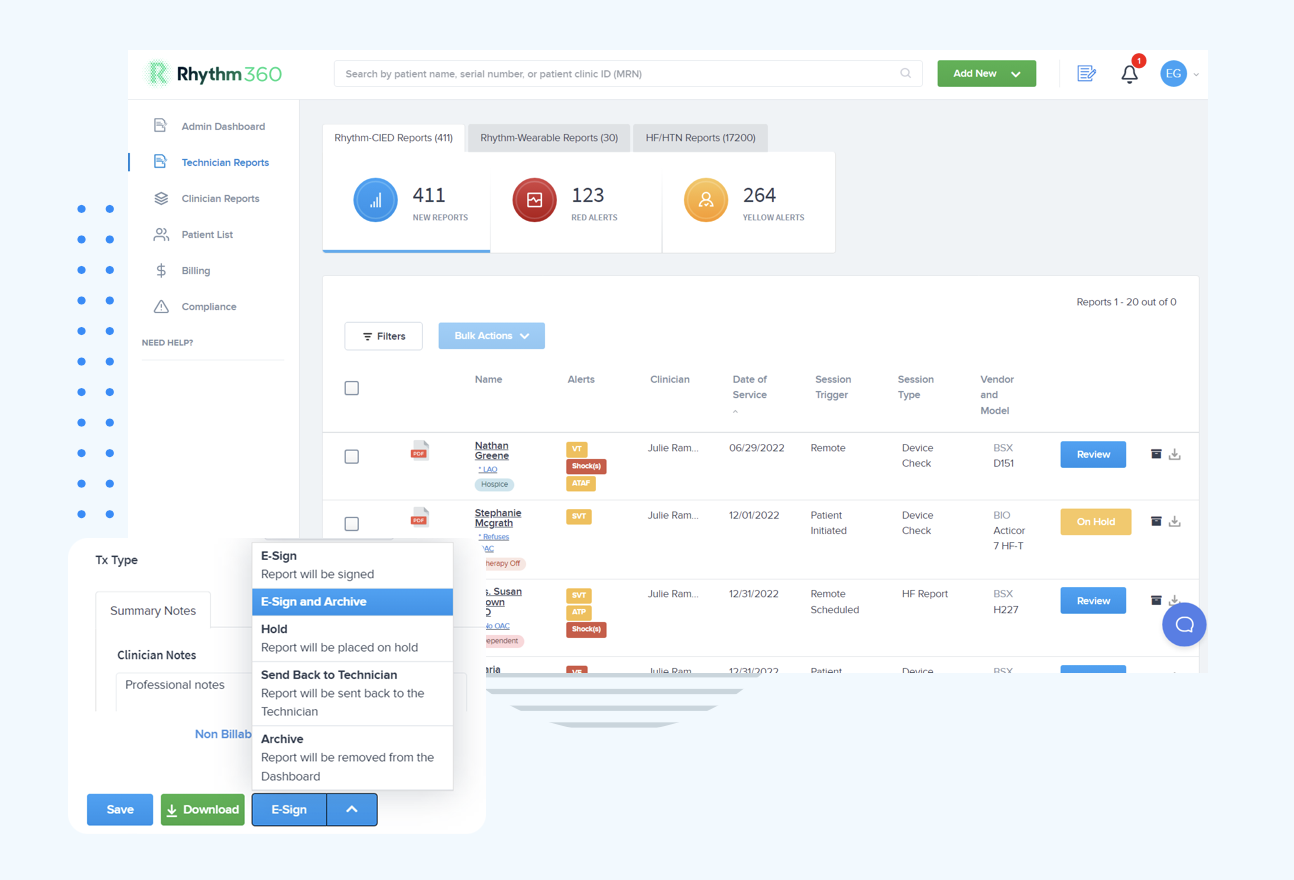
Rhythm360 automatically tracks device-specific CPT pairings and captures unbilled technical components, which prevents the device-type mismatch denials described above. The platform's administrative dashboard provides a real-time overview of patient compliance, critical alerts, and captured or potential revenue based on CPT code requirements. This visibility turns what would otherwise be a month-end manual audit into a continuous, transparent workflow. Practices using Rhythm360 can capture up to 300% more revenue through improved CPT code capture and compliant documentation.
Rhythm360's streamlined implementation, including EHR integration, typically takes only a few days to a few weeks. When evaluating any cardiac implant monitoring platform for EHR and device vendor integration, device clinic managers and health-system integration leaders can use the following checklist.
EHR vendors advertise FHIR support, but implementations vary dramatically in completeness. Some vendors expose only a handful of resource types, search parameters may be partially implemented, and US Core profile conformance may be incomplete. A platform that has already built and certified its integrations in-house removes much of this risk for the practice.
No single EHR fits every cardiology practice. The right choice depends on practice size, existing infrastructure, and integration requirements. Epic is the most widely deployed EHR in large health systems and academic medical centers, holding 43.7% of acute care hospital market share and 56.9% of hospital beds as of 2025, with both large health system enterprise EHR decisions that year going to Epic. According to an American College of Cardiology survey, the most widely used EHRs in cardiology practices are GE Healthcare's Centricity (24%), NextGen (20%), Gateway EMMS (13%), and Allscripts (10%), which together account for two-thirds of cardiology practices that have adopted EHR technology. What matters most for a cardiac device clinic is whether the cardiac monitoring platform can integrate bi-directionally with the chosen EHR and write discrete data and signed documentation back to the chart automatically. Rhythm360 supports deep, bi-directional integration with all of these EHR systems.
The cardiac remote patient monitoring space includes both legacy and modern cloud-based platforms. Rhythm360 is a vendor-neutral, AI-powered platform that ingests data from all major OEMs, normalizes it, and synchronizes it bi-directionally with major EHR systems. The differentiating factors for any practice evaluating these platforms are vendor neutrality, depth of bi-directional EHR integration, AI-powered alert triage, CPT documentation automation, and implementation timeline.
The major cardiac implantable device manufacturers, including Medtronic, Abbott, Boston Scientific, and Biotronik, each produce devices with proprietary remote monitoring portals. The question of which monitoring platform best manages data from those devices differs from the device selection itself. Rhythm360 is designed to work with all of these manufacturers simultaneously and to normalize their disparate data formats into a single workflow. This approach allows a practice to implant the clinically appropriate device for each patient and manage all transmissions through one platform.
Yes. Rhythm360 connects to the major OEM ecosystems using a combination of API connections, HL7 messaging, XML parsing, and PDF parsing via computer vision. Rhythm360 is a vendor-neutral platform that aggregates and normalizes cardiac data from all major CIED manufacturers into a unified view before bi-directional EHR integration. Redundant data feeds ensure that a temporary OEM server outage does not create a gap in the patient record or a missed billable event.
The core problem in cardiac device clinic management is fragmentation. Each OEM holds its own raw transmissions in a non-interoperable portal. Staff manually transcribe findings into the EHR and absorb alert fatigue from unfiltered OEM notifications. Documentation gaps cause denials on codes like 93298, and missed technical components represent revenue that never reaches a claim.
Rhythm360 ingests and normalizes cardiac device data from major OEM manufacturers using APIs, HL7, XML, and computer vision PDF parsing; maps data to a vendor-neutral CIED model; synchronizes it bi-directionally with Epic, Cerner (Oracle Health), athenahealth, eClinicalWorks, and Greenway Health using HL7 and FHIR or API integrations; filters non-actionable transmissions with AI-powered triage; and writes compliant CPT documentation back to the chart automatically. Implementation typically completes in days to weeks. Clinics gain faster response to critical alerts and significantly higher revenue capture through stronger CPT documentation.
Talk with Rhythm360 About Your Workflow