Get a compliance walkthrough for your device mix
Medicare covers remote interrogation and monitoring of implanted cardiac devices when medical necessity, a physician order, and documentation requirements are met. Coverage spans four device categories:
See how Rhythm360 tracks device-specific cycles
Once coverage is established, the next step is to determine how often a claim can be submitted. Billing frequency is determined by device type. The number of transmissions received does not change the billing cycle. The applicable cycles are:
CMS Billing and Coding Article A56602 states that CPT codes 93293, 93294, 93295, and 93296 are reported no more than once every 90 days and not at all if the monitoring period is under 30 days. The monitoring period must meet minimum day thresholds before a claim is submitted. Claims submitted before the period closes are denied. For the general RPM code family, CMS requires data collection on at least 2 days within a 30-day period, which is structurally different from CIED interrogation cycle rules and does not replace them.
The four device categories below each map to a distinct code set and monitoring cycle. Work through the category that matches the implanted device.
CPT 93294 is the professional code for remote pacemaker interrogation, and CPT 93296 is the technical component covering data acquisition, receipt of transmissions, and technician review. Both codes follow the 90-day cycle noted above. When the same billing entity performs both components, both codes are reported. Documentation must identify the device type and lead configuration, service modality, date range, data reviewed, clinically relevant findings, medical necessity, interpretation, and management plan, along with the implant date and device identification.
CPT 93295 is the professional code for remote ICD interrogation, and CPT 93296 is the technical component shared with the pacemaker family. A September 3, 2026 revision to the ICD LCD (LCD 34087 v21) is in effect. Practices should verify documentation workflows against the updated coverage criteria to confirm that existing records satisfy current requirements. CMS also modified its ICD coverage policy with an effective date of August 20, 2026. Billing teams should audit pending and future claims against these changes.
CPT 93298 applies to subcutaneous cardiac rhythm monitors and implantable loop recorders, billable once per 30 days, and can be billed global, with modifier -26, or with modifier -TC. CPT 93298 is a device-specific code for rhythm monitoring, billable once per 30 days. CPT blocks reporting 93298 together with 33285, 93291, 93297, 99091, or 99454. This parenthetical restriction applies before any payer edit. Devices in this category include the Medtronic LINQ II, Abbott Assert-IQ, Boston Scientific LUX-Dx, and Biotronik BIOMONITOR.
CPT 93297 applies to implantable cardiovascular physiologic monitors that report hemodynamic data such as pulmonary artery pressure (e.g., CardioMEMS), billable once per 30 days, and can be billed global, with modifier -26, or with modifier -TC. CPT 93297 is a device-specific code for physiologic monitoring, billable once per 30 days, and applies only to cardiovascular physiologic monitors.
The table below consolidates device types, CPT codes, billing cycles, modifier options, and documentation requirements from the sections above so coders can verify a claim against a single reference.
| Device Type | CPT Code | Billing Cycle | Modifier Options | Documentation Required |
|---|---|---|---|---|
| Pacemaker | 93294 (professional), 93296 (technical) | Once per 90 days | 93294: -26; 93296: -TC; or bill both for global | Implant date, device ID, physician order, transmission records, formal interpretation and report, medical necessity |
| ICD | 93295 (professional), 93296 (technical) | Once per 90 days | 93295: -26; 93296: -TC; or bill both for global | Implant date, device ID, physician order, transmission records, formal interpretation and report, medical necessity; verify against LCD 34087 v21 |
| ILR / Subcutaneous Cardiac Rhythm Monitor | 93298 | Once per 30 days | Global, -26, or -TC | Implant date, device ID, physician order, completed 30-day monitoring period, transmission records, physician-authored interpretation, symptom/medical necessity documentation |
| Cardiovascular Physiologic Monitor | 93297 | Once per 30 days | Global, -26, or -TC | Implant date, device ID, physician order, completed 30-day monitoring period, transmission records, physician-authored interpretation, symptom/medical necessity documentation |
Yes, when the practice furnishes both the professional interpretation and the technical monitoring service. CPT 93295 is the professional component for ICD remote interrogation. CPT 93296 is the technical component, covering data acquisition, receipt of transmissions, technician review, technical support, and distribution of results. Billing both requires that the practice actually perform both functions and that documentation supports each component independently.
An in-person interrogation that falls within the same 90-day monitoring period as a remote interrogation is included in the remote service and should not be billed separately for that period.
Medicare does not allow separate payment for remote interrogation and an in-person device evaluation that falls within the same 90-day monitoring period for the same device. When an in-person device check falls inside the same 90-day window as a remote check, the in-person service is read and documented but the charge is not separately billable.
The operational implication is a workflow rule. Because the in-person charge is not separately billable inside the remote monitoring period, practices must schedule in-person visits and remote transmissions so they do not overlap. Staff should check the date of the last remote transmission before creating an in-person charge, and coders should verify current CPT instructions, NCCI edits, and payer-specific policies before reporting both services in the same cycle.
To support a cardiac implant monitoring claim under Medicare, documentation must establish what was monitored, who ordered it, and what the physician concluded. The required elements are:
The following errors account for the majority of cardiac device monitoring claim denials:
See how Rhythm360 reduces denial risk
CPT codes 93294–93299 form a distinct family of remote cardiac implant interrogation codes used for pacemakers, ICDs, and implantable loop recorders, separate from the general remote physiologic monitoring codes 99453, 99454, and 99457. CIED interrogation codes describe services furnished over a defined monitoring period: up to 90 days for pacemakers and ICDs, and up to 30 days for loop recorders and physiologic monitors. Each includes physician review and technical transmission work. General RPM codes cover physiologic data collection and management for chronic conditions such as heart failure and hypertension using external connected devices.
General RPM codes cover a different service than CIED interrogation codes. Practices must not bill CPT 99454 for a pacemaker or ICD transmission. CMS requires RPM device supply (99454) to include data collection on at least 2 days within a 30-day period, which differs from the defined monitoring periods governing CIED interrogation. The CPT parenthetical under codes 99453 and 99454 instructs that they are not reported alongside codes for more specific physiologic parameters, citing 93296 as an example.
Rhythm360 supports both CIED interrogation workflows and general RPM service lines for heart failure and hypertension, providing a centralized workspace for both code families within a single platform.
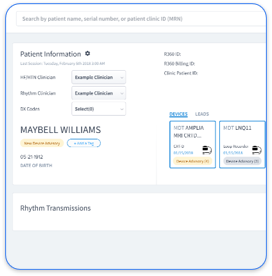
Rhythm360 is a vendor-neutral, cloud-based platform that consolidates data from all major device manufacturers, including Medtronic, Boston Scientific, Abbott, Biotronik, and others, into a single dashboard. This structure removes the need for staff to log into multiple non-interoperable OEM portals.
The platform automates CPT code capture and documentation for 93294, 93295, 93296, 93297, and 93298, including 90-day and 30-day cycle tracking, to help practices prevent device-type mismatch denials and unbilled technical components. Rhythm360 tracks device-specific CPT pairings and monitoring period start dates at enrollment, so claims release on the correct date rather than at the point of transmission receipt, which is the most common source of frequency denials in this code family.
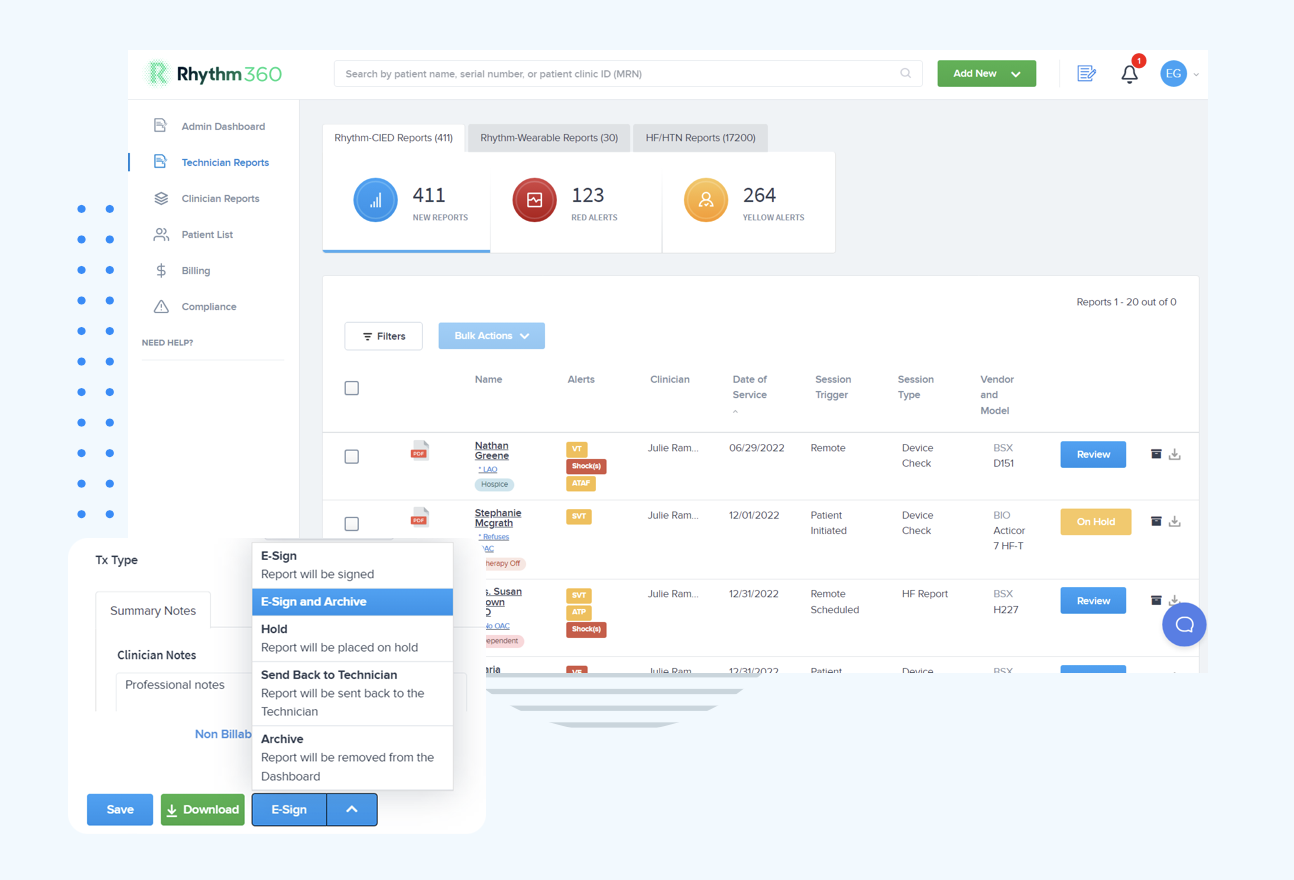
Practices using Rhythm360 have achieved up to an 80% reduction in critical alert response times and up to a 300% increase in revenue capture and profitability. Those results depend on fitting the platform into existing workflows, which is why Rhythm360 offers bi-directional EHR integration with Epic, Cerner, Athenahealth, eClinicalWorks, and Greenway Health. Implementation typically takes from a few days to a few weeks.
Rhythm360 focuses on providing auditable documentation, automated CPT capture across all device types and manufacturers, and a unified workspace for both CIED interrogation and RPM service lines. Other platforms in this space include Murj, Implicity, Rhythm Management Group, and Octagos.
Medicare covers remote interrogation and monitoring of implanted cardiac devices, including pacemakers, ICDs, implantable loop recorders, and cardiovascular physiologic monitors, when medical necessity, a physician order, and documentation requirements are met. Coverage is tied to the specific device type and the applicable CPT code family. External and wearable monitors such as Holter, patch, and mobile cardiac telemetry devices are billed under separate code ranges (93224–93272) and are not device interrogation services.
Telemetry and external ambulatory monitoring fall under separate code families (93224–93272) and are not device interrogation. Those codes are duration-based and cover external recording over a specified period while a patient goes about daily activities. CIED interrogation codes (93294–93299) cover implanted device checks over defined monitoring periods, with 90-day cycles for pacemakers and ICDs and 30-day cycles for loop recorders and physiologic monitors. These services require a physician-authored interpretation of the transmitted device data.
CMS National Coverage Determination 20.8.1 places monitoring frequency with the treating physician, who accounts for the individual patient's condition and circumstances. The NCD states that the decision as to how often any patient's pacemaker should be monitored is the responsibility of the patient's physician, and that these circumstances may vary over time, requiring modifications of the frequency with which the patient should be monitored. Prescriptions for monitoring are renewed at least annually. There is no single fixed interval that applies to all patients, so the treating physician determines the appropriate schedule.
As explained above, remote interrogation codes (93294–93299) cover implanted device checks over defined monitoring periods, with physician review and technical transmission work. General RPM codes (99453, 99454, 99457) cover physiologic data collection and management for chronic conditions using external connected devices. The two families are not interchangeable.
Claims submitted before the required 30-day or 90-day monitoring period closes are typically denied as frequency errors. CMS expects the full monitoring period to elapse before billing. Practices should hold claims until the minimum day threshold is met and confirm that documentation reflects the complete period.
Medicare requires the documentation elements listed in the checklist above, including device identification, a signed physician order, transmission records, a physician-authored interpretation, and medical necessity justification. These items collectively show what was monitored, why it was monitored, and how the physician used the data.
Across all the device types and code families covered above, one pattern holds. The 2026 Medicare landscape for cardiac implant monitoring is governed by device-specific rules. A pacemaker patient and a loop recorder patient in the same practice require different CPT codes, billing cycles, and documentation structures. The September 3, 2026 ICD LCD revision adds a current-year compliance checkpoint that practices must reconcile against existing workflows.
The evaluation framework for every CIED monitoring claim is four steps: which device, which code, which cycle, and which documentation. Applying the wrong answer at any step produces a denial that a consistent operational infrastructure can prevent. Rhythm360 automates that infrastructure by tracking monitoring periods, capturing the correct CPT codes by device type, and generating auditable documentation so practices can focus on patient care rather than claim correction.
Request a device-specific compliance review