

Many cardiology practices now manage large CIED populations through separate portals from Medtronic, Boston Scientific, Abbott, Biotronik, and others. Each portal has its own logins, interfaces, and reporting formats, which creates a fragmented environment for clinical and administrative staff.
Annual staff time to manage CIED patients can range from 1.6–2.4 hours for therapeutic devices and 7.7–9.3 hours for implantable cardiac monitors. This work often involves repetitive portal logins, manual data reconciliation, and documentation tasks that add little clinical value.
More than 40% of patient calls to CIED clinics relate to remote monitoring equipment or transmission issues. Staff who spend large portions of the day troubleshooting connectivity have less time for direct patient care, which can contribute to burnout and turnover.
Fragmented portals also create clinical risk. Only 21% of remote transmissions are clinically meaningful and require physician review. When teams must sort through large volumes of non-actionable alerts across multiple systems, important events such as new-onset atrial fibrillation or device malfunction can be delayed or overlooked.
Managing 1,000 patients on remote monitoring can require an estimated 30–40 hours of staff time per week. Without a centralized platform that tracks billable events and generates compliant documentation, clinics often miss appropriate claims for CIED and remote monitoring CPT codes such as 93298, 93299, and 99454.
Unbilled services, inconsistent documentation, and denied claims can create substantial revenue loss over time and limit the resources available to support comprehensive monitoring programs.
Integrated cardiac implant monitoring platforms bring data from all major CIED manufacturers into a single, vendor-neutral system. These platforms ingest information through APIs, HL7 feeds, XML files, and computer vision parsing of PDF reports, then normalize the data into a unified view for clinicians and staff.
Clinics that adopt an integrated approach typically gain three primary benefits:
RhythmScience’s Rhythm360 platform is a cloud-based, vendor-neutral solution built to address the operational, clinical, and financial challenges of traditional OEM-centric workflows.
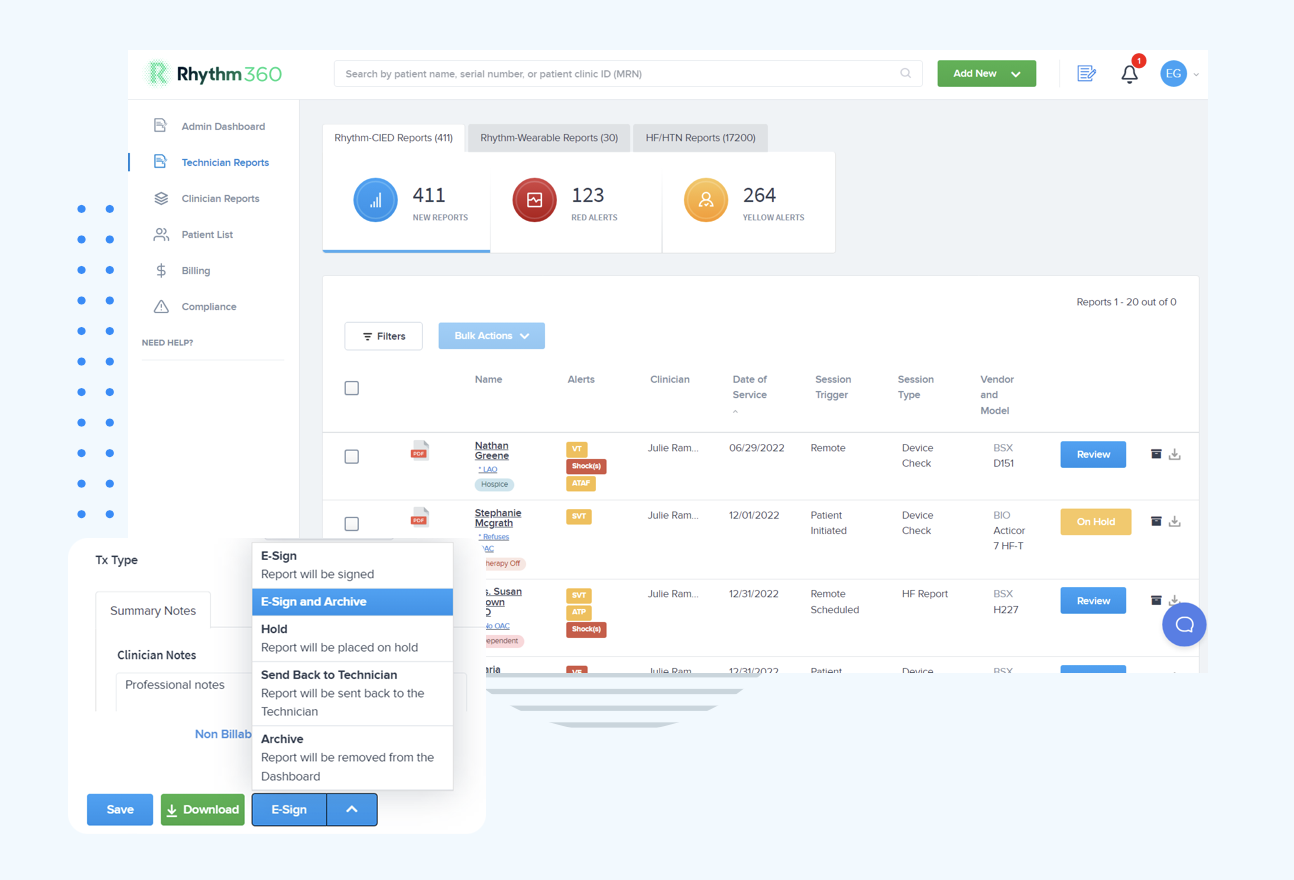
Clinics that want to see these capabilities in detail can schedule a Rhythm360 demo.
Rhythm360 removes the need to log into multiple OEM portals for routine tasks, which decreases manual data entry and reconciliation. Even modest efficiency gains in CIED workflows can translate into significant time savings across a clinic.
The platform’s alert triage tools focus attention on transmissions that are clinically meaningful, while filtering low-value notifications. This approach helps teams respond more quickly to important events such as arrhythmias, device advisories, and battery depletion alerts.
Rhythm360 presents normalized data across all manufacturers, which supports consistent protocols and staffing models. Variation in OEM systems can make it difficult to standardize operating procedures, and a single consolidated interface helps reduce that complexity.
Rhythm360 identifies and documents billable remote monitoring activities so teams can more reliably capture CPT codes such as 93298, 93299, 99453, 99454, and 99457. Clinics often use this visibility to expand appropriate monitoring services and recover revenue that previously went unbilled.
The platform automatically logs transmission reviews, clinical decisions, and patient communications, creating detailed audit trails that support billing integrity and reduce the risk of denials.
Standardized workflows and automation allow clinics to manage larger CIED panels with similar or lower staffing levels. These efficiency gains can free resources for additional service lines, quality initiatives, or expanded patient access.
Teams interested in assessing the financial impact can request a financial review and demo of Rhythm360.
Feature | Traditional OEM Portals | Rhythm360 Platform |
Data consolidation | Data scattered across multiple logins and formats | Unified, single dashboard for all supported devices |
Workflow efficiency | Manual, time-consuming processes | Automated workflows and standardized procedures |
Alert management | High alert volume with many false positives | AI-supported triage with prioritized alerts |
Revenue capture | Inconsistent CPT capture and documentation gaps | Structured CPT tracking and compliant documentation |
How does Rhythm360 consolidate data from multiple CIED manufacturers?
Rhythm360 uses APIs, HL7 feeds, XML processing, and computer vision parsing of PDF reports to ingest and normalize data from major OEMs, creating a single, comprehensive view without separate portal logins.
Can Rhythm360 help reduce alert fatigue and improve response times?
AI-supported alert triage filters out non-actionable transmissions and elevates clinically meaningful events, which helps teams focus on priority alerts and can shorten response times for critical findings.
What financial impact can clinics expect from implementing Rhythm360?
Clinics may see improved financial performance through more consistent CPT capture, automated billing documentation, and reduced administrative overhead, with potential gains when new remote monitoring service lines are added.
Cardiology practices that rely only on individual OEM portals face rising administrative demands, increased risk of missed events, and ongoing revenue leakage. Integrated cardiac implant monitoring platforms offer a more sustainable approach by unifying data, standardizing workflows, and supporting accurate billing.
RhythmScience’s Rhythm360 platform provides a structured way to manage CIED and chronic disease monitoring programs within a single environment. Clinics that want to modernize their cardiac implant monitoring in 2026 can schedule a Rhythm360 demo to evaluate how the platform aligns with their clinical, operational, and financial goals.





