

Last updated: July 14, 2026
A consistent set of evaluation criteria keeps cardiac implant monitoring ROI comparisons grounded in measurable outcomes. The six criteria below focus on operational and financial factors that most directly affect practice profitability and clinical safety in 2026.
The table below presents Rhythm360’s documented performance across each evaluation criterion and contrasts it with OEM portals and outsourced monitoring services. OEM portals work well for single-manufacturer device populations, yet practices that implant devices from more than one manufacturer face a fragmentation problem that no individual OEM portal can solve. Outsourced monitoring services move administrative work off-site but introduce different trade-offs, including reduced real-time visibility, variable billing control, and dependence on a third party’s staffing and service levels. Where direct like-for-like metrics are unavailable for these categories, the comparison appears in the narrative following the table.
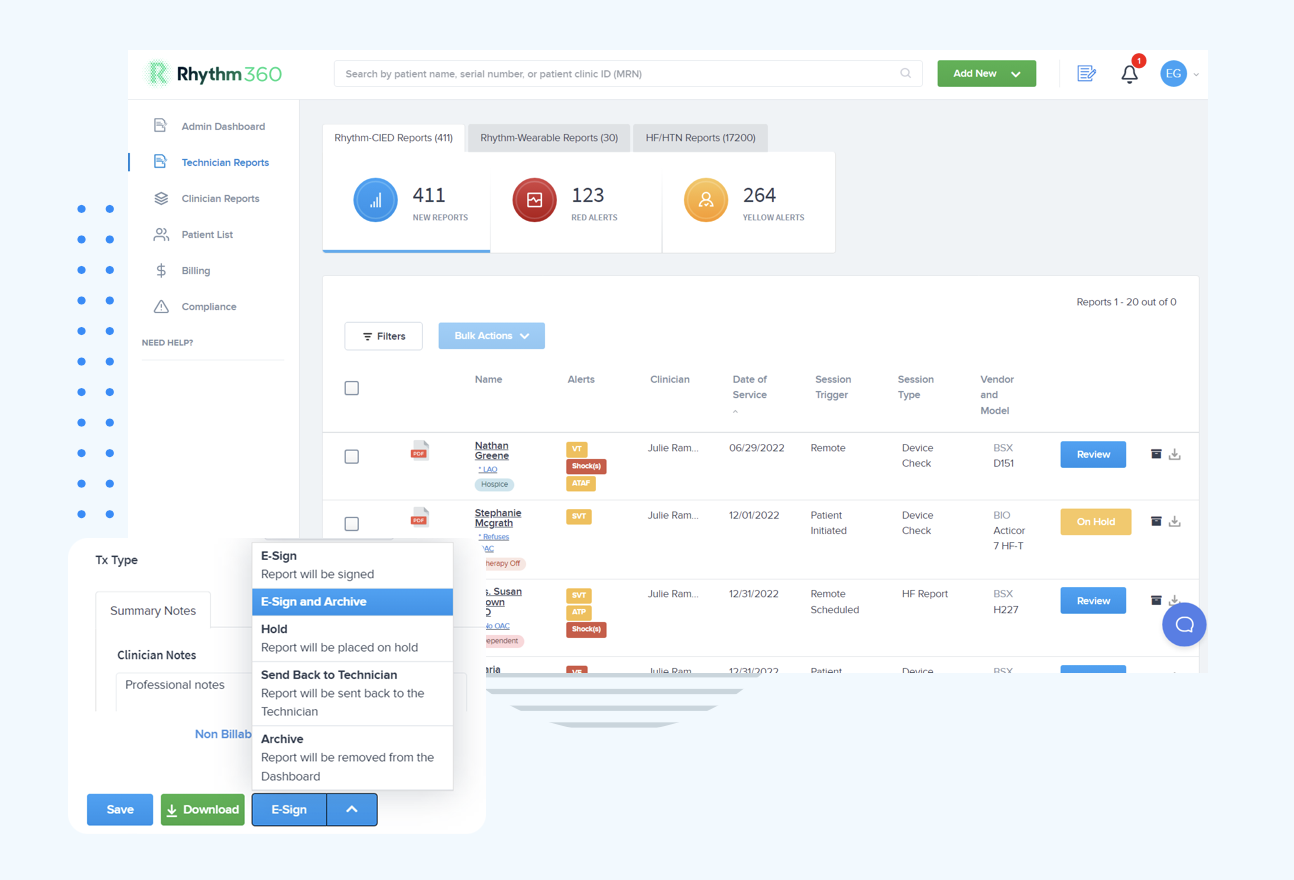
| Metric | Unified Vendor-Neutral Platform (Rhythm360) | OEM Portals | Outsourced Services |
|---|---|---|---|
| Implementation Timeline | A few days to a few weeks, including bi-directional EHR integration with Epic, Cerner, Athenahealth, and others | Each OEM portal is deployed independently, so multi-vendor practices manage separate timelines per manufacturer with no unified go-live | Onboarding timelines vary by vendor contract and depend on the outsourced provider’s scheduling capacity and data-sharing agreements |
| Data Transmissibility | Very high, supported by redundant data feeds, computer vision OCR, and AI-powered extrapolation | Transmissibility is manufacturer-specific and not normalized across OEMs, and data gaps occur when OEM servers experience downtime | Dependent on the outsourced provider’s data pipeline, and practices typically lack direct visibility into transmissibility rates |
| CPT Billing Automation (93298, 93299, 99454) | Automated CPT documentation and capture, with documented revenue increases after implementation | OEM portals generate device reports but do not automate CPT documentation or billing workflows across manufacturers | Billing support varies by contract, and practices may cede billing control or pay per-transmission fees that compress net contribution |
| Critical Alert Response Time | Significant reduction in critical alert response times through AI triage and optional 24/7 CCT oversight | Alert delivery is manufacturer-specific, and no cross-OEM triage layer exists to prioritize alerts across a mixed-device population | Response times depend on the outsourced team’s staffing model and service-level agreement terms |
| Staff Hours / Administrative Burden | Single dashboard eliminates redundant logins; University of Chicago Medicine reviewed more than 73,000 reports annually with stable dismissal rates using Rhythm360 | Staff must log into a separate portal for each OEM, so practices with Medtronic, Boston Scientific, Abbott, and Biotronik devices manage four or more independent systems | Administrative burden shifts to the outsourced vendor, but practices lose real-time visibility and direct control over patient data |
| HIPAA Audit Trail | Full audit trail for every access, modification, and communication, with Twilio-integrated call logging within the patient record | Each OEM portal maintains its own access logs, and no unified audit trail exists across manufacturers | Audit documentation is held by the outsourced vendor, and practices must contractually secure access to their own compliance records |
A 10-physician cardiology practice managing 2,000 CIED patients represents a common mid-market profile where platform choice has clear financial impact. The following model uses Rhythm360’s documented performance benchmarks.
Revenue capture: Practices that automate CPT documentation for codes 93298, 93299, and 99454 across a 2,000-patient population recover billing that manual or fragmented workflows often miss. RhythmScience clients have reported revenue increases through stronger CPT code capture and improved staff efficiency. At scale, this reflects the combined effect of fewer claim rejections, capture of previously undocumented billable events, and added RPM service lines for heart failure and hypertension patients.
Staff-hour savings: Clinical staff manually re-entering data across disconnected systems add 45–90 minutes of administrative burden per provider per day when remote monitoring platforms lack EHR integration. For a 10-physician practice, removing that burden over a full year returns thousands of staff hours that can shift to patient-facing care or additional monitoring volume.
Claim rejection reduction: University of Chicago Medicine reported improved billing and accountability for patients after integrating Rhythm360, a direct outcome of automated documentation replacing manual, error-prone workflows.
Data reliability: Rhythm360’s high transmissibility rate, achieved through redundant data feeds and AI-powered gap-filling, helps ensure that billable transmission events are captured even when an OEM’s server experiences downtime. Portal-dependent practices often lose this revenue silently.
Alert fatigue creates both clinical and operational risk in CIED monitoring programs. A mixed-device population can generate hundreds of transmissions per week across multiple OEM portals, and the volume of non-actionable notifications weakens the signal-to-noise ratio for clinical staff. The result often includes delayed responses to critical events such as new-onset atrial fibrillation, ventricular tachycardia, lead malfunction, or device ERI that require immediate intervention.
Rhythm360 addresses this with an AI-powered triage layer that filters non-actionable alerts and surfaces clinically significant events in priority order. The platform has documented large reductions in critical alert response times. For context on what AI triage can achieve at scale, a JACC: Advances study validated AI-driven alert filtering at 78 U.S. clinics, demonstrating that AI triage can reduce transmissions while catching more true clinical events, which establishes a benchmark for algorithmic filtering in production CIED environments.
While AI triage handles routine noise efficiently, complex clinical judgment still requires human expertise. Rhythm360 therefore supplements algorithmic prioritization with an optional 24/7/365 oversight layer staffed by certified cardiac technicians (CCTs) supervised by physicians. This two-layer model, combining AI and human review, helps ensure that a critical arrhythmia flagged on a Saturday morning reaches a clinician within the same day. Clinicians can then start anticoagulation or adjust device settings immediately rather than waiting for a scheduled three-month visit. As UCM clinicians noted after implementing Rhythm360, the platform supports earlier intervention: “rather than waiting for a 3-month visit, we can call patients in for evaluation.”
Device technician burnout acts as a hidden cost driver in cardiology practices. A typical day can involve logging into four or more OEM portals, reconciling conflicting data, transcribing findings into the EHR, and chasing billing documentation while managing an alert queue that mixes critical events with routine noise. Turnover becomes likely in this environment, and replacing a specialized CCT carries direct recruiting costs and the risk of losing institutional knowledge concentrated in a single “super-user.”
Rhythm360’s centralized workflow design reduces this burden by consolidating all CIED and RPM data into a single dashboard. Staff interact with one system, one alert queue, and one documentation workflow regardless of device manufacturer. Beyond reducing login friction, the platform’s secure, HIPAA-compliant mobile application extends this access beyond the workstation, allowing clinicians and technicians to review transmissions, sign reports, and coordinate care from any location. This flexibility improves quality of life for on-call staff who would otherwise remain tethered to their desks.
For administrators, Rhythm360’s real-time dashboard provides live visibility into patient compliance status, critical alert queues, and captured versus potential revenue by CPT code. This view replaces the end-of-month reconciliation process that many practices use to identify billing gaps, a process that often surfaces missed claims after the correction window has closed.
Implementation disruption often ranks as a top objection to platform migration. Rhythm360’s onboarding process targets full operational status in a few days to a few weeks, including bi-directional EHR integration with Epic, Cerner, Athenahealth, eClinicalWorks, Greenway Health, and others via HL7.
This timeline stands out against typical EHR integration complexity. A bidirectional production EHR integration using HL7 v2 and FHIR typically takes 8–16 weeks and costs $40K–$120K when built from scratch, with enterprise Epic or Cerner integrations requiring App Orchard or marketplace review extending to 4–8 months. Rhythm360’s pre-built integration pathways with major EHR vendors compress this timeline for practices because certification and connectivity work already exist at the platform level.
From a compliance standpoint, the HL7 FHIR API criterion (§ 170.315(g)(10)) is included in the Base EHR definition under the ONC Health IT Certification Program rules implementing the 21st Century Cures Act, though ONC certification remains voluntary. The CMS Interoperability and Prior Authorization Final Rule (CMS-0057-F) requires payers to implement non-technical provisions by January 1, 2026, and API development requirements by January 1, 2027, which makes FHIR-capable platforms a practical regulatory consideration. Rhythm360’s infrastructure supports API, HL7, XML, and PDF parsing via computer vision, covering the full range of data formats encountered across OEM manufacturers.
Post go-live, RhythmScience provides ongoing customer success support so the platform can evolve with the practice’s clinical and operational requirements rather than functioning as a one-time deployment.
The following matrix helps practice administrators match their monitoring model to volume, staffing, and revenue priorities.
| Practice Profile | Primary Priority | Recommended Model | Rhythm360 Fit |
|---|---|---|---|
| Solo or 2-physician practice, single OEM device population, <200 patients | Simplicity, low overhead | OEM portal may be sufficient at this scale | Rhythm360 scales down; evaluate if RPM service lines are a growth target |
| 3–10 physician practice, multi-OEM device population, 500–2,000 patients | Staff efficiency, billing capture, alert management | Unified vendor-neutral platform | Strong fit; consolidates portals, automates CPT documentation, reduces technician burden |
| Large group or health system, 2,000+ patients, multi-site | Scalability, EHR integration, compliance, revenue visibility | Unified vendor-neutral platform with 24/7 CCT oversight | Strong fit; UCM managed high annual report volume with stable dismissal rates on Rhythm360 |
| Any practice with HF/HTN RPM growth goals | New revenue streams, chronic disease management | Integrated CIED + RPM platform | Strong fit; Rhythm360 supports Rhythm-CIED and HF/HTN RPM in a single workspace |
Rhythm360’s implementation approach minimizes operational disruption. Most practices reach full go-live within a few days to a few weeks, depending on EHR complexity and the number of device manufacturers in their patient population. RhythmScience manages onboarding end-to-end, including workflow configuration, EHR integration setup, staff training, and go-live readiness. Because Rhythm360 consolidates existing OEM data streams rather than replacing them, clinical staff can continue monitoring patients throughout the transition. Post go-live support remains active rather than ending with a single handoff.
Transmissibility describes the percentage of scheduled device transmissions that are successfully received, processed, and made available for clinical review and billing documentation. Rhythm360 achieves very high transmissibility through redundant data feeds, computer vision OCR for PDF-based reports, and AI-powered extrapolation that fills data gaps when an OEM’s server experiences downtime. For billing, a missed transmission equals a missed billable event. CPT codes 93298, 93299, and 99454 require documented transmission data to support a compliant claim, so every transmission that fails to reach the platform represents potential revenue that the practice cannot recover later.
Rhythm360 uses a cloud-based SaaS architecture that scales with practice volume without new infrastructure investment. A practice that adds a new device manufacturer, opens a second location, or launches a heart failure RPM service line can extend Rhythm360’s coverage without migrating to a new platform. The University of Chicago Medicine’s experience illustrates performance at high volume, as UCM processed more than 73,000 reports annually through Rhythm360 in 2025, averaging more than 18,000 reports per quarter, with stable dismissal rates. RhythmScience’s SaaS pricing model scales based on clinic size and platform usage, so the cost structure grows proportionally with the practice rather than front-loading investment.
Rhythm360 automates the documentation workflow that supports compliant billing for CPT codes 93298, 93299, and 99454. The platform captures transmission data, generates reports, and maintains a full audit trail for every patient interaction, including automated and manual communications logged through the integrated Twilio framework. This documentation chain provides the evidence base that payers require for remote monitoring claims. Practices using Rhythm360 have reported improved billing and revenue outcomes that reflect both recovery of previously missed billable events and fewer claim rejections caused by incomplete documentation. Rhythm360 supports the billing documentation process while billing decisions and revenue cycle management remain within the practice’s control.
Rhythm360 includes distinct but integrated service lines for Rhythm-CIED monitoring and remote physiological monitoring for heart failure and hypertension. The HF/HTN service line supports patient onboarding, automated billing documentation for RPM CPT codes including 99453, 99454, and 99457, and integration with connected devices such as CardioMEMS pulmonary artery monitors. Practices can manage rhythm disorders, heart failure, and hypertension within a single workspace, which creates a more comprehensive view of each patient’s cardiovascular status and adds recurring revenue streams without new platforms or workflows.
The cardiac implant monitoring ROI comparison for cardiology practices in 2026 points clearly toward unified platforms when measured against quantifiable criteria. Fragmented OEM portals create administrative overhead that compounds with every additional device manufacturer. Outsourced models move work off-site but reduce real-time visibility and billing control. A unified, vendor-neutral platform with AI triage, automated CPT documentation, bi-directional EHR integration, and high transmissibility addresses these failure modes within a single operational framework.
Rhythm360 translates these capabilities into faster critical alert response, stronger revenue performance, and earlier interventions in live clinical environments, including a 2025 implementation at the University of Chicago Medicine that handled high annual report volume with improved billing accountability and earlier patient outreach. For a 10-physician practice managing 2,000 CIED patients, these benchmarks convert into measurable annual net contribution per monitored patient, recovered staff hours, and a claim acceptance rate that reflects the practice’s true monitoring volume.
Schedule a demo to model Rhythm360’s ROI impact for your specific practice size and patient population.




