

A cardiac device specialist must show proficiency across five domains defined by the IBHRE CDRMS examination blueprint:
Specialists also need working knowledge of EHR and software integration, billing and reimbursement management for RPM and virtual care management (VCM), SOC2 cybersecurity standards, and patient education protocols.
Current clinical consensus supports regular remote transmission review for stable pacemaker patients, with in-person evaluations when a remote transmission flags a clinically significant finding. ICD and CRT-D patients typically require regular remote review, and implantable loop recorder (ILR) transmissions follow clinic-specific protocols.
A training curriculum must map these monitoring intervals to staff workflows by defining the review steps required within each transmission window. The following checklist reflects a standard transmission review cadence that helps staff avoid missed data points:
Training staff to follow this checklist consistently across every OEM device type creates the operational foundation of a vendor-neutral program.
Fragmented OEM portals drive most operational dysfunction in CIED programs. Traditional remote monitoring software focuses only on transmission processing, while clinics still manage alert prioritization, documentation, billing readiness, audit trails, recall management, and heart failure workflows in separate systems.
Fragmented systems increase the risk of missed reports, duplicate work, and operational uncertainty by forcing staff to perform manual steps in alert review, documentation, and billing preparation across disparate platforms. This fragmentation creates excessive task switching, reduces focus on patient care, and raises compliance risk.
At the University of Chicago Medicine (UCM), pre-implementation workflows were, in the words of Andrew Beaser, MD, Associate Professor of Medicine, “a major challenge and incredibly difficult.” Gaurav A. Upadhyay, MD, FACC, FHRS, Director of the Pacing & Defibrillation Device Clinic at UCM, noted that “staffing was always an issue for our center, because our device clinic, like many other medical centers, had struggled with technician turnover and timely weekend coverage.”
Alert fatigue compounds these problems. High dismissal rates in CIED monitoring at UCM reflect a safety-first remote monitoring model, with most OEM-generated alerts proving nonactionable across more than 73,000 reports reviewed annually. Training programs that ignore triage methodology leave staff overwhelmed and increase the chance that critical events remain buried in low-value alerts.
Addressing these operational challenges requires better technology and formal credentialing, along with ongoing education that keeps staff current across evolving device platforms and clinical protocols.
The IBHRE CDRMS credential requires applicants to show documented experience performing remote monitoring or in-person evaluations of pacemakers, ICDs, and subcutaneous cardiac rhythm monitoring devices from all major manufacturers. The IBHRE CDRMS examination includes 150 items, covers the five competency domains listed above, and is administered at computer-based testing centers over 210 minutes.
The Heart Rhythm Society (HRS) supports accredited continuing education (ACE) and maintenance of certification (MOC) points through its annual Board Review Course and, beginning fall 2026, through Heart Rhythm ONE, a streamlined professional development platform for heart rhythm specialists. Clinics should budget continuing education hours annually for each monitoring staff member to satisfy recertification and compliance training requirements.
The 2026 Duke Heart Failure Symposium includes device management and remote patient monitoring as a formal learning objective, which shows how deeply RPM competency now fits into broader cardiology CE curricula.
IBHRE distinguishes the CDRMS from the higher-level CCDS credential. The CDRMS is not encouraged for holders of the CCDS credential, so clinics must map each staff role to the right certification pathway rather than apply a single standard to every position.
A structured onboarding program replaces informal, OEM-specific learning that creates competency gaps. The following checklist applies to clinics that deploy a unified monitoring platform and want consistent training.
Dr. Upadhyay at UCM summarized the value of this integrated approach: “That was a big piece for us, to have an integrated review of data from trained personnel.”
The operational differences between fragmented and unified training environments appear clearly when you compare outcomes across four key dimensions.
| Training Element | Multi-Portal OEM Outcomes | Unified-Platform Outcomes | Impact Metric |
|---|---|---|---|
| Alert triage speed | Manual review across separate portals, delayed escalation | AI-prioritized single queue, immediate escalation path | Up to 80% reduction in critical alert response times |
| CPT documentation accuracy | Manual, error-prone billing process across disparate platforms | Automated CPT capture with audit-ready time stamps and physician sign-off | Up to 300% increase in revenue capture |
| Report volume capacity | Staff capacity constrained by portal switching and manual data entry | UCM improved efficiency in cardiovascular remote monitoring report processing | Scalable review without proportional staffing increases |
| Staff retention | Technician turnover and burnout from fragmented workflows and weekend coverage gaps | Centralized workflows that reduce task switching and administrative burden | Reduced burnout and more reliable weekend and on-call coverage |
Schedule a demo to see Rhythm360’s unified training and monitoring platform in action.
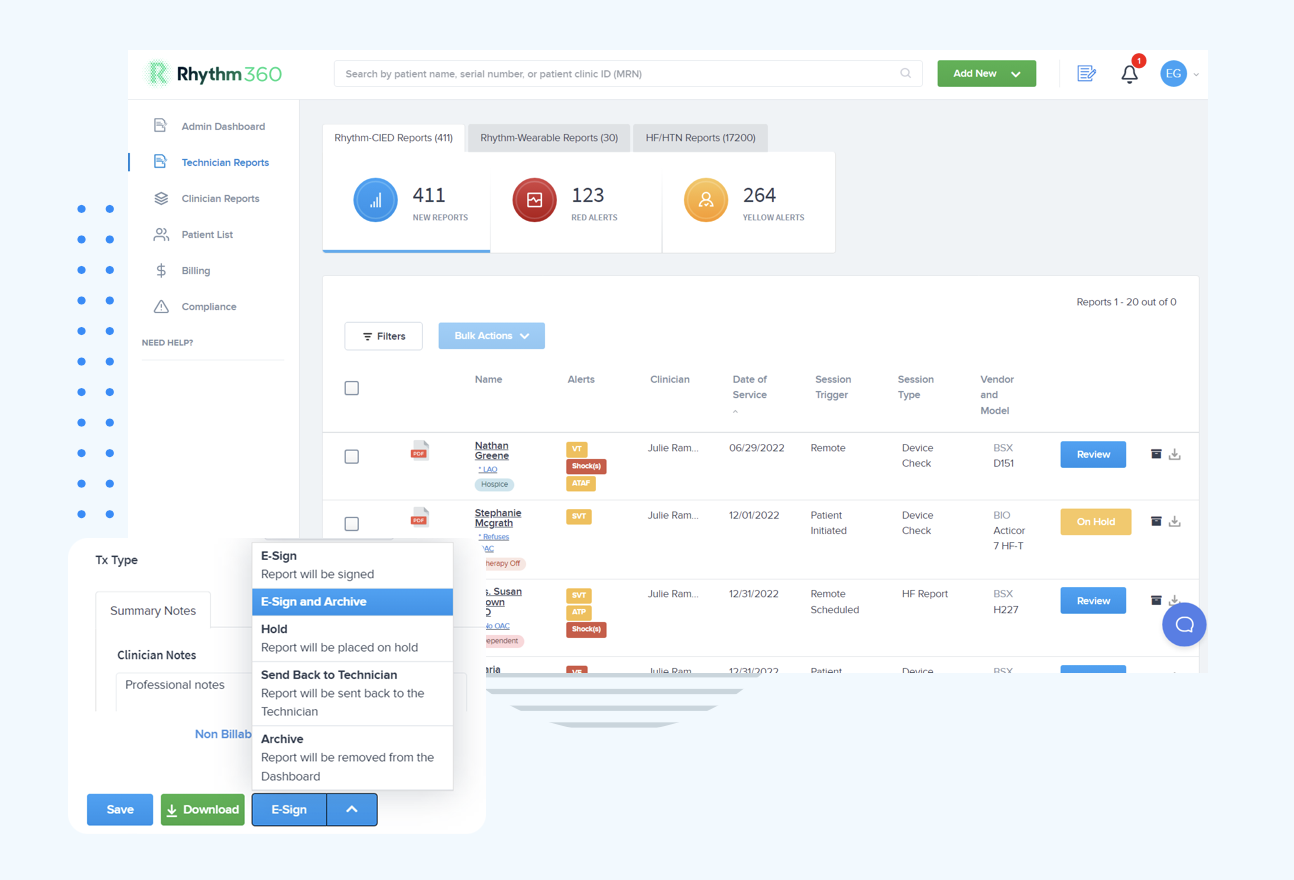
A vendor-neutral training program and a unified monitoring platform function as a single strategy, not separate investments. Training staff on rhythm recognition, alert triage, and CPT documentation delivers measurable results only when the platform supplies consistent, complete data across all OEM devices. Fragmented portals weaken even highly trained staff by creating data gaps, duplicate workflows, and inconsistent audit trails.
UCM’s post-implementation experience confirms this relationship. Dr. Upadhyay observed, “We have improved billing and accountability for our patients after the integration.” That improvement required trained personnel and a platform that reliably surfaced actionable data.
Clinics that align their 2026 CE planning, including CDRMS and CCDS pathways and HRS-accredited modules, with a single cloud platform that automates CPT capture, filters nonactionable alerts, and integrates bidirectionally with Epic, Cerner, and other EHRs can protect patient safety and recover revenue at the same time. The alternative, which relies on fragmented portals, informal OEM-specific training, and manual billing workflows, creates compounding clinical and financial risk that no individual staff member can absorb.
Vendor-neutral CIED staff training is a structured education program that teaches device monitoring personnel to review, triage, and document transmissions from all major cardiac device manufacturers, including Medtronic, Boston Scientific, Abbott, and Biotronik, using a single set of clinical competencies and workflows. This approach matters in 2026 because most cardiology practices implant devices from multiple manufacturers at the same time. OEM-specific academies train staff on one portal at a time and leave gaps when a patient’s device comes from a different manufacturer. A vendor-neutral program, delivered through a unified platform, supports consistent competency regardless of device brand and removes the portal-switching burden that drives staff burnout and missed alerts.
The three CPT codes most relevant to remote CIED monitoring programs are 93298 for remote monitoring data analysis for pacemakers, 93299 for remote monitoring data analysis for ICDs and CRT devices, and 99454 for remote physiologic monitoring device supply and daily transmission. Each code requires specific documentation elements. A physician or qualified non-physician practitioner must review and sign the report, staff must record the transmission date and data completeness, and the clinical findings must appear in the patient record with a time stamp. Staff training should include simulated documentation exercises for each code type, and the monitoring platform should generate audit-ready records that match these billing requirements. Gaps in any of these elements often cause claim rejections and revenue leakage in CIED programs.
Cardiac device specialists should complete continuing education hours on a regular schedule to satisfy recertification requirements and maintain current clinical competency. The Heart Rhythm Society offers accredited CE and maintenance of certification points through its Board Review Course and, beginning fall 2026, through the Heart Rhythm ONE platform. Specialists pursuing or maintaining the IBHRE CDRMS credential must also show ongoing proficiency across the five CDRMS competency domains: Rhythm Recognition, Device and Lead Function, Remote Service Management, Diagnostic Monitoring, and Device Technology. Clinics should build annual CE scheduling into their training calendar and track completion through the monitoring platform’s administrative dashboard so no staff member falls out of compliance.
AI-powered alert triage changes training requirements in two main ways. First, staff must understand how the platform’s prioritization logic works, including which alert categories the system filters as nonactionable and which it escalates, so they can validate outputs instead of accepting them passively. Second, because AI triage reduces the volume of low-priority notifications, staff can spend training time on high-acuity scenarios such as new-onset atrial fibrillation, ventricular tachycardia, lead integrity failures, and ERI or RRT battery events. Training programs should include simulated critical-alert exercises that mirror the AI-prioritized queue so staff can respond appropriately when the platform flags a clinically significant event. Rhythm360’s AI-powered system reaches greater than 99.9% data transmissibility through redundant feeds and computer vision, which gives trained staff a reliable data foundation for every triage decision.
The IBHRE CDRMS (Cardiac Device Remote Monitoring Specialist) credential validates competency specifically in remote patient monitoring for chronic cardiac disorders and fits staff whose primary role involves remote transmission review and alert triage. The CCDS (Certified Cardiac Device Specialist) is a higher-level credential that covers the full scope of cardiac device management, including in-person device programming and implant support. IBHRE does not encourage CCDS holders to also sit for the CDRMS, because the CCDS encompasses those competencies. Clinics should map each staff role to the right credential. Device technicians and monitoring nurses who focus on remote review are strong CDRMS candidates, while specialists involved in in-clinic programming and implant follow-up should pursue the CCDS pathway. A vendor-neutral training program should support both tracks within a single curriculum framework.





