

Last updated: July 13, 2026
Use this checklist as you compare platforms for your cardiology practice.
Interval rules determine when each remote monitoring CPT code becomes billable. Manual tracking of those windows is a primary source of denials.
CPT 93294 and 93295 each require a minimum 30-day monitoring period before the professional interpretation is billable. CPT 93298 covers remote interrogation device evaluation(s) for implantable loop recorder monitoring for a period of up to 30 days under Medicare. For RPM, the AMA’s 2026 CPT code set allows claims for physiologic parameter monitoring over 2–15 days within a 30-day period, replacing the prior minimum requirement of 16 days of data collection.
Manual tracking of these intervals across a multi-OEM device population produces two consistent failure modes. The first is missed billing windows: CIED remote monitoring transmissions received but not billed within the 90-day cycle are lost permanently. The second is frequency-limit denials: remote monitoring CPT codes 93295, 93296, and 93297 face frequent rejections due to frequency limits and device-type rules when documentation is incomplete or manually processed.
Automated billing cycle tracking eliminates both failure modes. The platform monitors each patient’s transmission calendar in real time, surfaces approaching billing windows, and flags documentation gaps before claims are submitted. This automation directly connects to revenue recovery for high-value codes that often go unbilled.
Revenue leakage from manual processes appears in practices of every size. A mid-sized cardiology practice can unknowingly lose substantial revenue each year from underpayments, denials, and missed charges. Cardiac remote monitoring remains one of the fastest-growing and most consistently underbilled revenue categories in cardiology.
CPT 93298 and 93299 cover technical and professional components for ILR and ICM monitoring. CPT 99454 covers device supply with daily recordings or programmed alert transmissions. Manual CPT documentation workflows commonly produce 99454 claims without the required days of transmissions in the 30-day window and 99457 claims lacking documented treatment management time.
Unified platforms recover these charges by automating the documentation chain. Transmission receipt is logged, interval thresholds are tracked, clinician review time is captured, and billing-ready documentation routes to the EHR and billing system without manual intervention. The annual revenue gap between point solutions and integrated platforms is $45,000–$63,000 for 100 patients, doubling at 200 patients.
Device clinics that manage patients with implants from more than one manufacturer face a structural data problem. Each OEM operates a separate, proprietary portal with its own data format, transmission schedule, and alert taxonomy. Current remote monitoring platforms for CIEDs differ substantially in technical architecture, data acquisition modalities, transmission systems, and alert algorithms, resulting in variable depth, frequency, and clinical relevance of information.
Achieving greater than 99.9% transmissibility across all OEMs requires more than API connections. Rhythm360 combines redundant data feeds, computer vision (OCR) for unstructured PDF parsing, and AI-powered extrapolation to normalize disparate data streams into a single source of truth. When an OEM server is unavailable, the redundant feed system acts as a fail-safe and prevents transmission gaps that would otherwise create billing and clinical blind spots.
A cross-manufacturer analysis of 2,659 rhythm episodes from 1,710 patients implanted with ICMs from Medtronic, Biotronik, Abbott, and Boston Scientific found that 32.9% of episodes from AI-equipped devices were non-actionable and 30.6% were indeterminate. Vendor-neutral normalization paired with AI-driven triage is therefore essential. Without this combination, clinicians reviewing raw multi-OEM feeds face an alert volume that is operationally unsustainable.
The table below summarizes Rhythm360’s documented capabilities.
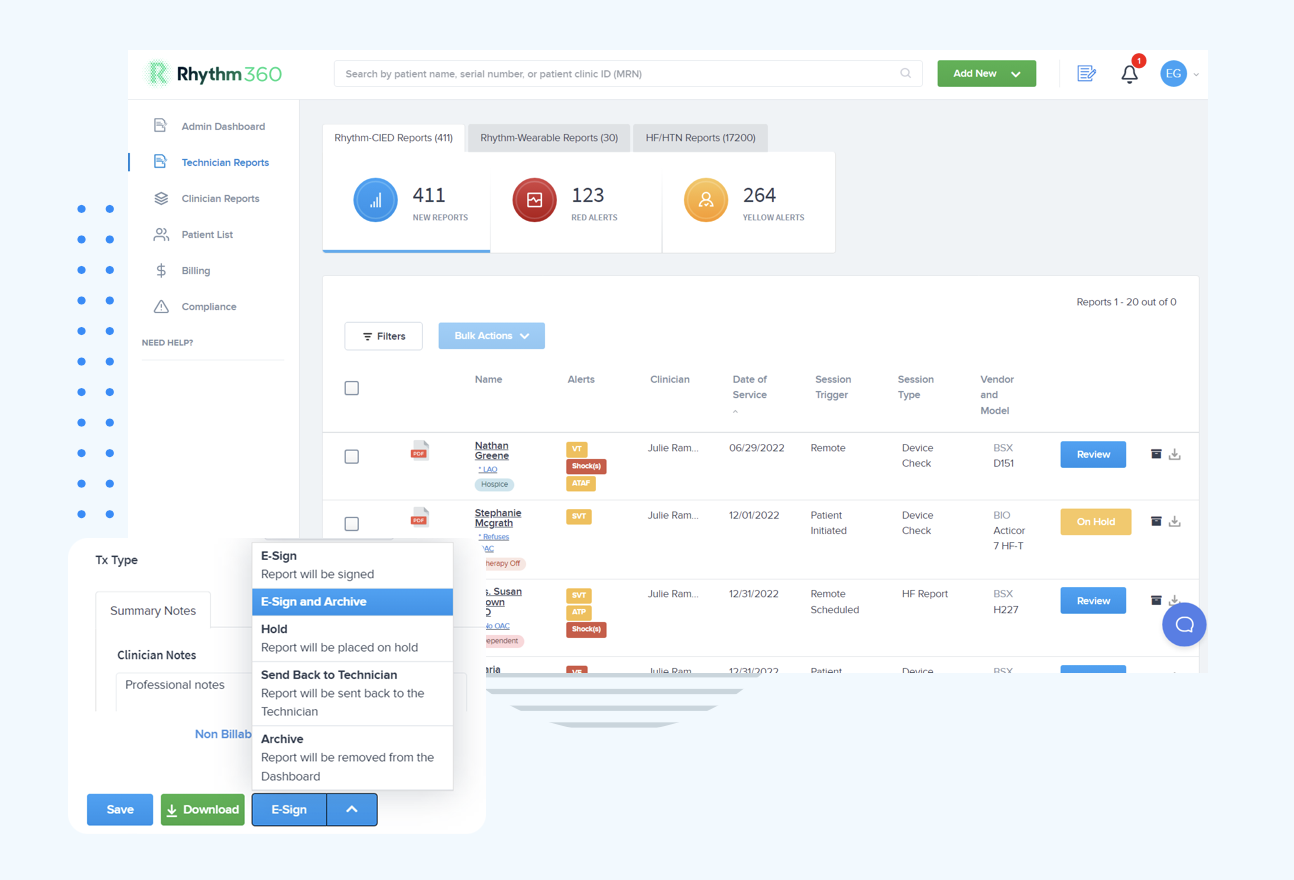
| Capability | Rhythm360 | Notes |
|---|---|---|
| Automated CPT tracking (93294–93298, 99454, 99457) | Yes, automated capture, interval monitoring, and billing-ready documentation generation | Manual workflows are a primary OIG audit trigger for 99454 and 99457 documentation gaps |
| Billing interval monitoring (30-day, 2–15-day windows) | Yes, real-time cycle tracking with alerts for approaching billing windows | Transmissions not billed within the 90-day cycle are permanently lost |
| EHR integrations (Epic, Cerner, athenahealth, eClinicalWorks) | Yes, bi-directional integration with onboarding in days to weeks | Eliminates the manual re-entry burden described in the checklist above |
| Mobile audit trails | Yes, HIPAA-compliant mobile app with timestamped transmission review, report signing, and communication logging | CMS 2026 guidance requires documented interactive communication logs for time-based RPM codes |
| AI-powered alert triage | Yes, filters non-actionable alerts and reduces critical response time by up to 80%, with optional 24/7/365 CCT oversight | AI-driven triage can reduce alert fatigue by up to 80% while maintaining 99.9% data reliability |
Rhythm360’s SaaS pricing model scales based on clinic size and platform usage. This structure keeps the platform accessible across the full spectrum of cardiology providers.
Solo EP clinics benefit most from removal of the multi-portal login burden and from automated CPT documentation that does not require a dedicated billing specialist. Onboarding in days to weeks means revenue capture improves quickly without a prolonged implementation disruption.
Mid-size cardiology groups gain a centralized dashboard that provides real-time visibility into patient compliance, critical alerts, and captured versus potential revenue across the entire device population. The platform reduces reliance on a single “super-user” by standardizing workflows that any trained staff member can execute.
Large integrated systems need proven volume-handling capacity. University of Chicago Medicine reviewed more than 73,000 reports annually through Rhythm360 in calendar year 2025. That scale, with stable dismissal rates, confirms the platform’s suitability for high-volume cardiology programs.
Consider a mid-size cardiology group managing 500 CIED patients across three OEMs. Before implementing a unified platform, device technicians log into three separate portals each morning, manually reconcile transmission data, and track billing intervals in spreadsheets. Alert volume is high, with the majority of transmissions non-actionable, as noted earlier, which creates fatigue and slows response to genuinely urgent events.
After implementing Rhythm360, AI-powered triage filters non-actionable transmissions and surfaces critical events such as new-onset atrial fibrillation, ventricular tachycardia, and low battery indicators. Prioritized notifications route to the on-call clinician’s mobile device, and critical response time drops by up to 80%. At the same time, automated CPT interval tracking captures previously missed 93298 and 99454 charges, and bi-directional EHR integration removes manual documentation steps. The combined effect of improved staff efficiency, recovered missed charges, and new RPM service lines for heart failure and hypertension patients produces revenue growth of up to 300%.
UCM’s implementation of Rhythm360 enabled clinicians to review more transmissions daily and identify more abnormalities, with the institution reporting, “We have improved billing and accountability for our patients after the integration.”
Request a revenue impact analysis specific to your practice’s device population and CPT mix.
Implementation complexity often becomes the most underestimated cost in cardiac remote monitoring software procurement. Poor EHR integration for remote patient monitoring programs can create substantial daily administrative burden per provider, duplicate patient records, unbilled services, and elevated claim denial rates due to disconnected data. A platform that requires months of integration work before delivering billing value extends the period of revenue leakage it was purchased to solve.
Training requirements vary significantly by platform architecture. Systems that consolidate multi-OEM data into a single dashboard reduce the training surface area compared with solutions that require staff to learn parallel workflows for different device types. Beyond initial training, this consolidation also mitigates business continuity risk, the “super-user” dependency that occurs when only one staff member understands the full workflow. Centralized platforms address this hidden cost by standardizing processes any qualified staff member can execute.
Ongoing maintenance costs include EHR version updates, OEM portal changes, and regulatory updates to CPT coding rules. CMS 2026 guidance on RPM and RTM billing has introduced new documentation standards that manual workflows cannot absorb without additional staff time. Platforms with automated compliance logic absorb regulatory changes at the software layer and avoid repeated retraining cycles.
The following conditions indicate that your practice is ready to evaluate Rhythm360.
If two or more of these conditions apply, the revenue leakage and compliance exposure your practice carries today likely exceeds the cost of a unified platform. Quantify your revenue gap and review implementation timelines for your specific EHR environment.
Manual CPT documentation in cardiac remote monitoring creates several active compliance risks under 2026 CMS guidance. Copy-paste notes, generic monthly summaries, and vendor-generated time logs without clinical context no longer qualify as sufficient documentation for RPM and RTM billing. Auditors assess whether documented time logically aligns with the volume and complexity of patient data reviewed, not just whether a numerical threshold was met. Common manual workflow failures include 99454 claims submitted without the required days of transmissions in the 30-day window, 99457 claims lacking documented treatment management time, missing interactive communication logs, and double-counting of CCM and RPM time in the same month. The OIG’s active audit under Project OAS-25-05-008 specifically targets these documentation patterns. Automated platforms address these risks by capturing time, transmission counts, and communication logs in real time and generating documentation that satisfies each element of the applicable CPT code’s requirements before the claim is submitted.
Revenue recovery varies by practice size, device population, and the number of CPT codes currently being missed or denied, but documented ranges are substantial. A mid-sized cardiology practice can unknowingly lose significant revenue annually from underpayments, denials, and missed charges. For RPM programs specifically, the annual revenue gap between point solutions and integrated platforms is $45,000–$63,000 for a 100-patient panel, doubling at 200 patients. Practices that add RPM service lines for heart failure and hypertension patients alongside CIED monitoring, and automate billing for both, have achieved revenue growth of up to 300% compared with their pre-platform baseline. The primary recovery mechanisms are capturing previously missed charges for codes like 93298, 93299, and 99454, reducing denials from incomplete documentation, and eliminating the 90-day billing window losses that occur when transmissions are received but not billed in time.
Rhythm360’s implementation process, including EHR integration setup, typically takes from a few days to a few weeks. The exact duration depends on the complexity of the practice’s existing EHR environment and device population. The platform supports bi-directional integration with Epic, Cerner, athenahealth, eClinicalWorks, Greenway Health, and additional systems via HL7. Data exchange uses API, HL7, XML, and PDF parsing via computer vision, which ensures compatibility across both modern FHIR-capable EHR instances and legacy HL7 v2 environments. During onboarding, the integration is configured to push billing-ready documentation directly into the clinical workflow and pull patient demographics, device type, and monitoring dates back into Rhythm360 without manual re-entry. Optional 24/7/365 oversight by certified cardiac technicians supervised by physicians can be activated as part of the service model and provides additional clinical support during and after the transition period.
Fragmented OEM portals, manual CPT interval tracking, and disconnected EHR workflows create measurable revenue leakage, audit exposure, and patient safety risk. The 2026 regulatory environment, with active OIG scrutiny of RPM billing and updated CMS documentation standards, has raised the cost of operating without automated compliance infrastructure.
Rhythm360 addresses these risks through a vendor-neutral architecture that normalizes multi-OEM CIED and RPM data at greater than 99.9% transmissibility, automates CPT code capture and interval tracking, and delivers bi-directional EHR integration that produces auditable documentation without manual re-entry. As Andrew Beaser, MD, Associate Professor of Medicine at University of Chicago Medicine, noted following UCM’s implementation, “Decision support, including AI-assisted decision support, will become increasingly important as data volumes grow.”
Practices that consolidate on a purpose-built platform recover missed charges, reduce denial rates, and free clinical staff to focus on patient care rather than portal navigation. See how Rhythm360 performs against your practice’s specific CPT mix, device population, and EHR environment.





