Last updated: July 13, 2026
The global remote cardiac monitoring market was valued at USD 3.80 billion in 2025, driven by rising cardiovascular disease prevalence, expanded home-based monitoring programs, and rapid adoption of cloud-based platforms. The CDC recorded 919,032 cardiovascular deaths in the US in 2023, which reinforces the clinical urgency behind continuous remote monitoring.
Device proliferation is outpacing administrative capacity. To illustrate the scale, device clinics process high volumes of transmissions annually, with nearly 60% of alerts often clinically non-relevant, and some clinics have seen significant growth in their device population. As soon as a practice implants devices from more than one manufacturer, including Medtronic, Boston Scientific, Abbott, Biotronik, and others, staff must log into separate, non-interoperable OEM portals to retrieve patient data, which fragments daily workflows.
The Heart Rhythm Society's white paper on CIED data interoperability notes that each manufacturer has developed proprietary nomenclature, technical standards, and communication protocols, and that traditional EHRs are not well suited to managing CIED data. These constraints create fragmented workflows, staffing strain, and missed critical events.
As Gaurav A. Upadhyay, MD, FACC, FHRS, Director of the Pacing & Defibrillation Device Clinic at the University of Chicago Medicine, observed, staffing pressure is constant: “Staffing was always an issue for our center, because our device clinic, like many other medical centers, had struggled with technician turnover and timely weekend coverage.”
Rhythm360 by RhythmScience serves as a vendor-neutral platform that consolidates CIED and chronic-condition data from all major OEMs into a single AI-powered workspace, which addresses data fragmentation, alert fatigue, and billing documentation at the same time.
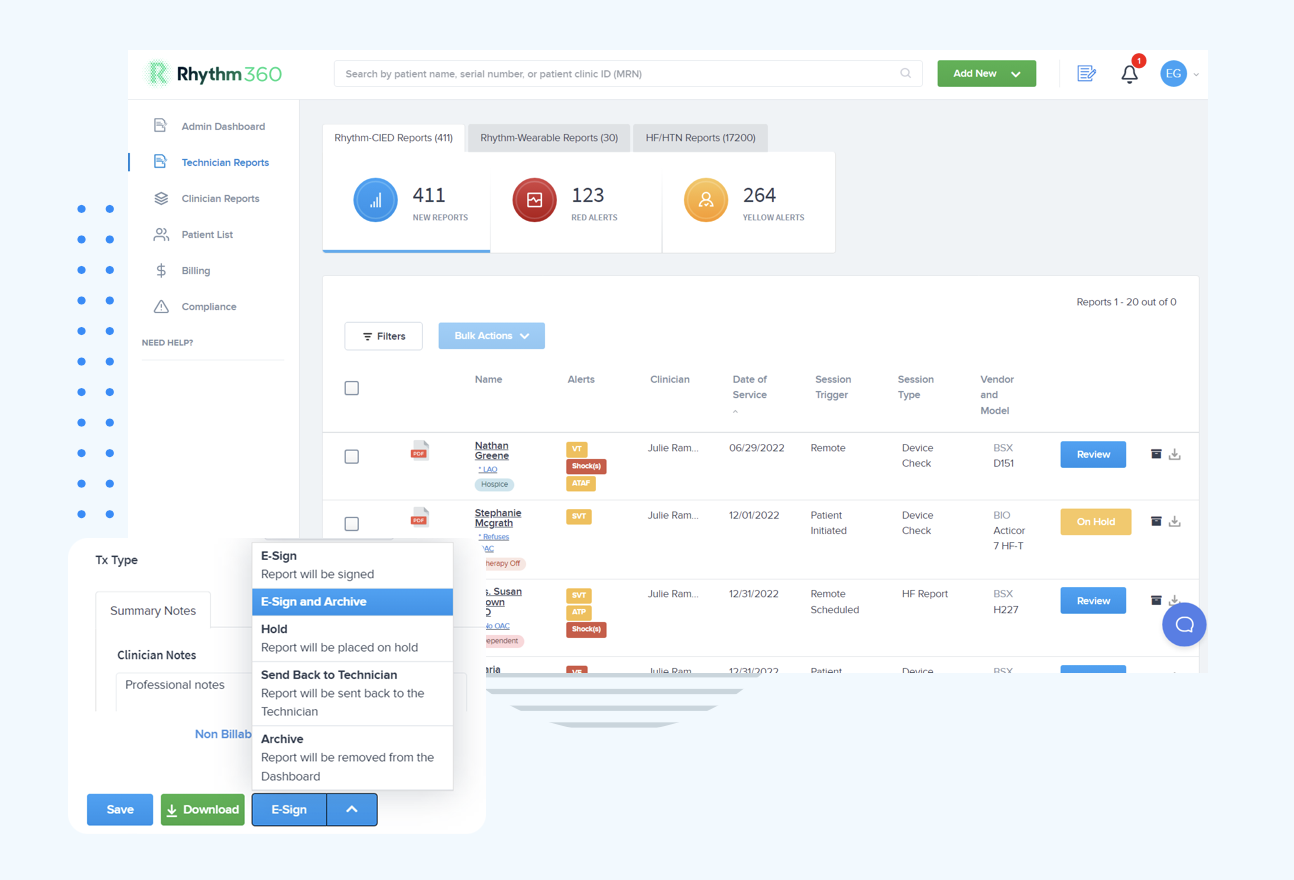
Rhythm360 ingests device transmissions through multiple data pathways so that no transmission is lost. The platform's data reliability architecture achieves greater than 99.9% transmissibility through AI-driven triage and redundant data feeds. This architecture explains how remote pacemaker and CIED monitoring deliver both clinical and operational value inside the platform.
The data ingestion workflow follows these steps:
The AI alert triage layer manages volume at scale. A cross-manufacturer analysis presented at the 2026 EHRA Congress found that even in AI-equipped implantable cardiac monitor devices, 32.9% of flagged episodes were non-actionable, which confirms the need for a manufacturer-agnostic triage layer that protects clinical team capacity.
As Andrew Beaser, MD, Associate Professor of Medicine at the University of Chicago Medicine, noted, decision support must keep pace with data growth: “Decision support, including AI-assisted decision support, will become increasingly important as data volumes grow.”
Rhythm360 also supports distinct but integrated service lines for Rhythm-CIED, including pacemakers, ICDs, ILRs, CRT/CCM devices, and CardioMEMS, and for chronic-condition RPM for heart failure and hypertension. This structure provides a centralized workspace for the full spectrum of cardiac monitoring needs.
Choosing a vendor-neutral platform instead of relying on individual OEM portals creates clear operational and financial advantages. Single-vendor portals provide no cross-manufacturer normalization, require separate logins for each device type, and produce siloed data that teams cannot review in aggregate. A vendor-neutral cardiac RPM platform removes redundant logins, standardizes data from all manufacturers, and enables population-level oversight from one dashboard.
The AI triage impact appears in measurable outcomes. Rhythm360 delivers a reduction in alert fatigue and an 80% reduction in critical alert response times. The transmissibility threshold described earlier, maintained even during OEM server outages, supports this faster response time.
The University of Chicago Medicine, after implementing Rhythm360, reviewed more than 73,000 reports annually, averaging more than 18,000 reports per quarter. These volumes demonstrate scalability in a high-volume academic setting.
The following table summarizes Rhythm360's capabilities across the dimensions most relevant to cardiology practice decision-makers.
| Capability | Rhythm360 (RhythmScience) |
|---|---|
| Data Sources | Vendor-neutral: Medtronic, Boston Scientific, Abbott, Biotronik, and others via API, HL7, XML, and computer-vision PDF parsing |
| AI Alert Triage | Reduction in non-actionable alert burden, with optional 24/7/365 CCT oversight |
| EHR Integration | Bi-directional with Epic, Cerner, Athenahealth, eClinicalWorks, Greenway Health, and others via HL7 |
| Billing Documentation | Automated CPT capture supporting 93294–93298, 99453, 99454, 99457, 99458, 99445, 99470; up to 300% revenue lift documented |
| Mobile Access | HIPAA-compliant mobile app for transmission review, report signing, and care coordination |
| Implementation Timeline | Days to a few weeks, including EHR integration setup |
Software-only models place the full monitoring burden on practice staff. Rhythm360 offers an optional service-supported model with certified cardiac technicians, supervised by physicians, who provide 24/7/365 triage coverage. This coverage becomes a critical differentiator for practices managing weekend and after-hours transmission volumes.
Schedule a demo to compare Rhythm360's vendor-neutral architecture and AI triage with your current workflow.
Rhythm360 delivers an efficient implementation timeline that includes EHR integration setup. This speed is possible because Rhythm360 arrives with pre-built connectors for Epic, Cerner, Athenahealth, eClinicalWorks, and Greenway Health.
Best practices for managing remote patient data in cardiology during implementation follow a logical sequence. First, conduct a pre-go-live audit of all active device manufacturers and patient counts to confirm data feed coverage, which creates a baseline inventory. Next, validate bi-directional EHR integration with a test patient cohort before full enrollment, using the audit data to select representative test cases. In parallel, designate a clinical champion, as the AMA's RPM Playbook identifies a strong physician champion as a significant predictor of implementation success.
After these steps, complete structured staff training that covers alert thresholds, escalation protocols, and CPT documentation standards. A 1–2 week training program gets new monitors productive quickly with defined protocols. Then run a pilot cohort before full-scale enrollment to validate alert configurations and documentation workflows. Finally, schedule a quarterly optimization review so the team can recalibrate alert thresholds and CPT capture rates as patient volume grows.
The interoperability challenges outlined earlier, including proprietary nomenclature and non-standard protocols, explain why Rhythm360's pre-built, tested connectors reduce the burden on practice IT teams. As Gaurav A. Upadhyay, MD, at UCM, stated, integrated review matters: “That was a big piece for us, to have an integrated review of data from trained personnel.”
Alert fatigue is the most operationally damaging risk in cardiac RPM programs. Niraj Varma, MD, PhD, Professor of Medicine and Consultant Electrophysiologist at the Cleveland Clinic, identified false-positive alerts as one of the biggest operational challenges in remote cardiac monitoring, and he noted that even devices equipped with manufacturer AI algorithms still generate a substantial number of non-actionable alerts. Without a secondary triage layer, clinical teams face unsustainable alert volumes.
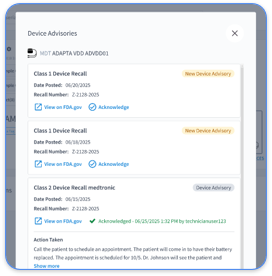
Missed transmissions create a direct patient safety risk. Shannon Sorescu, Certified Cardiac Device Specialist at Emory University Hospital Midtown, noted that relying on a manual process to track device advisories puts patients at risk. By using an automated platform, her team identified 7% more affected patients missing from manufacturer lists and cleared highest-risk patients within 24 hours.
Billing documentation gaps translate into immediate revenue risk. Vague documentation remains the leading cause of denials and audit findings for RPM claims in 2026 under Medicare billing rules. The 2026 CPT code set, including new codes 99445 and 99470, requires precise day counts and time logs. Practices without automated documentation tools face both under-billing and audit liability.
HIPAA compliance risks also escalate when platforms lack redundancy or complete audit trails. Rhythm360 maintains a full audit trail for all transmissions, communications, and clinician actions within each patient record, which supports compliance documentation and payer audit defense.
Defining success metrics before go-live enables objective quarterly reviews. The primary metrics for a cardiac RPM analytics platform include the following measures.
Cardiac RPM billing automation tracking within Rhythm360 monitors billable events in real time, flags incomplete documentation before claim submission, and surfaces revenue opportunities from newly eligible patients under the 2026 CPT expansions. Combining RPM and CCM codes can support additional monthly Medicare reimbursement per patient. Quarterly optimization reviews then recalibrate alert thresholds, staffing ratios, and CPT workflows as patient volume grows.
Rhythm360 is vendor-neutral and supports all major CIED manufacturers, including Medtronic, Boston Scientific, Abbott, and Biotronik, as well as specialized sensors such as CardioMEMS pulmonary artery monitors. Data flows into the platform via APIs, HL7, XML, and computer-vision PDF parsing, then normalizes into a single patient record. Practices no longer need to maintain separate OEM portal logins or reconcile conflicting data formats across manufacturers.
Rhythm360's AI triage engine classifies each incoming transmission by clinical priority and filters non-actionable alerts before they reach clinical staff. This approach achieves the alert reduction described earlier while maintaining greater than 99.9% data transmissibility through redundant feeds. For practices that require additional coverage, an optional 24/7/365 service layer staffed by certified cardiac technicians and supervised by physicians provides a human review checkpoint for prioritized alerts, which ensures that events such as new-onset AFib or ventricular tachycardia on a weekend receive same-day attention.
Rhythm360 automates documentation for the full range of cardiac remote monitoring CPT codes, including 93294, 93295, 93296, 93297, and 93298 for CIED monitoring, and 99453, 99454, 99457, 99458, 99445, and 99470 for chronic-condition RPM. The 2026 CMS Physician Fee Schedule introduced new codes 99445 (device supply for 2–15 days, reimbursed at a national average of approximately $47 per 30-day period) and 99470 (first 10–19 minutes of management time, approximately $26 per month), which close billing gaps for lower-adherence patients. Rhythm360's automated documentation tracks monitoring periods, day counts, and clinician time logs to support clean claim submission and reduce denial risk from vague documentation.
Rhythm360 offers bi-directional integration with Epic, Cerner, Athenahealth, eClinicalWorks, Greenway Health, and additional systems via HL7. Bi-directional integration means patient data flows into the EHR automatically, and clinician actions within Rhythm360 appear in the patient record without manual transcription. This structure removes the documentation burden identified by the HRS as a primary source of error in CIED data management. Integration setup is included in the onboarding process, which typically completes within days to a few weeks.
Rhythm360's implementation timeline runs from a few days to a few weeks, including EHR integration configuration. The onboarding sequence covers practice configuration, EHR integration setup, patient population import, alert threshold calibration, and staff training. A structured 1–2 week training program covers platform navigation, alert escalation protocols, CPT documentation standards, and HIPAA compliance requirements. Rhythm360 also offers an optional service-supported model in which RhythmScience's clinical team handles monitoring and triage under the supervising provider's direction, which allows practices to go live without immediately expanding internal headcount.
Schedule a demo to walk through the onboarding process and see Rhythm360's dashboard configured for your device population.
When evaluating a cardiac remote patient monitoring analytics platform, focus on criteria that most directly affect clinical outcomes and financial performance. These criteria include vendor neutrality across all active device manufacturers, AI triage performance measured by alert reduction and sensitivity, EHR integration depth and bidirectionality, billing documentation automation aligned to 2026 CPT requirements, implementation speed, and documented outcomes from comparable practice settings. Applying this framework consistently across platform options produces a defensible, outcome-focused selection decision.