Last updated: July 14, 2026
Unify your CIED and HF/HTN data in one platform built for 2026 CMS compliance and recover revenue manual processes leave behind.
CMS finalized two new RPM CPT codes effective January 1, 2026: 99445 and 99470. These codes lower the prior 16-day and 20-minute billing thresholds. Patients who transmit data on fewer days or need shorter clinical staff engagement now qualify for reimbursement that was previously unavailable.
For cardiology practices specifically, the codes that matter most are 99445, 99454, and the device interrogation codes 93294 through 93299. The table below breaks down the full 2026 RPM and cardiac device code set, including reimbursement rates.
| CPT Code | Description | 2026 Status | National Avg. Reimbursement |
|---|---|---|---|
| 99453 | Initial device setup and patient education (one-time per device) | Unchanged | ~$19–$22 |
| 99445 | Device supply and data transmission, 2–15 days per 30-day period | New for 2026 | ~$47–$52/month |
| 99454 | Device supply, 16+ days of data per 30-day period | Unchanged | ~$47–$52/month |
| 99470 | Treatment management, first 10–19 minutes per month (mutually exclusive with 99457) | New for 2026 | ~$26/month |
| 99457 | Treatment management, first 20 minutes per month | Unchanged | $51.77/month under the 2026 CMS PFS |
| 99458 | Treatment management, each additional 20-minute increment | Unchanged | ~$41/increment |
| 93294 | Remote pacemaker interrogation, requires 30-day minimum monitoring period | Unchanged | Varies by locality |
| 93295 | Remote ICD interrogation (single/dual-chamber, CRT-D), requires 30-day minimum | Unchanged | Varies by locality |
| 93297 | ILR/ICM remote interpretation, no 30-day minimum required | Unchanged | Varies by locality |
| 93298 | CardioMEMS hemodynamic monitor remote monitoring; 2026 allows 2–15 day billing window | Minimum period reduced | Varies by locality |
| 93299 | Technical component for CIED remote monitoring services | Unchanged | Varies by locality |
CPT 99454 still requires 16 or more days of data transmission within a 30-day billing period. CPT 99445 creates a parallel pathway for patients who transmit on 2 to 15 days. Practices can now capture reimbursement that was previously forfeited entirely. The two codes are mutually exclusive, so only one may be billed per patient per 30-day period. Practices must wait until each billing period ends to determine which code applies.
Documentation must show the number of transmission days within the reporting period to justify the code selected. Vague entries that skip transmission details can create audit liability under the 2026 CMS Physician Fee Schedule guidance.
Failure to meet the 16-day minimum is the single most common cause of Medicare 99454 denials. Manual tracking across multiple OEM portals makes this threshold hard to monitor reliably at scale, especially for practices managing hundreds of devices.
Rhythm360 solves this with a multi-layer data ingestion architecture. The platform ingests data via API, HL7, XML, and unstructured PDF parsing using computer vision and AI extrapolation. A redundant data feed system acts as a fail-safe during OEM server downtime, keeping transmissibility above 99.9% across the patient population. Staff see real-time transmission day counts per patient, so they can identify anyone approaching the 16-day threshold before the billing period closes.
When a patient falls short of 16 days, the billing code shifts from 99454 to 99445, a code that still generates reimbursement rather than triggering a denial. Automated alerts should flag patients falling short by day 10 so staff can re-engage before the period closes. Rhythm360's dashboard surfaces these at-risk patients automatically. Staff can then intervene through the platform's integrated Twilio-powered patient messaging before the billing period ends.
RPM claims often face initial denials due to documentation or coding issues. For cardiology practices, the financial impact compounds quickly across a large CIED population.
Cardiac device codes carry their own additional risks:
Automated compliance monitoring catches violations, such as sub-16-day transmission counts, before claims submission. That prevents denials instead of managing them after the fact. Rhythm360 generates automated reports with timestamped transmission logs, device identifiers, and clinical staff time records that meet CMS documentation standards and support fast audit response. University of Chicago Medicine reported improved billing and accountability after integrating Rhythm360.
The denial risks above often trace back to a structural problem: practices that implant devices from multiple manufacturers, such as Medtronic, Boston Scientific, Abbott, and Biotronik, must juggle separate, non-interoperable portals. Staff log into each system individually, reconcile conflicting data formats, and manually transfer information into the EHR. Every extra login and manual transfer adds another chance for the documentation gaps described in the previous section.
Rhythm360 removes that friction with a vendor-neutral approach. It consolidates all CIED and HF/HTN data, regardless of manufacturer, into a single compliance dashboard, replacing the five-portal routine with one login and one record per patient.
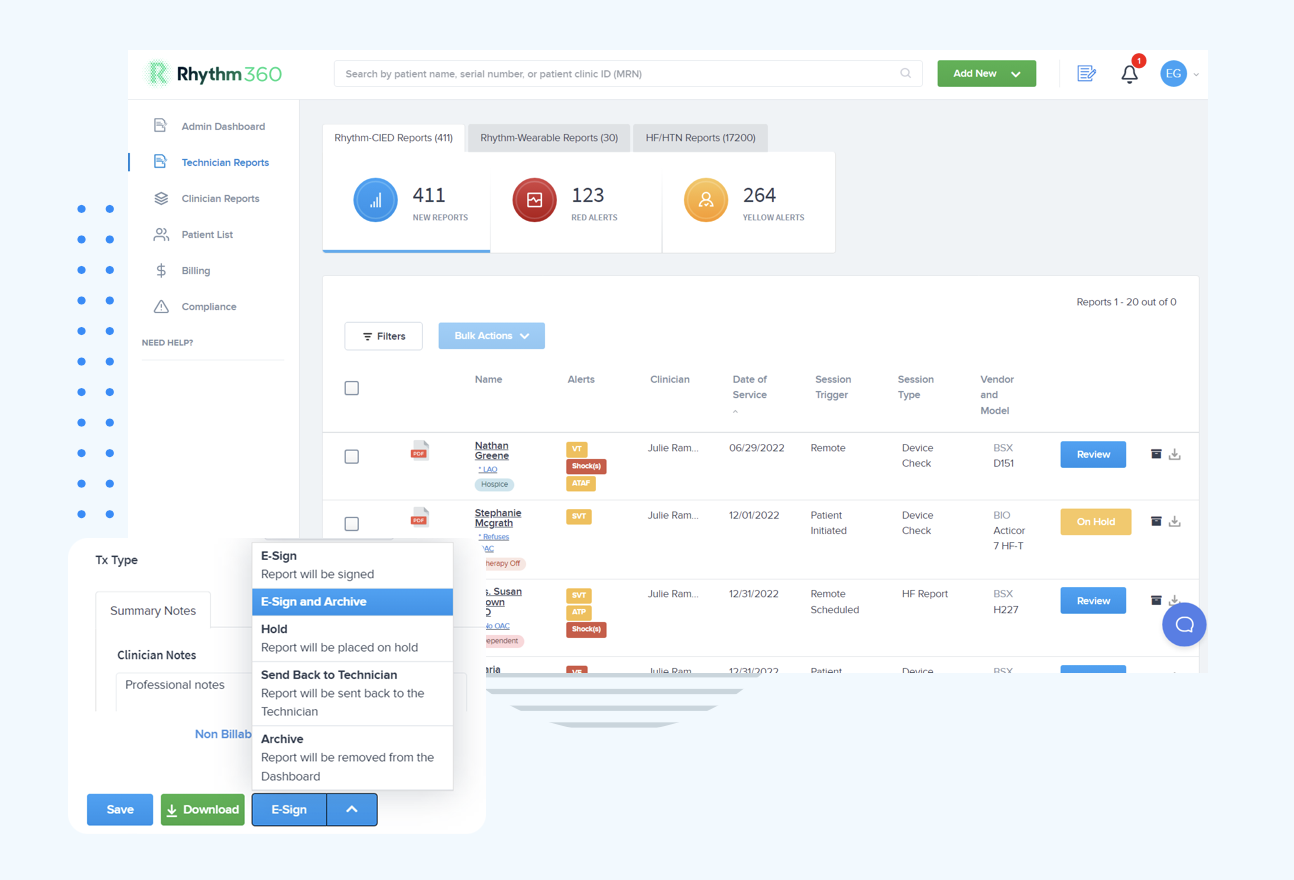
Rhythm360 connects to all major device manufacturers through API, HL7, XML, and computer-vision-based PDF parsing. Data from every device type, including pacemakers, ICDs, implantable loop recorders, CRT devices, CCM devices, and CardioMEMS pulmonary artery monitors, normalizes into a single patient record. Bi-directional integration with Epic, Cerner, Athenahealth, eClinicalWorks, Greenway Health, and other EHR systems eliminates manual transcription and keeps the EHR current without duplicate data entry.
See the unified dashboard in action during a live cardiology workflow walkthrough.
Consolidating device feeds solves the data problem, but high alert volume creates a separate challenge: alert fatigue. University of Chicago Medicine managed more than 73,000 reports annually through Rhythm360 in 2025, averaging over 18,000 reports per quarter. At that volume, manual triage without AI prioritization creates workloads staff cannot sustain.
Rhythm360's AI-powered alert triage filters non-actionable transmissions and surfaces clinically significant events, including new-onset atrial fibrillation, ventricular tachycardia, lead malfunction, ERI/RRT indicators, and significant weight gain in HF patients, for immediate review. The platform also offers optional 24/7/365 oversight by certified cardiac technicians supervised by physicians. This triage system drives the 80% reduction in critical alert response times, a result Andrew Beaser, MD, Associate Professor of Medicine at UCM, attributes to clinicians reviewing more transmissions daily and catching more abnormalities. As report volumes keep growing, he expects AI-assisted decision support to become even more central to sustaining that pace.
Consistent CIED billing compliance depends on data moving accurately between the monitoring platform and the EHR. Rhythm360's bi-directional integration follows six steps:
That same integration carries over into onboarding. New practices follow a similar sequence when they first connect their systems to Rhythm360.
Implementation, including EHR integration, typically completes in a few days to a few weeks. The onboarding sequence follows these steps:
The steps above translate into measurable results. The table below shows performance metrics reported by RhythmScience and validated through client implementations, covering the same compliance and revenue themes discussed throughout this article.
| Metric | Rhythm360 Performance | Clinical / Financial Impact | Access Method |
|---|---|---|---|
| Data transmissibility | >99.9% | Near-elimination of missed transmissions due to OEM server downtime | Redundant data feeds + computer vision ingestion |
| Critical alert response time reduction | 80% faster | Earlier intervention for AFib, VT, lead malfunction, and HF decompensation | AI-powered alert triage + optional CCT oversight |
| Revenue improvement | Up to 300% increase | Recovery of previously lost CPT code revenue through automated billing documentation | Automated CPT capture + unified compliance dashboard |
| Mobile access | Full platform access via HIPAA-compliant mobile app | Clinicians review transmissions, sign reports, and coordinate care from any location | iOS/Android secure mobile application |
Practices using automated transmission tracking show improved adherence to transmission requirements and higher billing capture rates for eligible codes. Automation also reduces chronic care claim denials by improving verification and documentation compliance.
Rhythm360 gives cardiology practices a single source of truth for managing CIEDs and chronic conditions together. By consolidating every OEM data feed, automating 16-day transmission tracking, enforcing 2026 CPT code logic, and integrating bi-directionally with major EHR systems, the platform removes the administrative overhead and revenue leakage that fragmented workflows produce.
Talk to our team about positioning your practice for full 2026 CMS compliance while recovering revenue manual processes leave behind.
Yes. Rhythm360 provides distinct but integrated service lines for Rhythm-CIED, covering pacemakers, ICDs, implantable loop recorders, CRT devices, and CardioMEMS monitors, and for HF/HTN remote physiological monitoring. Both service lines run within the same vendor-neutral dashboard, so staff manage rhythm disorders, heart failure, and hypertension patients without switching systems. CPT codes for both categories, including 93294–93299 for cardiac device interrogation and 99445, 99454, 99457, 99458, and 99470 for remote physiological monitoring, are tracked within a single compliance workflow.
Rhythm360 tracks transmission day counts in real time for every enrolled patient against the 30-day billing period. The dashboard flags patients at risk of falling below the 16-day threshold before the period closes, giving staff time to re-engage them through the platform's integrated messaging tools. When a patient transmits on 2 to 15 days rather than 16 or more, the platform automatically applies CPT 99445 instead of 99454, so the practice captures available reimbursement instead of submitting a claim that will be denied. All transmission dates are logged with timestamps to satisfy CMS documentation requirements for both codes.
Rhythm360 includes a HIPAA-compliant mobile app that provides full platform access from any location. Clinicians review device transmissions, triage AI-prioritized alerts, sign reports, and coordinate care directly from their phones. This matters most for critical events, such as new-onset atrial fibrillation or ventricular tachycardia flagged on a weekend, where a delayed response raises patient risk. The mobile app maintains the same audit trail and documentation standards as the desktop platform.
As shown in the benchmarks above, revenue gains have reached as high as 300% for some practices, driven by optimized CPT code capture, improved staff efficiency, and new recurring revenue from added HF/HTN RPM service lines. University of Chicago Medicine, mentioned earlier for its high-volume reporting workload, also reported improved billing and accountability after integration. Automated CPT code documentation reduces the manual burden on billing staff and catches eligibility gaps before claims submission, closing the revenue leakage that fragmented OEM portal workflows typically produce. Individual results vary based on patient population size, payer mix, and prior billing practices.