

See How Rhythm360 Unifies Your Device Data
A device clinic lead at a multi-vendor cardiology practice faces a specific operational question about daily workflow. The team wants to know whether a mobile monitoring layer can replace the routine of logging into separate, non-interoperable portals for Medtronic, Abbott, Boston Scientific, and Biotronik.
The search term “cardiac tech mobile monitoring app” creates confusion immediately because it is genuinely ambiguous. Google surfaces patient-support pages from OEM manufacturers, and ChatGPT often treats it as a software development query. This guide focuses on apps that clinicians and patients actually use in clinical practice and excludes developer-focused content.
The fragmentation problem is structural and shows up in daily work. Staff log into many vendor portals to register patients, check study status, or retrieve final reports, which pulls time away from complex cases and direct patient care. Industry analysis confirms the scale of the issue: the lack of a unified data management system spanning all device vendors and device types is the single biggest roadblock to efficient ambulatory cardiac monitoring management.
A cardiac tech mobile monitoring app is software that connects a smartphone or tablet to an implanted cardiac device or external sensor and transmits rhythm and physiologic data to a clinical team for review. Two functional classes exist in practice.
A practice running Medtronic, Abbott, and Boston Scientific devices simultaneously needs both classes. Patient-facing apps handle the transmission leg. A clinician-facing platform handles aggregation, triage, documentation, and billing. Single-OEM apps function as patient endpoints and do not serve as practice infrastructure.
Medtronic’s MyCareLink Heart mobile app uses a smartphone or tablet to automatically transfer implant data via Bluetooth from the LINQ II insertable cardiac monitor to the CareLink network. Clinicians review that data on a secure website. The app works outside the home when cellular or Wi-Fi service is available.
Clinicians can receive the same general implant information available from an in-office interrogation, including a current 30-second high-resolution intracardiac EKG plus stored parameters, events, and alerts. The LINQ II ICM is designed to detect abnormal heart rhythms for up to 4.5 years, which supports long-term surveillance.
Abbott’s myMerlin and myMerlinPulse apps serve patients implanted with Abbott cardiac devices and transmit device data to Abbott’s Merlin.net portal for clinician review.
MyMerlin is Abbott’s standard patient app for its Bluetooth-enabled insertable cardiac monitors (ICMs). It supports automatic scheduled transmissions and manual symptom recordings to the Merlin.net Patient Care Network. MyMerlinPulse is designed for Abbott’s Bluetooth-enabled implantable cardioverter defibrillators (ICDs) and cardiac resynchronization therapy defibrillators (CRT-Ds), including the Gallant, Entrant, and Neutrino NxT devices.
Both apps are patient-facing endpoints that transmit to Abbott’s proprietary portal rather than to a unified clinical workspace. Operationally, a practice running Medtronic and Abbott devices still logs into CareLink for one patient population and Merlin.net for another.
Boston Scientific’s LATITUDE remote monitoring system gives healthcare providers access to a patient’s implanted device data via a separate secure clinician website. That portal adds a third login to the rotation. Each portal is manufacturer-specific and does not interoperate with the others, which reinforces the portal-hopping problem.
Not every cardiac monitoring app connects to an implanted device. Portable EKG apps like KardiaMobile support symptom-triggered rhythm capture and introduce separate data-flow questions for practices already managing OEM portals.
AliveCor’s KardiaMobile is a single-lead ECG device with two electrodes. The user places two fingers from each hand on the electrodes to record an ECG during symptoms, and the trace transmits wirelessly to the KardiaMobile app before syncing to a secure cloud server. The Scottish Health Technologies Group (SHTG) found that significantly more people have AF detected using the KardiaMobile single-lead device compared with standard care, with the strongest evidence in people with undiagnosed palpitations and in people with a history of AF who need monitoring for AF recurrence.
KardiaMobile studies reported AF detection performance with sensitivity and specificity commonly around 92% to 99% and 92% to 98% per recorded ECG, depending on study design and reference standard. A 30-second tracing can be shared with a physician, which makes the device useful for spot-check documentation during symptomatic episodes such as palpitations or dizziness.
The triage decision for portable EKG remains straightforward. KardiaMobile is clinically sufficient for symptom correlation in patients with intermittent, recognizable palpitations and for AF recurrence surveillance in compliant, symptom-aware patients. Continuous monitoring, CIED interrogation, or heart failure physiologic monitoring require different modalities, particularly for patients who cannot reliably self-trigger, who have asymptomatic arrhythmias, or who need continuous rhythm surveillance.
Mobile cardiac telemetry (MCT) occupies a distinct clinical tier that rarely appears in standard search results despite its central role in arrhythmia diagnosis. MCT differs from device-tethered apps in a fundamental way because it follows a service-plus-app model rather than a clinic-owned infrastructure model.
Philips MCOT supports monitoring for up to 30 days and includes the MCOT device with the SmartDetect algorithm. The service includes an end-of-service report, technician ECG review, and urgent or emergent notification of detected cardiac events when appropriate. The monitoring center, not the practice, performs continuous review and escalation.
iRhythm’s ZioSuite pairs the Zio patch with a cloud-based analysis platform. Adhesive patch monitors such as the Zio Patch are water-resistant, wire-free, and designed for up to 14 days of continuous recording, which allows patients to shower and maintain normal routines with minimal disruption. ZioSuite delivers a physician report after the wear period ends.
MCT devices record a continuous ECG signal typically for 14 to 30 days, with onboard AI and algorithmic filters automatically identifying abnormal rhythm patterns and transmitting flagged events in real time via cellular network to a remote monitoring center staffed by trained cardiac technicians 24 hours a day, 7 days a week. MCT detects asymptomatic arrhythmias the patient never feels, including silent atrial fibrillation, which is a leading undiagnosed cause of cryptogenic stroke.
MCT service apps are prescribed diagnostic tools with their own billing pathway (CPT 93228/93229 for mobile cardiovascular telemetry). These services complement, rather than replace, the clinical platform a practice uses to manage its implanted device population.
Explore Rhythm360 for Multi-Vendor Monitoring
Multi-vendor device mixes create compounding operational consequences. Staff log into separate, non-interoperable portals to retrieve patient data, and those portals do not share information, so data silos form across them. A 2026 narrative review in Frontiers in Cardiovascular Medicine notes that remote monitoring programs require predefined alert hierarchies and response times and that data latency introduces bias because availability at the monitoring center may lag device detection due to connectivity issues or delays in review and escalation.
That fragmentation has clinical and financial consequences. Critical alerts such as new-onset atrial fibrillation, ventricular tachycardia, and low battery indicators can be missed when staff cycle through disconnected systems. Billing documentation fragments across portals, and billable events go uncaptured.
A 2026 multicentre observational study published in Cureus found that alert burden in implantable loop recorder services is highly concentrated, with 7% of patients generating more than 90% of all transmitted alerts. That pattern makes manual, portal-by-portal triage unsustainable at scale.
Rhythm360 by RhythmScience addresses this directly as a vendor-neutral platform that ingests and normalizes data from all major manufacturers, including Medtronic, Boston Scientific, Abbott, and Biotronik, via API, HL7, XML, and PDF parsing with computer vision. The result is a single clinical dashboard that consolidates the entire device population regardless of manufacturer.
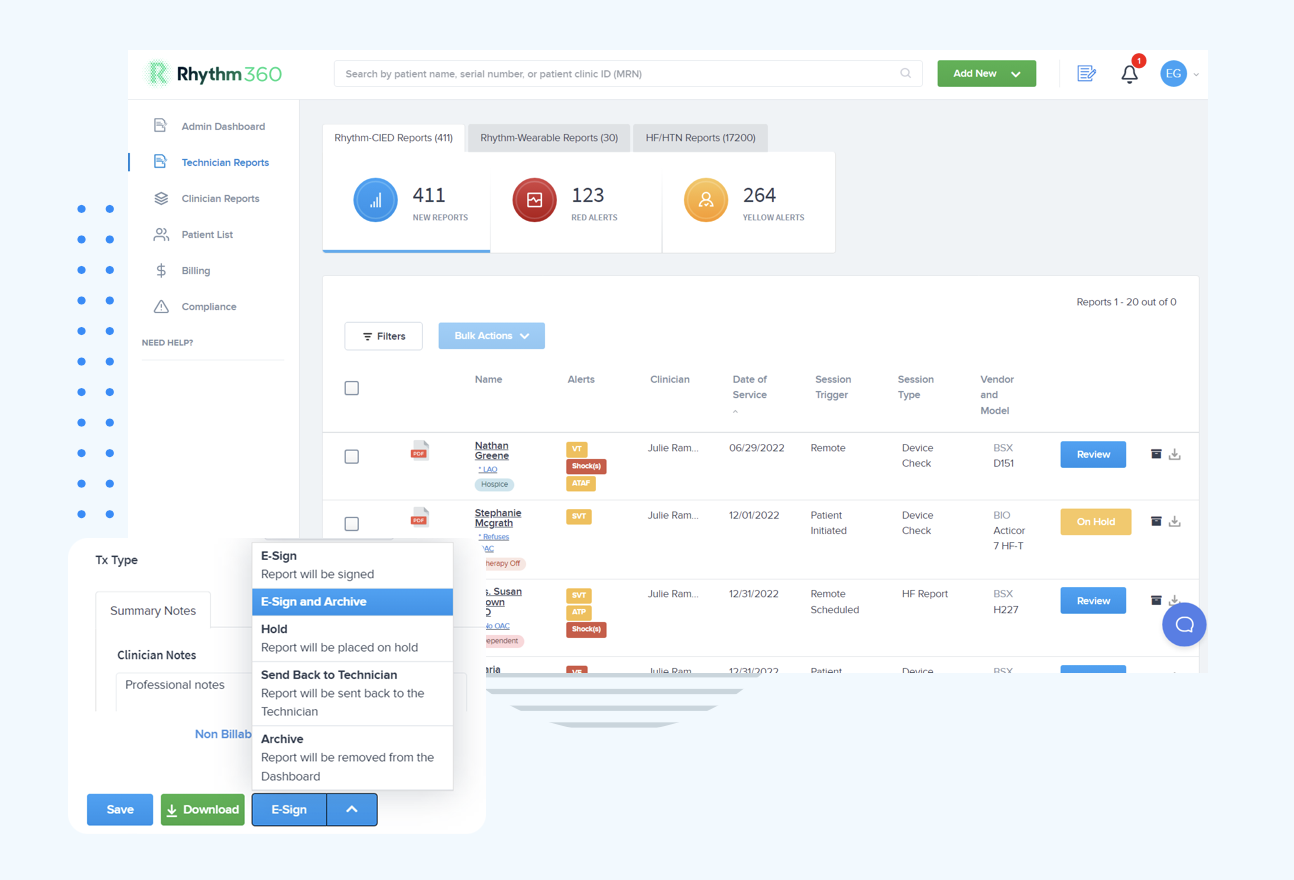
University of Chicago Medicine reviewed more than 73,000 reports annually through Rhythm360 in calendar year 2025, averaging more than 18,000 reports per quarter, which demonstrates the platform’s scalability in a high-volume, multi-vendor environment. As Andrew Beaser, MD, Associate Professor of Medicine at UCM, noted, “I am more likely to sign off on these while in meetings because I can easily access them on my phone.”
Other platforms in this space include Murj, Implicity, Rhythm Management Group, and Octagos. Rhythm360 delivers a unified, AI-powered workspace that eliminates portal-hopping, automates billing documentation, and provides mobile access for on-call clinicians, delivering the response-time and revenue improvements outlined in the Key Takeaways.
Device technicians hear the same patient questions repeatedly, and consistent answers support both safety and documentation. Clear responses also reinforce the workflows a monitoring platform must support.
The answer depends on the specific device and its components. The TelePatch Pendant and Electrode Patch are water resistant and designed to withstand brief periods of wetness such as light rain or showering, while the TelePatch handset is not water resistant and must be kept away from moisture.
For implantable devices such as the LINQ II ICM, the implant itself is subcutaneous and unaffected by showering. The MyCareLink Heart app transmits via Bluetooth and does not require the phone to be present during the shower. The technician’s instruction should specify which component is water-resistant and which is not, and the team should document that instruction in the patient record.
Wear duration for cardiac monitors ranges from 24 hours for a standard Holter monitor, up to 30 days for mobile cardiac outpatient telemetry, and 2 to 4 years for implantable loop recorders. Philips MCOT supports up to 30 days of continuous monitoring.
For implantable loop recorders, device-interrogation billing runs on a 30-day window under CPT 93298. The prescribing physician determines duration for external monitors. For implanted devices, the monitoring cycle continues until the device is explanted or the patient is discharged from monitoring.
Coverage depends on billing and documentation rather than on the app alone. Cardiac monitoring tests are covered by most insurance including Medicare, though patients remain responsible for any co-pays or deductibles.
The billable service depends on device type and monitoring duration. Remote physiologic monitoring device supply bills under CPT 99454 per 30-day period and requires a minimum of 16 days of transmitted data. Implantable loop recorder remote monitoring bills under CPT 93298 once per 30 days. Pacemaker and ICD remote interrogation bills under CPT 93294, 93295, or 93296 on a 90-day cycle. Documentation of the monitoring period, transmitted data days, and clinician review time must support each claim.
Holter monitoring is a short-term, continuous external recording typically worn for 24 to 48 hours. Standard Holter monitors do not provide real-time information, though some newer Holter devices use a companion smartphone app to wirelessly transmit ECG data.
The Holter recorder usually stores data locally and is returned to the clinic or lab for download and analysis. App-based monitoring applies more directly to MCT devices that transmit in real time via cellular or to implantable devices that transmit via Bluetooth to a companion app such as MyCareLink Heart. Patients who ask this question often describe palpitation symptoms that may be better evaluated with an MCT device or an event monitor, depending on symptom frequency and clinical risk.
Remote cardiac monitoring billing spans multiple CPT code families with different billing intervals. Teams must classify the device correctly before selecting the code family.
For pacemakers and ICDs on a 90-day billing cycle, CPT 93294 covers remote interrogation of pacemakers (professional component). CPT 93295 covers remote interrogation of ICDs (professional component). CPT 93296 is the technical code for pacemaker and ICD remote interrogation.
For physiologic monitors and loop recorders on a 30-day billing cycle, CPT 93297 covers remote monitoring of an implantable cardiovascular physiologic monitor such as CardioMEMS. It is device-specific to physiologic monitors and is billable once per 30 days. CPT 93298 covers remote monitoring of a subcutaneous cardiac rhythm monitor or implantable loop recorder. It is device-specific to rhythm monitors and is billable once per 30 days. Both codes can be billed global or split into professional (-26) and technical (-TC) components, and they represent distinct device categories.
For remote physiologic monitoring of chronic conditions, CPT 99454 covers device supply with daily recordings or programmed alerts per 30-day period and requires a minimum of 16 days of transmitted data. CPT 99457 covers the first 20 minutes of treatment management per calendar month, and CPT 99458 is the add-on for each additional 20 minutes. CPT 99454 and 99091 are excluded under 93297 and 93298 in the same period, so a patient whose loop recorder or pressure sensor is already being billed cannot also generate a home monitoring device supply claim in that same period.
Rhythm360 automatically tracks device-specific CPT pairings and billing cycles, which reduces documentation gaps that cause claim denials and missed revenue.
See Rhythm360’s Billing Automation in Action
Evaluating a cardiac monitoring platform for a multi-vendor practice centers on workflow fit rather than on a simple feature checklist. Seven dimensions guide that evaluation.
Consumer cardiac apps, including smartwatch ECG features and retail wellness monitors, do not function as primary monitoring tools for a cardiology practice. They do not meet the FDA medical device definition required for remote monitoring billing under CPT 99454, they lack the data transmissibility and audit trail required for compliant documentation, and they are not designed for the alert triage and escalation workflows that clinical monitoring requires.
Consumer apps may support patient engagement or preliminary symptom logging. They do not replace prescription-grade monitoring infrastructure.
A patient-facing single-OEM app cannot replace OEM portals because it functions as a portal endpoint that feeds one manufacturer’s system. A clinician-facing, vendor-neutral platform can replace the need to log into multiple OEM portals by aggregating and normalizing data from all manufacturers into a single workspace.
The OEM portals continue to exist and receive transmissions. The vendor-neutral platform sits above them and ingests their data so clinical staff interact with one system instead of four. That distinction shapes operations because the platform removes the need for staff to navigate OEM infrastructure directly.
A HIPAA-compliant cardiac monitoring app must encrypt ePHI at rest with AES-256 and in transit with TLS 1.2 or higher, with TLS 1.3 preferred. End-to-end encryption suits highly sensitive communications and complements required at-rest encryption.
The app must also implement the HIPAA Security Rule technical safeguard for access control (45 CFR 164.312(a)(1)), including role-based access control with least-privilege assignments so only authorized users can view electronic Protected Health Information (ePHI).
The platform must maintain an audit trail that records and examines all access to and clinical actions on ePHI, capturing at minimum who accessed the data, what action was taken, when, and which record was involved. OCR enforcement expects detailed fields such as user ID and role, action, resource type and ID, UTC timestamp, source IP and user agent, status code, and purpose-of-use, and the six-year retention requirement comes from § 164.316(b)(2)(i).
The platform must also execute Business Associate Agreements with every vendor or subprocessor that handles PHI. For a clinician-facing platform, this extends to the EHR integration layer, the alert notification system, and any mobile access component. Practices should verify that a platform’s HIPAA documentation covers all data pathways, not just the primary dashboard.
Onboarding timelines vary by practice size, EHR system, and the number of OEM data feeds being integrated. For Rhythm360, implementation, including EHR integration, typically takes a few days to a few weeks.
The critical path items include EHR integration configuration, OEM data feed activation, and staff training on the unified dashboard. Practices that previously attempted custom integrations for each vendor portal often find that a purpose-built vendor-neutral platform reduces total integration time and ongoing IT maintenance burden significantly.
A remote monitoring platform functions as practice infrastructure and provides software the clinic uses to manage its own patient population across device types and manufacturers. An MCT service such as Philips MCOT or iRhythm ZioSuite operates as a prescribed diagnostic service with a defined wear period, a monitoring center that performs the clinical review, and a report delivered to the ordering physician.
The practice does not operate the MCT monitoring center and instead orders the service and receives the report. A vendor-neutral platform like Rhythm360 can ingest MCT data alongside CIED data, but it serves a different function than the MCT service itself.
Cardiac tech mobile monitoring apps divide into two clear classes. Patient-facing single-OEM endpoints handle the transmission leg, and clinician-facing multi-vendor platforms handle aggregation, triage, documentation, and billing. Implantable device apps, portable EKG tools, and MCT services each serve a defined clinical purpose within the first class but do not resolve the portal-fragmentation problem that shapes multi-vendor practice operations.
The evaluation sequence for any practice running devices from more than one manufacturer starts with identifying the monitoring modality each patient requires. The next step is selecting a clinician-facing platform that remains vendor-neutral across all OEMs in use. The final step is confirming that the platform fits existing EHR workflows and billing documentation requirements.
Rhythm360 supports that sequence by consolidating all major manufacturer data into one HIPAA-compliant, AI-powered, mobile-accessible workspace that reduces alert response times and improves revenue capture while freeing staff from managing multiple portals.
Talk With Rhythm360 About Your Device Clinic Workflow





