

Last updated: July 14, 2026
The mobile cardiac telemetry systems market is projected to grow from USD 2.07 billion in 2026 to USD 3.84 billion by 2031 at a 13.17% CAGR, with software, including analytics, workflow orchestration, and billing documentation, accounting for most market value. The U.S. RPM market is also expanding and is projected to reach approximately $18.1 billion by 2026 at a 12.6% CAGR.
Most cardiology practices still rely on fragmented OEM portals and legacy on-premise databases. A 2025 survey of 190 U.S. medical billing companies found that 46% reported increasing denial rates, up from 28% in 2024, as payer utilization management algorithms grow more sophisticated. Many billing companies have not adopted AI and now operate at a structural disadvantage.
Regulatory pressure is rising at the same time. CMS's 2026 Physician Fee Schedule introduced new RPM billing codes CPT 99445 and 99470, which fill gaps that previously left low-adherence patients unbillable. The HHS Office of Inspector General has identified RPM as a service category vulnerable to improper billing, signaling heightened audit scrutiny. Vague documentation remains the leading cause of RPM claim denials and audit findings in 2026.
Other platforms operate in the cardiac monitoring software space. Rhythm360 by RhythmScience delivers a unified solution that combines vendor-neutral CIED data ingestion, AI-powered alert triage, automated CPT documentation, and bi-directional EHR integration in a single platform designed specifically for billing compliance.
Given these platform capabilities, practice administrators face a critical decision about how to automate. Before selecting a platform, they must evaluate a build-versus-buy strategy. Building internal automation requires dedicated engineering resources, ongoing maintenance, OEM API agreements, and compliance infrastructure, which rarely makes financial sense outside large health systems. Buying a purpose-built platform transfers that burden to a specialist vendor and usually delivers faster time-to-value.
Resource requirements for implementation are a common concern, but they fall into two categories. On the technical side, a well-designed platform should integrate with existing EHR workflows within days to weeks, not months. The more significant variable is organizational change management, because staff must learn new alert triage protocols, documentation standards, and billing thresholds before go-live.
ROI expectations should rely on documented benchmarks, not assumptions. Cardiology best-in-class practices often achieve denial rates under 5% and net collection rates above 95% compared to specialty averages. Remote cardiac monitoring for pacemakers, ICDs, and loop recorders is one of the most consistently underbilled service lines in cardiology. Practices with 200 or more device patients that are not actively billing the appropriate CIED codes every 90 days carry a recoverable revenue gap.
Practices that implement Rhythm360 report measurable ROI. They achieve faster critical alert response and higher revenue capture from accurate CPT billing while avoiding proportional increases in administrative headcount.
Rhythm360 addresses the core operational problem in cardiac telemetry billing: data fragmentation. The platform ingests transmission data from all major OEMs, including Medtronic, Boston Scientific, Abbott, Biotronik, and others, via API, HL7, XML, and computer-vision PDF parsing. This approach removes the need for staff to log into separate portals and manually reconcile conflicting data.
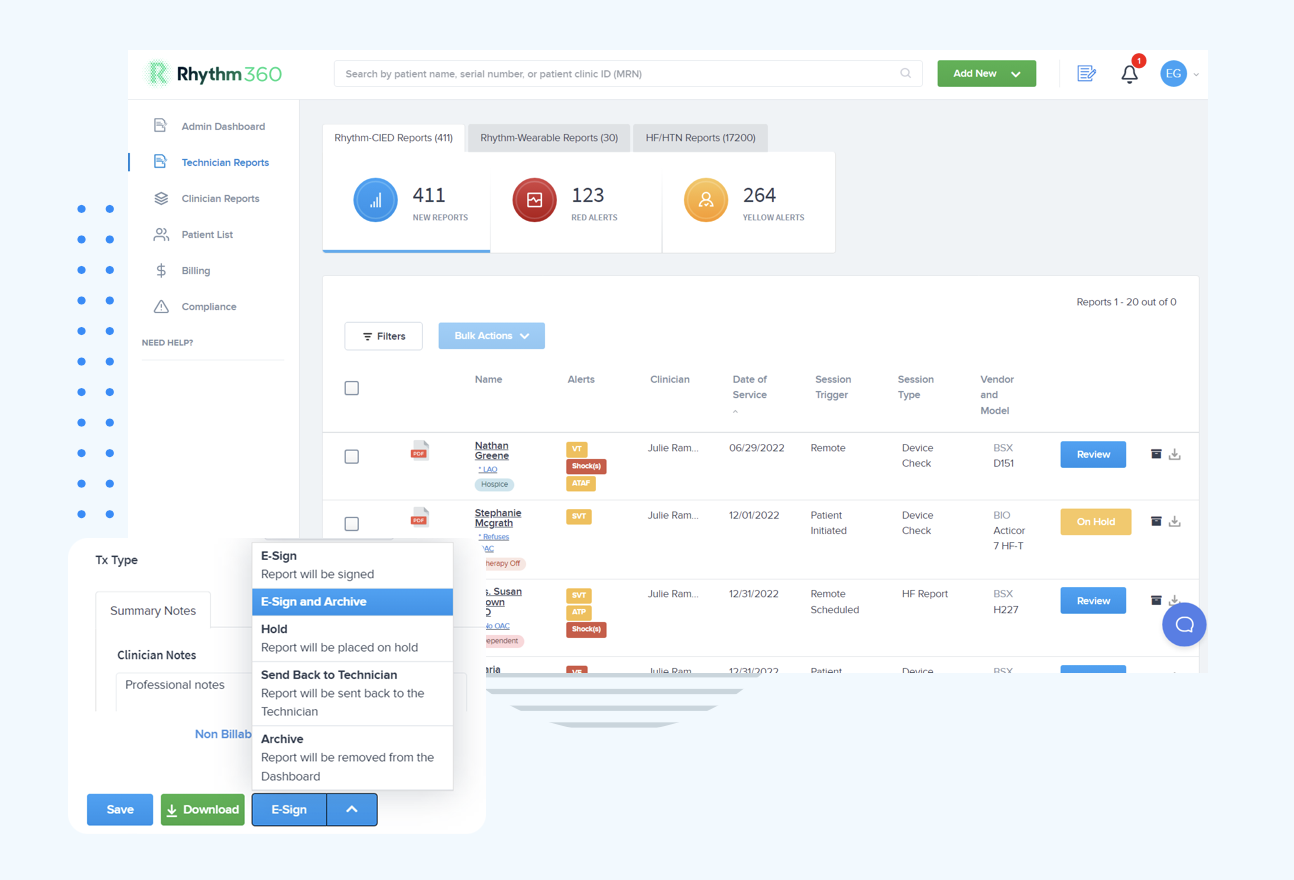
The AI-powered engine normalizes disparate data streams, fills transmission gaps using redundant data feeds, and achieves greater than 99.9% data transmissibility. At enterprise scale, where practices process tens of thousands of reports annually, the system prioritizes clinically significant alerts and suppresses non-actionable noise. This workflow reduces critical response times by up to 80%.
On the billing side, Rhythm360 tracks monitoring periods, transmission counts, and clinical management time against the specific thresholds required for each code. The platform then generates CPT-compliant documentation automatically. An administrative dashboard provides a real-time view of captured and potential revenue by CPT code, which gives practice administrators clear visibility into billing performance without manual reconciliation.
Bi-directional EHR integration with Epic, Cerner, Athenahealth, eClinicalWorks, Greenway Health, and other systems via HL7 ensures that reports post directly to the patient chart. This integration eliminates duplicate documentation and supports the audit trail CMS requires. The University of Chicago Medicine implemented Rhythm360 and reported that "we have improved billing and accountability for our patients after the integration."
The following table covers the primary CPT codes relevant to CIED remote monitoring and RPM programs in cardiology practices, reflecting 2026 CMS rules.
| CPT Code | Service Description | 2026 Key Rule | Documentation Requirement |
|---|---|---|---|
| 93295 | Professional interpretation of remote ICD transmissions (single, dual, or biventricular) | Minimum 30-day monitoring period, may not be billed with 93294 for same patient on same date | Device type, manufacturer, monitoring period dates, clinician interpretation addressing device function and actionable findings |
| 93296 | Technical component for remote CIED monitoring platform | Billed with 93294 or 93295, may be billed by clinic, clinical service partner, or monitoring center | Platform infrastructure documentation, billed per monitoring period, not per transmission |
| 99453 | Initial RPM device setup and patient education | Billed once per device, 2026 rate is $21.71 | Documentation of device provisioning, patient education, and consent before services begin |
| 99454 | RPM device supply with 16–30 days of readings per 30-day period | Revised in 2026 to cover 16–30 days only, mutually exclusive with new CPT 99445 | Exact number of days readings received, FDA-cleared device with automated electronic transmission confirmed |
Note: RPM codes 99453 and 99454 apply to physiological monitoring devices such as blood pressure cuffs and weight scales, not to implanted cardiac devices. Implanted device monitoring uses the 93279–93298 series. Rhythm360 tracks both code families and applies the correct documentation framework automatically based on device type and monitoring period.
A successful integration between Rhythm360 and an existing EHR requires confirming the following technical and workflow elements before go-live.
Alert fatigue from unfiltered transmission volumes. University of Chicago Medicine managed over 73,000 reports annually through Rhythm360 in calendar year 2025, averaging more than 18,000 reports per quarter. At that scale, manual triage is not viable, and AI-powered alert prioritization becomes the only sustainable approach.
Missing or vague audit trails. The documentation gap identified earlier, including vague time logs and missing activity details, manifests most often in denied claims. Time logs must record exact dates, durations in minutes, and specific activities, not phrases like "less than 20 minutes." Rhythm360's automated logging captures this detail at the point of care.
Single-vendor data silos. Practices that rely on OEM-specific portals for monitoring data cannot produce a unified billing record across a mixed-device population. A vendor-neutral platform that ingests all OEM data streams provides the structural solution.
Billing the wrong code for the monitoring duration. Billing a 30-day monitoring code for a 3-day recording is a compliance violation. Rhythm360 tracks actual transmission days against CPT thresholds and flags mismatches before submission.
Double-counting time across service categories. CMS bundling rules prohibit double-counting time spent interpreting RPM data with chronic care management, transitional care management, or behavioral health integration services. Automated time-tracking with service-category tagging prevents this overlap.
Practices can evaluate their current state against three maturity levels before sequencing a Rhythm360 rollout.
Rhythm360's implementation timeline, from contract to live integration, typically spans a few days to a few weeks, with SaaS-based pricing that scales to clinic size and platform usage.
Yes. CPT 93295 is the professional interpretation code for remote ICD monitoring and covers the physician or qualified non-physician practitioner's clinical review and documentation. CPT 93296 is the technical component code that covers the remote monitoring platform infrastructure, including the system that receives, processes, and formats transmission data. These two codes are designed to be billed together, with 93295 billed by the interpreting clinician and 93296 billed by the clinic, clinical service partner, or monitoring center providing the technical infrastructure. Both require a minimum 30-day monitoring period and are billed per monitoring period, not per individual transmission. The key restriction is that CPT 93294 and 93295 cannot be billed together for the same patient on the same date, because they cover different device types, with 93294 applying to pacemakers and 93295 applying to ICDs including biventricular devices.
The 2026 CMS Physician Fee Schedule, effective January 1, 2026, introduced two new RPM codes and revised existing ones. CPT 99445 covers device supply and data transmission for 2 to 15 days of readings within a 30-day period and fills a gap that previously left low-adherence patients unbillable. CPT 99454 was revised to apply specifically to 16 to 30 days of readings. CPT 99470 covers the first 10 to 19 minutes of clinical staff management time per month, while CPT 99457 continues to cover the first 20 minutes. CPT 99445 and 99454 are mutually exclusive within a calendar month, as are 99470 and 99457. CMS also updated reimbursement rates by 7 to 21% across the RPM code set. Compliance requirements include documented patient consent before billing begins, FDA-cleared devices with automated electronic transmission, a valid physician order tied to a qualifying chronic condition, an established patient-provider relationship, and contemporaneous time logs recording exact dates, durations, and specific activities. The HHS OIG has flagged RPM as a compliance risk area and is scrutinizing enrollment spikes, missing consent records, and claims submitted without all three required components, which are education, device supply, and management.
Yes, under specific circumstances. CPT 99453 covers the one-time initial setup and patient education for an RPM device and is billed only once per device, typically in the month the patient is enrolled and the device is provisioned. CPT 99454 covers the ongoing monthly device supply and data transmission for 16 or more days of readings within a 30-day period. In the month of enrollment, if the patient achieves the required 16 days of readings after setup, both 99453 and 99454 may be billed. In subsequent months, only 99454, or 99445 if readings fall in the 2 to 15 day range, applies. Documentation must confirm that device provisioning and patient education occurred and that the transmission threshold was met within the same billing period.
Automated billing platforms prevent denials by addressing the most common failure points before a claim is submitted. They track the actual number of transmission days against CPT thresholds in real time and prevent submission of a 30-day code when only 10 days of data exist. They generate structured documentation that captures device type, manufacturer, monitoring period dates, and a clinician interpretation note, which are the specific elements CMS auditors review. They maintain a contemporaneous audit trail of every clinical action, alert acknowledgment, and patient communication, which matches the standard CMS requires for time-based codes. They also flag bundling conflicts, such as when RPM management time is being counted toward both 99457 and a chronic care management code in the same month. Finally, they apply the correct CPT code based on device type and distinguish between CIED-specific codes in the 93279 to 93298 series and physiological RPM codes, which manual workflows frequently miss. The cumulative effect is a higher clean claim rate, fewer denials, and a defensible audit trail if a claim is reviewed.
Manual cardiac telemetry billing processes no longer provide a sustainable operating model in 2026. Expanded CMS RPM guidelines, heightened OIG audit scrutiny, growing device populations, and increasingly sophisticated payer denial algorithms create a compliance and revenue risk that manual workflows cannot manage effectively.
Rhythm360 provides a vendor-neutral, AI-powered platform that consolidates CIED and RPM data streams from major OEMs, automates CPT-compliant documentation across the 93295, 93296, 99453, 99454, and related code families, integrates bi-directionally with existing EHR systems, and maintains the audit trail CMS requires. Practices implementing Rhythm360 have achieved the response-time and revenue improvements outlined earlier without proportional increases in administrative headcount.
Plan your telemetry automation roadmap with Rhythm360 and see what scalable, compliant billing looks like in your practice.




