

Last updated: August 24, 2026
Telemetry technicians earn solid hourly wages that rise with experience, geography, and specialization. Payscale places the median base rate at $19.39 per hour, reflecting a broad dataset that includes part-time and entry-level roles. Hospital system contracts, shift differentials, and geographic premiums create wide variation between markets.
New York, NY has an average Indeed salary of $42.62 per hour for telemetry technicians, the highest metro-area average in the country. Other high-cost markets such as Los Angeles and Massachusetts show similar premiums, although exact figures vary by source and experience level. Within these markets, specialized cardiac device roles command an additional premium, and Beth Israel Deaconess pays up to $37.50 per hour for device-focused positions.
Entry-level technicians with less than one year of experience average $14.47 per hour. Technicians with one to four years of experience earn approximately $18.91 per hour. The highest observed hourly pay for telemetry technicians per Indeed reaches $48.31 in New York, NY, reflecting top-end experience and premium geography.
Remote cardiac monitoring roles usually sit at the upper end of the pay range. Cardiac device specialist positions at remote monitoring companies list pay between $34.61 and $44.23 per hour, and pacemaker/ICD device technician roles typically pay $35.50–$65 per hour depending on location, licensure, and experience, which sits well above the hospital floor average.
Telemetry technician certification timelines and costs depend on your background and the format you choose. The three primary pathways are the NTA national course, the CCI CRAT exam, and accredited community-college programs. The table below shows how these options differ in prerequisites, time commitment, clinical exposure, and employer recognition so you can match a route to your current credentials and budget.
Telemetry certification exams are challenging but manageable with focused preparation. The CCI CCT exam has an overall pass rate of 72%. The CRAT exam uses the same 130-question, 2-hour format with a passing scaled score of 650 on a 0–900 scale. Analyzing Abnormal Rhythms accounts for 60% of the CRAT exam, so arrhythmia recognition deserves most of your study time. California Medical Training Center reports an over 90% pass rate for students who complete its blended program, which shows how structured preparation improves outcomes.
Day-to-day stress in the role stays high but predictable. Telemetry technicians monitor multiple patients at once, communicate rhythm changes to nursing staff immediately, and work 12-hour shifts that often include nights, weekends, and holidays. As one RN educator notes, “The job requires a high level of focus and is often hospital-based, which means 12-hour shifts, nights, weekends, and holidays may be part of the schedule.” The cognitive load is significant, yet the scope stays well-defined. Technicians interpret rhythms and escalate findings, and they do not make independent treatment decisions.
Employer demand for telemetry technicians continues to grow across hospital and remote settings. The University of Washington updated its Cardiac Monitor Technician job classification in June 2026, which reflects ongoing institutional investment in the role. Harris Health System requires a high school diploma or GED and completion of a Cardiac Monitor Technician training course or equivalent coursework for its Cardiac Monitor Technician II positions, signaling that credentialed candidates hold an advantage over uncredentialed applicants in competitive markets.
Demand also extends beyond hospital floors into remote monitoring. Remote cardiac monitoring companies actively post for cardiac device specialists, pacemaker/ICD reporting technicians, and remote patient monitoring technicians, and all of these roles list rhythm interpretation as a core competency. As iRhythm's chief medical officer explains, “The resulting data is analyzed by FDA-cleared AI and reviewed by qualified cardiac technicians to generate a clinical report that supports physicians in making timely, informed diagnoses.” This AI-plus-human model drives demand for certified technicians in remote monitoring roles.
Platforms like Rhythm360 sit at the center of this shift. Rhythm360 is a vendor-neutral, HIPAA-compliant remote monitoring platform that ingests and normalizes data from all major cardiac implantable electronic device (CIED) manufacturers, including Medtronic, Boston Scientific, Abbott, and Biotronik, into a single AI-powered dashboard. Certified technicians who understand multi-manufacturer device data provide the human foundation that keeps that workflow safe and effective. Other remote monitoring platforms also operate in this space, which broadens employer options for credentialed technicians.
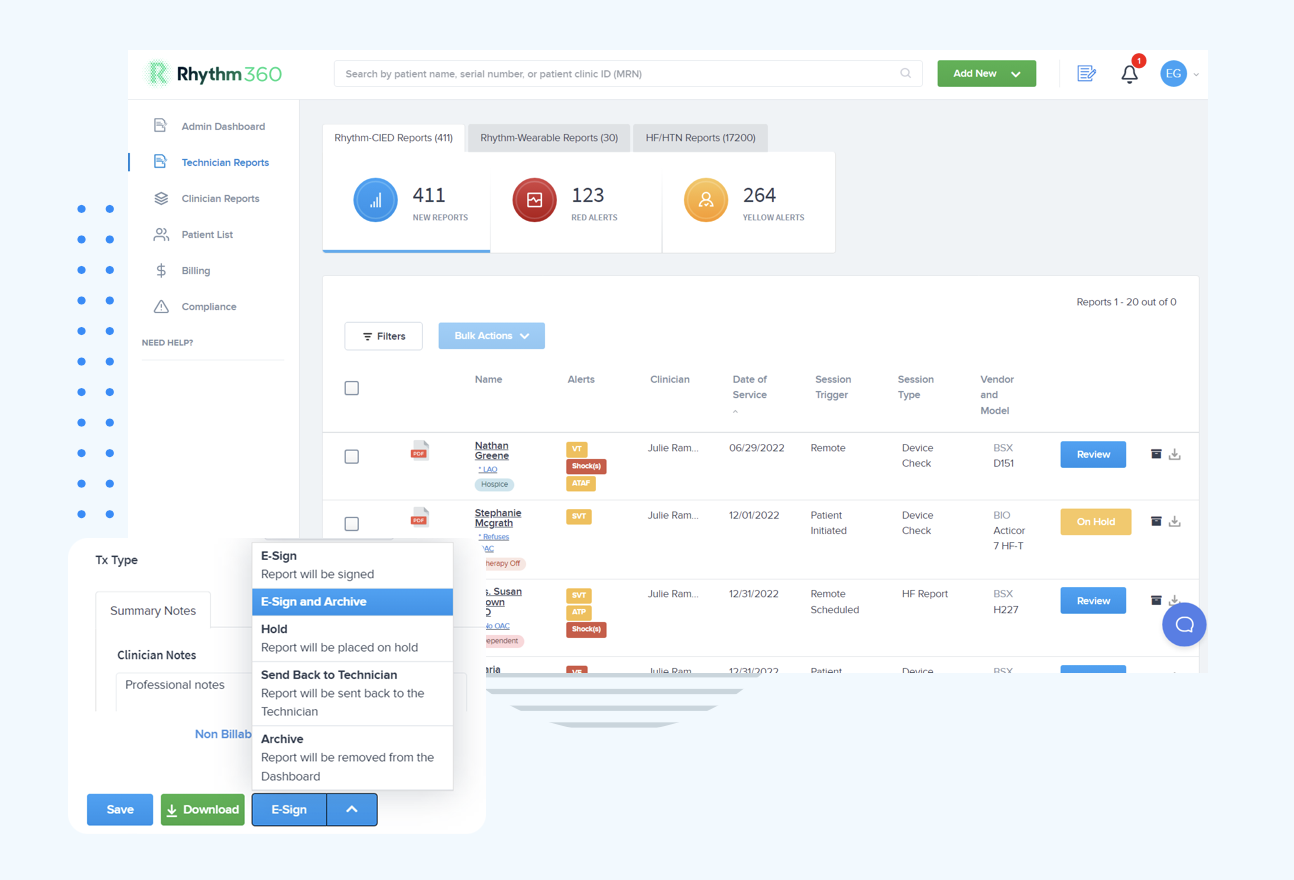
Learn how certified technicians fit into Rhythm360’s 24/7 monitoring workflow.
Telemetry technicians and EKG technicians share cardiac monitoring skills but support different types of work. An EKG technician primarily performs and processes 12-lead electrocardiograms, Holter monitor applications, and stress test recordings, which are discrete procedures ordered by a physician. A telemetry technician performs continuous rhythm surveillance, monitors multiple patients from a central station, and alerts clinical staff to rhythm changes in real time.
CCI's CRAT credential focuses on continuous rhythm analysis and telemetry monitoring, while the CCT covers a broader scope including 12-lead ECG, Holter monitoring, and stress testing. The NHA CET qualifies holders for EKG Technician and related cardiac monitoring roles, which makes it a flexible entry credential. Pay follows scope. Cardiovascular EKG technicians earn competitive wages, and telemetry-specific roles vary widely by setting and shift.
Career progression from either role usually moves toward remote monitoring specialist, cardiac device technician, or, with additional education, cardiovascular technologist or registered nurse.
Three common starting backgrounds map to three clear routes into telemetry work.
Background 1: Current CNA or prior healthcare experience
Background 2: Nursing student or enrolled allied-health learner
Background 3: Complete beginner with no healthcare experience
Certification timelines vary by pathway and prior experience. NTA online courses are self-paced and require no prerequisites. The CRAT exam requires self-study after you meet eligibility requirements. Community-college programs include supervised clinical hours and follow an academic calendar. Candidates with prior healthcare experience usually finish faster than those starting from zero.
The NTA Full Course costs $529 (as shown in the comparison table above) and includes two attempts at each exam. The CRAT exam fee is $175, and most candidates also purchase a prep course ranging from $310 to $950. Community-college programs vary, and North Central Texas College charges $496 for a 64-hour online-with-lab program. Background checks, drug screening, and BLS CPR certification add typical fees of $60, $35, and $40–$65. Total out-of-pocket costs usually fall between $300 and $1,100 depending on the path you choose.
The CRAT, issued by Cardiovascular Credentialing International (CCI), is accredited by the National Commission for Certifying Agencies (NCCA) and aligns with employer expectations in acute care. Harris Health System requires a high school diploma or GED and completion of a Cardiac Monitor Technician training course or equivalent coursework for its Cardiac Monitor Technician II positions, which illustrates the preference for formal training. The NTA credential is widely accepted for entry-level monitor tech roles but is not as broadly recognized in competitive acute-care markets. For candidates targeting hospital telemetry units or remote cardiac monitoring companies, the CRAT usually offers the stronger long-term investment.
Telemetry technicians can move into remote roles after gaining experience. As discussed in the demand section, remote cardiac monitoring companies actively hire certified technicians for oversight roles, typically requiring one to two years of hospital telemetry experience plus CRAT or CCT certification. These positions pay meaningfully above the hospital floor average, often $31 to $44 per hour depending on the employer and device specialization.
The telemetry technician role provides a strong entry point into healthcare but long-term advancement usually requires additional credentials. Many technicians use the role to complete prerequisites for nursing, physician assistant, or cardiovascular technologist programs while earning income and gaining clinical exposure. Employers with tuition assistance programs deserve priority for this reason. Technicians who specialize in cardiac implantable electronic device management and remote monitoring can reach senior specialist or lead technician roles without returning to school, especially as AI-powered monitoring platforms expand the scope and volume of remote oversight work.
Cardiac telemetry monitoring certification offers one of the most accessible entry points into hospital-based and remote healthcare work. With total costs under $1,100, timelines as short as eight weeks for credentialed candidates, and a clear upgrade path from NTA to CRAT to senior device specialist, the credential can deliver a strong return on a modest investment.
The next frontier for certified technicians centers on vendor-neutral remote cardiac monitoring. Rhythm360 by RhythmScience is a cloud-based, HIPAA-compliant platform that unifies CIED and remote physiological monitoring data from all major device manufacturers into a single AI-powered dashboard. The platform supports optional 24/7 oversight by certified cardiac technicians supervised by physicians and can reduce critical alert response times by up to 80%. For cardiology practices and health systems planning how to staff and scale remote monitoring programs, Rhythm360 provides the infrastructure, and certified technicians provide the clinical judgment that makes it work.
Explore Rhythm360’s AI-powered platform for certified telemetry professionals.





