Last updated: September 25, 2026
See How Rhythm360 Catches Coding Errors Before Submission
Code selection follows the actual monitoring duration at device return, not the planned duration. Most telemetry denials start with a duration mismatch that places the study in the wrong code family and unit limit.
| Monitoring Duration | Code Family | Component Billing Rule | Unit Limit |
|---|---|---|---|
| 24–48 hours (Holter) | 93224–93227 | Split at code level, no -26 or -TC on global 93224 | 1 unit per episode |
| >48 hours up to 7 days (extended external ECG) | 93241–93244 | Split at code level, no -26 or -TC on global 93241 | 1 unit per episode |
| >7 days up to 15 days (extended external ECG) | 93245–93248 | Split at code level, no -26 or -TC on global 93245 | 1 unit per episode |
| Up to 30 days, patient-activated (event monitor) | 93268–93272 | Split at code level, no -26 or -TC on global codes | 1 unit per episode |
| Up to 30 days, attended (mobile cardiac telemetry) | 93228/93229 | Split at code level, 93228 professional, 93229 technical, no -26 or -TC | 1 unit per 30-day period |
| >15 days up to 30 days, continuous (external ECG recording) | 0937T–0940T | Per AMA descriptor, check payer policy for component rules | 1 unit per episode |
This table resolves the highest-volume ambiguity around Holter monitor 7 days, 30 days, 72 hours, and 14 days. A study running past 48 hours but ending before day 7 bills from the 93241–93244 band. A study ending before day 15 but after day 7 bills from the 93245–93248 band. The code is determined at device return, not at device placement.
CPT 93228 is the professional component for mobile cardiac telemetry, covering physician review and interpretation with report. CPT 93229 is the technical component, covering device connection, patient instruction, attended surveillance, and data transmission. The two codes are billed together globally or split across entities, each once per 30-day period, and they remain distinct from Holter codes 93224–93227 and event monitor codes 93268–93272.
The financial consequence of confusing these codes is significant. A monitoring service that submits 93228 instead of 93229 collects roughly $990 less per patient, based on 2024 national average Medicare allowed amounts of $1,014.59 for 93229 versus $24.34 for 93228, per the CMS Medicare Physician and Other Practitioners public use file for calendar year 2024. The gap exists because the two codes pay for different work. CPT 93229 carries 0.00 physician work RVUs and is built entirely from practice expense and malpractice value. CPT 93228 carries 0.48 work RVUs and pays for the physician's interpretation.
The rule: the entity that owns the equipment and staffs the attended surveillance center bills 93229, and the interpreting physician bills 93228. Holter monitoring follows a different logic, with its component split built into four separate codes rather than two.
Holter monitor services map to CPT codes 93224–93227 for recordings up to 48 hours, with each code covering a distinct component of the service:
CPT codes 93224–93229 are already split at the code level, so appending -26 or -TC to the global code describes a component of a component and will trigger denials. CPT 93225 and 93226 cannot be billed together for the same encounter, and the global code 93224 cannot carry -26 or -TC. Modifier 52 applies when the recording runs under 12 hours.
Holter codes are distinct from mobile cardiac telemetry (93228/93229) and from extended external ECG monitoring (93241–93248). A 72-hour study bills from 93241–93244. A 14-day study bills from 93245–93248. A 30-day attended study bills 93228/93229. None of these are Holter codes.
CPT 93229 is billable once per 30-day period. The period begins on the date the monitor was placed, and the date of service is reported as the placement date. Submitting 93229 per transmission instead of per monitoring course generates an OA-18 duplicate service denial that requires a corrected claim rather than an appeal.
The boundary rule: monitoring that runs past 30 days is a new episode requiring a fresh order and a separate claim with its own placement date; units must never be added to the first claim. A monitor removed before 30 days can still be billed as one unit because the descriptor reads “up to 30 days,” with documentation of why monitoring ended early.
Inpatient bedside telemetry is bundled into the inpatient hospital stay and is not separately billable under the ambulatory cardiac telemetry codes. This distinction frequently drives miscoding that no modifier can fix.
LCD L40257 states that temporary nontherapeutic ambulatory cardiac monitoring is not covered for patients in hospitals, emergency rooms, skilled nursing facilities, or other specialized facilities, including outpatient or facility-based cardiac monitoring. If the patient is in any of those settings and the monitoring is part of the facility's routine care, the ambulatory telemetry codes do not apply.
Ambulatory cardiac telemetry codes apply to outpatient, home-based, or remote monitoring services. The place of service on the claim must reflect where the monitoring service operates, not the patient's home or the ordering physician's office.
The rule: verify the setting before code selection. A claim submitted with an ambulatory telemetry code for a patient in an inpatient or facility setting will be denied, and no modifier resolves the mismatch.
For CPT codes 93224–93229 and 93268–93272, the professional and technical components are already split into distinct codes. Appending -26 or -TC to the global code describes a component of a component and will trigger denials. CMS billing and coding article A57476 states that modifiers -26 and -TC are not used with CPT codes 93224 through 93229.
The concrete examples: 93224 is the global Holter code, 93225 is the technical component, and 93226 is the scanning analysis component, so 93224 should never carry -26 or -TC. Similarly, 93228 is the professional component and 93229 is the technical component for mobile cardiac telemetry, so the split is already built into the code set.
Some families do allow the -26/-TC split. CPT 93297 and 93298 are device-specific codes that can each be billed global, -26, or -TC. CPT 93294, 93295, and 93296 are already separated by device family and component for pacemakers and ICDs.
The rule: check the code's PC/TC indicator before appending a component modifier. An indicator of 2 or 3 means the modifier is redundant on its face, because indicator 2 is a professional-component-only code and indicator 3 is a technical-component-only code.
Run every cardiac telemetry monitoring claim against this checklist before submission. A missing item becomes an audit finding or a medical necessity denial.
The following 2026 changes affect cardiology and monitoring billing, effective January 1, 2026.
No cardiology E/M codes and no electrophysiology codes were deleted in the 2026 update, so EP and E/M coding remains unchanged.
The 2026 Medicare conversion factor is $33.40 for non-QP providers and $33.57 for qualifying APM participants.
The rule: claims are coded to the code set in effect on the date of service. The transition risk lies in systems applying one set of rules to both 2025 and 2026 dates of service. Refer to the AMA CPT Editorial Panel and CMS for the authoritative code set.
Cardiac telemetry monitoring codes carry specific time windows and unit limits, so overlapping monitoring periods or duplicate services within the same window produce denials.
The rule: reconcile claim dates against device placement dates monthly. The most common technical-component denial is a second claim filed inside an episode that already had one.
Remote cardiac device monitoring codes follow device-specific billing intervals and component structures that differ from ambulatory ECG monitoring families.
Pacemakers And ICDs — 90-Day Cycle: 93294 is the professional component for pacemaker remote interrogation, 93295 is the professional component for ICD remote interrogation, and 93296 is the technical component covering data acquisition, technician review, and distribution of results for both pacemaker and ICD systems. Modifier -26 does not apply to 93296 because separate professional codes exist for each device family. Modifier -TC does not apply to 93296 because it is already the technical component code.
Physiologic Monitors And Loop Recorders — 30-Day Cycle: CPT 93297 covers remote interrogation of implantable cardiovascular physiologic monitors such as pulmonary artery pressure sensors. CPT 93298 covers remote interrogation of subcutaneous cardiac rhythm monitors and implantable loop recorders. These are device-specific codes, not a professional/technical pair. Each is billable once per 30 days and each can be billed global, -26, or -TC. 93297 applies to implantable cardiovascular physiologic monitors, and 93298 applies to subcutaneous cardiac rhythm monitors and loop recorders. Each is a device-specific code rather than a professional or technical label.
The rule: match the code to the device, not to the monitoring platform.
Rhythm360 is a vendor-neutral, cloud-based remote patient monitoring platform that consolidates data from all major cardiac device manufacturers, including Medtronic, Boston Scientific, Abbott, and Biotronik, into a single dashboard. The platform focuses on closing the coding, documentation, and compliance gaps that generate the denials described throughout this article.
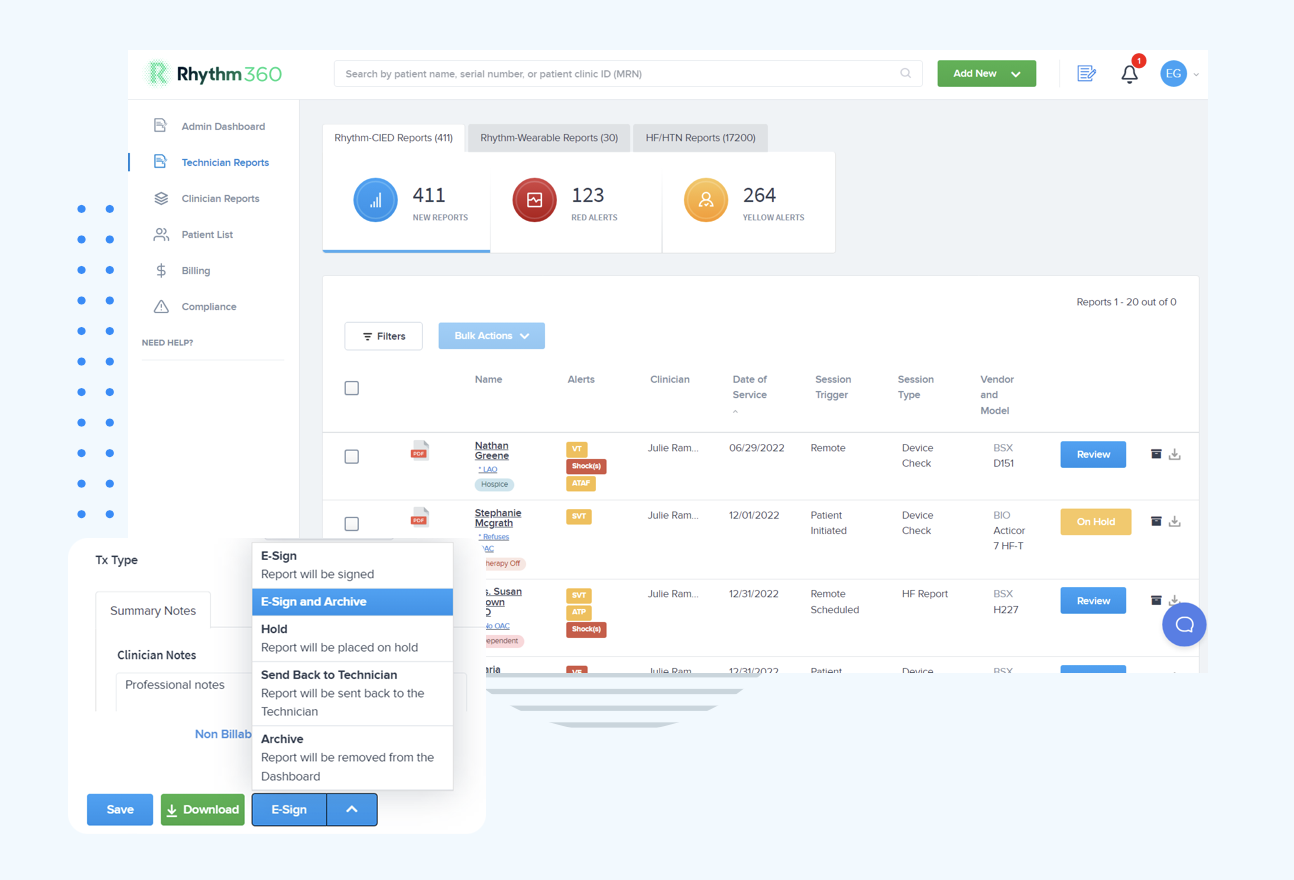
Rhythm360 automatically tracks device-specific CPT pairings. It manages 90-day cycles for pacemakers and ICDs (93294, 93295, 93296) and 30-day cycles for physiologic monitors and loop recorders (93297, 93298). This prevents device-type mismatch denials and unbilled technical components. The platform automates data ingestion, report generation, and billing documentation, which supports the response-time and revenue-capture gains shown below.
Other platforms in the remote cardiac monitoring space include Murj, Implicity, Rhythm Management Group, and Octagos. The table below summarizes Rhythm360's features and related benefits.
| Rhythm360 Feature | Benefit |
|---|---|
| Vendor-neutral data ingestion (Medtronic, Boston Scientific, Abbott, Biotronik) | Single dashboard eliminates multiple OEM portal logins and data silos |
| Automated CPT code capture for 93294, 93295, 93296, 93297, 93298 | Prevents device-type mismatch denials and missed billing cycles |
| AI-powered alert triage and automated reporting | Up to 80% reduction in critical alert response times |
| Automated billing documentation and EHR integration (Epic, Cerner, Athenahealth, eClinicalWorks) | Up to 300% increase in revenue capture through optimized CPT billing |
| >99.9% data transmissibility via redundant feeds, computer vision, and AI extrapolation | Eliminates missed transmissions due to OEM server downtime |
| HIPAA-compliant mobile application | Clinicians can review transmissions and sign reports from anywhere |
| Real-time administrative dashboard tracking billable events and compliance status | Proactive identification of unbilled episodes before the billing window closes |
| Optional 24/7/365 oversight by certified cardiac technicians (CCTs) | Continuous surveillance without additional in-house staffing burden |
See How Rhythm360 Automates Cardiac Telemetry CPT Coding And Compliance
Capable coding and billing teams still make several high-level mistakes that generate systematic denials across entire claim batches.
Automated platforms like Rhythm360 prevent these errors by capturing the correct code and the required documentation at the point of service, before the claim goes out.
No. CPT 93224 is the global Holter monitor code and cannot carry modifier -26 or -TC.