

Last updated: July 14, 2026
Structured remote cardiac monitoring reduces hospitalizations and deaths. A 2026 meta-analysis of 79 randomized controlled trials involving 31,669 heart failure patients found that remote monitoring reduced total HF hospitalizations (incidence rate ratio 0.81) and all-cause mortality. A separate analysis found lower rates of cardiovascular-related hospitalizations among CIED patients under remote monitoring compared with standard in-office monitoring.
Reliable data transmission drives these results. Rhythm360 achieves greater than 99.9% data transmissibility through redundant data feeds, computer vision, and AI-powered extrapolation, so critical information rarely gets lost to OEM server outages or transmission gaps. That reliability translates into speed: practices using the platform have cut critical-event response times by up to 80%. This kind of speed at scale is what let the University of Chicago Medicine (UCM) review more transmissions daily, catch more abnormalities, and process more than 73,000 reports annually, averaging over 18,000 per quarter.
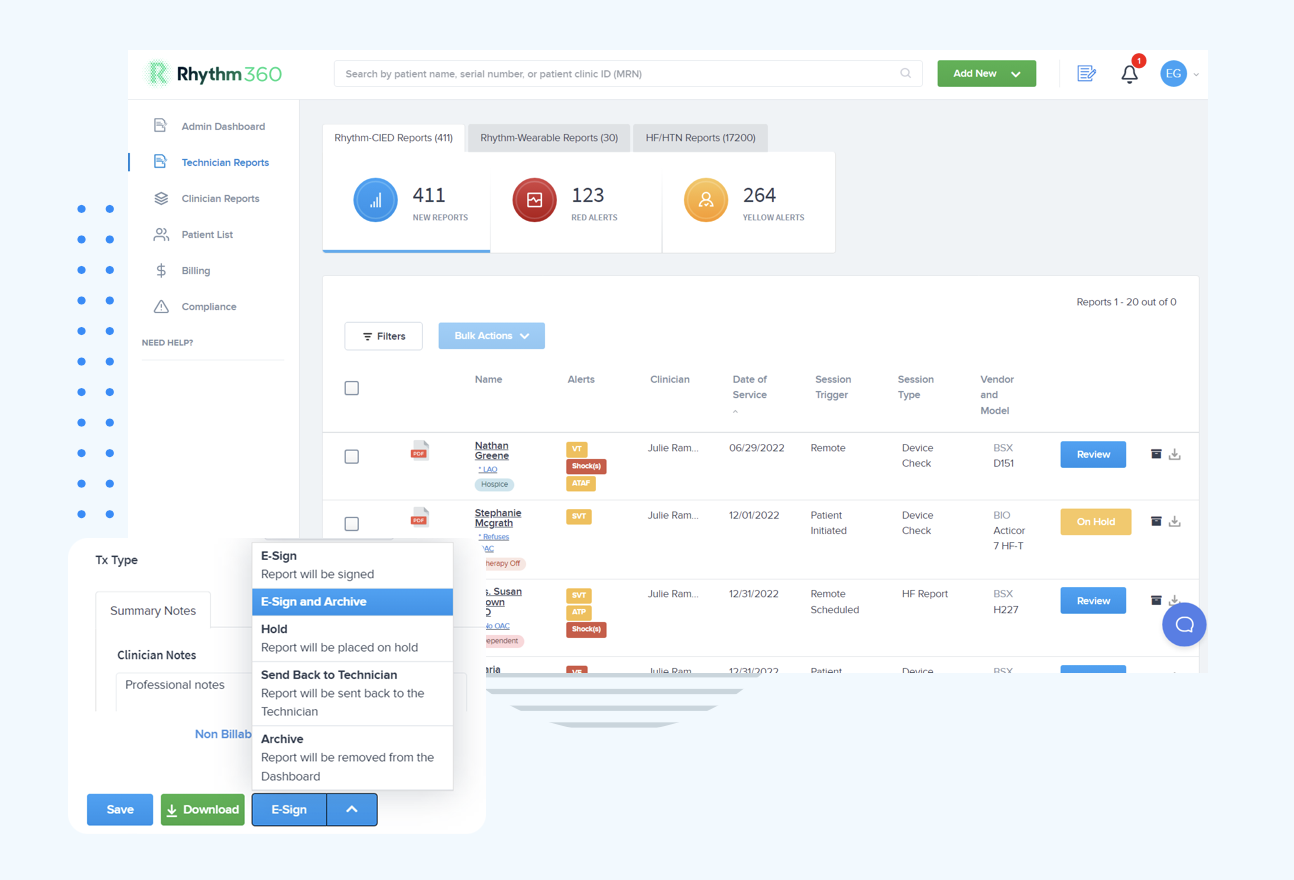
Faster, more reliable data capture also feeds directly into billing accuracy. Automated CPT tracking for remote monitoring programs has been linked to fewer 30-day readmissions and higher annual revenue per enrolled patient. Because Rhythm360 captures the documentation elements payers require, practices using it have reported revenue increases of up to 300%.
Before deploying a unified telemetry platform, address five readiness factors. Confirming these upfront determines how smoothly the first implementation step goes.
With readiness factors addressed, the first implementation step eliminates the multi-portal workflow. When a practice implants devices from more than one manufacturer, staff must log into separate, non-interoperable systems to retrieve patient data. This creates data silos, redundant effort, and a higher risk of missed transmissions.
Rhythm360 ingests and normalizes data from all major CIED manufacturers, including Medtronic, Boston Scientific, Abbott, and Biotronik, into a single dashboard. Data is captured via API, HL7, XML, and PDF parsing through computer vision, so even unstructured OEM reports get normalized into a consistent clinical format. A redundant data feed system acts as a failsafe when an OEM server goes down.
UCM's Gaurav A. Upadhyay, MD, noted: "We have improved billing and accountability for our patients after the integration." Single-dashboard access removes the need for device technicians to reconcile conflicting data across portals and gives them one unified view of the entire device population.
Consolidated data only helps if staff can act on it quickly, and alert volume makes that hard. Telemetry systems generate an average of 5.1 alerts per patient-day, and 87% are nonactionable. This volume desensitizes clinical staff and raises the risk that a genuinely critical event, such as new-onset atrial fibrillation, ventricular tachycardia, or lead malfunction, gets missed or delayed.
AI-enhanced monitoring shifts from reactive threshold-based alerting toward anticipatory risk prediction, spotting patterns tied to clinical instability before overt deterioration occurs. Rhythm360's AI-powered alert triage filters non-actionable noise and surfaces only clinically significant events, delivering that same up-to-80% response-time improvement noted earlier. The platform also supports optional 24/7/365 oversight by CCTs supervised by physicians, adding another layer of triage accountability.
Andrew Beaser, MD, at UCM, observed: "Decision support, including AI-assisted decision support, will become increasingly important as data volumes grow."
Faster triage frees up staff time, but revenue still leaks if documentation stays manual. When real-time clinical data flows seamlessly into billing systems via EHR integration, practices are less likely to miss billable services or submit claims with incomplete documentation.
Rhythm360 automates report generation for routine transmissions and urgent alerts alike. It captures the elements CPT compliance requires: patient demographics, device type and manufacturer, monitoring period dates, and clinician interpretation notes. Bidirectional EHR integration pushes completed reports and billing-ready documentation directly into the clinical workflow, eliminating manual re-entry. Practices using integrated EHR and billing systems have cut claim denials by up to 98%. That revenue lift, up to 300% as noted earlier, stems directly from this kind of automated CPT capture.
Critical cardiac events do not wait for office hours. A clinician tied to a specific workstation cannot respond effectively to a Saturday morning alert flagging new-onset atrial fibrillation or a ventricular tachycardia episode. Delayed response in these scenarios carries direct patient safety consequences, including stroke risk and hemodynamic compromise.
Rhythm360's secure, HIPAA-compliant mobile application lets electrophysiologists, cardiologists, NPs, PAs, and RNs review transmissions, sign reports, and coordinate care from any location. Syncing real-time monitoring alerts directly into clinical workflows reduces context switching, improves response times, and minimizes errors when managing patients across care settings. On-call clinicians get the same complete, AI-triaged view of their patient population they would have at a central workstation.
Nurse-driven protocols let bedside nurses discontinue cardiac telemetry monitoring when AHA criteria are no longer met, cutting unnecessary monitoring days and alarm burden. Structured daily review reduces both under-monitoring and over-monitoring: up to 43% of hospital telemetry use occurs without clinical indication.
An effective daily review protocol built on Rhythm360 includes these elements:
Once daily protocols are running, practices need concrete metrics to confirm the workflow is paying off. Each metric below ties back to one of the five implementation steps.
Once the five steps above run smoothly, practices can extend the same centralized workspace to other chronic conditions instead of adopting a separate platform. Start by refining AI alert rules using population-specific data, for example tightening thresholds for patients with a history of ischemic heart disease.
Rhythm360 supports this expansion through its integrated Rhythm-HF/HTN service line, letting practices manage rhythm disorders, heart failure, and hypertension RPM within the same dashboard built in Step 1. This creates new recurring revenue streams through CPT codes 99453, 99454, 99457, and 99458 without separate platforms or added administrative overhead. A multidisciplinary governance team conducting quarterly reviews of telemetry audit data supports ongoing refinement of alarm parameters and training protocols.
Implementation timelines for Rhythm360 range from a few days to a few weeks, depending on EHR integration complexity and the number of device manufacturers involved. Onboarding includes EHR integration setup, OEM data feed configuration, staff training, and workflow customization. Practices with straightforward Epic or Cerner environments and a defined device inventory typically complete deployment within one to two weeks. Larger health systems with multiple EHR instances or complex billing workflows may need more configuration time, but Rhythm360's modular design supports phased rollouts without disrupting existing clinical operations.
Rhythm360 offers bidirectional integration with Epic, Cerner, Athenahealth, eClinicalWorks, and Greenway Health, plus additional systems via HL7. Bidirectional integration means patient demographics, device data, completed reports, and billing documentation flow in both directions, eliminating manual re-entry and keeping the EHR as the single source of truth. Confirm your EHR version supports HL7 or FHIR-based API connections before starting implementation; older on-premise EHR versions may require middleware configuration.
AI triage does not eliminate the need for clinical oversight. It restructures how staff spend their time. By filtering non-actionable alerts and surfacing only clinically significant events, it lets device technicians, RNs, and NPs focus on transmissions that require a clinical decision instead of dismissing noise. That same up-to-80% response-time improvement noted earlier means the same staffing level can manage a much larger patient population without raising burnout risk. For practices that need additional coverage, Rhythm360 also offers optional 24/7/365 oversight by CCTs supervised by physicians, providing a staffing safety net during nights, weekends, and high-volume periods.
Automated CPT documentation must satisfy both clinical and payer-specific requirements to support compliant billing. For CIED remote monitoring, documentation must capture patient demographics, device type and manufacturer, monitoring period dates, and a clinician interpretation note addressing device function, programmed parameters, and any actionable findings. For RPM CPT codes such as 99454, payers including Medicare require at least 16 days of device readings within a 30-day calendar period. Rhythm360 tracks these thresholds in real time and flags patients at risk of falling below billing requirements before the claim period closes. All documentation generated by the platform is audit-ready and timestamped, supporting regulatory compliance and Medicare audit responses. Billing staff should also confirm they understand any LCD or payer-specific coverage criteria applicable to their patient population and monitoring modalities.
Effective cardiac telemetry monitoring depends on five connected steps, not any single technology. Consolidating fragmented data sources enables accurate AI triage. Accurate triage enables faster clinical response. Automated documentation enables compliant revenue capture, and mobile access ensures continuity of care regardless of location.
Practices ranging from solo EP clinics to large academic medical centers have used this framework with Rhythm360 to move from reactive, manual monitoring to a proactive, scalable telemetry program. The outcomes are measurable: fewer hospitalizations, faster critical-event response, more accurate billing, and patients who get earlier intervention instead of waiting for a scheduled visit.
Rhythm360 by RhythmScience is the vendor-neutral, AI-powered platform built to support every step of this workflow, from device data ingestion across all major manufacturers to bidirectional EHR integration, automated CPT documentation, and secure mobile review.
Schedule a demo to see how Rhythm360 transforms cardiac telemetry workflows at your practice.




