Last updated: October 11, 2026
See How Rhythm360 Improves Monitoring Margin
Ambulatory cardiac monitoring codes split into professional and technical components, and a practice that outsources technical monitoring may leave revenue unbilled or absorb costs it never recovers.
The component economics differ sharply by code family. For mobile cardiovascular telemetry (MCT), CPT 93228 is the professional component, covering physician review and the interpretive report. CPT 93229 is the technical component, covering device connection, patient instructions, attended surveillance, and daily data transmission. In calendar year 2024, Medicare allowed an average of $1,014.59 per office-setting CPT 93229 claim versus $24.34 per office-setting CPT 93228 claim, per the CMS Medicare Physician and Other Practitioners public use file for 2024. A monitoring service that submits CPT 93228 by mistake instead of CPT 93229 collects roughly $990 less per patient than the service it actually delivered.
For pacemakers and ICDs on the 90-day cycle:
For physiologic monitors and loop recorders on the 30-day cycle, the codes are device-specific rather than a professional and technical pair:
Each is billable once per 30 days and each can be billed global, with modifier -26 for the professional component, or with modifier -TC for the technical component.
To calculate contribution margin per modality, subtract direct and variable costs, including device or monitor cost, connectivity, technician review time, report generation, and follow-up, from net collected reimbursement for that code and payer. If the result is negative for the technical component under a given payer, billing that component only adds cost; if it is positive, the practice should bill it rather than let it flow to a vendor. For a deeper look at revenue by modality, see How To Optimize Cardiac Telemetry Revenue And Billing.
Action: Assign the component decision to the practice’s billing lead with a written determination per code family.
The CMS Billing and Coding Article A60286 for Temporary Nontherapeutic Ambulatory Cardiac Monitoring Devices was revised effective October 1, 2026, and the revision changed the ICD-10-CM code set that supports medical necessity.
The October 1, 2026 revision (R1) implemented the Annual ICD-10-CM Update. Under “ICD-10-CM Codes that Support Medical Necessity Group 1: Codes,” CMS deleted I42.0 and I49.8 and added I42.00, I42.01, I42.09, I42.81, I42.89, I47.22, I49.81, I49.82, and I49.89. Any claim submitted with a deleted code will be returned as incomplete under Section 1833(e) of the Social Security Act.
The once-per-30-day MCT reporting restriction under CPT 93228 and 93229 remains in place. The code pair is reported once per course of up to 30 consecutive days, not per transmission or per alert. Submitting 93229 for each data transmission instead of once per monitoring course generates an OA-18 duplicate service denial.
Documentation requirements under Article A60286 are specific. The medical record must:
Article A60286 also prohibits reporting CPT 93245, 93246, 93247, or 93248 in conjunction with 93224, 93225, 93226, 93227, 93228, 93229, 93270, 93271, 93272, 99445, 99453, 99454, 0937T, 0938T, 0939T, or 0940T for the same monitoring period.
Action: Assign a documentation audit of the last 20 monitoring episodes to the compliance lead.
Review Your A60286 Documentation With Rhythm360
A favorable practice-wide average can hide an unprofitable contract, so contribution margin must be segmented by payer, modality, and ordering clinician.
Three inputs determine whether a payer-modality-clinician combination is profitable. For each combination, calculate:
Contribution margin per episode equals net collections minus direct costs. A 2026 cross-sectional study published in JAMA Network Open analyzing negotiated commercial rates from four major national insurers found substantial variation in commercial pricing for common cardiology procedures, with greater variability in facility than professional prices. That variation reinforces how a single practice-wide average obscures contract-level economics. Cardiology denial rates run 15 to 20 percent, well above most specialties, driven by the documentation and authorization gaps described above.
Once the segmentation is complete, rank payer-modality-clinician combinations by contribution margin per completed episode. The combinations at the bottom of that ranking are either subsidized by the rest of the practice or destroying margin outright. Fix the highest-margin leak first. For a framework on maximizing revenue by modality, see How To Maximize Revenue From Remote Cardiac Monitoring.
Action: Assign the claims data pull by payer and modality to the practice’s data analyst or billing manager.
The right monitoring model is the one with the highest contribution margin per completed episode. A low advertised vendor fee can still produce a low-margin model once retained internal costs are counted.
Each model carries a distinct cost structure:
The decision matrix for a partner meeting should compare each model on contribution margin per completed episode at current volume, break-even episode count, staffing risk, documentation control, and scalability. For a detailed look at staff efficiency tools that affect this calculation, see Cardiac Telemetry Monitoring Staff Efficiency Tools Guide.
Action: Assign the model comparison to the operations lead with a target decision date.
Cost per episode equals the sum of direct and variable costs, including device or monitor cost, patient education and onboarding time, data transmission and connectivity, technician review time, report generation, and follow-up, divided by completed episodes.
Most practices underestimate cost per episode because they count only the device fee. The full cost stack includes:
The completion-rate problem is where cost per episode diverges from cost per enrolled patient. Incomplete episodes consume every cost in the stack above without generating reimbursement. A practice with a 70 percent completion rate absorbs 30 percent of its monitoring cost with zero revenue offset. The formula divides total direct and variable costs for a modality in a period by completed and billed episodes in that period. Enrolled patients are not the denominator. For a detailed ROI framework, see Cardiac Telemetry ROI Calculator: Cost Savings Guide.
Action: Assign the cost-per-episode calculation to the finance lead.
AHA-appropriate utilization functions as a revenue variable, because inappropriate utilization consumes monitoring capacity and technician time without generating defensible reimbursement.
A 2026 retrospective cross-sectional study published in Cureus analyzed 822 inpatient cardiac telemetry orders and found that 476 orders, or 57.9 percent, were non-evidence-based per American Heart Association criteria. Evidence-based orders averaged 2.98 monitoring days versus 5.68 days for non-evidence-based orders, a difference of roughly 2.7 additional monitoring days per patient (p < 0.001). Using an internal hospital cost estimate of $700 per telemetry patient-day, the study calculated mean costs of $4,711 per patient for non-evidence-based telemetry versus $3,122 for evidence-based telemetry.
For ambulatory monitoring, the mechanism differs but the economics remain parallel. An order that does not meet the medical necessity criteria in CMS Article A60286 and the associated LCD L40257 will not generate defensible reimbursement regardless of how accurately the CPT code is selected. Inappropriate utilization also consumes technician review time and monitoring capacity that could be allocated to billable, clinically indicated episodes. Utilization review therefore belongs in the revenue conversation, alongside coding and contract review.
Action: Assign a utilization review of the current monitoring panel to the clinical lead.
Capturing the utilization and documentation levers at scale requires automation for documentation and code capture.
Rhythm360 is a unified, AI-powered platform that consolidates CIED and RPM data from all major manufacturers into a single source of truth, so a practice can review every device type in one workflow regardless of manufacturer.
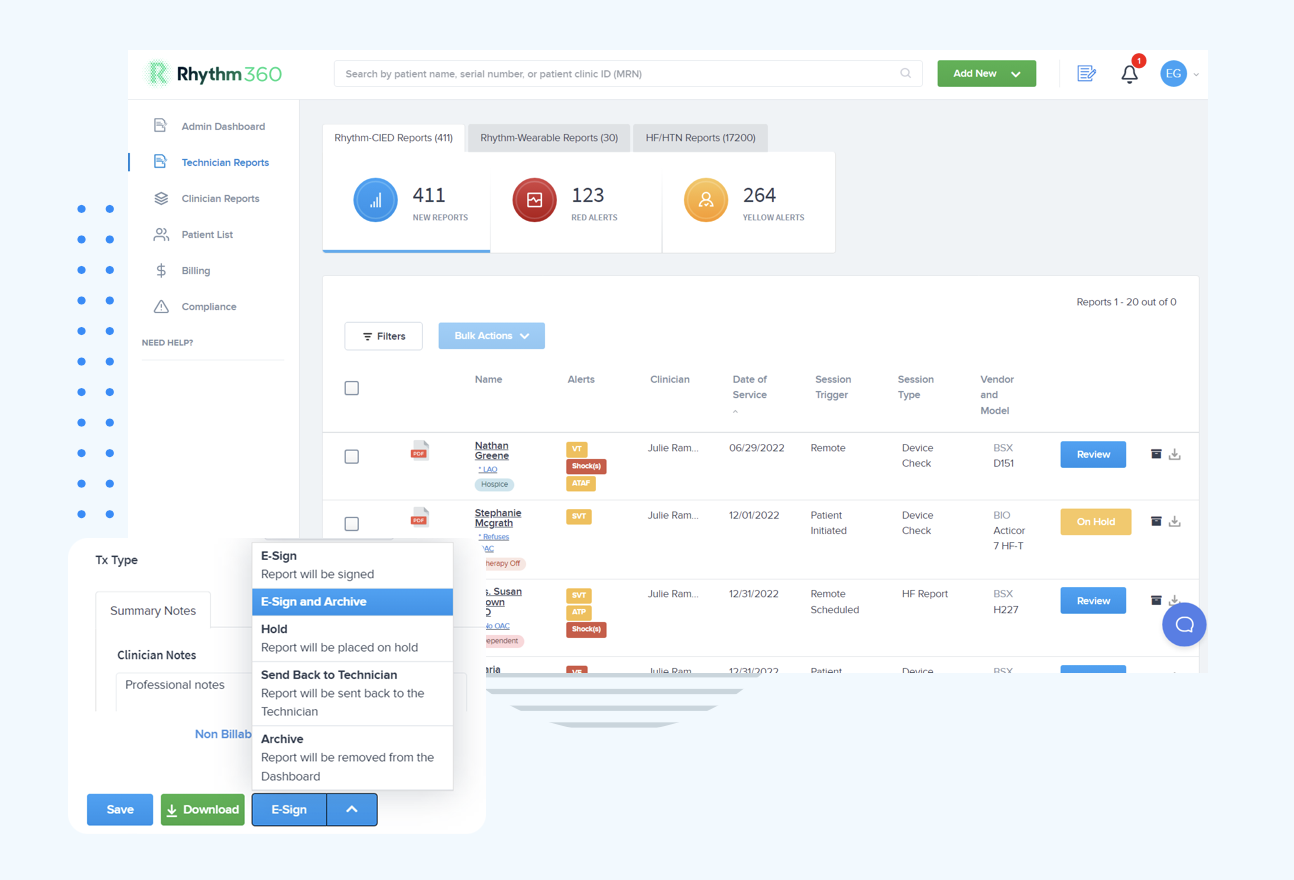
Rhythm360 addresses the specific profitability levers described throughout this article:
The University of Chicago Medicine reviewed more than 73,000 reports annually through Rhythm360 in calendar year 2025, averaging more than 18,000 reports per quarter. That volume demonstrates scalable handling in a high-volume academic cardiology environment. As noted in the same white paper: “We have improved billing and accountability for our patients after the integration.”
Other platforms in the cardiac monitoring space include Murj, Implicity, Rhythm Management Group, and Octagos. The focus here is on what Rhythm360 delivers for the specific profitability levers this article addresses.
See How Rhythm360 Automates CPT Capture
The 90-day plan follows three phases: baseline from days 1 to 30, bottleneck fixes from days 31 to 60, and scale from days 61 to 90.
The most capable practices make four strategic mistakes that quietly erode monitoring margin.
Action: Assign a partner-meeting review of these four pitfalls against the practice’s current model.
The questions below address the recurring points practices raise when they begin this work.
AHA guidelines define evidence-based indications for telemetry monitoring. Orders that fall outside those indications are more likely to fail medical necessity review, generating denials regardless of CPT code accuracy. Appropriate utilization preserves monitoring capacity and technician time for episodes that generate defensible reimbursement, so guideline adherence directly supports contribution margin.
Monitoring duration should match the clinical indication documented in the medical record. For ambulatory MCT under CPT 93228 and 93229, the episode covers up to 30 consecutive days and is billed once per course, not per transmission. Extending monitoring beyond what the documented indication supports risks medical necessity denial and consumes monitoring capacity without generating additional reimbursement for that episode.
CMS Billing and Coding Article A60286 for Temporary Nontherapeutic Ambulatory Cardiac Monitoring Devices was revised effective October 1, 2026, implementing the Annual ICD-10-CM Update. The revision deleted ICD-10-CM codes I42.0 and I49.8 and added nine replacement codes including I42.00, I42.01, I42.09, I42.81, I42.89, I47.22, I49.81, I49.82, and I49.89. Claims submitted with deleted codes will be returned as incomplete.
Cost per completed episode is the sum of device or monitor cost, patient onboarding and education time, data transmission and connectivity fees, technician review time, report generation, physician interpretation time, billing administration, and follow-up costs, divided by completed and billed episodes. Incomplete episodes consume the full cost stack without generating reimbursement, so completion rate has the greatest leverage on cost per episode.
Cardiac telemetry monitoring profitability is a service-line design problem. The practices that win determine which components they are entitled to bill, calculate contribution margin per payer and modality, align documentation with the requirements of CMS Article A60286, and scale volume only after compliance is airtight.
Every section of this article ends with an assignable action because the operating model is only as strong as the person responsible for each lever. The 90-day execution plan gives those assignments a sequence and a deadline.
Rhythm360 automates the CPT capture and documentation the contribution-margin analysis depends on, covering both the 90-day pacemaker and ICD cycle and the 30-day physiologic monitor and loop recorder cycle. The financial model then reflects what the practice actually delivered.
Talk With Rhythm360 About Your Monitoring Model