Cardiac telemetry billing starts with clear distinctions between monitoring types and their CPT codes. Mobile Cardiac Telemetry (MCT) delivers real-time monitoring with immediate alerts, while Holter monitoring supports retrospective rhythm review. Remote Patient Monitoring (RPM) covers broader physiologic data, and Cardiac Implantable Electronic Device (CIED) interrogation tracks pacemaker and ICD performance over time.
The 2026 CPT code set expands reimbursement for short-duration monitoring. Five new Category I CPT codes support remote monitoring services over 2–15 days within a 30-day period. These codes remove the restrictive 16-day minimum that previously blocked billing for many acute care scenarios.
Code | Description | Requirements | 2026 Medicare Rate (approx.) |
93228 | MCT technical component | 24/7 real-time, >24hrs | $150-200 |
93229 | MCT interpretation | Physician review, medical necessity | $50-75 |
93298 | CIED remote interrogation (subQ) | Up to 30 days, auditable data | $35-45 |
93299 | CIED remote evaluation (implantable) | Analysis of rhythm data | $40-55 |
99454 | RPM device setup/monitoring | Monthly, 16+ days data | $20-30 |
99457 | RPM treatment mgmt (first 20 min) | Clinical staff time, audio/video OK | $50-60 |
*Rates represent national averages; actual reimbursement varies by geographic location and payer mix. CMS 2026 physician fee schedule provides detailed payment methodology for revenue cycle planning.
The 2026 cardiac monitoring environment spans multiple device classes that each require specific billing rules. CIEDs from Medtronic, Abbott, Boston Scientific, and Biotronik generate continuous data streams that must be captured, analyzed, and documented to support reimbursement. RPM programs extend beyond rhythm to heart failure and hypertension management through sensors and patient-reported data.
Several 2026 trends reshape how practices bill and get paid. New RPM codes remove the 16-day rule and allow billing for 2-15 day monitoring, which finally supports short-term acute care use cases. Category III codes 0981T-0983T support transcatheter implantation of wireless inferior vena cava (IVC) sensors for advanced hemodynamic monitoring.
CMS permanently allows virtual direct supervision for cardiac rehabilitation services, which expands telehealth integration options. At the same time, Medicare tightens audits, and commercial payers increasingly bundle services and require prior authorization for longer monitoring periods.
Manual workflows break under this level of complexity. Practices that juggle multiple OEM portals face fragmented data, missed alerts, and documentation gaps that trigger denials. Alert fatigue from low-value notifications overwhelms staff, while billing teams struggle to identify and submit every billable event across disconnected systems.
The expanded 2026 CPT framework opens new revenue through short-duration RPM codes and emerging technology categories. Start with core telemetry codes such as 93228 and 93229 for MCT and 93298 and 93299 for CIED interrogation, then layer in new RPM options for 2-15 day monitoring. Document the clinical rationale for each monitoring duration to clearly support medical necessity.
Strong documentation prevents most telemetry denials before they occur. Required elements include signed physician orders with monitoring duration, clinical indications with symptoms and cardiac history, device connection details with setup steps, and progress notes that show clinical decisions during monitoring. Standardized templates help capture every element while still allowing clinical judgment.
Payers follow different playbooks, so workflows must match those rules. Medicare focuses on medical necessity, timing, and virtual supervision compliance. Commercial payers often bundle services, cap monitoring frequency, or require prior authorization. Build payer-specific checklists, keep coverage policies updated, and maintain direct contacts with payer representatives for faster issue resolution.
Proactive denial management protects revenue that practices often leave on the table. Practices with formal appeal strategies recover 60-67% of initially denied claims, while reactive teams recover about 25%. Frequent denial drivers include weak medical necessity notes, incorrect CPT selection, and missing prior authorization. Create appeal templates for common denial reasons and track win rates by payer to refine future submissions.
Staffing and billing models should match practice size and complexity. Smaller practices often gain efficiency with outsourced billing partners. Larger groups may achieve better margins with in-house teams supported by automation. Multi-OEM environments see particular value from vendor-neutral platforms that replace manual portal work and reduce staffing needs.
RPM and CCM programs extend revenue beyond traditional rhythm monitoring. Codes 99457 and 99458 support chronic disease management for conditions such as heart failure and hypertension. These services create recurring monthly revenue and can improve outcomes when bundled with existing cardiac care pathways.
EHR-integrated billing software with AI can cut errors by about 40% through automated scrubbers and real-time eligibility checks. Automated platforms remove manual data entry, standardize documentation, and surface real-time alerts for billing opportunities. Most practices see the investment pay for itself within months through higher capture rates and fewer denials.
Rhythm360 streamlines cardiac telemetry reimbursement with automation across the full revenue cycle. The AI-powered platform ingests data from all major OEMs, including Medtronic, Abbott, Boston Scientific, and Biotronik, into a single dashboard that replaces fragmented portals and manual workflows.
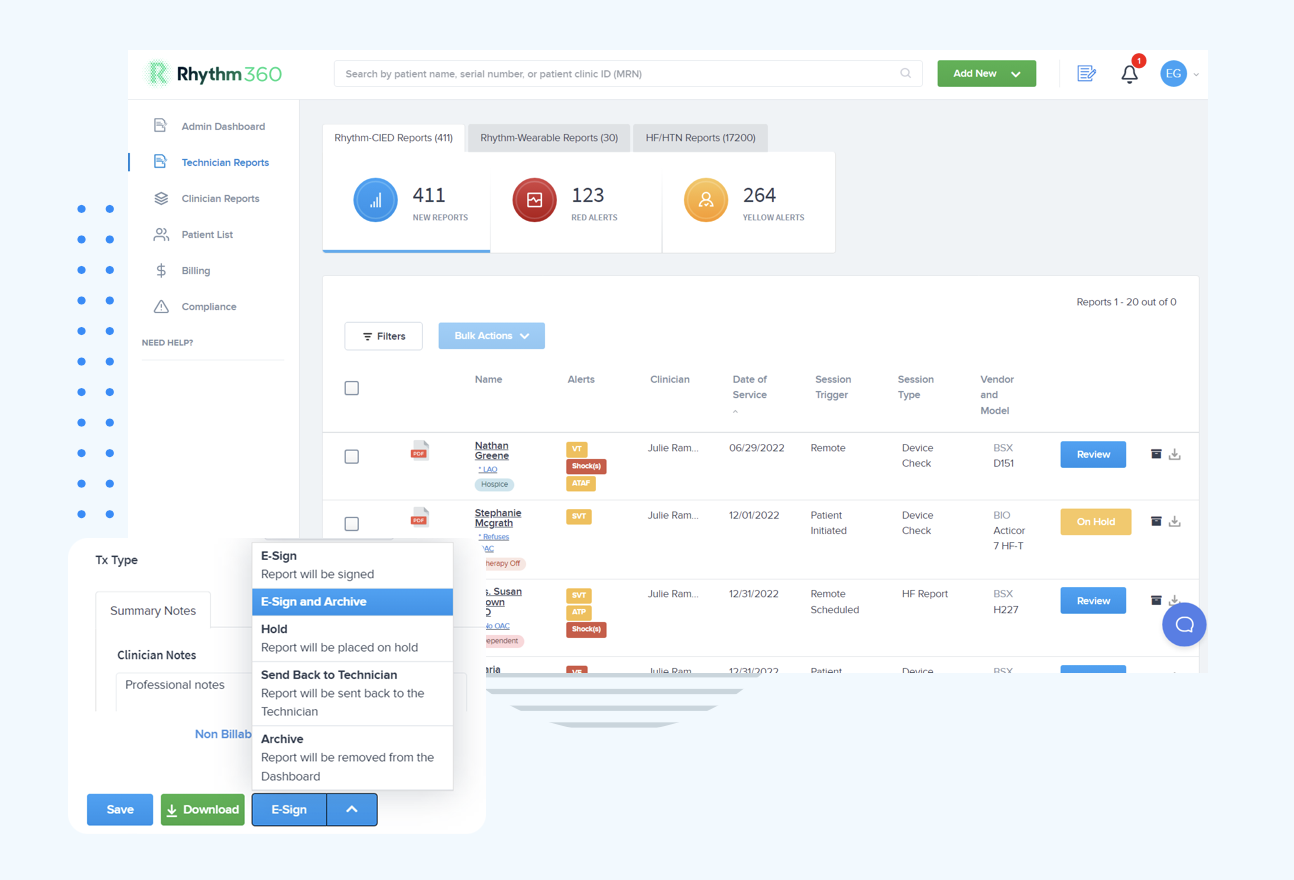
Key features that drive measurable results include:
A mid-sized electrophysiology clinic adopted Rhythm360 and reduced critical alert response times by 80%. The team handled more patients without adding staff. Revenue per monitored patient rose 300% through better capture and expanded services.
Schedule a demo to see how Rhythm360’s vendor-neutral platform can close revenue gaps and modernize your telemetry program.
Start with a quick self-assessment of your current telemetry billing maturity:
Implementation typically follows a phased timeline. Week 1 focuses on workflow audits and denial analysis. Week 2 covers platform selection and integration planning. Weeks 3 and 4 include staff training and a pilot group of patients. Month 2 supports full deployment, performance tracking, and fine-tuning.
Common pitfalls include underestimating training needs, overlooking 2026 code changes, and skipping clear success metrics. High-performing practices invest in structured change management and keep attention on measurable outcomes throughout the rollout.
The 2026 framework includes 93228 and 93229 for Mobile Cardiac Telemetry, 93298 and 93299 for CIED remote interrogation, and 99454 and 99457 for RPM services. New Category I codes support short-duration monitoring from 2 to 15 days, and Category III codes 0981T-0983T cover wireless IVC sensors. Removal of the 16-day RPM minimum creates new revenue for acute care monitoring.
Rhythm360 captures CIED interrogation data from all major manufacturers and builds compliant documentation for CPT 93299. The platform tracks billable events, enforces timing rules, and generates physician-ready reports that support medical necessity. EHR integration removes manual data entry and preserves complete audit trails for compliance.
Medicare requires strict adherence to CPT criteria, including minimum monitoring days and documented physician supervision. Private payers often add prior authorization, frequency caps, and bundled payments. Medicare supports virtual supervision for qualifying services, while some commercial plans still expect in-person oversight. Clear understanding of these differences helps practices improve reimbursement across payer types.
Core telemetry billing elements include physician orders with defined monitoring duration, documented clinical indications and symptoms, device setup and connection verification, daily monitoring logs with clinical correlation, and physician interpretation with actionable findings. Teams should confirm medical necessity, maintain proper timing between services, and verify complete documentation before claim submission.
Effective denial prevention centers on complete documentation, accurate CPT selection, and timely claim submission. Standardized workflows should capture every required element and include real-time eligibility checks. Regular staff training and review of denial trends help identify recurring issues and fix them before they affect revenue.
The 2026 cardiac telemetry environment rewards practices that pair automation with disciplined billing strategy. The seven strategies in this guide, from mastering new CPT codes to adopting vendor-neutral platforms, give cardiology groups a clear roadmap to reclaim lost revenue and strengthen patient care.
Manual, fragmented workflows cannot keep pace with payer scrutiny and expanding monitoring options. Practices that invest in automation platforms like Rhythm360 gain sustainable growth through higher efficiency, fewer denials, and broader service lines.
Your practice can either continue losing revenue to preventable denials and administrative friction or shift to automation that delivers up to 300% revenue increases and 80% faster response times. Schedule a demo today to close revenue gaps and position your practice as a leader in cardiac telemetry.