Last updated: August 24, 2026
Cardiac workflow automation for device clinics uses a unified, vendor-neutral software platform that replaces manual steps across the full monitoring cycle. The platform automatically ingests CIED transmission data from all OEM portals, applies AI-powered triage to prioritize clinically significant alerts, generates compliant documentation, and routes structured findings to the EHR and billing system. Clinics move from portal-by-portal work to a single, streamlined workflow.
The 2023 HRS international consensus statement offers guidance on remote monitoring for pacemakers, ICDs, CRTs, and implantable loop recorders, including clinic staffing and workflows. Many remote-monitoring-capable implanted devices still are not activated for remote monitoring, and operational friction drives much of this gap rather than clinical reluctance.
The technical architecture of remote monitoring involves three layers: the implantable device, the home monitor transmitting via Wi-Fi, cellular, or landline, and the manufacturer-managed cloud server. Each OEM maintains a proprietary server and portal, so a clinic with four device manufacturers manages four disconnected data streams. Andrew Beaser, MD, Associate Professor of Medicine at the University of Chicago Medicine, described pre-implementation workflows as “a major challenge and incredibly difficult.”
Gaurav A. Upadhyay, MD, FACC, FHRS, Director of the Pacing & Defibrillation Device Clinic at UCM, noted: “Staffing was always an issue for our center, because our device clinic — like many other medical centers — had struggled with technician turnover and timely weekend coverage.” Automation directly addresses both the data fragmentation and the staffing strain that fragmentation creates.
Manual, portal-dependent workflows slow response times and limit revenue capture, while automated workflows compress review time and standardize documentation. These operational differences translate into measurable time and revenue impacts. The table below compares representative benchmarks for a manual device clinic workflow against the Rhythm360 automated workflow, based on published platform capabilities and documented client outcomes.
| Workflow Step | Manual Process Time | Rhythm360 Time | Outcome |
|---|---|---|---|
| OEM portal login & data retrieval | 15–30 min per manufacturer per day | Automated ingestion via API, HL7, XML, and computer-vision PDF parsing | Eliminates redundant logins across all OEM portals |
| Alert triage & prioritization | Manual review of all transmissions, with about 40% of transmissions classified as alerts | AI triage filters non-actionable alerts with >95% accuracy for arrhythmia detection | Up to 80% reduction in critical alert response time |
| EHR documentation & data entry | Manual transcription per transmission | Bi-directional HL7/FHIR integration with Epic, Cerner, Athenahealth, and others | Eliminates manual re-entry, data lands directly in the clinical record |
| CPT code capture & billing documentation | Manual tracking of transmission days, management minutes, and interval windows | Automated CPT documentation for 93298, 93299, 99454, 99453, 99457, and more | Revenue capture increased by up to 300% |
| Data transmissibility & reliability | Dependent on individual OEM server uptime, gaps often undetected | Redundant feeds and AI gap-filling achieve >99.9% transmissibility | Critical transmissions reach the EHR even during OEM downtime |
This eight-step sequence shows how Rhythm360 moves a CIED transmission from device to documented, billable clinical record.
The operational goal of AI-assisted triage is to condense high-volume alert streams into a smaller set of actionable cases, so clinicians spend less time on non-actionable transmissions and more time on clinically important events. In a device clinic, the AI layer sits between raw OEM data and the clinician worklist and reshapes what reaches the team each day.
Rhythm360’s AI triage filters non-actionable alerts and prioritizes critical arrhythmias while maintaining clinical accuracy above 95% for arrhythmia detection, including ventricular tachycardia and atrial fibrillation. The system does not replace clinical judgment. It ensures that judgment focuses on the transmissions that matter most and delivers the response-time improvements shown in the comparison above.
The clinical stakes are concrete. Andrew Beaser, MD, at UCM explained: “We are able to address these issues earlier; rather than waiting for a 3-month visit, we can call patients in for evaluation.” A critical arrhythmia flagged on a Saturday morning can result in anticoagulation or device reprogramming by Saturday afternoon. Manual, portal-dependent workflows rarely support that level of responsiveness.
Andrew Beaser, MD, also noted: “Decision support, including AI-assisted decision support, will become increasingly important as data volumes grow.” With UCM reviewing more than 73,000 reports annually through Rhythm360, AI triage already operates at scale in a real-world clinic.
Rhythm360 achieves bi-directional EHR integration with Epic, Cerner, Athenahealth, eClinicalWorks, Greenway Health, and other major platforms. Orders and patient context flow from the EHR into Rhythm360, and completed reports, alerts, and documentation return to the EHR without manual transcription.
Building discrete fields in Epic so device data lands directly in the clinical workflow, similar to laboratory test results, is central to remote monitoring at scale. Rhythm360’s integration architecture delivers this model in practice. Patient readings land directly in the clinical record rather than remaining in a parallel dashboard, which supports unified care coordination.
Implementation, including EHR integration setup, typically takes from a few days to a few weeks. This timeline minimizes disruption to existing clinical operations. Gaurav A. Upadhyay, MD, at UCM observed: “We have improved billing and accountability for our patients after the integration.”
Watch Rhythm360’s EHR integration in a live demo and see how data moves directly into your current workflow.
Billing for remote cardiac monitoring follows a structured set of CPT codes, each with specific documentation requirements and monitoring interval thresholds. The core CIED remote monitoring codes are 93294 (professional component, pacemakers), 93295 (professional component, ICDs or CRT-D), 93296 (technical component, pacemakers or ICDs), 93297 (professional component, ILRs), and 93298 (technical component, ILRs or ICMs).
The 2026 Medicare updates did not alter CPT 93298, which continues to cover remote interrogation device evaluation across a monitoring period of up to 30 days. Two new codes effective January 1, 2026, 99445 for 2–15 days of transmitted home data and 99470 for 10–19 minutes of management time, now address short post-discharge and post-procedure episodes that previously fell below billing thresholds. Capturing these codes requires per-patient tracking infrastructure that manual workflows cannot sustain.
This is where automation delivers measurable value. Rhythm360 supports automated CPT code documentation for 93298, 93299, 99454, 99453, 99457, and additional codes through its bi-directional EHR integration. The platform tracks transmission-day counts, management minutes, and interval windows per patient and generates audit-ready documentation at the point of report signature. Common billing errors, including billing outside the required monitoring interval, failing to capture the technical component alongside the professional component, and lacking dated physician interpretation, trigger denials and create audit risk. Rhythm360’s automated tracking is designed to prevent each of these failure modes.
Rhythm360’s onboarding process minimizes operational disruption while clinics transition from manual to automated workflows. EHR integration and platform configuration typically complete within a few days to a few weeks, depending on the complexity of the existing environment. The checklist below helps clinic operators assess readiness before implementation.
A vendor-neutral platform ingests and normalizes data from all major CIED manufacturers, including Medtronic, Abbott, Boston Scientific, and Biotronik, without separate portal logins or manual reconciliation. True vendor neutrality means the platform handles every data format those manufacturers produce, including APIs, HL7 messages, XML files, and unstructured PDFs parsed via computer vision. Rhythm360 achieves this through a multi-method ingestion architecture combined with redundant data feeds, so a single OEM server outage does not create a gap in the patient record. A device technician then reviews any patient’s complete transmission history in one unified dashboard, regardless of implant manufacturer.
Rhythm360 automates tracking of the variables that determine CPT code eligibility, including transmission days per monitoring period, management minutes logged, and the specific interval windows required for codes such as 93294, 93295, 93296, 93297, 93298, 99453, 99454, and 99457. The platform generates compliant documentation at the point of report signature and routes structured billing data through its bi-directional EHR integration. This automation removes the manual tracking burden that leads to missed codes, interval errors, and denied claims. Practices implementing Rhythm360 have achieved revenue increases of up to 300% through improved CPT capture, higher staff efficiency, and the addition of RPM service lines for heart failure and hypertension patients.
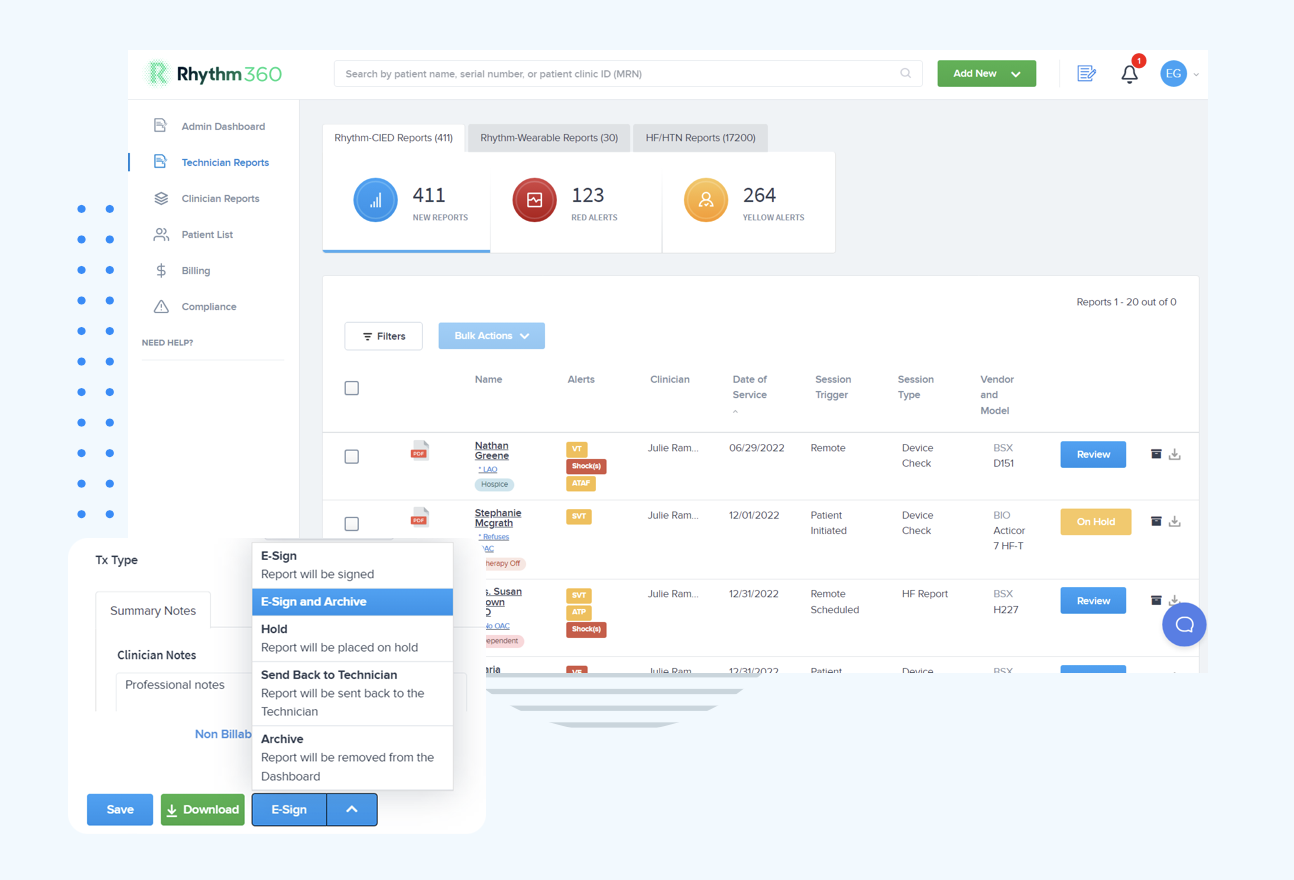
Rhythm360’s AI triage engine surfaces the highest-acuity findings first so clinicians see the most urgent issues at the top of the queue. Prioritized alert categories include ventricular tachycardia, ventricular fibrillation, new-onset atrial fibrillation, ICD shock delivery, lead malfunction, elective replacement indicator (ERI) and recommended replacement time (RRT) notifications, and significant physiologic changes in heart failure patients such as elevated pulmonary artery pressure or rapid weight gain. Non-actionable transmissions, such as routine scheduled checks with no clinically significant findings, are filtered before reaching the clinician worklist. The system maintains clinical accuracy above 95% for arrhythmia detection while delivering the critical alert response-time improvements documented earlier. Optional 24/7/365 oversight by certified cardiac technicians (CCTs) supervised by physicians supports clinics that need extended coverage.
Implementation, including EHR integration setup, typically takes from a few days to a few weeks, depending on the clinic’s existing infrastructure, EHR system, and number of OEM manufacturers in the patient population. The onboarding process runs in parallel with existing workflows so patient monitoring continues during the transition. Rhythm360’s SaaS-based pricing model scales with clinic size and platform usage and avoids the large upfront costs associated with legacy on-premise systems. Clinics designate an internal implementation lead who coordinates with the Rhythm360 onboarding team on EHR configuration, user access provisioning, and staff training.
Rhythm360 supports distinct but integrated service lines for Rhythm-CIED, which covers implantable devices including pacemakers, ICDs, CRT devices, and implantable loop recorders, and for heart failure and hypertension remote physiological monitoring. The HF or HTN service line includes patient onboarding checklists, automated billing support for RPM codes including 99453, 99454, and 99457, and an AI algorithm licensed from Cedars-Sinai that provides personalized Guideline-Directed Medical Therapy recommendations for heart failure with reduced ejection fraction. Supporting research documented 90.8% cardiologist agreement and a 74% reduction in hospitalizations. Both service lines operate within the same centralized dashboard, so clinical staff manage rhythm disorders, heart failure, and hypertension without switching systems.
Fragmented OEM portals, manual alert review, and disconnected billing documentation no longer match 2026 transmission volumes. UCM reviewed more than 73,000 reports annually through Rhythm360, averaging more than 18,000 reports per quarter, and documented earlier interventions and improved billing accountability. The operational model that made that scale possible, including unified data ingestion, AI triage, bi-directional EHR integration, and automated CPT tracking, now fits cardiology practices and electrophysiology clinics of every size.
Rhythm360 delivers the critical alert response times, data transmissibility rates, and revenue outcomes documented throughout this analysis. Implementation takes days to weeks, not months, and the platform scales from solo EP practices to large integrated health systems without a rip-and-replace approach to existing EHR infrastructure.
Request a personalized demo for your practice and see how Rhythm360 can support your device clinic’s next stage of growth.