Cardiology practices can bill CPT 99454 once every 30 days per patient when at least 16 days of physiologic data are collected and transmitted. Under 2026 Medicare Physician Fee Schedule guidelines, CPT 99454 for remote patient monitoring device data can be billed once every 30 days, and this timing follows a rolling 30-day period instead of strict calendar month boundaries.
This billing frequency applies to cardiology use cases such as heart failure monitoring with CardioMEMS weight and blood pressure data, hypertension management with wearable devices, and chronic disease tracking. The 30-day rule applies separately to each patient, so practices can stagger billing cycles based on individual enrollment dates.
The table below shows how the number of monitoring days determines which code to bill and the typical reimbursement for each scenario.
Days Monitored | Billable CPT Code | Cardiology Example | Reimbursement |
2-15 days | 99445 | Short-term HF monitoring | ~$47 |
16-30 days | 99454 | Monthly CardioMEMS data | ~$47-52 |
Less than 2 days | Not billable | Insufficient data | $0 |
The 16-Day Rule requires CPT 99454 to be billed when the patient transmits data for 16 or more days in a 30-day period, and practices can aggregate data across multiple devices when appropriate. For cardiology practices, qualifying physiologic data includes weight measurements, blood pressure readings, and pulse oximetry for heart failure and hypertension patients.
CIED transmission data does not qualify for CPT 99454 billing. Pacemaker, ICD, and implantable loop recorder transmissions should be billed using CPT codes 93298 and 93299 instead. This separation avoids billing conflicts and supports compliance with device-specific monitoring codes.
Data Type | Qualifying for 99454? | Cardiology Example | Alternative Code |
Weight/BP | Yes | HF scale readings | N/A |
Pulse oximetry | Yes | COPD/HF monitoring | N/A |
CIED transmissions | No | Pacemaker data | 93298/93299 |
Manual entries | No | Patient-logged symptoms | N/A |
CPT 99454 can be billed with specific RPM codes when practices follow clear pairing rules. CMS's 2026 Final Rule categorizes RPM CPT codes into device-based (99453, 99445, 99454) and time-based (99470, 99457, 99458) groups with no billing restrictions between these categories.
Effective combinations include CPT 99453 for device setup once per device with at least 2 days of data, CPT 99454 for monthly device data, and CPT 99457 or 99458 for monthly care management time. Codes 99454 and 99445 remain mutually exclusive for a single patient in the same 30-day period, so practices must choose the appropriate code based on monitoring duration.
Code Combination Compliance Checklist:
The CMS CY 2026 Medicare Physician Fee Schedule Final Rule introduces new RPM codes, such as CPT 99445 and 99470, to support billing for short-term or intermittent data monitoring, which creates new revenue opportunities and new compliance exposure for cardiology practices.
CPT 99445 for 2 to 15 days of monitoring at approximately $47 reimbursement gives cardiology teams more flexibility for short-term cardiac monitoring. Audit risk increases when practices overlap CIED device monitoring with RPM codes or fail to track data transmission days accurately across multiple devices.
A common cardiology pitfall involves missed atrial fibrillation alerts caused by weak data tracking systems, which can erase billing opportunities and create patient safety concerns. Practices benefit from automated systems that support continuous data capture and compliant documentation for every billable event.
Rhythm360 gives cardiology practices a vendor-neutral infrastructure that supports maximum CPT 99454 revenue while maintaining compliance. The platform automatically tracks 16 or more days of data transmission across wearable devices used for heart failure and hypertension monitoring.
The AI-powered data normalization system maintains greater than 99.9% uptime through redundant data feeds and computer vision technology, so billable events are not missed because of technical failures. Automated documentation generation reduces administrative burden by 80 percent and produces audit-ready compliance records for all RPM billing codes.
One 200-patient electrophysiology clinic implemented Rhythm360 and captured an additional $15,000 in monthly RPM revenue through automated 99454 billing and streamlined care management workflows. The platform's integrated communication hub and mobile app helped clinicians respond to critical alerts 80 percent faster while preserving complete billing documentation.
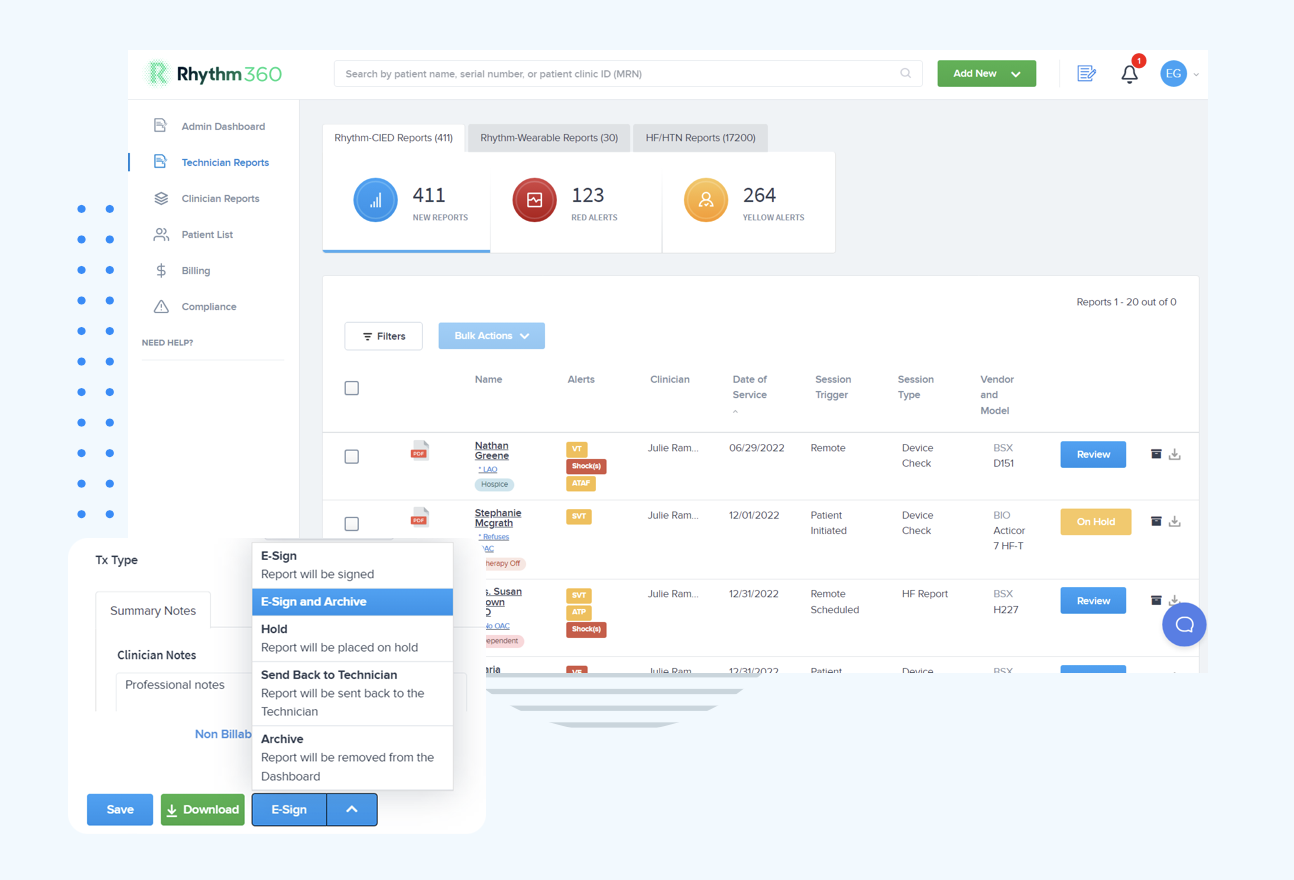
Revenue cycle management automation includes real-time tracking of billable thresholds, automated claim generation, and integrated EHR documentation that supports both device-based codes, such as 99454 and 99445, and time-based care management codes such as 99457 and 99458. Schedule a Rhythm360 demo to see how automated CPT 99454 billing can change your cardiology practice revenue.
Billing Step | Requirements | Rhythm360 Feature | Compliance Note |
Data Collection | 16+ days in a 30-day period | Automated tracking | Rolling period, not calendar |
Device Qualification | FDA-cleared, auto-transmission | OEM integration | Excludes CIED data |
Documentation | Transmission logs, patient data | Audit-ready reports | Required for claims |
Billing Frequency | Once per 30 days per patient | Cycle management | Patient-specific timing |
No, CPT 99454 can only be billed once every 30 days per patient. The rolling 30-day cycle explained above prevents billing twice within any 30-day window, even when both dates fall in the same calendar month. Attempts to bill 99454 twice within a single 30-day period often trigger claim denials and potential audit flags.
No, as noted in the data requirements section, CIED transmissions require separate billing with codes 93298 and 93299 and cannot be combined with 99454. CPT 99454 applies only to external physiologic monitoring devices such as weight scales, blood pressure monitors, and pulse oximeters.
The 2026 national average non-facility reimbursement for CPT 99454 ranges from approximately $47 to $52, and cardiology practices often achieve higher per-patient reimbursement. Medicare reimbursement varies by geographic location and payer contracts, and cardiology practices frequently outperform primary care providers in RPM revenue capture.
As explained in the billing frequency section above, 99454 follows a once-per-30-days rule with no annual limit, which supports ongoing chronic disease management. Practices can continue billing as long as each 30-day period meets the 16-day data transmission requirement and all documentation remains complete.
Yes, CPT 99454 for device data and 99457 for care management time can be billed together because they represent different service categories. CPT 99454 covers device supply and data transmission, and 99457 covers clinical staff time spent on patient care management. Both codes can be submitted for the same patient in the same billing period when all requirements for each code are satisfied.
Stop revenue leakage from missed CPT 99454 opportunities and inconsistent documentation. Rhythm360's automated tracking and compliance workflows help your cardiology practice capture every billable event while maintaining audit-ready records.
Schedule a Rhythm360 demo today to improve RPM billing efficiency and increase revenue potential.