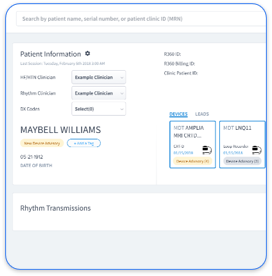
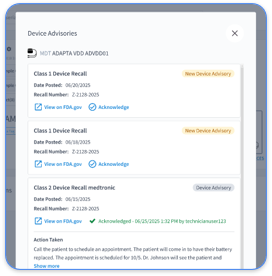
Explore how Rhythm360 prevents device-type mismatch denials
CPT codes in the 90000 series cover medicine services, including the full spectrum of cardiovascular procedures. Cardiology occupies a dense portion of that series, from non-invasive diagnostics like ECGs and echocardiograms through high-complexity interventions such as electrophysiology ablation and device implantation. Each code describes a specific service unit, including what was performed, by whom, and in what clinical context.
Cardiovascular CPT codes are procedure codes only, so they describe the service rendered rather than the reason for it. That second function belongs to the ICD-10-CM diagnosis codes submitted alongside them on the claim. A technically correct CPT code paired with an unsupported or unspecified diagnosis code will deny for medical necessity rather than coding error. CPT codes report what was done; ICD-10-CM codes report why it was done, and payers adjudicate by checking whether the submitted diagnosis plausibly justifies the billed procedure.
Cardiology’s code density also means that a single patient encounter can generate codes from multiple families simultaneously:
A single cardiology visit may generate an E/M code, a CPT code for a diagnostic procedure, a separate interpretation code, and one or more ICD-10 diagnosis codes. Getting the interaction between those code families right, including modifiers, bundling rules, and component splits, is where most cardiology revenue leakage originates.
The 2026 CPT code set included 288 new codes, 84 deletions, and 46 revisions across multiple specialties including cardiology. Cardiology-specific changes were substantial, particularly in the PCI family. Claims are coded to the code set in effect on the date of service, so 2026 changes do not affect 2025 claims. Systems that apply one rule set to both years create transition-period denials.
The table below maps each major cardiology code family to its range and the 2026 changes that affect it, so you can see which families require charge-master and template updates.
| Code Range | Family Name | Key 2026 Notes |
|---|---|---|
| 92920–92998 | Percutaneous Coronary Interventions | Six branch add-on codes deleted (92921, 92925, 92929, 92934, 92938, 92944); new codes 92930 (complex/bifurcation PCI) and 92945 (CTO antegrade + retrograde); thrombolysis codes 92975 and 92977 deleted |
| 93000–93042 | ECG and Monitoring | 12-lead ECG (93000 global, 93005 technical, 93010 professional); rhythm ECG 93040–93042; ambulatory cardiac monitoring uses separate codes such as 93224–93227 and related codes |
| 93303–93355 | Echocardiography | 93306 (complete TTE with Doppler), 93307 (without Doppler), 93308 (limited); stress echo 93350/93351/93352; TEE 93312–93318; fetal echocardiography uses separate codes (76825–76828) |
| 93451–93462 | Cardiac Catheterization | All-inclusive combination codes; catheter placement, imaging supervision, and injection bundled into base code; 0-day global period |
| 93501–93572 | Cardiac Catheterization and Intravascular Measurement | Cardiac catheterization codes, including intravascular Doppler/FFR (93571–93572 revised for 2026) |
| 93600–93662 | EP Studies, Monitoring, and Ablation | EP studies under 93600–93624 and ablation procedures under 93650–93657; autonomic device interrogation codes 93145–93146 deleted, replaced by 64654–64659 |
| 93279–93298 | Cardiac Device Evaluation and Remote Monitoring | Pacemaker/ICD 90-day cycle (93294–93296); physiologic monitor and loop recorder 30-day cycle (93297–93298); device-specific structure for 93297 and 93298 |
| 93797–93798 | Cardiac Rehabilitation | 93797 (without continuous ECG monitoring), 93798 (with continuous ECG monitoring); billed per session |
| 75557–75574 | Cardiac CT and MRI | New Category I code 75577 for coronary plaque assessment replaces deleted Category III codes 0623T–0626T |
Operational note: Billing a deleted 2025 code in 2026 produces an automatic invalid-code denial rather than a review, so purge deleted codes from EHR templates, charge masters, and superbills before Q1 claims go out.
Beyond the full code ranges, a small group of high-volume codes drives most cardiology claim activity. The table below highlights these codes so teams can focus audits and education where denials are most likely.
| CPT Code | Description |
|---|---|
| 93000 | 12-lead ECG with interpretation and report (global); 93005 = tracing only; 93010 = interpretation only |
| 93306 | Complete transthoracic echocardiogram with 2D, M-mode, spectral and color Doppler (global) |
| 93015 | Cardiovascular stress test with supervision, continuous ECG monitoring, and interpretation/report (global) |
| 93458 | Left heart catheterization with coronary angiography and imaging supervision and interpretation |
| 92928 | Percutaneous transcatheter placement of intracoronary stent(s), major coronary artery or branch(es) |
| 93653 | Comprehensive electrophysiologic evaluation with insertion and repositioning of multiple electrode catheters, induction or attempted induction of an arrhythmia with right atrial pacing and recording, right ventricular pacing and recording, and His bundle recording when performed, with catheter ablation of an arrhythmogenic focus for treatment of supraventricular tachycardia |
Operational note: Doppler add-on codes 93320, 93321, and 93325 are appropriate companions only to 93307 or 93308, not to 93306, which already includes Doppler. Billing them together creates an unbundling error that will be denied.
Of all the families in the table above, device monitoring generates the most preventable denials. It is also the family where device-type mismatch and unbilled technical components drive the highest denial volume in cardiology billing. The codes divide into two distinct cycle structures, so teams must treat them as separate workflows.
CPT 93294 covers the professional component of remote monitoring for single-chamber and dual-chamber pacemakers, requires physician or qualified non-physician practitioner review with a documented clinical interpretation, and is billed on a 90-day cycle rather than per transmission. CPT 93295 is the professional component for ICDs, including CRT-D devices, and mirrors the 90-day requirements of 93294. CPT 93296 is the single technical component code serving both the pacemaker and ICD families, covering remote data acquisition, receipt of transmissions, technician review, and distribution of results.
CPT limits the pacemaker and ICD remote monitoring families to once per 90 days and blocks reporting when the monitoring period runs under 30 days. Billing at the point of interrogation rather than at period end is the most common cause of a CO-151 frequency denial in this family.
CPT 93297 and CPT 93298 are device-specific codes. CPT 93297 covers physiologic monitors, and CPT 93298 covers loop recorders.
CMS deleted the technical code G2066 effective January 1, 2024, and folded the technical component work into CPT 93297 and 93298, which CMS assigned global, professional (modifier 26), and technical (modifier TC) indicators. Each code is billable once per 30 days and can be billed global when one entity performs both components, with modifier -26 for professional analysis, review, and report only, or with modifier -TC for technical work only such as data acquisition, transmission processing, technician review, and results distribution.
Treat 93297 as the physiologic monitor code and 93298 as the loop recorder code. Both accept global, -26, and -TC billing. CPT 93298 is also blocked when the monitoring period runs under 10 days.
CPT 99453 covers initial setup and patient education on remote monitoring device use and is billed once per episode of care. As of the 2026 descriptor update, 99453 is explicitly an initial service no longer tied to a minimum 16-of-30-day data requirement. CPT 99454 covers device supply with data transmission for 16–30 days within a 30-day period. New for 2026, CPT 99445 covers device supply for 2–15 days of transmitted data, filling a gap that previously left short post-discharge monitoring episodes unbillable. CPT 99457 covers the first 20 minutes of monthly remote monitoring treatment management time, and CPT 99458 is the add-on for each additional 20 minutes. Codes 99457 and 99458 require a minimum of 20 minutes of clinical staff or physician time per calendar month, documented separately from any E/M time billed the same month.
Operational note: Device-type mismatch and unbilled technical components are the two most common denial drivers in this family.
The global code applies when one provider performs and documents both components of a diagnostic service. Use modifier -26 when the physician performs only the interpretation and report, typically because a facility owns the equipment. Use modifier -TC when an entity provides only the equipment, supplies, and technician services.
When a cardiology diagnostic service is performed in a hospital outpatient department, the global service must be split: the hospital bills the technical component (CPT + modifier TC) on its facility claim, and the interpreting physician bills the professional component (CPT + modifier 26) on the professional claim. The global code with no modifier is correctly reported only in the non-facility office setting when the physician owns the equipment.
Not every CPT code supports a component split. Coders must check the Medicare Physician Fee Schedule database for the code’s professional/technical component indicator before appending modifier 26 or TC. The stress test family (93015–93018) splits at the code level rather than by modifier: 93016 is supervision only, 93017 is tracing only, and 93018 is interpretation only. CPT 93015 cannot be split using modifier 26 or TC.
Operational note: Billing modifiers 26 and TC together as a global fee on a study acquired on equipment the practice does not own is the single most common component error in cardiology. Payers catch it because the facility’s own claim shows a conflicting technical charge for the same date and patient.
The National Correct Coding Initiative (NCCI) defines which procedure pairs cannot be billed together in the same encounter. The NCCI Policy Manual Chapter 11 (Medicine, Evaluation and Management Services, CPT Codes 90000-99999), which includes a Cardiovascular Services subsection, is the authoritative reference for cardiology bundling rules for medicine services, while cardiovascular surgical procedures (CPT Codes 30000-39999) are addressed in Chapter 5. NCCI edits update quarterly, so a modifier override valid in a prior quarter can fail in the current one.
The ECG and stress-test families are a primary bundling zone. The NCCI Policy Manual guidance states that cardiovascular stress tests include the ECG strips obtained during the test, and those ECG services are not separately reportable when they are part of the stress test. Similarly, NCCI edits prohibit reporting CPT 93015 alongside CPT 93351, because the ECG supervision, recording, and interpretation components already sit inside 93351.
The NCCI Correct Coding Modifier Indicator (CCMI) governs whether a bundled pair can be separated. A CCMI of 0 means the codes cannot be reported together under any circumstances; a CCMI of 1 means the pair may be reported together only in limited circumstances using NCCI-associated modifiers (59, XE, XP, XS, or XU) when the services are separate and distinct. The more specific X-modifiers are preferred over modifier 59 where they apply: XE (separate encounter), XP (separate practitioner), XS (separate structure), and XU (unusual non-overlapping service).
Operational note: Before writing any bundling appeal, verify the NCCI modifier indicator for the pair and the MUE Adjudication Indicator for the code. If either returns the non-appealable value (indicator 0 or MAI 2), no argument reverses it.
Cardiology office/outpatient visits are reported under the standard E/M code set: 99202–99205 for new patients and 99211–99215 for established patients (with 99212–99215 covering the higher-level established-patient visits). Established-patient cardiology office visits 99212–99215 are billed on either total time or medical decision making, not both together; 99214 requires 30–39 minutes of total time or moderate-complexity MDM, and 99215 requires 40–54 minutes or high-complexity MDM.
When a cardiologist performs an office visit and a same-day procedure such as an ECG, stress test, or catheterization, modifier 25 must be appended to the E/M code to indicate a significant, separately identifiable evaluation and management service. An E/M note that only describes the indication for the stress test does not qualify for modifier 25; a note that addresses the patient’s chest pain, reviews medication compliance, adjusts therapy, and documents clinical reasoning does qualify. Without modifier 25, the payer bundles the E/M payment into the procedure.
CPT codes report the procedure, test, or service performed, while ICD-10-CM codes report the diagnosis or reason for the encounter. On a cardiology claim, the CPT code tells the payer what was done, and the ICD-10-CM code tells the payer why it was done. Both are required on every claim, and each procedure line must link to a diagnosis code that establishes medical necessity.
CPT codes are maintained by the AMA and update annually effective January 1. ICD-10-CM codes are maintained by NCHS/CDC with CMS and update annually effective October 1. The two systems operate on independent schedules. CPT is exclusively a procedure and service code set and never codes diagnoses. ICD-10-PCS, a separate seven-character system, is used for inpatient hospital procedure coding and is not interchangeable with CPT.
CPT and ICD-10 codes must always align logically, linking the procedure performed to the diagnosis that justifies it; incorrect or mismatched pairings are one of the most common reasons for denials and audits in cardiology billing. A claim for a nuclear stress test submitted without a supporting diagnosis such as coronary artery disease or chest pain will fail a medical necessity review regardless of how accurately the procedure was coded.
All cardiology claims for dates of service on or after January 1, 2026 must use the 2026 CPT code set. The primary reference for 2026 procedure valuation is the 2026 Medicare Physician Fee Schedule, which publishes relative value units (work, practice expense, and malpractice) along with global surgery indicators and professional/technical component indicators for covered codes, though separate professional and technical component payment applies only to many diagnostic tests and a limited number of other services. Reimbursement rates are locality-specific and should be verified using the CMS PFS Look-Up Tool for the applicable MAC jurisdiction and place of service.
Bundling rules are governed by the NCCI Policy Manual Chapter 11, which defines procedure-to-procedure edits for cardiology. NCCI edits update quarterly, so practices should verify current edit values in the CMS NCCI PTP Edits Lookup Tool rather than relying on static internal scrubber rules built from a prior quarter.
Key 2026 code-year verification checkpoints for cardiology practices:
Cardiology coding follows AMA CPT guidelines, CMS NCCI bundling rules, and Medicare Physician Fee Schedule indicators. Each procedure code must be supported by an ICD-10-CM diagnosis code that establishes medical necessity. The NCCI Policy Manual Chapter 11 governs which cardiology code pairs can and cannot be billed together. Global surgery indicators determine whether pre- and post-operative services are separately billable. Professional and technical component indicators determine whether a code can be split with modifier -26 and -TC. NCCI edits update quarterly, and the 2026 CPT code set introduced significant changes to the PCI family, including deletion of six branch add-on codes and introduction of two new codes (92930 and 92945). Practices should verify current edit values and code descriptors against the date of service rather than relying on prior-year templates.
As explained above, 93297 and 93298 are device-specific codes. Apply 93297 to implantable cardiovascular physiologic monitors and 93298 to subcutaneous cardiac rhythm monitors such as implantable loop recorders and insertable cardiac monitors. Both codes are billable once per 30-day monitoring period and each carries a global, professional (-26), and technical (-TC) component structure. Bill globally when one entity performs and documents both components. Bill with modifier -26 when only the professional analysis, review, and report were performed. Bill with modifier -TC when only the technical work was performed.
Modifier -26 (professional component) is used when the physician performs only the interpretation and report for a diagnostic service, typically when the equipment is owned by a hospital, ASC, or separate entity. Modifier -TC (technical component) is used when an entity provides only the equipment, supplies, and technician services without performing the interpretation. The global code with no modifier is used only when the same provider or group performs and documents both components, generally in a non-facility office setting where the practice owns the equipment. Before appending either modifier, verify the code’s PC/TC indicator in the Medicare Physician Fee Schedule database, because not every CPT code supports a component split. The stress test family (93015–93018) splits at the code level, not by modifier, so modifier -26 and -TC do not apply to 93015.
Cardiology office visits use the standard evaluation and management code set: 99202–99205 for new patients and 99211–99215 for established patients (with 99212–99215 covering the higher-level established-patient visits). Code selection is based on either total time (face-to-face plus same-day documentation time) or medical decision making complexity, but not both simultaneously. When a cardiologist performs a same-day procedure such as an ECG, stress test, or echocardiogram, modifier 25 must be appended to the E/M code to indicate a significant, separately identifiable evaluation and management service beyond the work inherent to the procedure. The E/M documentation must stand on its own and address clinical issues beyond the indication for the test.
CPT codes and ICD-10-CM codes are separate, distinct code sets maintained by different organizations on different update schedules. CPT codes describe procedures and services performed, so they state what was done. ICD-10-CM codes describe diagnoses and reasons for the encounter, so they state why it was done. Both are required on every cardiology claim. CPT is maintained by the AMA and updates January 1 each year. ICD-10-CM is maintained by NCHS/CDC with CMS and updates October 1 each year. A cardiology claim with a correct CPT code but an unsupported or unspecified ICD-10-CM diagnosis will deny for medical necessity. ICD-10-PCS, a separate seven-character system, is used for inpatient hospital procedure coding and is not the same as CPT.
The 2026 cardiology CPT codes list serves as a reference tool only when teams can apply it consistently in daily workflows. The highest-risk code families, including cardiac device evaluation (93294–93298) and remote physiological monitoring (99453–99457), are also the ones where device-type mismatch and unbilled technical components produce the most preventable denials.
Rhythm360 is the workflow layer that makes this list actionable. The platform consolidates CIED and RPM data across all major device manufacturers, tracks device-specific CPT pairings automatically, and documents each monitoring cycle to prevent device-type mismatch denials and unbilled technical components. Practices using Rhythm360 have achieved up to an 80% reduction in critical alert response times and up to a 300% increase in revenue capture and profitability. These gains come from aligning coding rules with real-world device and monitoring workflows.
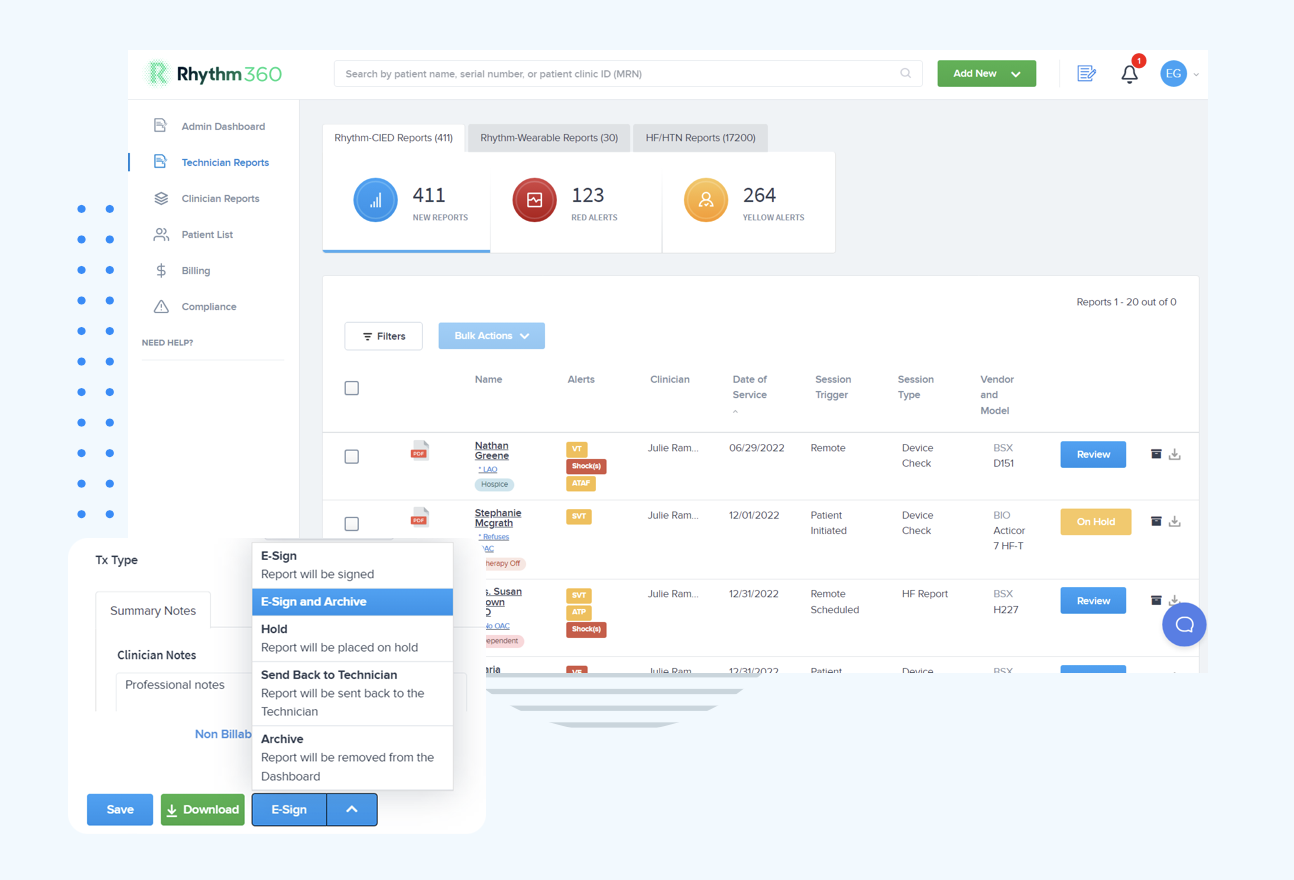
A code list tells you what to bill. Rhythm360 helps ensure you bill it correctly, completely, and on time, across every device and monitoring cycle.
Get a workflow review for your cardiology billing