Last updated: July 13, 2026
Clinic leaders in 2026 rely on a clear evaluation framework before selecting a cardiology platform. The detailed checklist appears later in this guide, but several capabilities deserve early attention. These include unification speed, alert reduction, EHR connectivity, CPT automation, mobile access, and implementation timeline.
Speed of unification sets the baseline. Practices that manage patients with devices from more than one manufacturer need a system that consolidates data feeds within days to weeks, not months. Alert reduction carries equal weight. A 2026 mixed-methods study by Güner and Üçüncüoğlu found that CICU nurses experience alarm fatigue from prolonged exposure to high-frequency non-actionable alarms. Platforms that filter non-actionable noise before it reaches clinical staff directly address this documented risk.
Bi-directional EHR integration with systems such as Epic, Cerner, and Athenahealth determines whether data flows automatically into the clinical record or requires manual transcription. Automated CPT documentation protects revenue. Manual workflows often bill CPT 99457 on only a portion of eligible patient-months, whereas automated workflows can improve capture rates by surfacing real-time at-threshold lists before month-end. Mobile access for on-call clinicians and a proven, short implementation timeline complete the high-level framework that the later decision checklist expands.
See how Rhythm360's alert reduction and EHR integration perform against your current workflow.
In a traditional multi-OEM environment, a device technician begins each morning by logging into separate portals for each manufacturer in the practice's patient population. Each portal uses a different interface, a different alert taxonomy, and a different data export format. The result matches what Andrew Beaser, MD, Associate Professor of Medicine at the University of Chicago Medicine (UCM), described as “a major challenge and incredibly difficult” before his institution implemented a unified platform.
Alert fatigue compounds the login problem. When every OEM portal generates its own notification stream, clinical staff face an undifferentiated flood of alerts with no cross-manufacturer prioritization layer. The 2026 Güner and Üçüncüoğlu study identified a significant positive correlation (Pearson r = 0.58, P < .001) between alarm discomfort and alarm fatigue levels among cardiac ICU nurses. In a remote monitoring context, the same dynamic appears as non-actionable transmissions crowding out clinically significant events.
Revenue leakage follows fragmented workflows. A correctly automated, vendor-neutral workflow for a 500-patient cardiology CCM/RPM panel typically captures $300,000 to $500,000 per year in incremental revenue by closing gaps in 99457/99458 capture, eliminating 99454 denials, and tracking 90-day device cycles across multiple OEM portals. Manual workflows cannot reliably enforce the transmission thresholds and time-tracking requirements that CPT compliance demands.
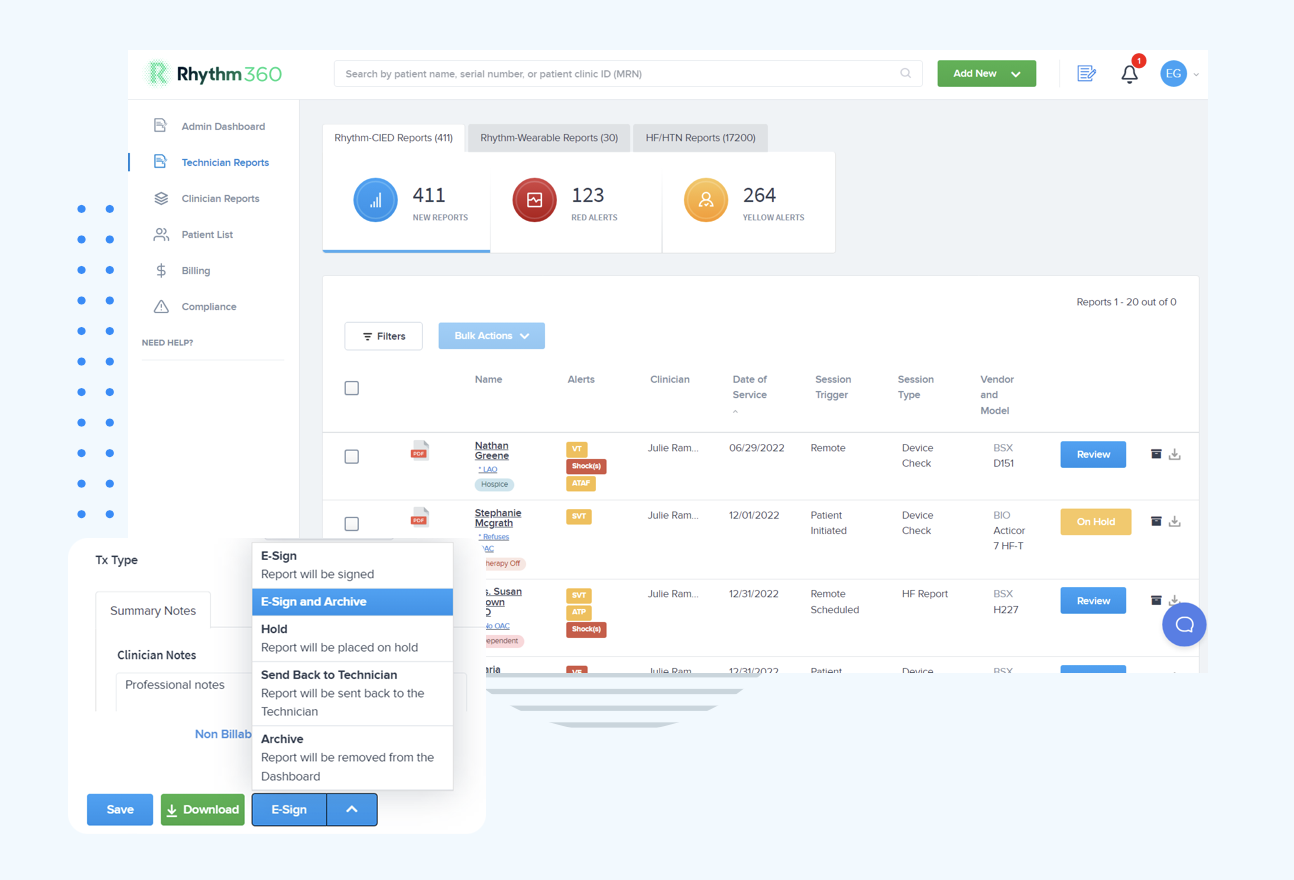
A unified vendor-neutral platform replaces this complexity with a single dashboard. Data from every connected OEM flows into one normalized triage queue. AI-powered alert logic filters non-actionable transmissions before they reach clinical staff. Billing documentation is generated automatically against CPT requirements. Gaurav A. Upadhyay, MD, FACC, FHRS, Director of the Pacing & Defibrillation Device Clinic at UCM, noted, “That was a big piece for us, to have an integrated review of data from trained personnel.”
The following table quantifies the operational and financial impact of moving from fragmented OEM workflows to a unified platform, using documented outcomes from University of Chicago Medicine and RhythmScience platform data.
| Outcome Metric | Traditional Multi-OEM Workflow | Rhythm360 Unified Platform | Source |
|---|---|---|---|
| Critical alert response time | Baseline (manual triage across portals) | Up to 80% faster | UCM White Paper / RhythmScience platform data |
| Revenue generation improvement | Lower CPT 99457 capture rate | Up to 300% revenue increase | SynergyIQ / RhythmScience platform data |
| Data transmissibility | Variable, gaps from OEM server downtime | >99.9% via redundant feeds, computer vision, and AI extrapolation | RhythmScience platform specification |
| Annual report volume (UCM) | Fragmented across multiple portals | 73,000+ reports/year; 18,000+ per quarter | UCM White Paper (2025 data) |
Walk through the five-step unification process with your own OEM mix and EHR.
On-call clinicians managing CIED patients need full access to device data outside business hours. A patient's device may transmit a ventricular tachycardia episode on a Saturday morning. Without mobile access to a unified platform, the reviewing clinician either waits until Monday or attempts to access multiple OEM portals from a personal device, which creates inefficiency and documentation gaps.
Rhythm360's HIPAA-compliant mobile application allows electrophysiologists, NPs, PAs, and RNs to review transmissions, sign reports, and coordinate care from their smartphones. In a real-world scenario, a nurse practitioner on weekend call receives a prioritized alert for new-onset AFib. She reviews the full transmission in the Rhythm360 mobile app, confirms the clinical significance, and initiates anticoagulation protocols within hours of the event, mirroring the intervention that Andrew Beaser, MD, at UCM described: “We are able to address these issues earlier; rather than waiting for a 3-month visit, we can call patients in for evaluation.”
All mobile actions are logged with a full audit trail within the patient record, which satisfies HIPAA documentation requirements and supports CPT billing compliance. The mobile workflow frees clinicians from a specific workstation and directly addresses a common pain point among EP teams that manage high-volume device populations.
Rhythm360 shortens the typical cardiology integration timeline from months to weeks. Standard cardiology EHR and device integration projects often carry significant time and cost burdens. Rhythm360 onboarding and multi-device, multi-EHR integrations typically take from a few days to a few weeks, reflecting the efficiency of the platform's pre-built and validated connections.
The implementation model relies on pre-built OEM connections, HL7 interfaces, and EHR integration templates. Because these components are validated in advance, onboarding, including EHR integration with Epic, Cerner, Athenahealth, eClinicalWorks, Greenway Health, and others, completes in a few days to a few weeks rather than months. Gaurav A. Upadhyay, MD, at UCM confirmed improved billing and accountability outcomes following integration, and the UCM deployment scaled to process more than 73,000 reports annually, demonstrating support for high-volume environments without extended stabilization periods.
The SaaS-based pricing model scales with clinic size and platform usage. This structure removes the high upfront fees associated with traditional on-premise implementations.
Administrators and EP teams in 2026 benefit from a structured checklist when comparing cardiology platforms. The following seven criteria align with the earlier high-level framework and translate directly into clinical and financial outcomes.
Rhythm360 is built to satisfy each criterion in this framework. Apply this seven-point framework to Rhythm360 in a live demonstration.
Rhythm360 maintains greater than 99.9% data transmissibility through a redundant data feed architecture that acts as a fail-safe when any single OEM server experiences downtime. The platform also applies computer vision and optical character recognition to extract data from unstructured PDF reports when structured API or HL7 feeds are unavailable. An AI-powered extrapolation layer fills remaining data gaps, so clinicians retain the most complete and accurate view of a patient's device status. This architecture prevents a server outage at one manufacturer from creating a blind spot in the practice's monitoring workflow.
Rhythm360 automates the documentation required for CPT codes including 93298, 93299, 99454, 99457, and 99458 by tracking transmission counts, enforcing billing window thresholds, and logging the interactive communications required for time-based codes. The platform generates per-patient audit documentation that records exact transmission counts, staff attributions, and time logs, which supports compliance with OIG audit requirements. Practices using automated CPT capture workflows can achieve higher billing rates on eligible patient-months for codes like 99457 compared to manual workflows. Rhythm360's administrative dashboard provides a real-time view of captured and potential revenue by CPT code, allowing billing staff to act before month-end deadlines. Rhythm360 supports billing documentation and workflow automation, while practices retain responsibility for their own revenue cycle management and compliance determinations.
The implementation section above outlines the overall timeline as a few days to a few weeks. The FAQ perspective focuses on what happens during that period. Rhythm360's onboarding process covers OEM portal connections, EHR bi-directional integration setup, staff training on the unified dashboard and mobile application, and configuration of alert triage parameters. Because connections to major OEM portals and EHR systems, including Epic, Cerner, Athenahealth, eClinicalWorks, and Greenway Health via HL7, are pre-built and validated, teams avoid the multi-month timelines associated with custom integrations. The SaaS-based pricing model removes large upfront infrastructure costs and allows the platform to scale as the practice's patient population grows.
Rhythm360's AI triage layer filters non-actionable transmissions before they reach clinical staff and surfaces only events that meet clinically significant thresholds, such as new-onset AFib, ventricular tachycardia, lead malfunction, or ERI/RRT indicators. This approach directly addresses the documented relationship between high-frequency non-actionable alarms and alarm fatigue, which research has linked to delayed responses and missed critical alerts in cardiac care settings. The platform also offers optional 24/7/365 oversight by certified cardiac technicians (CCTs) supervised by physicians, which adds a human review layer for high-acuity events. The combined effect delivers the response-time improvements reported in UCM data while maintaining clinical confidence that meaningful events are not suppressed by the filtering logic.
Fragmented OEM portals, manual data entry, alert fatigue, and missed CPT revenue reflect workflows that never anticipated multi-manufacturer device populations at scale. A vendor-neutral cardiology platform that unifies cardiac device data silos addresses each of these problems through a single, integrated architecture. Clinics gain one dashboard for all OEM data, AI-powered triage that shortens critical response times, automated CPT documentation that supports revenue capture, and HIPAA-compliant mobile access for on-call clinicians.
The University of Chicago Medicine's implementation of Rhythm360 shows this model at scale, with more than 73,000 reports reviewed annually, earlier patient interventions, and improved billing accountability. These outcomes reflect the platform's design rather than exceptional circumstances.
Clinic administrators and EP teams in 2026 can rely on the seven-point framework in this guide to compare options and validate vendor claims with documented results. Rhythm360 is built to meet that standard in real clinical environments. Request a demonstration using your practice's actual device mix and patient volume.