Last updated: July 14, 2026
A 2023 systematic review of drug-drug interaction alerts found override rates ranging from 88% to 95%. CIED monitoring shows the same pattern. High dismissal rates are a structural feature of safety-first remote monitoring, with most OEM-generated alerts being nonactionable across more than 73,000 reports reviewed annually at the University of Chicago Medicine (UCM). Clinicians conditioned by constant nonactionable notifications struggle to distinguish genuinely critical signals from noise.
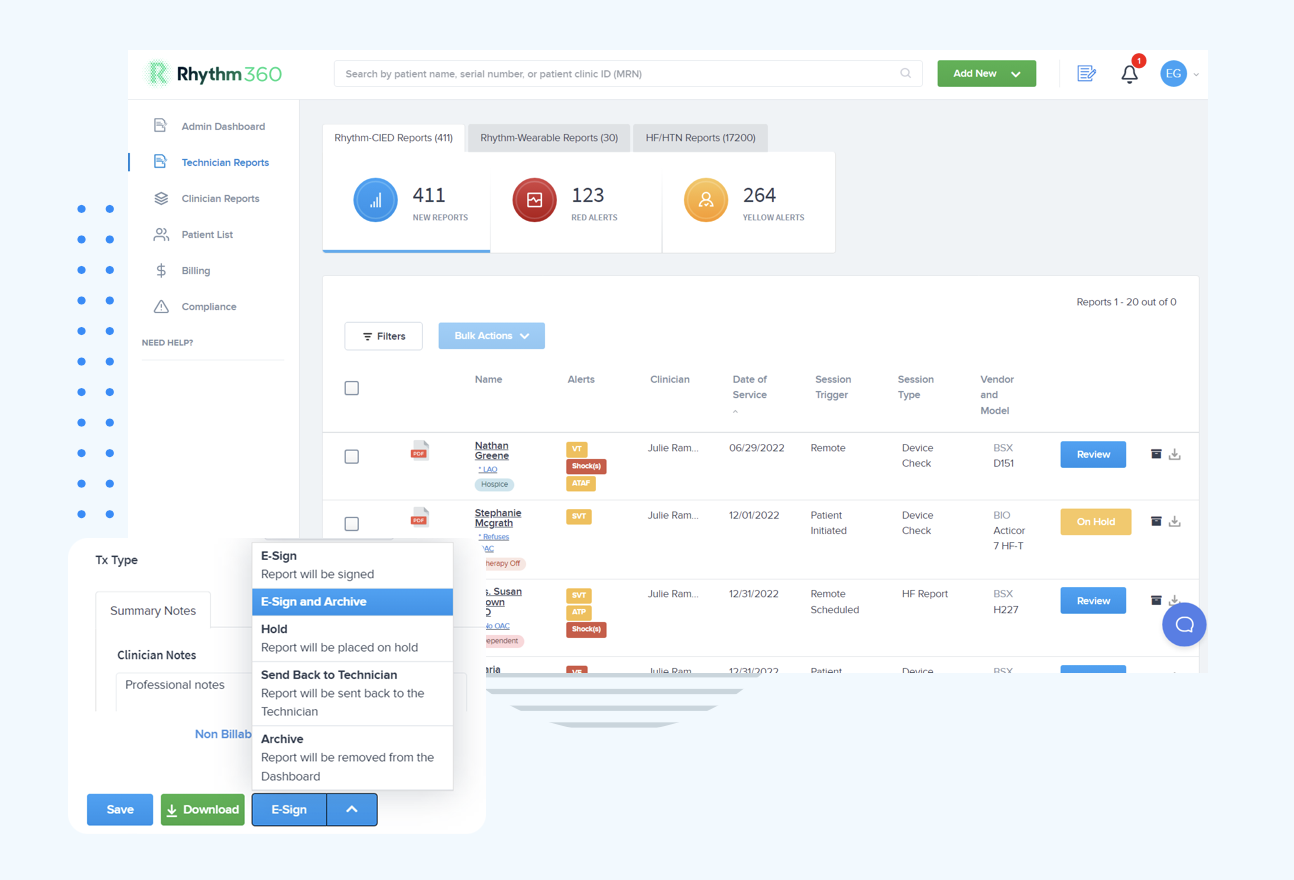
Guideline-based alert reprogramming reduces non-actionable CIED alerts by 74% without increasing adverse outcomes, but most practices lack the infrastructure to implement it systematically. Rhythm360's AI-powered alert triage engine filters nonactionable transmissions and surfaces clinically significant events in priority order. This cuts critical alert response times by up to 80%.
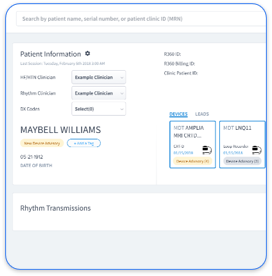
A practice implanting devices from Medtronic, Boston Scientific, Abbott, and Biotronik maintains separate logins, workflows, and data exports for each manufacturer's portal. Reliance on unstructured formats such as PDFs, scanned reports, and free text slows extraction of clinically important information and delays alert prioritization. The result is data silos that make a unified view of a patient's status nearly impossible without heavy manual effort.
Andrew Beaser, MD, Associate Professor of Medicine at UCM, described pre-implementation workflows as "a major challenge and incredibly difficult." Rhythm360 consolidates data from all major OEM portals into one vendor-neutral dashboard. Using API, HL7, XML, and PDF parsing via computer vision, the platform normalizes disparate data streams into a single source of truth. This eliminates redundant logins and manual transcription.
An international survey of 471 device clinic staff across 44 countries revealed significant staffing challenges. Respondents named three tasks as most burdensome and most worth outsourcing: managing disconnected patients, initial transmission review, and patient phone calls.
Gaurav A. Upadhyay, MD, FACC, FHRS, Director of the Pacing & Defibrillation Device Clinic at UCM, stated: "Staffing was always an issue for our center, because our device clinic, like many other medical centers, had struggled with technician turnover and timely weekend coverage." Rhythm360 offers optional 24/7/365 oversight by certified cardiac technicians (CCTs) supervised by physicians. This creates a scalable staffing layer that ensures timely triage regardless of in-house capacity or weekend coverage gaps.
Failure rates for CIED data transmission in remote-monitoring studies can be significant. Separating technical device problems from connectivity issues, like internet outages or patients being out of range, is difficult. Unplugged monitors, monitor malfunction, 4G network upgrades, and hardware replacement all interrupt the data feed before an alert can reach a clinician.
Rhythm360 achieves greater than 99.9% transmissibility through a redundant data feed architecture that acts as a fail-safe when an OEM's server goes down. Computer vision and AI-powered extrapolation fill gaps in unstructured or incomplete transmissions. Connectivity failures at the device or network level no longer translate into missed clinical events.
Traditional EHR integration relies on batch syncing that reflects a prior state, so medication changes or recent ED admissions may not appear when a clinician opens an alert report. Clinicians end up leaving the platform to find that information manually. When anticoagulation status or hospitalization history is missing at the moment an atrial-fibrillation alert is reviewed, this increases time, cognitive load, and decision variability.
This gap shows up across the field, not just in isolated cases. Cardiac device transmissions frequently arrive without implant history, device type, previous interventions, known arrhythmias, or recent clinical events, limiting their usefulness at scale. Rhythm360's bi-directional EHR integration with Epic, Cerner, Athenahealth, eClinicalWorks, and others via HL7 surfaces current patient context at the moment of review. This closes the gap between connected data and current data.
Critical alerts do not observe business hours. A ventricular tachycardia event flagged on a Saturday morning demands the same response as one flagged on a Tuesday afternoon, yet most legacy workflows tether clinicians to a single workstation. Guideline execution varies mainly due to operational capacity constraints, not lack of clinical knowledge or technology. When on-call clinicians cannot access transmissions remotely, response waits until the next workstation session.
Rhythm360's secure, HIPAA-compliant mobile app lets clinicians review transmissions, sign reports, and coordinate care from a smartphone at any time. A nurse receiving a prioritized notification of new-onset AFib on a weekend can start anticoagulation protocols immediately, without returning to the office. That turns a potential stroke into a prevented one.
See how Rhythm360's mobile app keeps on-call clinicians connected around the clock.
Documentation gaps do not just affect care quality; they cost practices money directly. Many cardiac device clinics do not measure remote monitoring performance in any structured way, and of those that do, only a minority track quality metrics. Without structured documentation, billable events for CPT codes such as 93298, 93299, and 99454 go uncaptured, and claims get rejected or never submitted. This financial leakage compounds over time and often stays invisible until a billing audit surfaces the gap.
Rhythm360 automates report generation and CPT-compliant documentation in near-real-time, creating an auditable record for every transmission reviewed. Practices implementing the platform have achieved up to 300% improvement in revenue outcomes through better CPT code capture and improved staff efficiency, without adding billing headcount.
The seven failure modes described above are not independent problems. They form a compounding chain: alert overload exhausts staff, fragmented portals slow retrieval, staffing gaps leave weekends uncovered, connectivity failures create silent data voids, missing context forces manual lookups, mobile inaccessibility delays response, and absent documentation erases the financial record of work performed. Fixing any single failure mode in isolation produces marginal improvement. Fixing all seven at once produces the response-time and revenue gains noted earlier, now realized simultaneously.
Andrew Beaser, MD, at UCM noted: "Decision support, including AI-assisted decision support, will become increasingly important as data volumes grow." Remote patient monitoring platforms are increasingly embedding AI, driven by Medicare coverage decisions and FDA clearances for cardiology algorithms. The operational case for consolidation only strengthens as CIED patient volumes grow.
The table below shows how each of the seven failure modes plays out under a fragmented multi-portal workflow compared to a consolidated Rhythm360 dashboard.
| Workflow Step | Fragmented Multi-Portal Approach | Rhythm360 Single-Dashboard Approach |
|---|---|---|
| Data retrieval | Staff log into separate OEM portals, manually reconciling unstructured PDFs and free-text reports | All OEM data ingested automatically via API, HL7, XML, and computer vision into one vendor-neutral dashboard |
| Alert triage | High rates of alerts are overridden or ignored due to lack of actionability; no AI prioritization layer | AI-powered triage filters nonactionable transmissions and surfaces critical events in priority order; optional 24/7 CCT oversight available |
| Clinical context at review | Batch-synced EHR data reflects a prior state; medication changes and recent admissions may be absent at time of alert review | Bi-directional EHR integration (Epic, Cerner, Athenahealth, eClinicalWorks, others via HL7) surfaces current patient context at moment of review |
| Transmissibility and connectivity | CIED data transmission failure rates can be significant; technical and connectivity failures are difficult to separate and often go undetected until data is weeks overdue | Greater than 99.9% transmissibility via redundant data feeds, computer vision, and AI-powered extrapolation; connectivity failures flagged proactively |
| Documentation and billing | Many clinics do not track structured performance metrics; CPT code documentation is manual and prone to omission | Automated near-real-time report generation with CPT-compliant documentation; auditable record for every transmission reviewed |
Managing separate portals for each device manufacturer creates data silos that prevent a unified view of a patient's status. Staff must maintain multiple logins, learn distinct interfaces, and manually reconcile data exported in different formats. This fragmentation increases retrieval time, raises the chance of transcription errors, and makes it hard to spot trends across a patient's full device history. When a critical alert arrives in one portal while staff work in another, the delay can have direct clinical consequences. Consolidating all OEM data into a single vendor-neutral platform removes these silos and cuts the administrative burden on device clinic staff.
Device clinic staffing is a near-universal challenge. When teams are understaffed, proactive tasks get deferred first: scanning for missed transmissions, following up on disconnected patients, and reviewing lower-priority alerts. Weekend and after-hours coverage is particularly vulnerable, since many clinics lack the personnel for continuous oversight outside standard business hours. Technician turnover compounds the problem by concentrating institutional knowledge in a small number of people and creating gaps when those people leave. Practices that add optional 24/7 certified cardiac technician oversight can maintain consistent coverage without expanding permanent headcount.
Alert fatigue happens when clinicians face such a high volume of notifications that they start dismissing or overriding alerts without full evaluation. In CIED remote monitoring, most OEM-generated alerts are nonactionable under standard clinical criteria. A clinician reviewing a transmission queue encounters far more routine or false-positive notifications than genuine emergencies. Over time, this builds a pattern of rapid dismissal that raises the risk of overlooking a critical alert, such as ventricular fibrillation, a lead fracture, or new-onset atrial fibrillation. AI-powered triage systems that filter nonactionable transmissions before they reach the queue directly reduce this risk.
Remote CIED monitoring generates billable events under several CPT codes, including 93298 and 93299 for interrogation device evaluations and 99454 for remote physiological monitoring device supply. Each code carries specific documentation requirements tied to device type, transmission review frequency, and clinical actions taken. When documentation is generated manually or inconsistently, practices often miss billable events, submit claims with insufficient records, or fail to meet the time-based thresholds required for billing. Automated systems that generate CPT-compliant records in near-real-time for every reviewed transmission close this gap and recover revenue otherwise lost to incomplete records or rejected claims.
Implementation timelines vary by practice size, EHR system, and the number of OEM integrations required. Modern cloud-based platforms are built for rapid deployment. Rhythm360's onboarding process, including EHR integration setup, typically takes from a few days to a few weeks. The platform's vendor-neutral architecture means practices do not need to replace existing device hardware or renegotiate OEM contracts; data from all major manufacturers flows through existing transmission pathways. The consolidated interface also cuts training time, since staff no longer need proficiency across multiple OEM portals at once.
These questions cover the operational details. The bottom line comes down to whether a practice can afford to keep running seven separate failure points at once.
Cardiology practices miss critical remote monitoring alerts because the systems supporting those programs were not built to handle today's volume, complexity, and urgency. Alert overload, fragmented OEM portals, staffing gaps, connectivity failures, missing clinical context, mobile inaccessibility, and absent automated documentation each represent a distinct failure mode. Each one is addressable with the right platform infrastructure. Rhythm360 consolidates all seven solutions into a single vendor-neutral, AI-powered dashboard, delivering the response-time and revenue gains outlined above simultaneously across every failure mode. The real question for practice administrators and EP lab managers is not whether these failure modes exist in their programs. The evidence shows they do. The question is whether the current workflow is acceptable given what is at stake for patients and for the practice.
Talk to Rhythm360 about closing every gap in your remote monitoring program.