

Last updated: July 14, 2026
CMS finalized two new RPM CPT codes effective January 1, 2026. CPT 99445 covers device supply and data transmission for 2 to 15 days within a 30-day period, reimbursing approximately $47 to $52 nationally. CPT 99470 covers the first 10 to 19 minutes of RPM treatment management, reimbursing approximately $26, and requires at least one live interactive communication per calendar month. Together, these codes let cardiology practices bill for lower-compliance patients who previously generated zero revenue under the prior 16-day minimum for CPT 99454.
CPT 99445 requires a minimum of 2 days of data transmission per 30-day period, while CPT 99454 requires 16 or more days. These codes are mutually exclusive per patient per billing period. Practices must select the correct code based on actual transmission logs. Non-cellular Bluetooth devices tend to produce lower patient compliance, which means a large share of any cardiology panel was previously unbillable. CPT 99445 turns those patients into a revenue-generating tier.
Four steps make this work in practice:
The target outcome is a 95% clean-claim rate on device supply codes. That comes from eliminating the most common denial trigger: billing 99454 when the patient never hit the 16-day threshold.
Beyond tracking transmission days, practices also need airtight time records. CMS requires that clinical staff time on RPM activities be recorded with timestamps, staff identity, and notation of whether interactive communication occurred. CPT 99457 covers the first 20 or more minutes of treatment management at approximately $52 nationally. CPT 99470 covers 10 to 19 minutes at approximately $26. These codes are mutually exclusive in the same calendar month. Once documented time reaches 20 minutes, 99457 applies, and 99458 becomes available as an add-on for each additional 20-minute increment.
Build this workflow in four steps:
Aim for time documentation completeness of 95% or higher, matching CCN Health's recommended compliance benchmark. Beyond time and transmission-day tracking, another major source of denials comes from fragmented device data.
Cardiology practices implanting devices from Medtronic, Boston Scientific, Abbott, Biotronik, and other manufacturers face a structural problem. Each OEM runs a separate, non-interoperable portal. Staff logging into multiple systems introduce transcription errors, miss billable events, and lose hours that could go toward clinical care. A device-agnostic aggregation layer normalizes data formats across manufacturers, enabling vendor-neutral data collection without platform lock-in.
Four steps get you there:
Rhythm360 ingests data from all major device manufacturers through API, HL7, XML, and computer vision PDF parsing, achieving over 99.9% transmissibility through redundant feeds. University of Chicago Medicine reviewed more than 73,000 reports through Rhythm360 in 2025, averaging over 18,000 reports per quarter. That volume only works with centralized, automated aggregation.
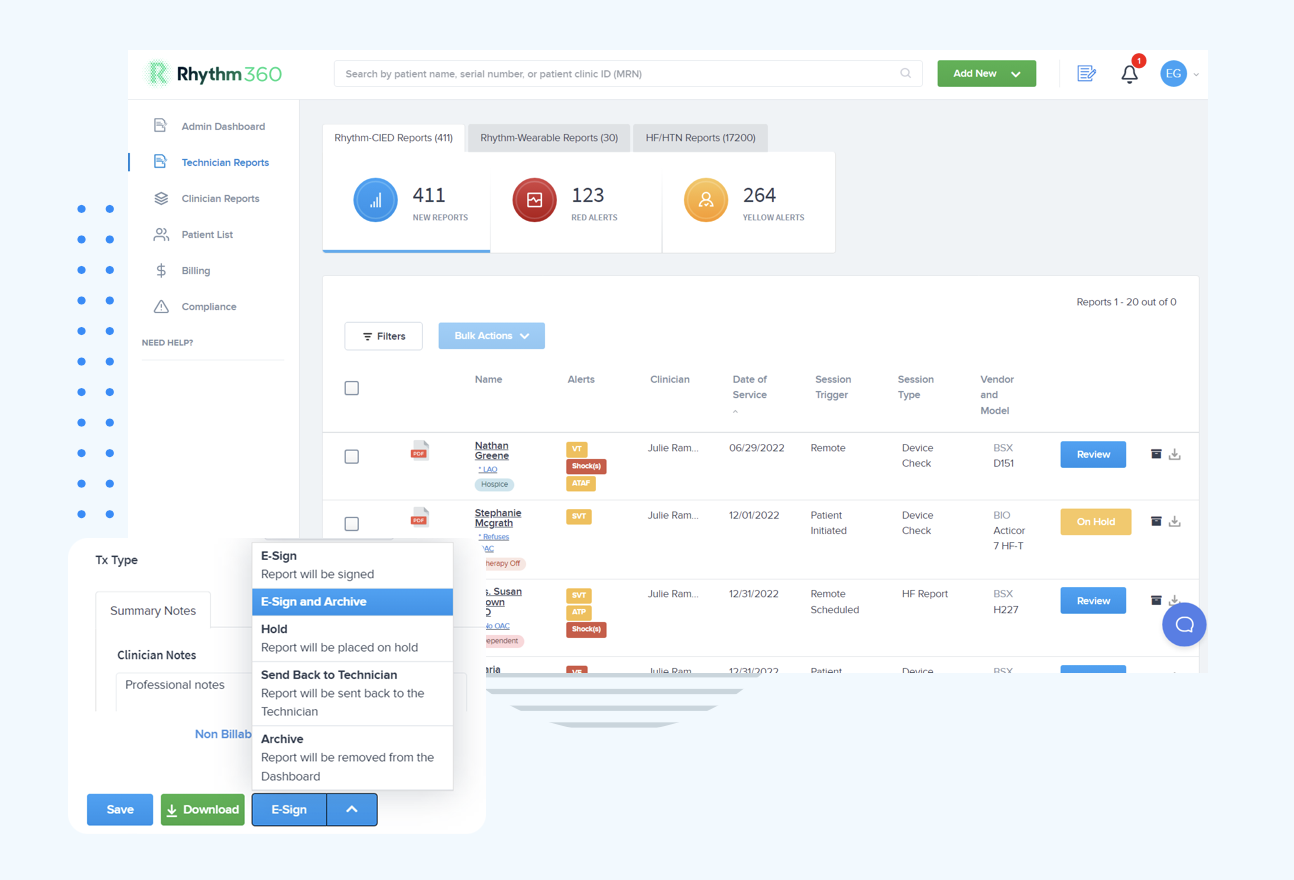
See Rhythm360's multi-OEM dashboard in action.
The most common RPM denial reasons are missing consent documentation and expired or absent physician orders. CMS requires that patient consent cover agreement to participate, single-provider acknowledgment, cost-sharing disclosure, and the right to revoke at any time. This documentation has to exist in the medical record before any billing begins. CMS also requires proof of a device order, confirmation the device meets the FDA medical device definition, and transmission logs with exact day counts to support billing 99445 versus 99454.
Start by building a pre-billing checklist that blocks claim submission when consent, a signed physician order, or a confirmed FDA-cleared device record is missing. This creates the enforcement point. Because physician orders expire, pair that checklist with annual renewal reminders so orders don't lapse silently. Quarterly audits reviewing a random 10 to 20% sample of active records then verify the checklist and reminders are working. Tracking consent coverage as a KPI, with a target of 100%, closes the loop by making compliance visible in real time.
The payoff is elimination of consent- and order-related denials, a preventable and fully recoverable revenue loss category for every cardiology RPM program.
In early 2024, 60% of medical groups reported increased denial rates compared to 2023, while operating expenses rose at the same time. For cardiology RPM programs, the highest-risk claims involve complex code interactions: 99445 versus 99454 selection, 99470 versus 99457 exclusivity, and add-on code stacking for 99458. Manual charge capture cannot enforce these rules reliably at scale.
Four steps reduce that risk:
Practices using Rhythm360 have reported up to a 300% increase in revenue through optimized CPT code capture and improved staff efficiency. Automated charge capture removes the documentation gaps that make manual workflows a persistent source of leakage.
First Pass Acceptance Rate, also called Clean Claims Rate, is the primary benchmark for clean claim performance in cardiology billing, with a high-performing goal of 95% or higher. Reaching that target from a typical 88% baseline takes daily visibility into the metrics that predict claim outcomes before submission.
A strong cardiology RPM KPI dashboard tracks these indicators:
Daily dashboard review turns lagging financial results into leading operational signals billing teams can act on before month-end, reducing denials and increasing revenue over time.
With KPI tracking in place to catch problems early, practices can layer additional revenue through compliant code stacking. Layering RPM with CCM and BHI under the 2026 code set can generate approximately $200 to $318 per patient per month when each service's documentation requirements are met independently. Code stacking is compliant when each billed service has its own documented clinical basis, time log, and qualifying interaction, and when NCCI edits and payer-specific bundling rules are applied before submission.
Four steps keep stacking audit-proof:
Building on the 300% revenue increase mentioned earlier, Rhythm360's automated documentation also supports compliant stacking by maintaining separate, timestamped records for each service line. Practices using short-period RPM codes can capture additional compliant recurring revenue with minimal added work for front-desk staff.
Explore how Rhythm360 automates compliant code stacking for your billing team.
The table below summarizes how each RPM workflow step changes when moving from manual OEM-portal processes to Rhythm360's automated approach, and the measurable outcomes practices can expect from that shift.
| Workflow Step | Manual OEM-Portal Process | Rhythm360 Automated Process | Measurable Outcome |
|---|---|---|---|
| Data Retrieval | Staff log into separate portals for each OEM (Medtronic, Boston Scientific, Abbott, Biotronik, others) and manually retrieve transmission reports | Rhythm360 ingests data from all OEMs via API, HL7, XML, and computer vision PDF parsing into a single dashboard | UCM processed 73,000+ reports annually at stable dismissal rates |
| Transmission-Day Tracking | Staff manually count transmission days per patient per month to determine 99445 vs. 99454 eligibility; error-prone at scale | Platform auto-tracks transmission days and alerts billing staff at the 2-day and 16-day thresholds before month-end | Target: 80%+ of patients meeting 16-day threshold; clean-claim rate target 95%+ |
| Time Documentation | Clinical staff manually log minutes in EHR notes without structured timestamps or activity codes; documentation gaps trigger 99457/99470 denials | Rhythm360 auto-stamps start/stop times, activity type, and staff identity for every interaction | CMS requires timestamps, staff identity, and interaction type for all management codes |
| Charge Capture and Claim Submission | Billing staff manually select CPT codes, apply modifiers, and submit claims without automated scrubbing; NCCI edit conflicts and missing documentation cause post-submission denials | Rhythm360 triggers CPT code suggestions when program milestones are met, applies payer-specific scrubbing rules, and routes flagged claims to review before submission | Denial rates dropping from 15% to 5% post-implementation |
CPT 99445 and 99470 add to the existing RPM code set. They don't replace anything. They create a lower-tier billing pathway for patients who transmit data for fewer than 16 days or whose clinical management time falls between 10 and 19 minutes. Practices already billing 99454 and 99457 for high-compliance patients can now capture reimbursement from patients who previously generated no revenue. The codes are mutually exclusive within their categories: bill either 99445 or 99454 for device supply, and either 99470 or 99457 for management time, never both in the same period. Update billing workflows to evaluate each patient's actual transmission-day count and documented clinical time at month-end before selecting the code pair.
CMS requires patient consent documented in the medical record before any RPM billing begins. The consent record must cover agreement to participate, acknowledgment that only one provider may bill RPM services at a time, disclosure of cost-sharing responsibilities (typically 20% coinsurance under Medicare), and the right to revoke consent anytime. A valid physician order must also be on file, signed by a physician or qualified healthcare professional with an established patient relationship, specifying the qualifying condition and monitoring type. Annual renewal of the order is the recommended standard. The device must be FDA-cleared for the intended measurement and capable of automatic data transmission; consumer wearables requiring manual entry don't qualify. Build a pre-billing checklist that blocks submission if any of these elements are missing.
Yes. Compliant stacking is permitted when each service has independent documentation, a time log, and a qualifying clinical basis. RPM codes (99445 or 99454; 99470 or 99457) can be billed alongside Chronic Care Management codes for patients with multiple chronic conditions, or alongside Principal Care Management codes for a single dominant cardiac condition like heart failure. CIED remote monitoring codes (93295, 93296, 93297, 93298, 93299) run under a separate framework and can coexist with RPM codes when services are clinically distinct and separately documented. The key rule: RPM and Remote Therapeutic Monitoring cannot be billed for the same patient in the same month. Apply NCCI edit checks at the claim level and keep separate documentation threads per service line for audit defense. When all thresholds are met across RPM, CCM, and add-on codes, a single Medicare patient can generate approximately $200 to $318 per month in compliant reimbursement.
Rhythm360 targets the root causes of RPM denials at the workflow level instead of the appeals stage. The platform tracks transmission-day counts per patient automatically, flags patients approaching or missing the 2-day and 16-day thresholds, and generates compliant time documentation with timestamps and activity codes for every clinical interaction. When program milestones are met, Rhythm360 triggers CPT code suggestions and applies payer-specific scrubbing rules before submission, catching NCCI edit conflicts and missing documentation before they reach the payer. Bi-directional EHR integration with systems including Epic, Cerner, and Athenahealth keeps consent records, device orders, and clinical notes accessible within the billing workflow without manual transcription. The result is fewer administrative hours per patient and a measurable improvement in first-pass acceptance rates, without adding front-desk or billing staff.
Every month that cardiology RPM billing runs on manual OEM portal workflows, incomplete time documentation, and reactive denial management is a month of recoverable revenue lost for good. The seven strategies above, from capturing short-period transmission days with 99445 to layering compliant code stacking with automated audit trails, address the specific documentation and workflow gaps driving leakage in 2026. An integrated, vendor-neutral platform that automates charge capture, consolidates multi-OEM data, and enforces CPT compliance at the point of documentation gives practices the operational foundation to make these strategies work at scale.
Talk to Rhythm360 about maximizing your cardiology RPM reimbursement in 2026.





