

Last updated: July 13, 2026
Legacy remote cardiac monitoring depends on separate logins for each OEM portal, including Medtronic CareLink, Abbott Merlin.net, Boston Scientific Latitude, and Biotronik Home Monitoring, with staff manually retrieving, reconciling, and transcribing data into the EHR. Workflows in cardiac remote monitoring must be designed around clinical usefulness rather than the limitations of disconnected manufacturer portals and fragmented systems. Ignoring this principle creates operational chaos, duplicated effort, inconsistent alert thresholds, and revenue leakage from missed billable transmissions.
Andrew Beaser, MD, Associate Professor of Medicine at the University of Chicago Medicine (UCM), described pre-implementation workflows as "a major challenge and incredibly difficult." Gaurav A. Upadhyay, MD, FACC, FHRS, Professor of Medicine and Director of the Pacing & Defibrillation Device Clinic at UCM, added that "staffing was always an issue for our center, because our device clinic — like many other medical centers — had struggled with technician turnover and timely weekend coverage."
Unified automation replaces this fragmentation with a single dashboard that normalizes data from all device manufacturers, applies AI triage, and generates compliant documentation automatically. This consolidation only delivers value when the platform reliably captures every transmission, even when OEM servers experience downtime or data formats change. Rhythm360 achieves greater than 99.9% transmissibility through redundant data feeds, computer vision, and AI-powered extrapolation, maintaining data integrity at a level that manual, portal-by-portal workflows cannot approach.
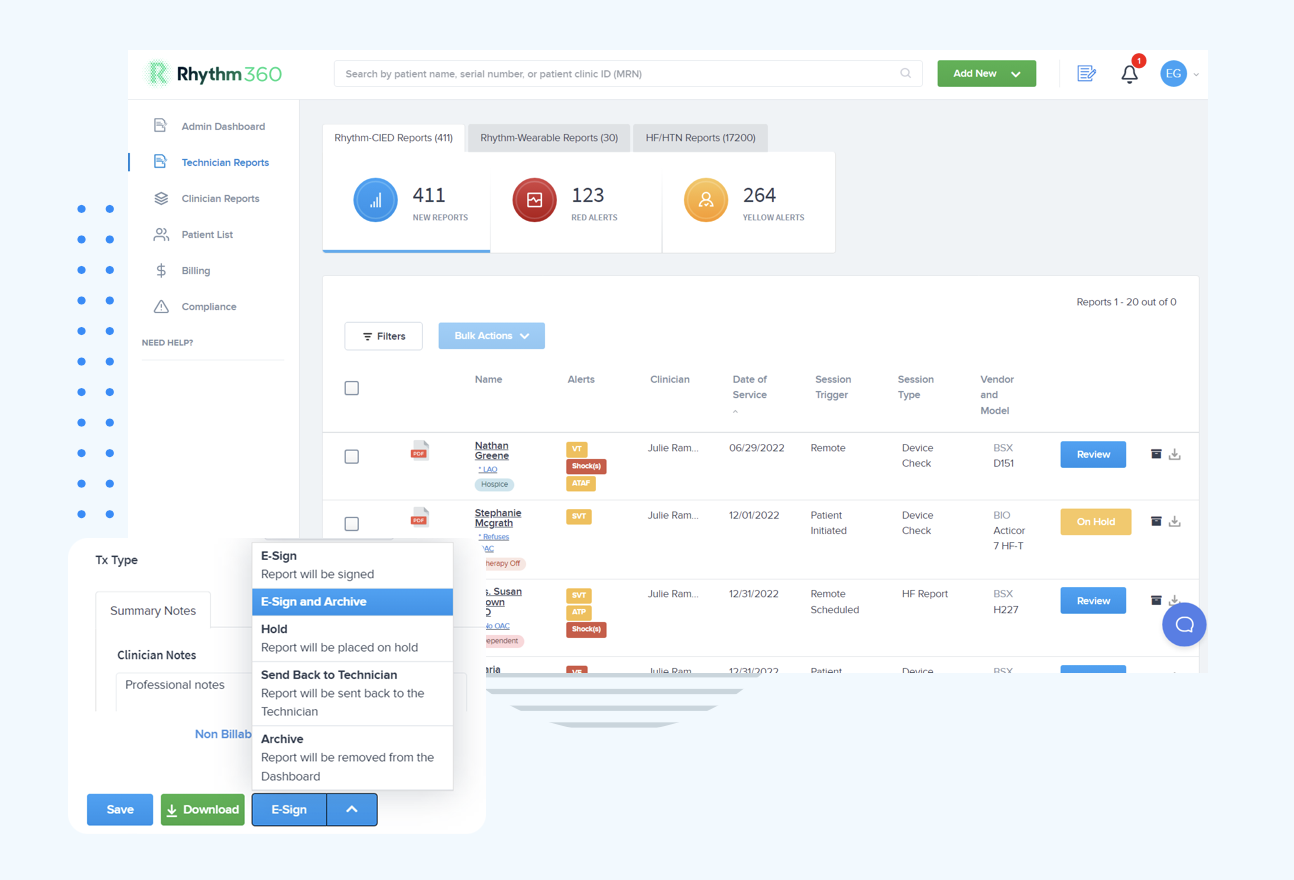
Effective vendor-neutral remote cardiac monitoring platforms ingest data from Medtronic, Boston Scientific, Abbott, Biotronik, and other manufacturers through a combination of API connections, HL7 messaging, XML parsing, and computer vision applied to unstructured PDFs. "The real distinction is not simply whether data is available. It is whether the data is structured and connected," according to Robert Kelly, Founder and CEO of Heart Rhythm International.
Integration challenges from data fragmentation across multiple device vendors are overcome by implementing a device-agnostic aggregation layer that normalizes data formats from manufacturers using varying protocols and measurement standards. Rhythm360 applies this architecture at scale: UCM reviewed more than 73,000 reports annually through Rhythm360 in calendar year 2025, averaging more than 18,000 reports per quarter, a volume that demonstrates the platform's capacity to serve high-complexity, high-census cardiology programs.
The outcome is a single source of truth for the entire device population. A device technician logs into one dashboard to view normalized data for any patient, regardless of implant manufacturer, which eliminates the need to authenticate across separate portals and reconcile conflicting data formats.
Raw OEM notifications generate substantial non-actionable volume. Even in AI-equipped devices, 32.9% of episodes remained non-actionable and another 30.6% were deemed indeterminate due to guideline-based interpretation gaps and signal-detection issues. Machine learning alarms have demonstrated higher positive predictive value than traditional threshold alarms for identifying events that require clinical management changes, which represents an improvement in actionable signal.
Rhythm360's AI-powered alert triage system filters this noise and surfaces clinically significant events, including new-onset atrial fibrillation, ventricular tachycardia, lead malfunction, and ERI/RRT indicators, as prioritized notifications. The platform also offers optional 24/7/365 oversight by certified cardiac technicians (CCTs) supervised by physicians, providing a human-in-the-loop layer for complex triage decisions. The combined effect is an up to 80% reduction in critical-alert response times. As Dr. Beaser noted at UCM, "we are able to address these issues earlier; rather than waiting for a 3-month visit, we can call patients in for evaluation."
The clinical stakes are significant. Research indicates that remote monitoring of CIED patients with heart failure is associated with lower rates of cardiovascular hospitalizations compared with standard in-office visits. Faster, more accurate triage directly contributes to that improvement.
Even when AI triage surfaces the right alerts, the clinical value disappears if device data never reaches the EHR or billing documentation remains incomplete. Manual transcription of device data into the EHR introduces errors, delays billing, and creates audit risk. EHR integration, including building discrete fields in Epic so device data lands in the clinical workflow like lab results, is the critical infrastructure requirement for remote cardiac monitoring programs.
Rhythm360 provides bi-directional integration with Epic, Cerner, Athenahealth, eClinicalWorks, Greenway Health, and others via HL7, which allows device data to flow directly into structured patient records without manual entry. On the billing side, the platform automates documentation for CIED remote monitoring codes such as 93298 and 93299, as well as RPM codes including 99454 and 99457. Automation tracks rolling 30-day transmission windows; when a patient falls below the 16-day threshold required for CPT 99454, the system flags the patient and triggers an outreach task to prevent claim denial.
Dr. Upadhyay confirmed the financial impact at UCM: "We have improved billing and accountability for our patients after the integration." Practices implementing Rhythm360 have reported the revenue increases noted earlier (up to 300%) through optimized CPT code capture and the elimination of documentation gaps that previously caused claim rejections.
Workstation-tethered access to OEM portals prevents on-call clinicians from reviewing transmissions, signing reports, or coordinating care without returning to a fixed terminal. Rhythm360's HIPAA-compliant mobile application resolves this constraint and allows electrophysiologists, NPs, PAs, and CCTs to act on critical alerts from any location, a capability that directly supports the 80% response-time improvement the platform delivers.
"Physicians' time is too valuable to manually process every transmission," observed Troy Leo, MD, MHCM, FACC, Service Line Leader for Heart and Vascular at Atrium Health. The mobile-first design of Rhythm360 operationalizes that principle by decoupling clinical review from physical location.
Implementation, including EHR integration setup, typically completes within days to weeks, not the months-long, disruptive onboarding associated with legacy on-premise systems. SaaS-based pricing scales with clinic size and platform usage, which reduces the fixed-cost burden that makes enterprise software prohibitive for solo practices and mid-sized EP clinics. Because practices can deploy the platform quickly without large upfront capital expenditure, they begin capturing previously lost revenue within weeks rather than waiting months to see ROI. The combined effect on total value of ownership is a reduction in staff burnout from eliminating multi-portal workflows, lower administrative overhead from automated documentation, and a billing capture rate that converts previously lost revenue into recurring income.
Rhythm360 manages the complete patient journey, from enrollment through billing, within a single automated workflow that eliminates handoffs and data re-entry across multiple portals. The following six steps show how each stage feeds directly into the next.
The right workflow automation platform depends on the specific operational profile of the practice. Solo clinics prioritize simplicity and mobile access, mid-sized groups need multi-vendor unification, health systems require scalability and oversight, and practices launching new service lines need turnkey onboarding support. The following matrix maps each scenario to the Rhythm360 capabilities that address those needs.
| Practice Profile | Primary Need | Rhythm360 Capability |
|---|---|---|
| Solo EP clinic, 1–2 device vendors | Simplified workflow, mobile access, billing automation | Single dashboard, HIPAA-compliant mobile app, automated CPT documentation |
| Mid-sized cardiology group, 3+ device vendors | Multi-vendor unification, AI triage, EHR integration | Vendor-neutral ingestion, AI alert prioritization, bi-directional Epic/Cerner/Athenahealth integration |
| Integrated health system, high CIED volume | Scalable monitoring, CCT oversight, revenue optimization | UCM-scale volume (73,000+ annual reports), optional 24/7 CCT layer, automated CPT capture with up to 300% revenue lift |
| Practice adding HF/HTN RPM service line | Turnkey RPM launch, chronic disease management, new revenue stream | Integrated HF/HTN RPM service line with patient onboarding checklists and automated billing support for 99453, 99454, 99457 |
Rhythm360 connects to all major CIED manufacturers, including Medtronic, Boston Scientific, Abbott, Biotronik, and others, through a combination of direct API connections, HL7 messaging, XML data feeds, and computer vision applied to unstructured PDF reports. Each data stream is ingested and normalized into a unified patient record within the platform. A redundant data feed architecture acts as a fail-safe when an OEM server experiences downtime, maintaining the transmissibility rate discussed above (greater than 99.9%). The result is a single dashboard where device technicians and clinicians can review any patient's data regardless of implant manufacturer, without logging into separate portals.
Rhythm360 supports automated documentation for both CIED remote monitoring codes and remote physiological monitoring codes. For CIED monitoring, the platform covers codes such as 93296, 93297, 93298, and 93299, automatically pairing each remote interrogation event with its 90-day billing cycle. For RPM programs covering heart failure and hypertension patients, the platform tracks transmission compliance for CPT 99454, monitors interactive communication time for 99457 and 99458, and supports one-time onboarding documentation under 99453. The system flags patients approaching or falling below billing thresholds, such as the 16-day transmission requirement for 99454, and triggers outreach tasks to prevent claim denials before the billing period closes.
Rhythm360 includes a secure, HIPAA-compliant mobile application that allows electrophysiologists, cardiologists, nurse practitioners, physician assistants, and certified cardiac technicians to review transmissions, triage alerts, sign reports, and coordinate care from their smartphones. This capability is particularly valuable for on-call coverage. When a critical arrhythmia is flagged on a weekend, the responsible clinician can review the transmission and initiate an intervention, such as anticoagulation, device reprogramming, or patient recall, without returning to the office. All actions taken through the mobile app are logged with a full audit trail within the patient record.
Rhythm360's implementation process, including EHR integration setup with systems such as Epic, Cerner, and Athenahealth, typically completes within a few days to a few weeks. This timeline is significantly shorter than legacy on-premise systems, which often require months of configuration and staff retraining. RhythmScience provides structured onboarding support throughout the process, including integration testing, workflow configuration, and staff training. The SaaS-based pricing model scales with clinic size and platform usage, so mid-sized practices are not required to absorb enterprise-level fixed costs. Practices can also add service lines, such as HF/HTN remote physiological monitoring, incrementally as their program grows.
Evaluation criteria for cardiology practice workflow automation software converge on a consistent set of requirements: vendor-neutral multi-device integration, AI-powered alert triage, bi-directional EHR connectivity, automated CPT documentation, mobile access, and a rapid implementation path. Practices that consolidate these capabilities into a single platform eliminate the administrative overload of fragmented OEM portals, achieve the response-time improvements described earlier (up to 80% reduction), and capture revenue that manual workflows routinely miss.
Other platforms exist. Rhythm360 by RhythmScience is built to address all of these requirements within one vendor-neutral architecture, from data ingestion across Medtronic, Boston Scientific, Abbott, and Biotronik devices through AI triage, bi-directional EHR integration, and automated billing documentation. The University of Chicago Medicine's experience, processing the volume described earlier (73,000+ reports annually) with earlier interventions and improved billing accountability, illustrates what a unified platform delivers at scale. As Dr. Beaser noted, "decision support, including AI-assisted decision support, will become increasingly important as data volumes grow."





