Last updated: September 26, 2026
Talk With Rhythm360 About Closing Handoff Gaps
The escalation chain for a remote cardiac device monitoring alert has three named handoffs, and each one carries a documented failure mode.
Many clinics operate well below recommended staffing ratios. Research has found that in some remote monitoring programs, only 7% of alerts were judged to be clinically meaningful. Staff spend most of their review time on transmissions that require no action, which erodes focus and increases the likelihood that a genuinely critical alert is buried.
Remote cardiac device monitoring and remote telemetry monitoring are distinct workflows, and that distinction shapes alert ownership, response time expectations, and accountability when a red alert fires.
Inpatient telemetry uses a real-time, unit-based workflow that requires continuous monitoring and rapid intervention capabilities. A centralized monitoring station, continuous waveform review, and nursing staff physically present on the unit support response times measured in minutes.
Remote cardiac device monitoring, governed by CPT codes 93294 through 93298, covers CIED transmissions from pacemakers, ICDs, implantable loop recorders, and CRT devices. Staff review these on scheduled and alert-based intervals in an outpatient or clinic-based workflow. Response time expectations are measured in hours for actionable alerts and days for routine scheduled transmissions.
When patients or staff conflate the two, they apply inpatient response-time expectations to an outpatient workflow or assume that a device clinic has continuous waveform surveillance when it does not. Accountability becomes unclear, and the handoff fails before it begins.
Device clinic staff managing patients across all four major manufacturers, Medtronic CareLink, Abbott Merlin.net, Boston Scientific Latitude, and Biotronik Home Monitoring, face structural fragmentation. Each portal uses a different interface, alert format, and data structure. Each one requires a separate login and a separate documentation workflow. A clinic managing 500 CIED patients can expect more than 2,000 scheduled transmissions per year before counting unscheduled alerts.
The 2023 HRS/EHRA/APHRS/LAHRS Expert Consensus Statement was developed in collaboration with and endorsed by both the ACC and AHA, giving it the weight of a multi-society recommendation. It points toward alert-based monitoring, where clinics respond to meaningful events rather than processing every scheduled transmission equally. That shift requires reliable continuous connectivity and a structured escalation framework. A 2024 analysis in Heart Rhythm O² found that 14% of patients with active CIED transmissions had interrupted connectivity, which undermines any alert-based strategy.
The staffing math compounds the problem. Research published in Heart Rhythm O² found that the low supply of knowledgeable clinicians and staff is a major barrier to running effective remote monitoring programs. Burnout, lengthy training timelines, and a lack of qualified applicants are consistent obstacles. Most clinics default to scheduled transmissions rather than alert-based monitoring because real-time triage infrastructure is missing, so workload rises without a matching improvement in outcomes.
As Andrew Beaser, MD, Associate Professor of Medicine at the University of Chicago Medicine, noted after implementing Rhythm360, “We are able to address these issues earlier; rather than waiting for a 3-month visit, we can call patients in for evaluation.” UCM reviewed more than 73,000 reports annually through Rhythm360 in calendar year 2025, averaging more than 18,000 reports per quarter. That volume illustrates what scalable, centralized monitoring looks like when the infrastructure supports it.
Threads on r/PacemakerICD surface two recurring complaints. Patients describe surprise co-pays from entities they never chose and confusion about whether routine transmissions can be disabled while keeping critical alerts active. Both concerns reflect a structural gap in how remote monitoring billing is explained at enrollment.
The CPT code structure for cardiac device remote monitoring operates on device-specific billing cycles.
For remote physiologic monitoring of non-implantable devices such as blood pressure cuffs and weight scales, CPT 99454 covers device supply and physiologic data collection. It requires transmission on at least 16 separate calendar days within a 30-day billing period.
Surprise co-pays often arise when a third-party monitoring entity, separate from the implanting clinic, bills under these codes. Patients may receive a bill from an organization they have never interacted with directly, for a service they did not realize a separate entity provided. Home transmitter connectivity failures and device warning alerts add daily stress. A disconnected transmitter generates a warning that can alarm a patient who does not understand that it is a technical notification rather than a clinical emergency.
The billing confusion described above is not hypothetical. It reflects the same structural gap that drives search activity around “Cadence remote patient monitoring experiences,” where patients and practices encounter billing from a third-party monitoring entity that operates separately from the implanting or treating clinic. Cadence’s reimbursement framework has drawn scrutiny from the federal health department’s watchdog and insurers including UnitedHealthcare, with critics arguing the framework is ripe for abuse and may support low-quality care.
The billing and workflow complaints that appear on Reddit, such as surprise co-pays, third-party entities billing separately from the implanting clinic, and confusion about routine transmissions, are not unique to any single company. They are structural features of any third-party monitoring arrangement in which the monitoring entity and the treating provider bill under separate tax identification numbers.
Before enrolling in any third-party remote monitoring arrangement, patients and practices should clarify the following.
These questions apply regardless of which third-party monitoring service is under consideration. The answers determine whether the patient’s care team retains meaningful oversight of the escalation chain and connect directly to the closed-loop infrastructure described in the clinical sections above.
The fix for escalation and handoff failures requires a different structure, not a faster version of the same fragmented workflow. Each failure mode described above maps to a specific requirement. Missed notification calls for named responsibility at every step. Batch review calls for real-time triage. The documentation gap calls for documented notification. Portal fragmentation calls for a single source of truth across all device manufacturers.
Gaurav A. Upadhyay, MD, FACC, FHRS, at the University of Chicago Medicine, identified the operational requirement directly: “That was a big piece for us, to have an integrated review of data from trained personnel.”
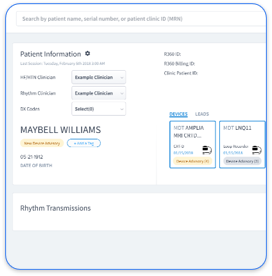
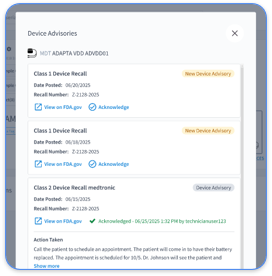
Rhythm360 by RhythmScience is built for the escalation and handoff failures described in these threads. Other platforms exist in this space, including Murj, Implicity, Rhythm Management Group, and Octagos. Rhythm360’s closed-loop, vendor-neutral architecture targets the specific failure chain from monitor tech to device clinic to on-call EP. Its capabilities include:
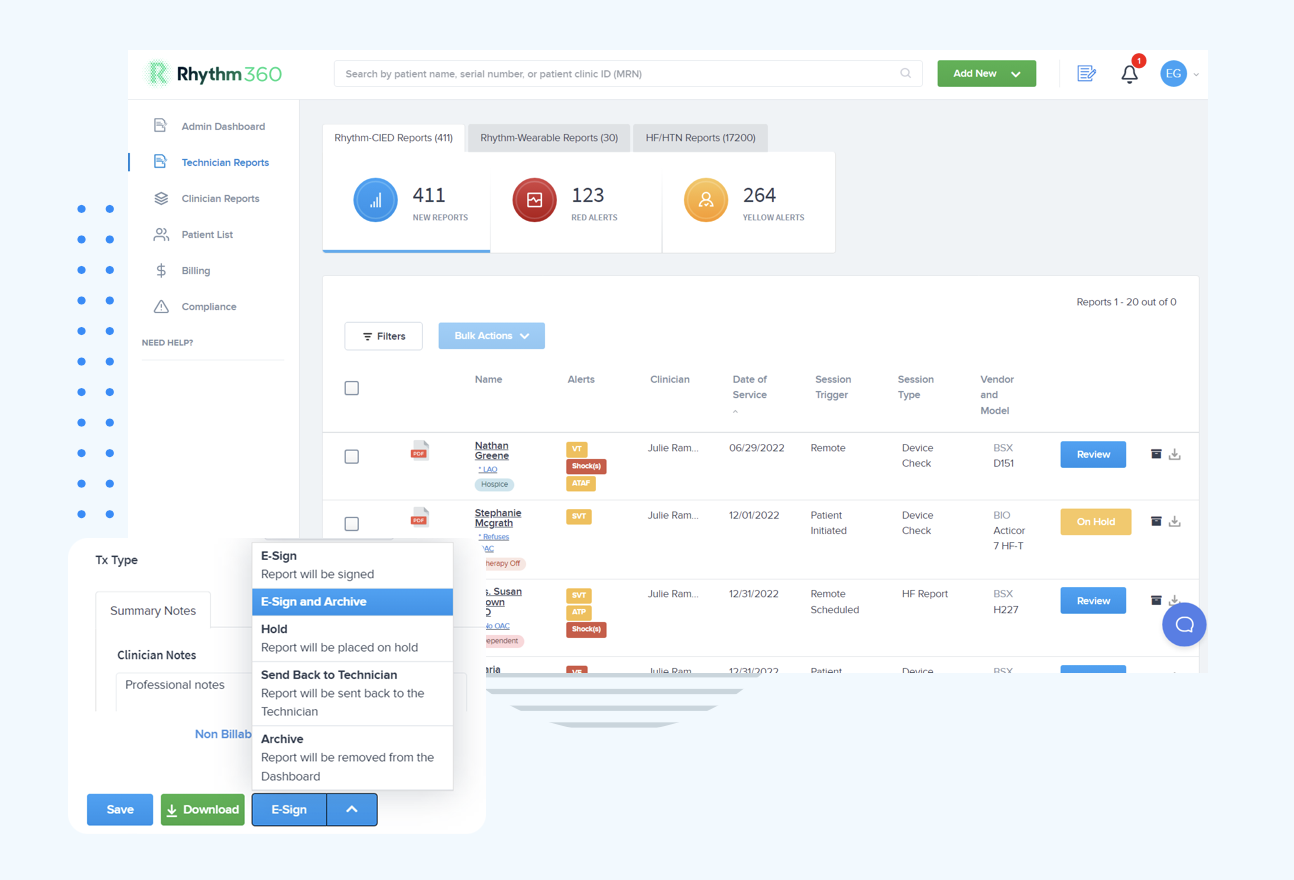
Practices implementing Rhythm360 have achieved up to a 300% increase in revenue capture and profitability alongside significant reductions in critical alert response times. These outcomes follow directly from closing the handoff gaps the threads describe.
See How Rhythm360 Closes the Handoff Gap
The answer depends on the escalation protocol the device clinic has defined, and many programs lack a clear, consistently followed protocol. In a well-structured workflow, a Tier 1 critical alert, such as an ICD shock, high ventricular rate during atrial fibrillation, or lead integrity failure, triggers same-day clinical review and direct patient contact. Events that require immediate intervention escalate to the on-call electrophysiologist.
Reddit threads document the “documented without notification” failure pattern. Monitor techs or device clinic staff log the alert in the EMR, creating a record that it was seen, but they do not generate a notification to the bedside nurse or on-call EP. Rhythm360 addresses this by requiring documented notification at each handoff. AI-powered triage routes alerts by acuity, and optional 24/7/365 CCT oversight ensures a named person remains accountable for every critical transmission.
Patients on r/PacemakerICD often ask about reducing co-pays from routine scheduled transmissions while retaining alert-based monitoring for genuine emergencies. The answer depends on the device manufacturer’s programming capabilities and the clinic’s monitoring protocol. Most major cardiac device manufacturers allow alert thresholds to be configured, although nominal settings and the degree of programmability vary across manufacturers. Some device alerts are fixed and cannot be programmed off.
Under CMS billing article A56602, CPT codes 93293, 93294, 93295, and 93296 are reported no more than once every 90 days and should not be reported when the monitoring period is less than 30 days. The number of scheduled or unscheduled transmissions within a qualifying period does not create additional billing units. Disabling routine scheduled transmissions does not by itself change billing eligibility as long as the monitoring period meets the 30-day minimum and qualifying work is performed.
Patients considering this option should ask their device clinic three specific questions:
As covered earlier, inpatient telemetry is a real-time, unit-based workflow with response times measured in minutes, while remote cardiac device monitoring is an outpatient workflow with response times measured in hours for actionable alerts and days for routine transmissions. The practical consequence is that the two systems use different staffing models, billing frameworks, and accountability structures.
Surprise bills in cardiac remote monitoring typically arise when a third-party monitoring entity, separate from the implanting or treating clinic, reviews transmissions and bills under CPT codes 93294 through 93298 or 99454. The patient may have consented to remote monitoring at implant without understanding that a separate organization would perform the monitoring and submit its own claims.
Each billable entity bills under its own tax identification number, so a patient can receive one bill from the implanting clinic and a separate bill from the monitoring service. The billing cycles add to the confusion. Pacemaker and ICD codes (93294, 93295, 93296) bill on a 90-day cycle, while loop recorder and physiologic monitor codes (93297, 93298) bill on a 30-day cycle. A patient may receive multiple bills per quarter from entities they cannot easily identify. Before enrolling in any monitoring arrangement, patients and practices should confirm in writing which entity will bill, under which codes, and on what cycle.
Across r/nursing, r/Cardiology, and r/nursepractitioner, the pattern remains consistent. A monitor tech documented without notifying, a device clinic batched strips to end of shift, an on-call EP was never paged, or a notification reached an inbox that no one cleared. The alert fired correctly, yet the escalation chain failed to move that information to the right clinician in time.
Closing that chain requires named responsibility at every step, real-time triage, documented notification, and a single source of truth across all device manufacturers. Rhythm360 by RhythmScience provides a vendor-neutral, AI-powered platform built for the operational reality of device clinics managing thousands of patients across fragmented manufacturer portals.
Explore Rhythm360 for Closed-Loop Remote Monitoring