Use this table to see how the 2026 updates create a tiered RPM structure based on monitoring duration and management time. Notice how 99445 captures short-term monitoring that previously went unbilled, while 99470 reimburses brief management interactions that fall below the 20-minute threshold for 99457.
The CMS 2026 Physician Fee Schedule final rule introduces new codes and maintains existing RPM billing structures.
CPT Code | Description/Cardiology Use | Requirements | 2026 Reimbursement |
99453 | Initial setup/patient education (HF/HTN/CIED) | Once per device, patient consent | ~$22 |
99445 | Short-term monitoring 2–15 days (post-acute HF) | 2+ days readings, 30-day period | ~$47 |
99454 | Standard monitoring 16–30 days (chronic HF/AFib) | 16+ days readings, cannot bill with 99445 | ~$47 |
99470 | Brief management 10–19 minutes (CIED alerts) | 10+ minutes, 1 live interaction | ~$26 |
99457 | Standard management 20+ minutes (HF/AFib) | 20+ minutes, live interaction monthly | ~$52 |
99458 | Additional management (each 20 minutes) | Add-on to 99457, full 20-minute increments | ~$41 |
93298/93299 | CIED monitoring (stack with RPM using mod-59) | Separate service, modifier required | Varies |
See how automated tracking ensures you never miss the 16-day threshold for 99454 billing.
Understanding these codes forms the base. Billing them successfully then requires systematic workflows that protect compliance at every step. The next seven practices address the most common failure points that cause denials and audit flags.
Patient consent creates the legal and compliance foundation for RPM billing. Accurate documentation is required for 2026 RPM CPT billing, with device supply codes needing specific dates of data transmission and total monitoring days. Design consent workflows that capture patient agreement, device education completion, and setup verification in one continuous process.
Essential consent checklist:
Rhythm360 maintains complete audit trails for every patient interaction, which supports CMS compliance from day one.
The 16-day rule remains central for standard RPM billing. CPT code 99454 requires at least 16 days of patient readings per month, which do not need to be consecutive days. Missing this threshold causes automatic claim denials and direct revenue loss.
16-day compliance checklist:
Warning: No qualifying data results in automatic denial. Rhythm360’s greater than 99.9% transmissibility rate through redundant data feeds helps prevent lost billable opportunities caused by technical failures.
Time documentation determines eligibility for RPM management codes. CPT code 99457 requires at least 20 minutes of clinical staff time per calendar month, with partial time beyond 20 minutes not qualifying for additional billing. Create structured time-logging habits so every billable minute appears in the record.
Time tracking workflow:
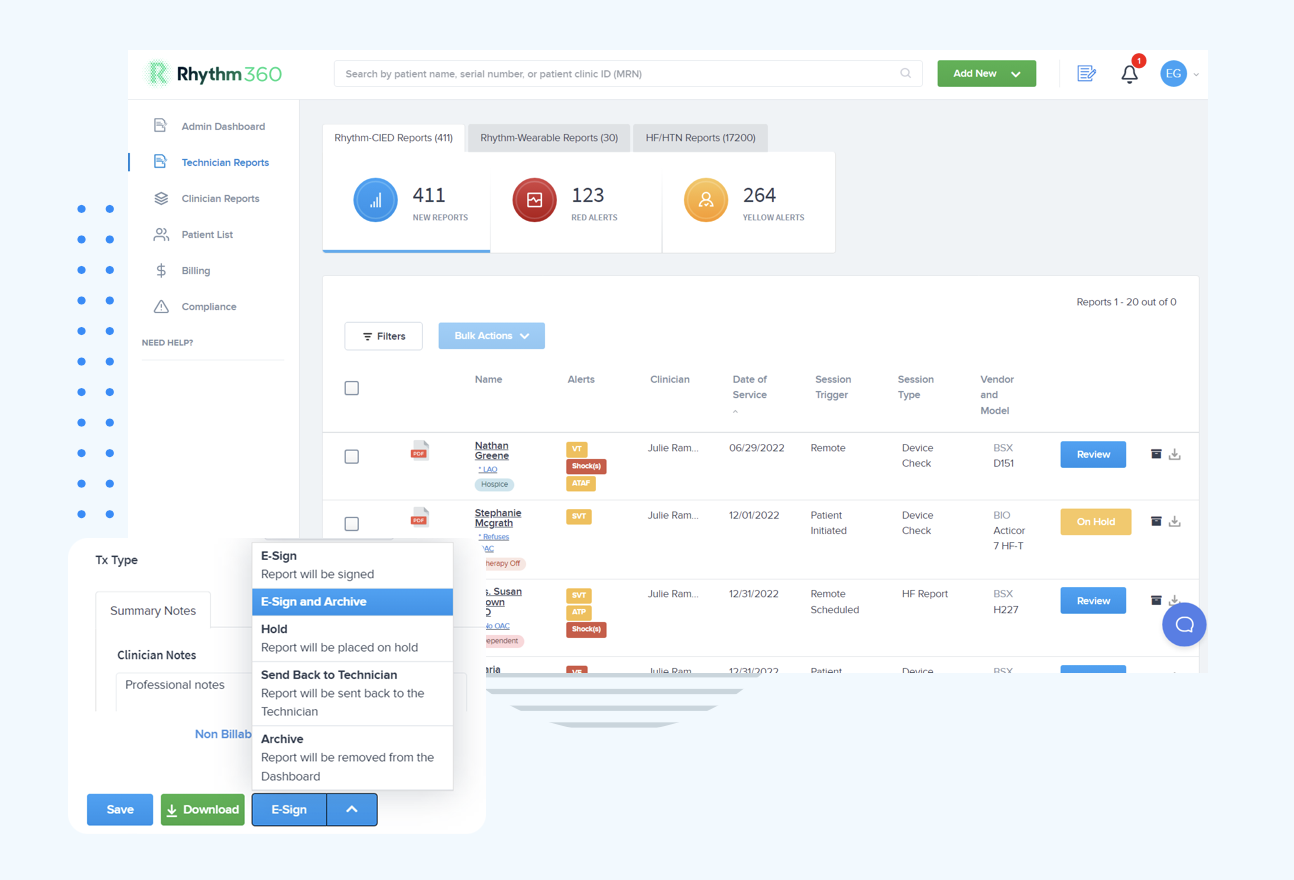
Rhythm360’s platform automates clinical workflows and documentation, which supports accurate billing for 99457, 99458, and the new 99470 code while keeping records audit ready.
Cardiology practices increase revenue when they stack CIED monitoring codes with RPM services correctly. This approach requires precise modifier usage that proves separate, distinct services for the same patient during the same period.
CIED stacking checklist:
Rhythm360 unifies CIED data from major OEMs such as Medtronic, Abbott, Boston Scientific, and Biotronik while preserving proper service separation for compliant code stacking.
Manual OEM portal management creates data silos and compliance gaps that slow billing. Leading cardiology practices rely on vendor-neutral platforms that aggregate data from all device manufacturers into one consistent workflow.
Data aggregation requirements:
Rhythm360’s AI-powered platform ingests data from all major OEMs using APIs, HL7, XML, and computer vision for PDF parsing. This approach removes manual portal work while maintaining the reliability discussed earlier.
Once you unify data collection across vendors, the next challenge becomes managing the volume of alerts that comprehensive monitoring generates.
Alert fatigue increases the risk of missed critical events and compliance failures. Effective RPM programs use intelligent filtering to highlight clinically significant alerts and reduce low-value notifications.
Alert management workflow:
Rhythm360’s AI-driven alert triage reduces response times by 80% while filtering non-actionable notifications, which allows clinical staff to focus on billable and clinically meaningful interactions.
CMS audits focus on documentation completeness and proof of clinical necessity. Build record-keeping systems that show why monitoring was needed and how services were delivered for every billed code.
Audit-ready documentation checklist:
Maintaining these records manually increases administrative burden and raises audit risk through human error. Rhythm360 addresses this risk by automatically generating each checklist item, from consent forms to time-stamped activity logs, as services occur. This automation closes the gap between service delivery and documentation and keeps your practice CMS ready.
Request an audit readiness assessment to identify documentation gaps in your current RPM program.
Use these scannable checklists to standardize RPM billing compliance across your cardiology practice and reduce variation between providers.
99454 16-Day Compliance Workflow:
CIED and RPM Stacking Protocol:
Time Tracking Log Template:
Rhythm360’s bi-directional EHR integration automates these workflows and provides real-time compliance dashboards, which significantly reduces administrative overhead and supports consistent billing accuracy.
Once these workflows are in place, the next step involves avoiding common mistakes that still trigger denials and audits.
Cardiology practices can avoid frequent RPM billing errors that trigger audits and claim denials by watching for these patterns and correcting them early.
Rhythm360’s automated compliance features prevent these common errors through real-time billing guidance and validation, which supports clean claims submission and higher reimbursement rates.
CPT code 99454 covers remote monitoring of physiologic parameters such as weight, blood pressure, pulse oximetry, and respiratory flow rate, with initial device supply and daily recordings or programmed alert transmission for 16–30 days within a 30-day period.
This code plays a key role for chronic cardiology conditions like heart failure and atrial fibrillation that require extended monitoring. The code requires at least 16 days of patient readings, which do not need to be consecutive, and can be billed once per patient per 30-day period.
Cardiology RPM billing requires documented patient consent, FDA-cleared devices with automatic transmission, at least one live patient interaction monthly for management codes, precise time tracking for clinical activities, and clear separation of RPM from other care management services.
Practices must maintain 16 or more days of readings for 99454, document 20 or more minutes of clinical time for 99457, and use appropriate modifiers when stacking with CIED codes. All services require medical necessity justification and audit-ready documentation.
Cardiology practices avoid RPM audit red flags by maintaining complete patient consent forms, documenting precise transmission day counts, and tracking clinical staff time accurately. They also justify medical necessity for monitoring duration, separate RPM from CCM activities, use proper modifiers for code stacking, and ensure FDA device compliance.
Automated documentation systems, quarterly internal audits, regular staff training on CMS requirements, and backup data collection protocols further reduce audit risk. Practices should also avoid billing for partial time increments and confirm that all patient interactions are documented.
The 2026 CMS updates introduce CPT 99445 for short-term monitoring of 2–15 days and CPT 99470 for brief management services of 10–19 minutes, which expands billing opportunities for cardiology practices. The 16-day requirement remains for 99454, while the new codes support billing for shorter monitoring periods and lower management time thresholds. Reimbursement rates increased across all RPM codes, with stronger support for post-acute care monitoring and intensive short-term interventions.
CPT code 99457 requires at least 20 minutes of clinical staff or qualified healthcare professional time per calendar month, including at least one real-time interactive communication with the patient or caregiver. The service must occur under physician direction, be documented with precise time tracking, and remain separate from other care management activities. Partial time beyond 20 minutes does not qualify for additional billing unless a full additional 20 minutes is reached for the add-on code 99458.
Cardiology practices should stack RPM codes with CIED monitoring codes 93298 or 93299 using modifier-59 to indicate distinct services. They document separate clinical rationales, confirm that different physiologic parameters are monitored, and maintain clear service separation in clinical records while verifying payer-specific policies. RPM can also be billed concurrently with Chronic Care Management when separate time and service requirements are met. Each billed code must have documented medical necessity and audit-ready support.
Manual RPM billing processes leak revenue through compliance gaps, missed data collection thresholds, and incomplete documentation. RPM programs generate $100–$150 per patient per month in reimbursement with positive ROI of 22.2% or higher. Rhythm360 automates these complex workflows and supports greater than 99.9% compliance while delivering 300% revenue gains through unified data management, intelligent alert triage, and audit-ready documentation.
Transform your cardiology practice’s RPM billing compliance and capture previously lost revenue opportunities. Start your compliance assessment today and discover where your practice is leaving RPM revenue on the table.