Last updated: July 14, 2026
Cardiology practices that implant devices from more than one manufacturer face an immediate structural problem. Medtronic CareLink, Abbott Merlin.net, Boston Scientific Latitude, and Biotronik Home Monitoring each operate as separate, non-interoperable portals. Staff authenticate into each system individually, retrieve transmissions manually, and reconcile conflicting data formats before any clinical review can begin. Each CIED manufacturer has developed proprietary nomenclature, technical standards, and communication protocols to describe similar device features, which compounds the reconciliation burden.
Andrew Beaser, MD, Associate Professor of Medicine at UCM, described pre-implementation workflows as “a major challenge and incredibly difficult.” His colleague, Gaurav A. Upadhyay, MD, FACC, FHRS, Director of the Pacing & Defibrillation Device Clinic at UCM, noted that “staffing was always an issue for our center, because our device clinic, like many other medical centers, had struggled with technician turnover and timely weekend coverage.”
The financial consequences match the operational strain. Manual time logs in cardiology RPM programs can lose billable 99457 and 99458 minutes, and missed transmission thresholds generate CPT 99454 denials that automated upstream enforcement would prevent. Approximately 80% of healthcare data is unstructured and stored in disconnected systems, which makes manual CPT documentation error-prone and vulnerable during audits. That risk has grown under the OIG audit Project OAS-25-05-008 focused on documentation gaps for the 16-day transmission and 20-minute time requirements.
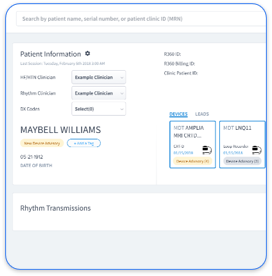
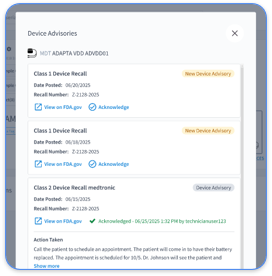
These operational and financial challenges, including fragmented portals, staffing constraints, and documentation gaps, are exactly what Rhythm360 addresses. Rhythm360 is a vendor-neutral, HIPAA-compliant, cloud-based platform built for cardiology practices managing CIEDs and chronic cardiac conditions. It consolidates data from all major device manufacturers, including Medtronic, Boston Scientific, Abbott, and Biotronik, into a single clinical dashboard. This structure removes redundant portal logins and manual data transcription.
The platform uses three core automation processes.
Optional 24/7 oversight by certified cardiac technicians (CCTs) supervised by physicians is available for practices that need continuous coverage. Onboarding, including EHR integration, typically completes within days to weeks.
See the unified dashboard in action with a demo that shows how Rhythm360 consolidates device data into one actionable view.
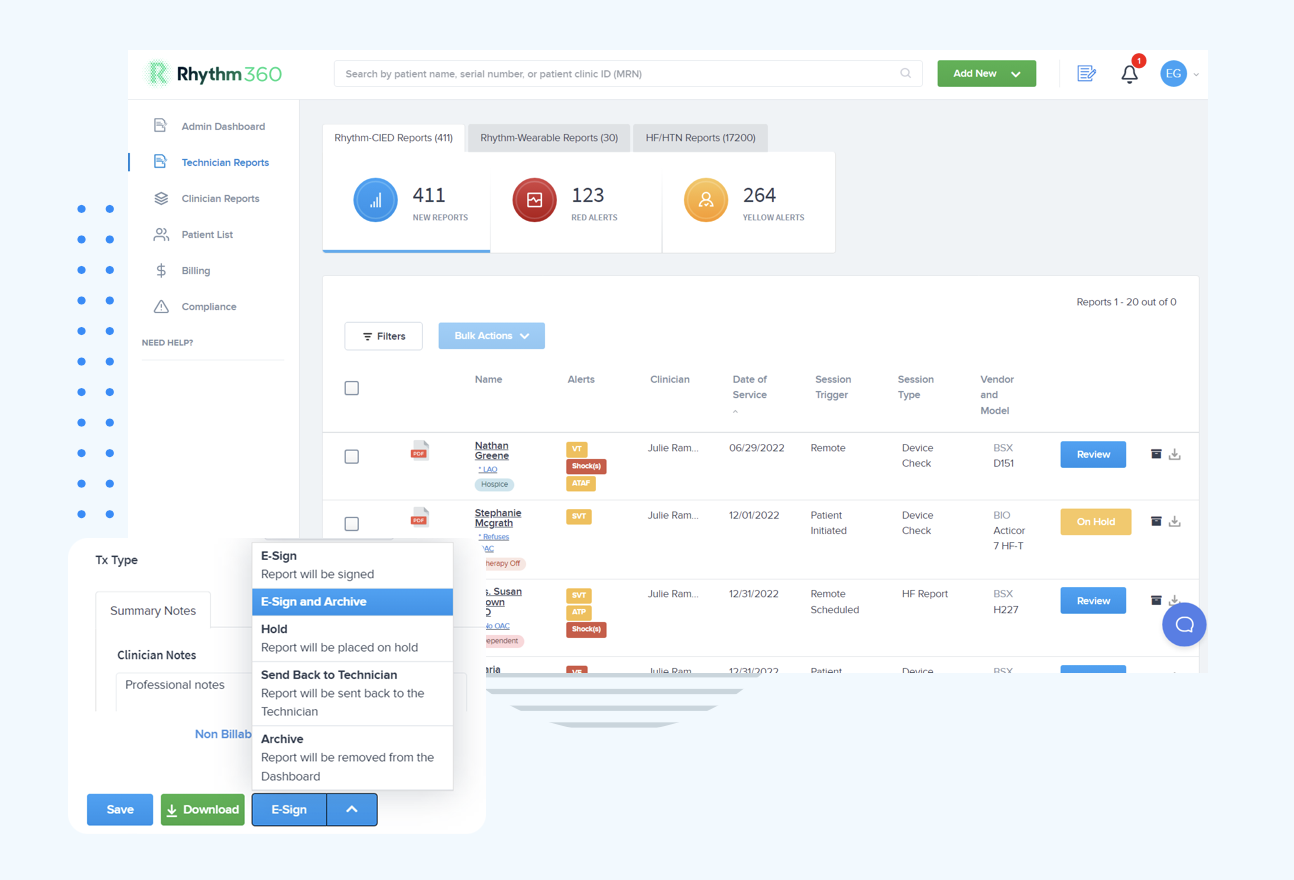
AI-powered alert triage drives shorter time to intervention. In a JACC: Advances study, AI reduced the volume of transmissions forwarded for review. The JACC study on AI for MACE adjudication in clinical trials does not analyze device transmissions or report 99.1% AI sensitivity. Separately, AI implementation has raised the success rate in identifying actionable alerts and improved billing efficiency.
Rhythm360’s AI triage applies this filtering logic across all ingested OEM transmissions and presents clinicians with a prioritized queue instead of an undifferentiated alert volume. A familiar scenario illustrates the impact. A Saturday-morning AFib transmission appears in the Rhythm360 mobile app, the on-call clinician reviews it within minutes, and by Saturday afternoon the patient starts anticoagulation. A manual, portal-by-portal workflow would likely delay that intervention until Monday.
Andrew Beaser, MD, at UCM, explained that “we are able to address these issues earlier; rather than waiting for a 3-month visit, we can call patients in for evaluation.” That shift from reactive to proactive care captures the clinical value of workflow automation improving cardiology remote monitoring outcomes and revenue.
AI-guided alert systems also improve broader patient safety. A prospective trial found that AI-guided alerts reduced ward-based cardiac arrest incidence and were associated with a significant decline in in-hospital mortality, without adding clinical staff.
Workflow automation improving cardiology remote monitoring outcomes and revenue starts with removing redundant manual steps. Before automation, a device technician’s morning routine involves five or more OEM portal logins, manual data retrieval, format reconciliation, EHR transcription, and report generation. Each step adds delay and creates room for error. After Rhythm360 implementation, that sequence becomes a single dashboard review.
With multi-OEM automation, a technician no longer logs into four separate vendor portals every morning. The cardiologist signs one structured interpretation note per interrogation, and the claim stages automatically. Rhythm360 customers report 60% to 80% time savings per patient across the following workflow stages.
| Workflow Stage | Manual Process | Rhythm360 Automated Process | Time Impact |
|---|---|---|---|
| Data retrieval | 5+ OEM portal logins per day | Single consolidated dashboard | Eliminated per-portal authentication time |
| Report generation | Manual transcription and formatting | Near-real-time automated report creation | Large reduction in per-report time |
| EHR entry | Manual copy-paste into EHR fields | Bi-directional Epic, Cerner, and Athenahealth integration | Eliminated duplicate data entry |
| Alert triage | Manual review of all transmissions | AI-filtered priority queue | Up to 40% fewer transmissions requiring review |
| CPT documentation | Manual time logging and code assignment | Automated time capture and code staging | Recovery of previously lost billable minutes |
Gaurav A. Upadhyay, MD, at UCM, stated that “that was a big piece for us, to have an integrated review of data from trained personnel.” Rhythm360’s centralized platform reduces dependence on a single “super-user” and supports continuity when staff turn over, which remains a persistent challenge in device clinics.
The 2026 CMS Physician Fee Schedule increased RPM reimbursement rates across all primary codes. National average Medicare reimbursement for CPT 99457 is now $51.77 per patient per month, with additional reimbursement available through CPT 99458 and 99454. Maximum monthly RPM reimbursement per patient under the 2026 codes (99454 + 99457 + 99458 ×2) totals approximately $181.
Consistent revenue capture depends on meeting documentation thresholds. Rhythm360 auto-populates key fields for each billable event.
The financial impact of closing documentation gaps is substantial. A 500-patient cardiology practice with automated CCM and RPM workflows generates over $300,000 in incremental annual revenue before counting CPT 93296 and 93297 recovery. Moving from 65% to 90% CPT 99457 capture on a 500-patient panel adds about 1,500 claims per year and roughly $72,000 annually.
Program-level economics also favor automation. A 2024 micro-costing study at NYU Langone Health Cardiology Division estimated average RPM program cost at $330 per patient, with return on investment averaging 22.2% per patient at a 55% compliance rate. Rhythm360’s automated compliance tracking directly supports higher compliance, which is the most sensitive driver of ROI in that model. Gaurav A. Upadhyay, MD, at UCM, confirmed that “we have improved billing and accountability for our patients after the integration.”
Review your CPT capture opportunities with a Rhythm360 demo that shows exactly how automated documentation closes billing gaps.
Rhythm360 uses a unified architecture that supports CIED monitoring, heart failure and hypertension RPM, AI-powered triage, automated CPT documentation, and bi-directional EHR integration in one platform. The table below summarizes core capabilities.
| Capability | Rhythm360 | Availability |
|---|---|---|
| Vendor-neutral multi-OEM data ingestion | API, HL7, XML, and PDF via computer vision | Standard |
| Data transmissibility | >99.9% with redundant feeds | Standard |
| AI-powered alert triage | Filters non-actionable transmissions and prioritizes critical events | Standard |
| Bi-directional EHR integration | Epic, Cerner, Athenahealth, eClinicalWorks, Greenway Health | Standard |
| Automated CPT documentation | 93298, 93299, 99454, 99457, 99458, 99445, 99470 | Standard |
| CIED plus HF and HTN RPM service lines | Integrated within one platform | Standard |
| 24/7 CCT oversight | Physician-supervised certified cardiac technicians | Optional add-on |
| HIPAA-compliant mobile app | Transmission review, report signing, care coordination | Standard |
Rhythm360 implementation, including EHR integration setup, typically takes days to weeks, not months. The SaaS-based pricing model scales with clinic size and platform usage and avoids high upfront setup fees.
The weekend on-call scenario shows the mobile app’s value clearly. A clinician receives a prioritized AFib alert on a Saturday morning, reviews the full transmission on a smartphone, coordinates with the covering nurse, and starts anticoagulation the same day. Under a manual workflow, that patient would likely wait until a Monday clinic visit. Repeating that pattern across a monitored population defines workflow automation improving cardiology remote monitoring outcomes and revenue.
Rhythm360 implementation, including EHR integration with systems such as Epic, Cerner, and Athenahealth, typically takes days to a few weeks. Timelines depend on practice size and the number of OEM data feeds connected. The onboarding process includes API and HL7 connection setup for each device manufacturer portal, EHR bi-directional integration configuration, staff training on the consolidated dashboard, and optional CCT oversight activation. Rhythm360 uses a cloud-based architecture, so practices avoid on-premise hardware installation and benefit from a compressed deployment timeline compared with legacy systems.
Rhythm360 is fully HIPAA-compliant. The platform uses end-to-end encryption, role-based access controls, and a complete audit trail for all patient data interactions, including automated and manual communications logged through the integrated Twilio framework. Data from multiple OEM portals is normalized and stored within Rhythm360’s secure cloud infrastructure, with redundant data feeds that maintain continuity if any individual OEM server experiences downtime. The mobile application follows the same HIPAA-compliant security standards, so clinicians can review transmissions and sign reports from any location without compromising data integrity.
Rhythm360 uses a SaaS-based pricing model that scales with clinic size and platform usage. Solo EP practices and large integrated health systems pay in proportion to monitored patient volume and the service lines they activate, such as CIED monitoring or HF and HTN RPM. The model avoids rigid per-seat fees and high upfront setup costs. Practices can add the optional 24/7 CCT oversight service as a separate layer and match their investment to staffing capacity and patient volume.
Rhythm360 supports automated documentation for the CIED and RPM codes detailed earlier and also includes 99453 for device setup. The platform enforces compliance thresholds upstream. For example, it flags when a patient approaches the 16-day transmission requirement for 99454 before the billing window closes. Time capture starts automatically when a clinical session opens and attributes minutes to the correct CPT category, which removes the manual time-logging gaps that cause lost billable minutes. Claims stage only when all required documentation fields are complete, which reduces denial rates from threshold and documentation failures.
Rhythm360 supports distinct but integrated service lines for Rhythm-CIED and HF or HTN remote physiological monitoring. Rhythm-CIED covers implantable devices including pacemakers, ICDs, implantable loop recorders, CRT and CCM devices, and CardioMEMS pulmonary artery monitors. HF and HTN RPM operate in the same dashboard, so staff manage rhythm disorders, heart failure, and hypertension without switching systems. Patient onboarding checklists and automated billing support are available for both service lines, which helps practices launch new RPM programs for chronic disease patients with minimal overhead.
Fragmented OEM portals, alert fatigue, and manual CPT documentation cost cardiology practices time, clinical accuracy, and revenue that automation can recover. Workflow automation improving cardiology remote monitoring outcomes and revenue, through consolidated data ingestion, AI-powered triage, and automated CPT documentation, has become the operational standard for leading EP clinics in 2026. Rhythm360 delivers all three processes in a single vendor-neutral platform, with documented results that include an 80% reduction in critical response time and up to 300% revenue lift.
Book your Rhythm360 demo and discover how to consolidate device data, reduce alert fatigue, and capture the CPT revenue your practice currently leaves on the table.