Last updated: July 14, 2026
Cardiology practices managing CardioMEMS alongside pacemakers, ICDs, CRT devices, and wearable RPM sensors face a structural data problem. Each OEM, including Medtronic, Boston Scientific, Abbott, and Biotronik, operates a separate portal with proprietary data formats. Staff must log in and out of multiple systems to build a complete picture of any one patient. The result is administrative overload, data silos, and missed critical events.
Health systems are responding by consolidating device monitoring onto unified dashboards. At Atrium Health, a single platform already consolidates data from loop recorders, pacemakers, and ICDs while extending the same workflow to Apple Watch and AliveCor tracings, enabling consistent review, documentation, and reimbursement. Prisma Health operates device monitoring as one systemwide clinic rather than separate local device clinics, using real-time metrics to redistribute workload and avoid single points of failure. Vendor-neutral platforms that consolidate CIED, CardioMEMS, and RPM streams are no longer optional infrastructure. They are the prerequisite for scalable, billable heart failure care.
See how Rhythm360 consolidates CardioMEMS and CIED data in one platform.
The clinical evidence base for CardioMEMS has strengthened considerably through 2025 and 2026. The foundational CHAMPION trial demonstrated a 28% reduction in HF hospitalizations at six months versus standard care (HR 0.72, P = 0.002) in 550 NYHA Class III patients. The MONITOR-HF randomized trial showed a 44% reduction in HF hospitalizations and a mean 7.13-point improvement in KCCQ quality-of-life score. The pre-COVID analysis of the GUIDE-HF trial showed a 28% reduction in HF hospitalizations, with greater benefit observed in early-stage Class II patients.
The 2026 COAST prospective registry of 304 NYHA Class III patients across six countries corroborated these randomized findings in real-world practice, reporting a reduction in HF hospitalizations. This growing evidence base has informed regulatory guidance. NICE has since issued recommendations on pulmonary artery pressure technologies for remote monitoring of chronic heart failure. Researchers have also identified a mortality signal beyond hospitalization reduction. An analysis of CardioMEMS patients found that change in PA diastolic pressure from baseline to six months is associated with all-cause mortality risk, establishing PA pressure trajectory as an independent prognostic biomarker.
Appropriate patient selection is the first operational decision in any CardioMEMS program. The FDA originally approved the CardioMEMS HF System in 2014 for NYHA Class III patients with at least one HF hospitalization in the prior year. The indication was expanded in February 2022 to include NYHA Class II patients and those with elevated natriuretic peptide levels. NICE 2026 guidance recommends CardioMEMS for adults with NYHA Class 3 chronic heart failure at risk of hospitalization, regardless of ejection fraction, provided patients can perform daily home measurements and act on medication adjustments.
Key selection criteria include:
Absolute and relative contraindications include:
Once patients are selected, they enter a daily workflow that determines whether a program actually captures the clinical and financial benefits shown in the trials. A replicable, nurse- or APP-led workflow is the operational backbone of any successful CardioMEMS program. The table below breaks down each step, showing how it reduces administrative burden or protects billing capture for practices using Rhythm360 to manage CardioMEMS alongside CIED and RPM streams.
| Step | Action | Rhythm360 Function | Responsible Role |
|---|---|---|---|
| 1. Data Ingestion | Automatically pull PA pressure transmissions, CIED reports, and RPM readings into a single dashboard | Vendor-neutral ingestion via API, HL7, XML, and computer-vision PDF parsing; over 99.9% transmissibility | Platform (automated) |
| 2. AI Triage | Filter non-actionable alerts; surface clinically significant PA pressure deviations and CIED events | AI-powered alert prioritization; suppresses noise, flags critical thresholds | Platform (automated) + RN/APP review |
| 3. Clinical Review | Review prioritized alerts; assess PA diastolic trend against patient-specific baseline | Unified patient timeline with PA pressure, weight, rhythm, and device data | RN, NP, or APP |
| 4. Escalation | Escalate critical events (PA pressure above threshold for 2+ days, new arrhythmia, device malfunction) to supervising physician | Tiered escalation rules; optional 24/7 CCT oversight with physician supervision | RN/APP to Cardiologist/EP |
| 5. Intervention and Documentation | Adjust diuretics, titrate GDMT, or schedule urgent visit; document clinical decision in EHR | Bi-directional EHR integration (Epic, Cerner, Athenahealth, eClinicalWorks, others via HL7); automated report generation | Cardiologist/EP + RN/APP |
| 6. Patient Communication | Notify patient of medication change or follow-up instruction; log all communications | Twilio-powered messaging with full audit trail in patient record | RN/APP or Medical Assistant |
| 7. Billing Capture | Confirm transmission days, clinician time, and documentation completeness for CPT code submission | Automated CPT tracking for 93264, 99453, 99454, 99457, 93298, 93299; administrative dashboard flags billable events | Platform (automated) + Practice Administrator |
Operational workflows must route heart-failure transmissions to dedicated heart-failure teams rather than electrophysiology teams. A key technical requirement is the ability to build discrete fields in Epic for specific heart-failure metrics so that device data lands in the clinical workflow like laboratory test results. Rhythm360's bi-directional EHR integration supports exactly this architecture.
Remote PA pressure monitoring generates multiple billable events per patient per month. Capturing that revenue requires complete, compliant documentation, a requirement that manual, portal-based workflows routinely fail to meet. The relevant code set includes:
Practices that consolidate CardioMEMS, CIED, and RPM documentation into a single platform, rather than managing each stream in a separate portal, capture significantly more billable events per patient. Rhythm360's automated CPT tracking and documentation workflows help practices improve billing outcomes, with clients reporting up to a 300% increase in revenue generation through optimized CPT code capture and improved staff efficiency. University of Chicago Medicine reported improved billing and accountability for patients after integrating Rhythm360 into their cardiovascular remote monitoring program.
Sustainable CardioMEMS workflow integration requires PA pressure data to flow directly into the EHR as discrete, structured values, not as PDF attachments or manual entries. Data that lives in a separate system and is not visible during clinical encounters leads providers to reject monitoring programs.
Rhythm360 supports bi-directional integration with Epic, Cerner, Athenahealth, eClinicalWorks, Greenway Health, and other systems via HL7. This lets PA pressure readings, alert acknowledgments, and clinical notes flow in both directions. Onboarding, including EHR integration setup, typically takes from a few days to a few weeks, minimizing disruption to existing clinical operations. Device data is modeled with FHIR R4 Observation resources using LOINC-coded values delivered to EHRs as flowsheet rows or discrete entries, ensuring CardioMEMS readings appear in the clinical record with the same fidelity as lab results.
Talk to our team about integrating Rhythm360 with your EHR.
With data flowing reliably into the EHR, the next challenge is staffing the review process itself. A tiered staffing model is essential for managing the transmission volume that CardioMEMS programs generate at scale. University of Chicago Medicine reviewed more than 73,000 reports annually through Rhythm360 in calendar year 2025, averaging more than 18,000 reports per quarter. That volume is unmanageable without automated triage.
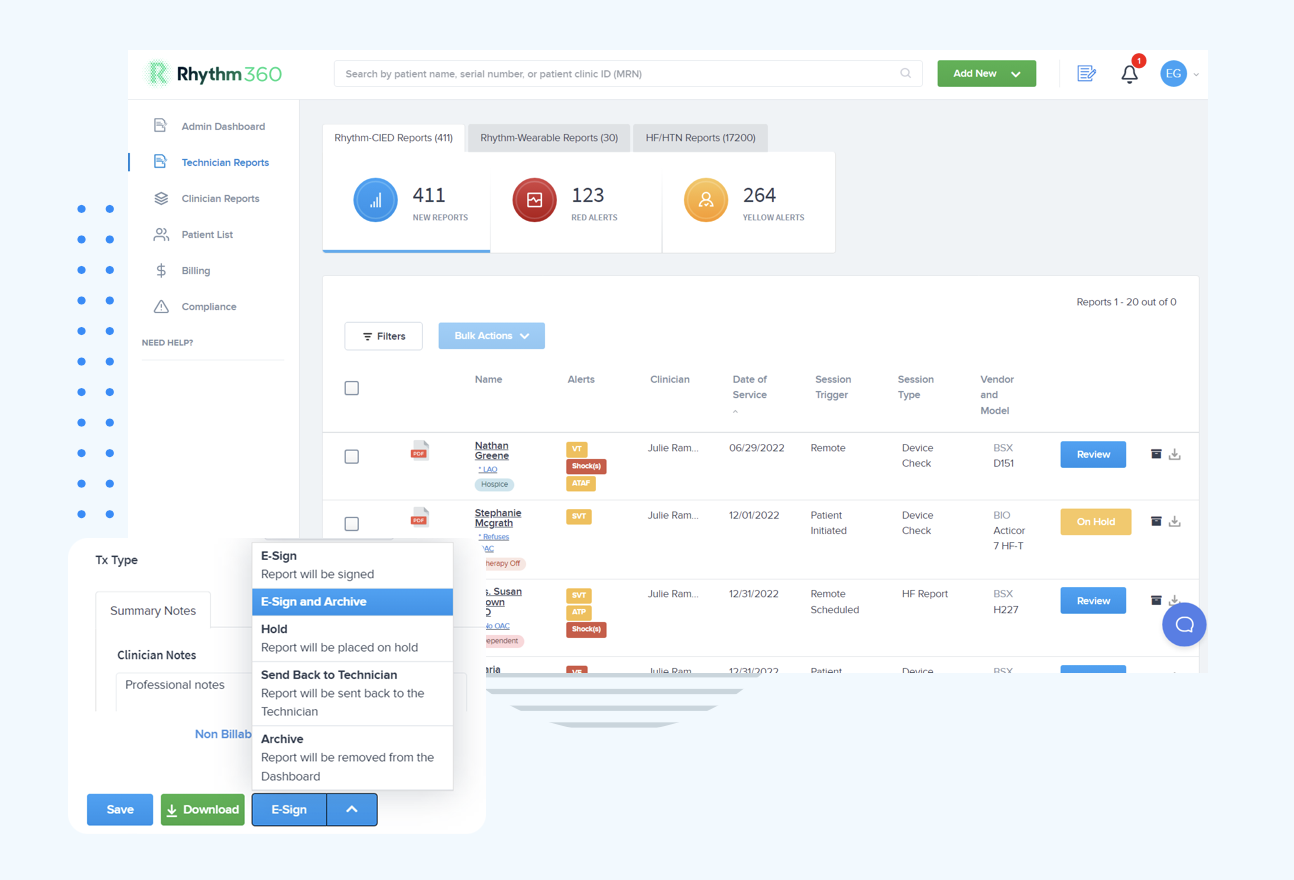
Rhythm360's AI-powered alert triage filters non-actionable transmissions and surfaces only clinically significant events for human review. For practices requiring additional coverage, Rhythm360 offers optional 24/7 oversight by certified cardiac technicians supervised by physicians. A tiered staffing model assigns medical assistants or care managers to daily dashboard review and routine outreach, RNs or clinical supervisors to escalated alerts, and physicians or NPPs to complex cases and billing attestation, a structure Rhythm360 supports natively through its role-based workflow architecture. Andrew Beaser, MD, Associate Professor of Medicine at UCM, noted that implementation of Rhythm360 enabled clinicians to review more transmissions daily and identify more abnormalities, a direct outcome of AI-assisted triage reducing the noise-to-signal ratio.
CardioMEMS programs that underperform clinically and financially share a common set of operational failures. Each pitfall compounds the next: data silos create alert overload, alert overload leads to incomplete documentation, and slow EHR adoption undermines everything else. Fixing them requires addressing the root infrastructure, not just individual symptoms.
The UCM implementation analysis notes that AI-assisted decision support will become increasingly important as data volumes grow. That trajectory makes vendor-neutral, AI-powered infrastructure the durable long-term investment for any HF program.
As detailed above, CHAMPION, MONITOR-HF, and GUIDE-HF each demonstrated significant reductions in HF hospitalizations, ranging from 28% to 44%, with the 2026 COAST registry corroborating these findings in real-world practice across six countries.
The ideal CardioMEMS candidate is an adult with NYHA Class II or III heart failure who has experienced at least one HF hospitalization in the prior 12 months, regardless of ejection fraction. The patient must be willing and able to perform daily PA pressure transmissions using the external antenna pillow, tolerate dual antiplatelet therapy or anticoagulation for at least one month post-implant, and act on medication adjustments directed by their care team. Patients with cognitive impairment, limited manual dexterity, or limited digital skills may still qualify with appropriate carer support. Patients with GFR below 25 mL/min, inability to tolerate antiplatelet or anticoagulant therapy, chest circumference exceeding approximately 160 cm, or NYHA Class IV status are generally not appropriate candidates.
The primary billing code for remote PA pressure monitoring is CPT 93264, which covers up to 30 days of monitoring including at least weekly downloads, interpretation, trend analysis, and a physician report. When CardioMEMS monitoring is integrated with a broader RPM program, additional codes apply: CPT 99453 for initial setup, CPT 99454 for device supply over 30 days, and CPT 99457 for the first 20 minutes of monthly treatment management services. CPT 93298 and 93299 apply when implantable cardiovascular monitor data is reviewed alongside CIED transmissions. Revenue capture depends on complete documentation of transmission days, clinician review time, and clinical decision-making. Practices using a unified platform that automates this documentation consistently capture more billable events per patient than those relying on manual, portal-based workflows.
CardioMEMS programs generate daily transmissions for every enrolled patient, and OEM systems typically flag a high proportion of readings as alerts, most of which are nonactionable. Without automated triage, clinical staff spend most of their review time dismissing noise rather than responding to genuine clinical events. AI-powered triage layers analyze incoming PA pressure data against patient-specific baselines and predefined escalation thresholds, suppressing nonactionable transmissions and surfacing only readings that warrant clinical review. This approach reduces critical response times by up to 80% and lets the same clinical team manage a significantly larger patient population without proportional staffing increases. Optional 24/7 oversight by certified cardiac technicians adds a safety layer for after-hours and weekend coverage.
Integration typically takes from a few days to a few weeks, depending on the complexity of the existing IT environment and the number of device manufacturer feeds being consolidated. The platform ingests CardioMEMS PA pressure data alongside CIED and RPM streams using API, HL7, XML, and computer-vision PDF parsing, normalizing all data into a single structured format before routing it to EHR flowsheets as discrete clinical values. This ensures CardioMEMS readings stay visible during clinical encounters instead of sitting siloed in a separate monitoring portal.
The clinical case for CardioMEMS is established. Across CHAMPION, MONITOR-HF, GUIDE-HF, and the 2026 COAST registry, PA pressure-guided management consistently reduces HF hospitalizations and improves quality of life, with emerging evidence that PA diastolic pressure trajectory independently predicts mortality. The operational case is equally clear. Those outcomes are only achievable when PA pressure data is ingested reliably, triaged intelligently, documented compliantly, and integrated seamlessly with the rest of the cardiac monitoring workflow.
Rhythm360 provides the infrastructure that connects clinical evidence to daily practice. It unifies CardioMEMS data with CIED and RPM streams, automates CPT documentation, reduces alert fatigue through AI triage, and integrates bi-directionally with every major EHR. The result is a scalable, billable heart failure monitoring program that delivers on the promise of the trials.
Get a walkthrough of how Rhythm360 turns CardioMEMS trial evidence into billable outcomes.