Last updated: July 14, 2026
The 2026 Medicare Physician Fee Schedule introduced two new RPM codes that materially change what cardiology practices can bill. The full code family forms the baseline capability that any RPM compliance platform must support.
The complete 2026 RPM code set and national average reimbursement rates are:
Among these codes, the practical impact of CPT 99445 is especially significant. Under prior rules, patients who transmitted fewer than 16 days of data generated zero billable supply code revenue. The new 2–15-day threshold converts many previously unbillable months into recoverable claims. An RPM-enrolled patient can generate up to $145.30 per month on RPM codes alone, and over $211 per month when chronic care management codes are also billed, which most RPM patients qualify for because of their multi-condition profiles.
To bill RPM codes compliantly, practices must satisfy a sequence of prerequisites before the first claim is submitted. Patient consent must be documented before services begin and must include cost-sharing disclosure and the right to revoke. That consent authorizes the physician order, which must specify a qualifying chronic condition. The order then governs which device is deployed, and that device must be FDA-cleared with automated electronic data transmission because manual patient entry does not meet CMS requirements. Transmission days must be tracked for each 30-day period, with 2–15 days supporting CPT 99445 and 16 or more days supporting CPT 99454. Time logs must capture specific dates, durations in minutes, activity descriptions, and staff identity for 99457, 99458, and 99470. Only one practitioner may bill RPM per patient per 30-day period. Quarterly internal audits that review a random 10–20% sample of patient records help confirm that each of these elements remains in place over time.
See how Rhythm360 automates CPT code capture across the full 2026 code family, including the new 99445 and 99470 codes that many platforms do not yet support.
Eligible billing providers for Medicare RPM include physicians, nurse practitioners, physician assistants, and other qualified healthcare professionals operating under applicable state scope-of-practice laws. Only one practitioner may bill RPM for a given patient in a 30-day period. Qualifying management time includes data review, patient outreach, clinical assessment, and care coordination that the RPM findings trigger.
Several eligibility and consent requirements govern RPM billing. An established patient-provider relationship must exist before billing begins. Written consent provides stronger audit protection than verbal consent and must document agreement to participate, single-provider billing acknowledgment, and cost-sharing obligations, which typically involve 20% coinsurance. Clinical staff time counts toward management codes only when it involves reviewing device data, identifying trends, patient outreach, clinical assessment, or care coordination. Entries such as “reviewed data” are insufficient and create audit liability. Medicare treats RPM as a care-management service, not telehealth, so it is not subject to geographic or originating-site restrictions.
CIED-specific remote monitoring uses a parallel code set, CPT 93296–93298, with 90-day transmission cycles. Transmissions received but not billed within the cycle are lost permanently. Automated cycle tracking therefore becomes a core platform requirement.
The core technical problem any solution must solve is substantial. Each CIED manufacturer has developed proprietary nomenclature, technical standards, and communication protocols, which creates significant barriers to integrating data from multiple vendors into a single platform.
The integration challenge grows more complex as device volume increases. Medical devices from different manufacturers typically use proprietary interfaces that require custom implementation, documentation review, software development, and repeated testing for each software version. Traditional EHRs are not well suited to managing CIED data, which forces clinicians to handle data from multiple hospital, office, and remote monitoring settings across vendors.
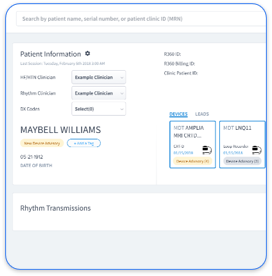
To solve this multi-vendor fragmentation problem, Rhythm360 uses a vendor-neutral architecture that ingests data from Medtronic, Boston Scientific, Abbott, Biotronik, and other manufacturers via API, HL7, XML, and PDF parsing with computer vision and AI-powered data normalization. The result is a single dashboard that replaces multiple OEM portal logins. University of Chicago Medicine reviewed more than 73,000 reports annually through Rhythm360 in calendar year 2025, averaging more than 18,000 reports per quarter, which demonstrates the platform’s capacity in high-volume multi-OEM environments.
| Capability | Rhythm360 Feature | Compliance Standard Met | Clinical/Operational Outcome |
|---|---|---|---|
| HIPAA / FDA / CMS Compliance | BAAs executed, AES-256 encryption, TLS 1.3, role-based access, audit logs, FDA-cleared device support | HIPAA Privacy, Security & Breach Notification Rules; CMS RPM billing requirements | Audit-ready documentation, reduced breach and denial risk |
| Multi-OEM Data Ingestion | Vendor-neutral ingestion via API, HL7, XML, and AI-powered PDF parsing from all major CIED manufacturers | HRS interoperability standards | Single dashboard that eliminates redundant OEM portal logins |
| AI Alert Triage | AI-driven prioritization of clinically significant events, filtering of non-actionable noise, optional 24/7/365 CCT oversight | CDS-exempt under January 2026 FDA guidance when recommendations are explainable and clinician-reviewed | Up to 80% reduction in critical alert response time |
| Bi-Directional EHR Integration | Native integrations with Epic, Cerner, Athenahealth, eClinicalWorks, Greenway Health, and others via HL7 | HL7 FHIR R4 interoperability standards | Eliminates manual transcription and closes documentation gaps |
| Mobile Access | Secure, HIPAA-compliant mobile app for transmission review, report signing, and care coordination | HIPAA Technical Safeguards, MFA enforced | Clinicians can act on critical alerts from any location |
| Automated CPT Documentation | System-level tracking of transmission days, management minutes, and consent status, with auto-generated billing documentation for full 2026 RPM and CIED code families | CMS 2026 RPM billing requirements (99445, 99453, 99454, 99457, 99458, 99470; 93296–93298) | Up to 300% revenue improvement through optimized code capture |
| >99.9% Data Transmissibility | Redundant data feeds, computer vision OCR, and AI-powered gap extrapolation that act as fail-safes when OEM servers are unavailable | CMS data transmission requirements for RPM billing | No missed transmission days due to OEM downtime, so billing thresholds are reliably met |
Clinic administrators evaluating cardiovascular RPM compliance software tools should verify specific security and billing controls before contracting with any vendor.
Security controls should include the following elements.
Billing documentation controls must work together to create audit-ready records. The foundation is system-enforced consent documentation that captures agreement, single-provider acknowledgment, and cost-sharing disclosure before any billing event occurs. Once consent is in place, automated transmission-day counters track whether each patient meets the 2–15-day threshold for CPT 99445 or the 16-day-and-above threshold for CPT 99454 in each 30-day period. For management codes, time-log templates must capture date, duration, activity description, and staff identity rather than free-text fields that generate audit liability. Physician order tracking with expiration alerts prevents billing against lapsed orders. A quarterly internal audit workflow that covers a random 10–20% sample of patient records across consent, orders, devices, transmission thresholds, and time documentation confirms that these controls remain effective.
A structured launch sequence prevents the billing leakage and compliance gaps that often appear when practices expand RPM programs without a defined workflow.
Walk through this seven-step workflow inside the Rhythm360 platform with a clinical specialist who can map it to your current EHR and device population.
The clinical and financial case for unified cardiovascular RPM compliance software is well documented. The CONNECT trial found that wireless remote monitoring with automatic clinician alerts reduced the median time from event occurrence to clinical decision from 22 days to 4.6 days. The TRUST trial showed that remote monitoring reduced in-office follow-up visits by 45% and significantly shortened the time to evaluation of arrhythmic events. These research findings translate directly into measurable practice-level outcomes.
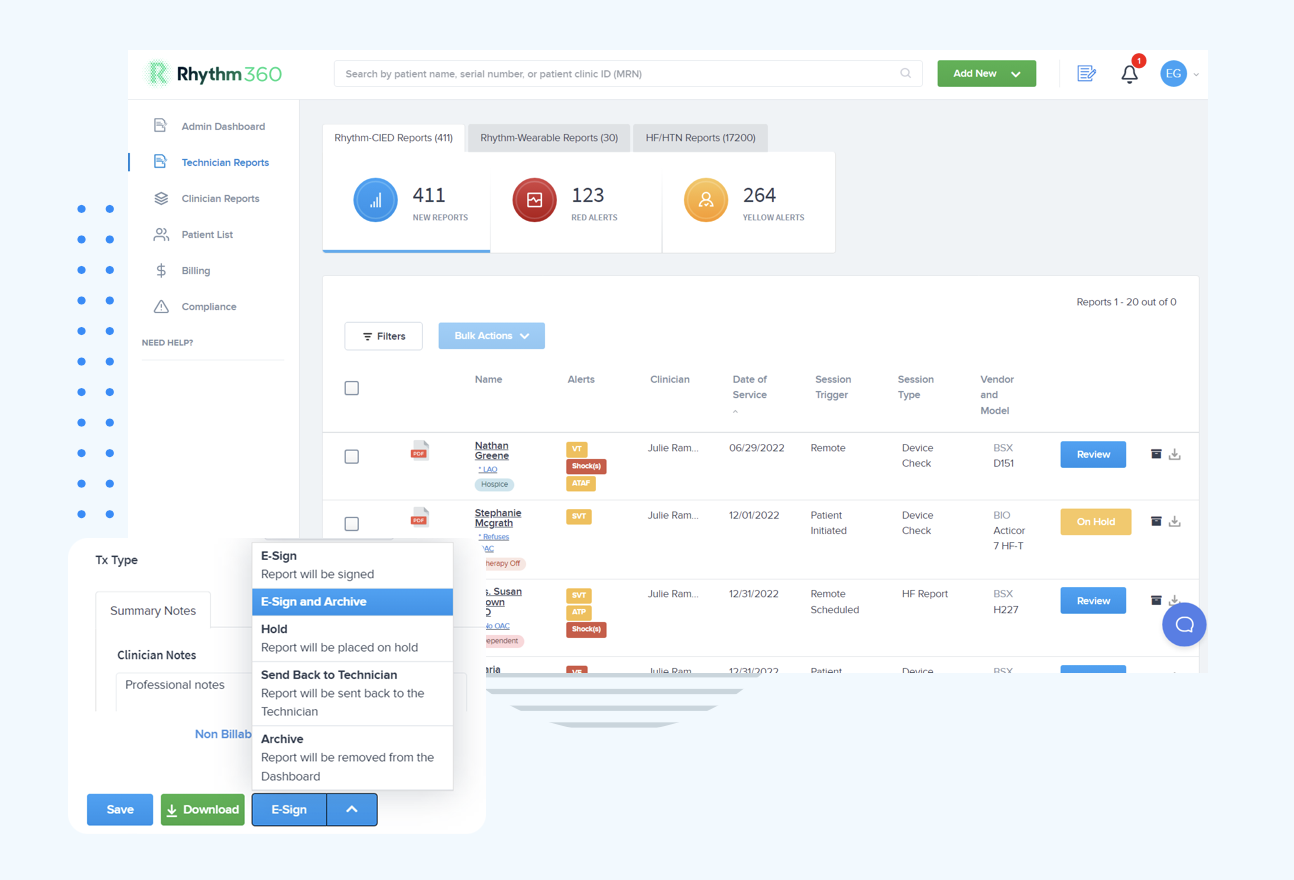
Rhythm360 clients report the alert-triage improvements shown in the capability table above, alongside up to a 300% improvement in revenue generation through optimized CPT code capture and the addition of HF and HTN RPM service lines. University of Chicago Medicine’s implementation of Rhythm360 enabled clinicians to review more transmissions daily and identify more abnormalities, and the team noted improved billing and accountability for patients after integration.
One operational scenario illustrates the platform’s value clearly. A patient’s device transmits a new-onset atrial fibrillation event at 7:00 a.m. on a Saturday. Rhythm360’s AI triage system prioritizes the alert above routine transmissions and routes it to the on-call clinician’s mobile app. By Saturday afternoon, the clinician has reviewed the transmission, initiated anticoagulation, and documented the intervention, all without the patient presenting to an emergency department. Without a unified platform, that transmission would likely wait in an OEM portal queue until Monday, a delay that bi-directional alert middleware research identifies as a primary driver of adverse outcomes in cardiac monitoring programs.
On the revenue side, practices with legitimate monitoring programs routinely bill less than half of entitled Medicare revenue because of gaps in billing workflows rather than fraud. A practice with 50 RPM patients where half require 40 or more minutes of monthly management leaves $1,035 per month unclaimed by failing to bill CPT 99458 add-on codes. Automated CPT documentation closes this gap in a consistent way.
The 2026 Medicare Physician Fee Schedule added two new codes to the RPM family. CPT 99445 covers device supply when patients transmit 2–15 days of data in a 30-day period, reimbursing approximately $52 per month. This code is detailed in the billing section above. CPT 99470 covers the first 10 minutes of treatment management, reimbursing approximately $26. These codes lower the entry threshold for billing RPM services and create new revenue opportunities for patients who previously fell below the 16-day transmission requirement. The existing codes, 99453, 99454, 99457, and 99458, remain in effect with updated 2026 rates. CIED-specific monitoring continues to use CPT codes 93296–93298 under 90-day transmission cycles.
All patient-identifying data flowing through a multi-OEM CIED integration, including device IDs, vital signs, alert logs, and care plans, constitutes Protected Health Information or Electronic Protected Health Information under HIPAA. Every component in the ecosystem, including sensors, mobile apps, integration engines, and cloud platforms, must implement Privacy Rule, Security Rule, and Breach Notification Rule safeguards. Business Associate Agreements are required with every manufacturer, cloud provider, and analytics vendor that handles PHI on behalf of the monitoring platform. A formal risk assessment must be conducted at least annually and after any material change, such as onboarding a new device model or adding an EHR integration. Encryption standards require AES-256 at rest and TLS 1.2 or higher in transit, with role-based access control and centralized audit logging across all integrated data streams.
Alert fatigue occurs when the volume of monitoring notifications, most of which are non-actionable or technical in origin, desensitizes clinical staff to the point where critical alerts are missed or delayed. Research that analyzed more than 65 million alarms across multiple ICU and intermediate care settings found that 88% of alarms were technical rather than physiologic, with ICUs experiencing up to 10 audible alarms per patient per hour. AI-powered triage addresses this problem by filtering non-actionable noise, grouping same-type alerts within defined intervals, and surfacing only clinically significant events with explainable reasoning for clinician review. Under the January 2026 FDA guidance update, AI alert triage that provides risk scores with explainable reasoning and preserves clinician decision authority qualifies as exempt Clinical Decision Support software, not a regulated medical device. Rhythm360’s AI triage system applies these principles to CIED and RPM data, reducing critical alert response times by up to 80% while maintaining the clinician as the final decision-maker.
A single platform can handle both service lines effectively. Rhythm360 provides distinct but integrated service lines for CIED monitoring, including pacemakers, ICDs, implantable loop recorders, CRT and CCM devices, and CardioMEMS pulmonary artery monitors, and for chronic condition RPM for heart failure and hypertension. The two service lines share a unified dashboard, common patient record, and integrated billing documentation engine, so a device technician or nurse practitioner can review a patient’s arrhythmia transmission and their most recent weight or blood pressure reading in the same workflow. This integration is clinically relevant because many CIED patients also carry heart failure or hypertension diagnoses, and managing both conditions in separate systems creates the same data fragmentation problem that multi-OEM portal management creates for device data alone.
The administrative and clinical costs of fragmented cardiovascular remote monitoring, including multiple OEM portal logins, manual CPT documentation, missed transmission thresholds, and delayed critical alert response, are both quantifiable and addressable. The 2026 CMS code updates create new billing opportunities that automated platforms can capture consistently, while tighter audit scrutiny makes compliant documentation a financial necessity rather than a best practice.
Rhythm360 is built specifically for cardiology practices that manage the complexity of multi-OEM CIED populations alongside chronic-condition RPM programs. The platform’s vendor-neutral data ingestion, AI-powered alert triage, bi-directional EHR integration, and automated CPT documentation address each of the seven capabilities outlined in this guide within a single HIPAA- and CMS-compliant environment.
Compare Rhythm360 against your current workflow in a live demo with a clinical specialist who will benchmark the platform’s performance against your device population and billing gaps.