

Last updated: September 17, 2026
Contact Rhythm360 to Learn More
Home monitoring tracks trends and triggers escalation. Clinical teams still handle diagnosis. A clinician diagnoses heart failure using three tools: a physical examination, a BNP or NT-proBNP blood test, and an echocardiogram. BNP rises when the heart is under stress or failing, and transthoracic echocardiography is used in around 87% of heart failure diagnoses because it measures ejection fraction, valve function, and filling pressures. A bathroom scale or a finger-press cannot provide that information.
Home monitoring works well for detecting the fluid accumulation that precedes a crisis. Weight increases in heart failure patients begin gradually approximately 30 days before hospitalization, so a daily routine gives patients and caregivers a meaningful head start. The 2022 AHA/ACC/HFSA heart failure guideline, the University of Maryland Medical System patient guidance, and MedlinePlus patient instructions all reinforce the same division of labor. Home monitoring tracks trends and prompts action, while diagnosis and staging remain clinical decisions.
Weigh yourself every morning after using the bathroom and before eating or drinking, on the same scale and in similar clothing. Recording the number every day, including weekends and holidays, turns a single reading into a trend the care team can act on. If you are helping someone else, anchor the weigh-in to the morning routine before breakfast so it does not get skipped.
The thresholds to know for daily weight monitoring for heart failure are straightforward. A gain of 2 to 3 pounds in one day or 5 pounds in one week is a red flag that the heart is struggling. These numbers form the foundation of heart failure monitoring at home because weight gain from fluid retention often precedes worsening shortness of breath by a day or more. That timing gives you a chance to act before a crisis develops.
Consistency matters more than precision. A scale that reads two pounds high every time still shows the trend correctly. Place the scale on a hard, flat surface and use it at the same time each day.
Press a fingertip firmly into the skin over the shin, ankle, or top of the foot for about five seconds, then release. If an indentation remains after you lift your finger, that is pitting edema, a sign of fluid retention. Check both legs and note any difference between them. Swelling that is worse in one leg than the other, or that does not resolve overnight with elevation, warrants a call to the care team.
Swollen legs signal fluid buildup that can appear at different stages of heart failure. Peripheral edema is one sign among many and should be reported to the care team. The four stages, A through D, are defined by structural findings and symptoms assessed by a clinician, so staging does not come from swelling alone.
Breathing-related changes often slip past patients until they become severe. Watch for:
If the care team has asked you to track blood pressure and pulse, record those numbers in the daily log as well.
A written log removes guesswork and gives the care team a trend to act on rather than a memory to reconstruct. If you are a caregiver, keeping this log is one of the most concrete ways to support the care plan. A printable version taped near the scale helps anyone managing this routine for a spouse or parent stay consistent. The table below shows the fields to record each morning, so the care team can see changes at a glance.
| Date | Morning Weight (lbs) | Change from Yesterday (lbs) | Blood Pressure | Pulse (bpm) | Swelling (None / Mild / Worse) | Breathing (Normal / Some Effort / Difficult) | Energy (Good / Fair / Poor) | Notes |
|---|---|---|---|---|---|---|---|---|
| — | — | — | — | — | — | — | — | — |
Daily Heart Failure Monitoring Log — RhythmScience / Rhythm360
The two clearest signs of worsening heart failure are the rapid weight gain pattern described in Step 1 and new or worsening swelling in the legs, ankles, or feet. Experiencing more than one warning symptom at the same time means the heart needs help.
Additional signs of worsening heart failure include worsening shortness of breath, trouble breathing when lying flat, and waking up short of breath at night. Any weight gain combined with new or worsening breathlessness should prompt an immediate call to the care team.
This framework turns daily readings into clear next steps. Treat these as general guideposts, and always follow your care team’s specific instructions first.
Tier 1 — Keep Monitoring (Green Zone): Weight stays within about 2 pounds of your established dry weight. You notice no new swelling. Breathing feels normal, and sleep is undisturbed. Continue your routine and bring the log to your next scheduled visit.
Tier 2 — Call the Clinic Today (Yellow Zone):
Tier 3 — Call 911 Now (Red Zone):
Several avoidable habits allow fluid to accumulate for days before a crisis becomes obvious. These patterns undercut the value of your daily routine.
When a patient calls the clinic reporting a 3-pound overnight gain, the care team takes that report seriously. The clinician may review the weight trend from the log, order a BNP blood test to assess how much stress the heart is under, adjust diuretic dosing, or schedule an in-person visit for an echocardiogram. Early decompensation can often be managed with a brief diuretic adjustment over the phone or in clinic, while patients who wait a week or two often need IV diuresis and a multi-day admission.
Remote monitoring programs close the loop between those calls. When daily weights and vitals are transmitted to the care team automatically, trends are visible between visits instead of reconstructed from memory. In one analysis, 96.4% of cardiology structures that implemented remote patient monitoring reported a reduction in the time between cardiac decompensation and initiation of medical care.
That is the workflow Rhythm360 was built to support. Rhythm360, developed by RhythmScience, is the platform care teams use to receive and act on home monitoring data for heart failure and hypertension patients. It provides a single, HIPAA-compliant, vendor-neutral platform that consolidates patient-transmitted data from cardiac devices and remote monitoring for heart failure and hypertension, so clinicians can spot a worsening trend early, before it becomes an emergency admission. Care teams interested in building or strengthening a structured remote monitoring program can see how Rhythm360 supports that workflow directly.
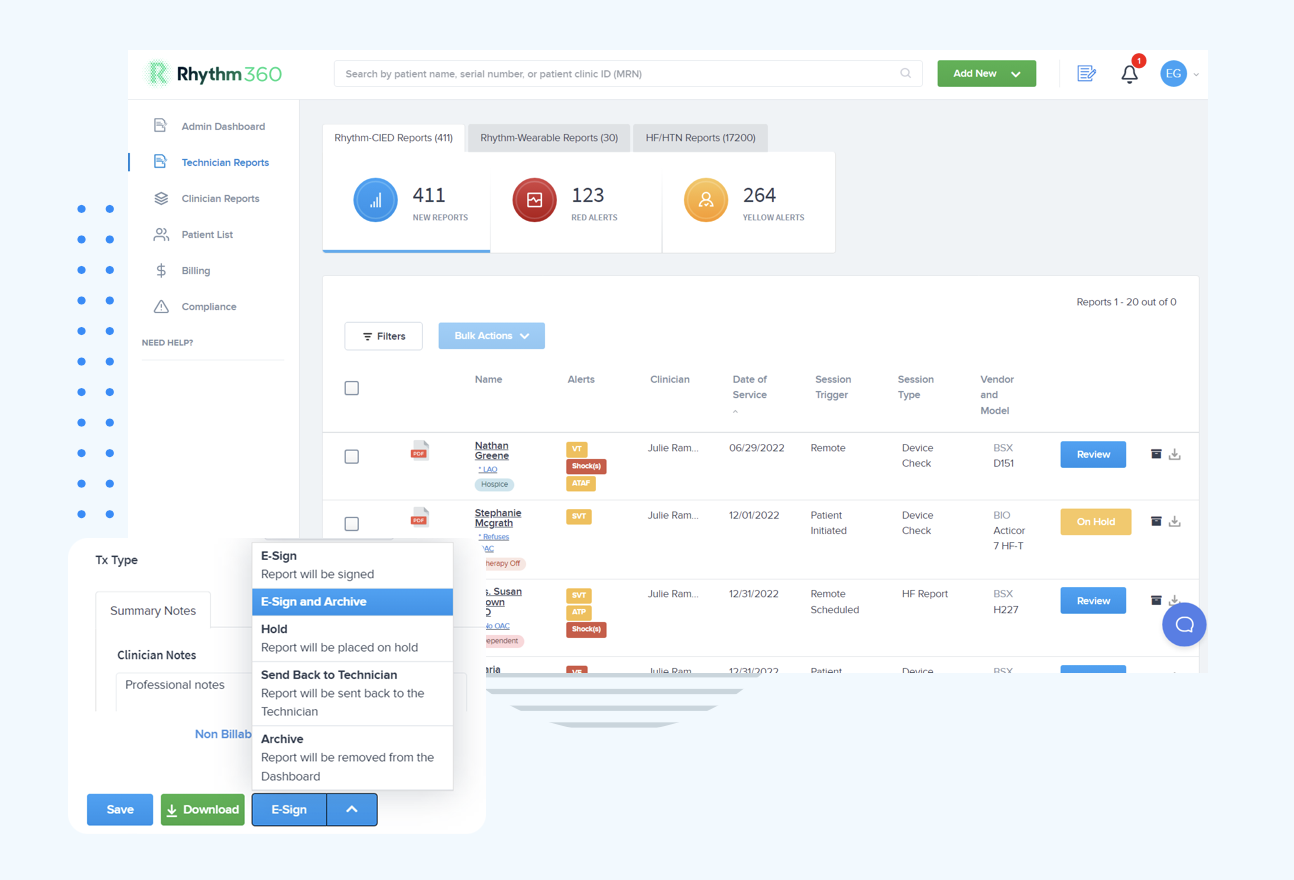
See How Rhythm360 Supports Remote Monitoring
Heart failure is a serious condition, and the daily monitoring routine described here aims to support quality of life and reduce hospital stays. Palliative care focuses on symptom relief, comfort, and quality of life and can begin at any stage of heart failure, not only near the end of life. Patients and caregivers who want to explore palliative support alongside active heart failure management should ask their care team about options in their area.
Heart failure patients and their caregivers often hear “watch for weight gain” and “check for swelling” without clear instructions. The seven-step routine above fills that gap with a daily weigh-in and specific numbers, a five-second finger-press edema check, breathing and sleep tracking, a copyable log, and a three-tier escalation ladder that clarifies when to call and when to call 911.
The data patients collect at home becomes powerful when it connects to a timely clinical response. Rhythm360, developed by RhythmScience, is the platform care teams use to receive, organize, and act on that home monitoring data. It gives clinicians a continuous, HIPAA-compliant view of weight trends, vitals, and device readings between visits, so a 3-pound overnight gain becomes an early intervention rather than an emergency admission.
Schedule a Demo of Rhythm360 Today





