Last updated: August 24, 2026
The 2023 HRS/EHRA/APHRS/LAHRS Expert Consensus Statement on Practical Management of the Remote Device Clinic gives clear guidance on remote monitoring for CIED follow-up. It covers scheduled interrogations, automatic unscheduled alert transmissions, and patient-initiated transmissions. The framework defines three severity tiers that guide how quickly clinicians must respond.
The three tiers and their response-time benchmarks are:
A letter in Clinical Case Reports highlighted that prioritization guidance must be paired with explicit response-time expectations and escalation protocols. This shifts the standard from simply counting alerts to measuring operational response speed. Any software under evaluation must map its alert categories directly to these tiers and enforce the corresponding response windows.
A 2026 cross-manufacturer real-world analysis of 2,659 rhythm episodes from 1,710 patients showed that even AI-equipped implantable cardiac monitors generated 32.9% non-actionable episodes. As Niraj Varma, MD, PhD, of the Cleveland Clinic, stated, “False-positive alerts remain one of the biggest operational challenges in remote cardiac monitoring. Every episode flagged by an implantable cardiac monitor must be reviewed by a clinician, yet even devices equipped with manufacturer AI algorithms still generate a substantial number of non-actionable alerts.”
Rhythm360 addresses this problem with configurable, patient-specific suppression logic instead of broad population defaults. When evaluating any platform, confirm it supports patient-specific alert threshold overrides with effective dates, authorizing clinician, and version history. This structure keeps suppression decisions traceable and reversible.
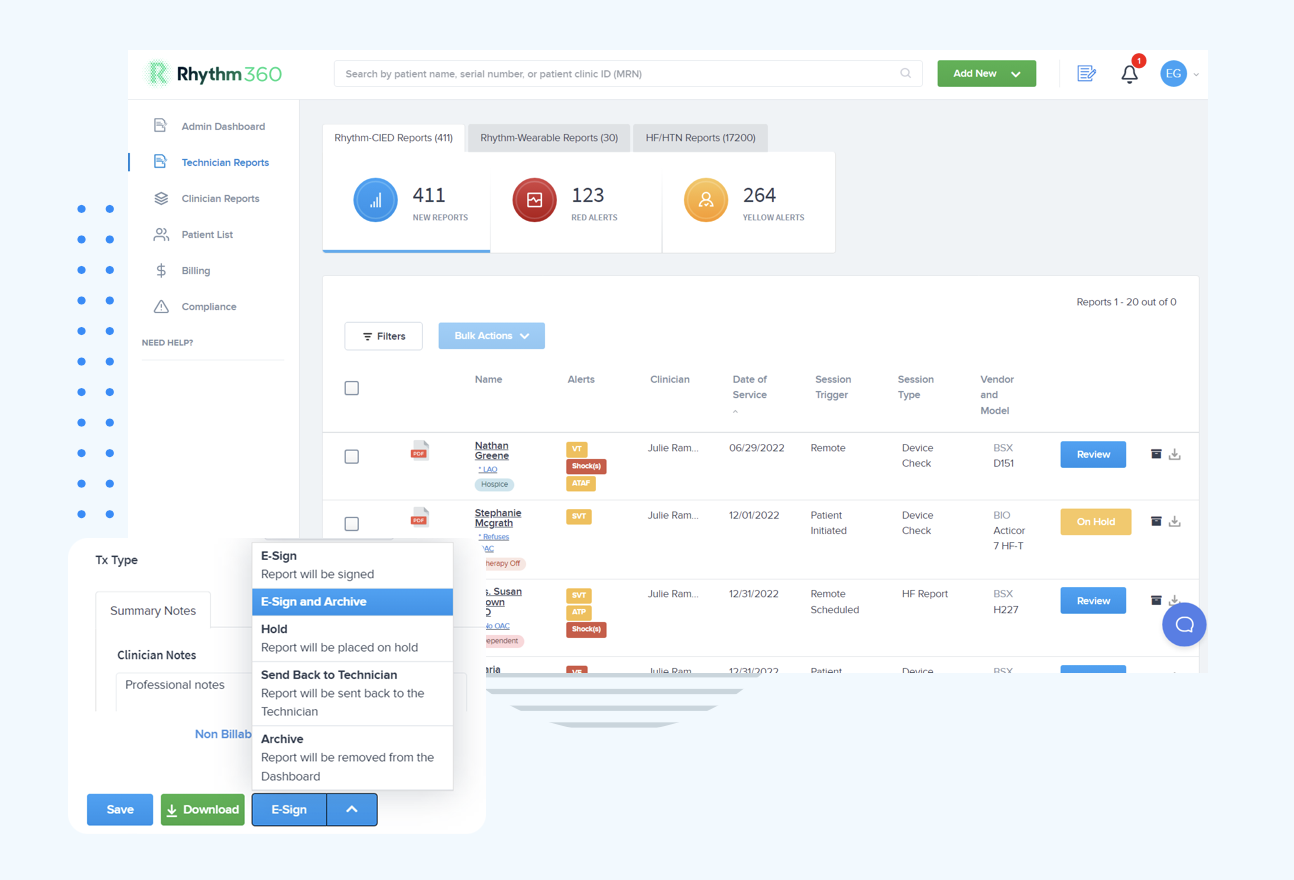
Those overrides should connect to device type, implant age, and clinical context so thresholds match the risk profile of each device and patient. An audit trail for every suppression decision then allows clinical leadership to review and refine thresholds over time. AI-assisted adjudication should flag indeterminate episodes for human review rather than auto-dismissing them, which preserves clinical oversight while reducing false positives.
Customized alert programming, per the 2023 international consensus statement, reduced alert frequency to roughly one per patient-year while increasing the proportion of actionable alerts. Any candidate platform should show how its suppression rules perform against that benchmark for your patient population.
In a multi-center study of more than 26,000 CIED patients, a large volume of transmissions arrived in 12 months, with many classified as alerts. Managing that volume across siloed OEM portals quickly becomes unsustainable. True vendor-neutral aggregation means the platform ingests data from every major manufacturer through APIs, HL7, XML, and PDF parsing via computer vision, then normalizes it into a single canonical record.
Rhythm360 achieves greater than 99.9% transmissibility through redundant data feeds that act as a fail-safe when an OEM server is unavailable. When evaluating platforms, confirm coverage of all OEMs in your current and anticipated device mix, including Medtronic, Boston Scientific, Abbott, Biotronik, and others. Also confirm a redundant ingestion architecture so a single vendor outage does not create a monitoring gap.
The platform should include computer vision or OCR to parse unstructured PDF reports from legacy OEM systems. A canonical data model must resolve identity conflicts when the same patient appears across multiple source systems. As middleware-based integration is often required for multi-vendor CIED environments because it handles terminology conversion, complex routing, high data volume, EHR API limits, and centralized audit and retry handling across mixed FHIR and HL7 v2 targets, the aggregation layer becomes the foundation for every downstream workflow.
The aggregation layer supports several downstream workflows, and EHR integration is the most critical of these. One-way data export into an EHR does not support a compliant CIED monitoring program. Bi-directional integration means alert acknowledgments, clinical notes, and billing documentation flow back from the monitoring platform into the EHR without manual transcription.
Rhythm360 integrates bi-directionally with Epic, Cerner, Athenahealth, eClinicalWorks, Greenway Health, and others via HL7, with implementation typically completed in a few days to a few weeks. Before signing any contract, verify the following checklist items.
Practices that implement compliant bi-directional integration report measurable improvements in CPT capture rates. As Gaurav A. Upadhyay, MD, at the University of Chicago Medicine, observed after implementing Rhythm360, “We have improved billing and accountability for our patients after the integration.”
The 2023 HRS/EHRA/APHRS/LAHRS consensus statement recommends writing down reaction time to red alerts, staffing to that target, and auditing performance against it. An overnight alert without a named owner reflects a policy, not an operational process. A documented escalation pathway for a critical CIED alert at 2 a.m. must specify named responders, timeframes, and a fallback.
Rhythm360’s HIPAA-compliant mobile application lets clinicians review transmissions, sign reports, and coordinate care from their smartphones. Andrew Beaser, MD, Associate Professor of Medicine at the University of Chicago Medicine, noted, “I am more likely to sign off on these while in meetings because I can easily access them on my phone.”
An effective after-hours escalation workflow includes several elements.
Alert prioritization and billing capture move together, because a reviewed, documented, and acknowledged alert creates the clinical event that supports a billable service. Practices using Rhythm360 have reported revenue improvements of up to 300% through improved CPT code capture, better staff efficiency, and the addition of RPM service lines for heart failure and hypertension management.
The relevant CPT codes and their documentation dependencies are:
A platform that prioritizes alerts but does not automatically generate compliant billing documentation forces staff into a second manual workflow. Confirm that the software creates draft billing tasks linked directly to the reviewed alert record rather than a separate documentation step.
Schedule a demo to see how Rhythm360 connects prioritized alert review directly to CPT billing documentation.
A platform that takes months to deploy or depends on a single “super-user” introduces operational risk. Rhythm360’s implementation, including EHR integration, typically completes in a few days to a few weeks. A structured rollout limits disruption and speeds time to value.
Use the following checklist when evaluating implementation readiness:
The table below shows how Rhythm360 addresses the four core technical dimensions of CIED alert prioritization. This view helps teams compare a single consolidated platform with the effort of stitching together multiple point solutions.
| Dimension | Rhythm360 (RhythmScience) |
|---|---|
| Prioritization Method | AI-powered triage mapped to Critical / Urgent / Routine categories aligned with 2023 HRS/EHRA consensus tiers |
| Vendor Coverage | Vendor-neutral ingestion of Medtronic, Boston Scientific, Abbott, Biotronik, and others via API, HL7, XML, and computer vision; redundant feeds that maintain the transmissibility rate documented earlier |
| EHR Sync | Bi-directional integration with Epic, Cerner, Athenahealth, eClinicalWorks, Greenway Health, and others; implementation in days to weeks |
| Response-Time Impact | Documented reduction in critical alert response times at institutions such as University of Chicago Medicine, supported by HIPAA-compliant mobile access for after-hours review |
Configuring suppression rules before go-live gives practices one of the highest-yield levers for reducing non-actionable alert volume. A structured template ensures clinical leadership reviews and approves every suppression decision, with version history and authorizing clinician documented for audits.
RhythmScience provides an alert-suppression rules template as part of the Rhythm360 implementation package. The template covers device type, arrhythmia category, threshold parameters, patient-specific override fields, effective date, and approving clinician signature. Schedule a demo to receive the template and review how suppression rules are configured within the platform.
Rhythm360 reduces response times through three compounding mechanisms. First, AI-powered triage filters non-actionable alerts and surfaces only clinically significant events in a prioritized queue, which eliminates the time staff spend manually reviewing every transmission. Second, HIPAA-compliant mobile access sends the on-call clinician a push notification with alert context immediately rather than waiting for the next scheduled portal check. Third, bi-directional EHR integration removes the extra documentation step between alert review and clinical action, so the time from alert receipt to intervention shrinks at every stage.
University of Chicago Medicine, which reviewed more than 73,000 reports annually through Rhythm360, reported that clinicians could address issues earlier and call patients in for evaluation instead of waiting for a scheduled 3-month visit.
Rhythm360 supports documentation for CIED remote monitoring codes including 93298 and 93299, as well as remote physiological monitoring codes 99453, 99454, 99457, and 99458. The platform automatically records the clinical events, reviewed transmissions, signed interpretations, and care-team time that each code requires, then generates draft billing tasks linked to the underlying alert record. This approach removes the separate documentation workflow that often causes revenue leakage in manual processes. Practices implementing Rhythm360 have reported the revenue improvements described earlier, driven by better CPT capture rates and new RPM service lines for heart failure and hypertension patients.
Rhythm360 works alongside existing EHR systems rather than replacing them. It integrates bi-directionally with Epic, Cerner, Athenahealth, eClinicalWorks, Greenway Health, and others via HL7, functioning as a specialized layer between OEM device portals and the practice’s clinical record. Implementation, including EHR integration setup and OEM portal credentialing, typically completes within the timeframe noted earlier, depending on the number of integrations and the complexity of the existing environment. RhythmScience provides a dedicated implementation manager and a structured rollout process that includes role-based training for device technicians, nurses, administrators, and on-call physicians.
Vendor-neutral aggregation sits at the core of Rhythm360’s design. The platform ingests data from Medtronic, Boston Scientific, Abbott, Biotronik, and other manufacturers through APIs, HL7, XML, and PDF parsing via computer vision, then normalizes all transmissions into a single dashboard. A redundant data feed architecture ensures that if one OEM’s server is unavailable, transmissions are not lost. This capability is especially important for practices with implants from more than one manufacturer, because the alternative, logging into separate non-interoperable portals, recreates the data silos and alert fatigue that prioritization software aims to eliminate.
Choosing CIED alert prioritization software in 2026 requires evaluating seven concrete dimensions. These include alignment with HRS/EHRA alert categories and response-time benchmarks, AI-driven suppression logic with patient-specific rules, vendor-neutral data aggregation with redundant feeds, bi-directional EHR integration with compliant billing documentation, after-hours mobile escalation with named responders and audit trails, CPT billing capture tied directly to reviewed alerts, and a structured implementation process that fits existing workflows.
Rhythm360 by RhythmScience addresses each criterion through a single, AI-powered, vendor-neutral platform that has delivered the response-time improvements and revenue gains described earlier for practices that moved away from fragmented OEM portals. Andrew Beaser, MD, at the University of Chicago Medicine, summarized where the field is heading: “Decision support, including AI-assisted decision support, will become increasingly important as data volumes grow.”
Schedule a demo with RhythmScience to walk through how Rhythm360 maps to each of these seven criteria for your specific patient population and device mix.