Last updated: July 14, 2026
CIED remote monitoring uses continuous or scheduled wireless transmission of device diagnostics, including arrhythmia logs, lead impedance, battery status, and therapy delivery data. These transmissions come from implanted pacemakers, ICDs, CRT devices, and implantable loop recorders (ILRs) into a clinical review platform. From the clinic's perspective, remote monitoring functions as patient safety infrastructure, a workflow system, and a billable service line with direct revenue tied to CPT code compliance and complete documentation.
Most cardiology practices implant devices from multiple manufacturers such as Medtronic, Boston Scientific, Abbott, and Biotronik. Each OEM runs a separate, non-interoperable web portal. Staff must log into each system individually, reconcile data formats, and manually transcribe findings into the EHR. This fragmentation creates a cascade of compounding problems.
Data silos block a unified view of the patient population. Manual logins increase the time required per transmission review. A cross-manufacturer analysis of 2,659 rhythm episodes from 1,710 patients presented at the 2026 EHRA Congress found that even AI-equipped implantable cardiac monitors generated 32.9% non-actionable episodes and 30.6% indeterminate episodes. Staff process large volumes of alerts that require clinical judgment yet rarely lead to intervention. Without intelligent triage, that volume drives alert fatigue and burnout.
This staffing strain directly impacts revenue capture. Billing leakage compounds the operational burden. When billable transmission periods go undocumented or CPT codes are applied to the wrong monitoring window, claims are denied. A practice managing hundreds of device patients across fragmented portals lacks a reliable mechanism to track which patients have met the documentation thresholds required for each code.
See how Rhythm360 unifies multi-portal CIED workflows into a single, auditable review process.
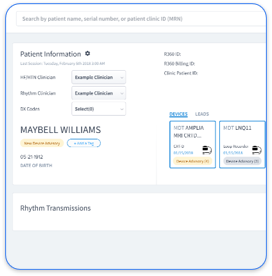
A vendor-neutral platform solves fragmentation by ingesting data from all OEM sources through API, HL7, XML, and PDF parsing with computer vision. The platform then normalizes this information into a single dashboard. Clinicians use one interface regardless of device manufacturer, which removes redundant logins and manual transcription.
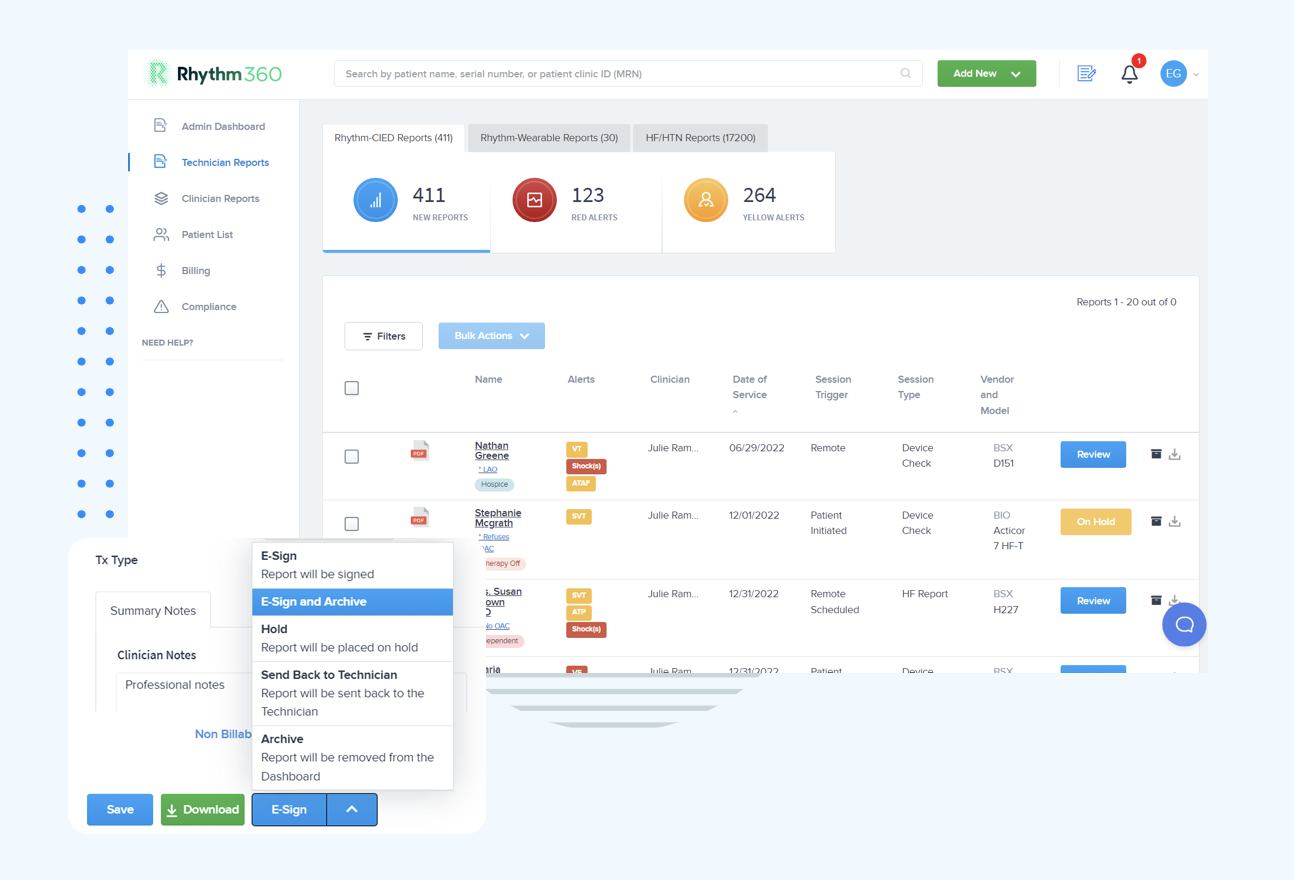
Rhythm360 by RhythmScience follows this architecture. The platform reaches greater than 99.9% transmissibility through redundant data feeds that remain active even when an OEM server experiences downtime. Bi-directional EHR integration with Epic, Cerner, Athenahealth, eClinicalWorks, and Greenway Health sends documentation directly into the patient record. A HIPAA-compliant mobile application lets clinicians review transmissions, sign reports, and coordinate care from any location. At the University of Chicago Medicine, implementation of Rhythm360 enabled clinicians to review more transmissions daily and identify more abnormalities, as noted by Andrew Beaser, MD, Associate Professor of Medicine at UCM.
Other platforms operate in this market. Clinics evaluating any option should review vendor neutrality, EHR integration depth, data transmission guarantees, and billing automation capabilities.
The 2015 HRS Expert Consensus Statement on Remote Interrogation and Monitoring for Cardiovascular Electronic Implantable Devices, reinforced by the 2023 HRS consensus statement, endorses remote monitoring as the primary mode of follow-up for pacemakers, ICDs, CRTs, and ILRs. Standard transmission schedules by device type include:
Hybrid care models combine remote monitoring with structured in-person and telephone follow-up. A 2026 care algorithm from the Department of Cardiology at Guillermo Grant Benavente Hospital specifies that pacemaker patients receive telephone follow-up every 6 months and annual cardiologist evaluations when remote monitoring is stable. ICD recipients require 6-month electrophysiology follow-ups, and CRT patients need 6-month comprehensive heart failure plus EP assessments. Remote monitoring does not replace in-person visits. It identifies which patients need earlier in-person evaluation. As Andrew Beaser, MD, at UCM explained, "We are able to address these issues earlier; rather than waiting for a 3-month visit, we can call patients in for evaluation."
The CPT code series 93293–93299 governs CIED remote monitoring reimbursement. Correct use requires matching the code to the device type, monitoring period, and documentation elements. The table below summarizes the primary codes, their monitoring periods, and key documentation requirements.
| CPT Code | Device / Service | Monitoring Period | Key Documentation Requirements |
|---|---|---|---|
| 93294 | Pacemaker — professional interpretation | 90 days, billed once per period | Device manufacturer and model, transmission date, data summary, physician interpretation, and clinical action taken |
| 93295 | ICD / CRT-D — professional interpretation | 90 days, billed once per period | Device manufacturer and model, transmission date, data summary, physician interpretation, and clinical action taken |
| 93296 | Pacemaker / ICD — technical component | Billed alongside 93294 or 93295 by the entity operating the monitoring platform | Patient demographics, device type, and monitoring period dates |
| 93297 | ILR / ICM — professional interpretation | Per clinically indicated transmission period, with no 30-day minimum | Clinical interpretation documented for each episode |
| 93298 | Subcutaneous cardiac rhythm monitor — technical component | Up to 30 days per 2026 Medicare Physician Fee Schedule, once per window | Device manufacturer and model, transmission date, and monitoring period dates |
Cardiology practices can capture substantial annual recurring revenue from properly billed remote monitoring. Rhythm360 automates CPT code tracking and documentation generation, which helps practices capture previously lost revenue and reduce claim denials from incomplete records.
Staffing strain is a widespread challenge in device clinics, compounded by technician turnover and growing data volume. Teams often feel overwhelmed by transmissions instead of supported by scalable workflows. As Gaurav A. Upadhyay, MD, FACC, FHRS, Professor of Medicine and Director of the Pacing & Defibrillation Device Clinic at UCM, stated, "Staffing was always an issue for our center, because our device clinic, like many other medical centers, had struggled with technician turnover and timely weekend coverage."
The table below contrasts a commonly cited staffing benchmark with the workflow gains achievable through platform automation.
| Model | FTE per 1,000 Patients | Key Workflow Characteristic | Critical Alert Response |
|---|---|---|---|
| Manual multi-portal model | ~3.0 FTE | Separate logins per OEM, manual EHR transcription, and no automated triage | Baseline, variable by staffing availability |
| Unified platform with AI triage (Rhythm360) | Scales without proportional headcount increase | Single dashboard, automated report generation, bi-directional EHR integration, and optional 24/7 CCT oversight | Up to 80% reduction in critical response times |
UCM reviewed more than 73,000 reports annually through Rhythm360 in calendar year 2025, averaging more than 18,000 reports per quarter. This volume shows that high-volume monitoring becomes operationally sustainable with the right platform infrastructure. Dr. Upadhyay noted, "That was a big piece for us, to have an integrated review of data from trained personnel."
A 2026 qualitative study found that alert fatigue manifests along a continuum influenced by individual, technical, and contextual factors, each carrying distinct risks to patient safety and care quality. Effective reduction strategies operate at multiple levels:
High dismissal rates in CIED monitoring at UCM are structural features of safety-first remote monitoring, with most OEM-generated alerts being nonactionable across more than 73,000 reports reviewed annually. Platforms that surface only clinically meaningful events reduce the cognitive burden on staff and improve the signal-to-noise ratio that determines whether a critical event receives timely action.
CIED remote monitoring functions as a scheduled or triggered review service rather than an emergency service. Transmissions follow defined review cycles, and patients must understand that a transmitted alert does not guarantee immediate clinical contact. Clinics need clear protocols that define which findings trigger an urgent callback and which findings qualify as routine follow-up.
Patient travel and device disconnections create frequent operational challenges. Key policies to establish include:
Transitioning to a unified platform can move quickly. Rhythm360's onboarding process, including EHR integration setup, typically ranges from a few days to a few weeks. Integration support covers Epic, Cerner, Athenahealth, eClinicalWorks, and Greenway Health via HL7, with device manufacturer connections for Medtronic, Boston Scientific, Abbott, Biotronik, and others.
Pricing follows a SaaS model that scales with clinic size and platform usage, which avoids the high upfront costs of legacy on-premise systems. Key implementation considerations include:
What is the difference between CPT 93294 and CPT 93295 for CIED remote monitoring billing?
CPT 93294 applies to the professional interpretation of remote transmissions from single- or dual-chamber pacemakers and is billed once per 90-day monitoring period. CPT 93295 applies to ICDs, including CRT-D devices, and follows the same 90-day billing cycle. The two codes are mutually exclusive and cannot be billed together for the same patient on the same date. Both require a minimum 30-day remote monitoring period in a calendar year before billing, along with a documented physician interpretation that addresses device function, programmed parameters, and any actionable findings.
How many staff members does a cardiology clinic need to manage a CIED remote monitoring program?
Staffing needs vary by patient volume, device mix, and workflow automation level. International survey data indicates that roughly 42% of device clinic staff rate their programs as insufficiently staffed, with teams overwhelmed by data volume rather than supported by scalable processes. A commonly referenced benchmark is approximately 3.0 FTE per 1,000 monitored patients under manual multi-portal workflows. Platforms that automate data ingestion, report generation, and alert triage allow practices to scale patient volume without proportional headcount increases. Optional certified cardiac technician oversight can extend coverage to weekends and after-hours without requiring additional in-house staff.
Can CIED remote monitoring replace in-person device clinic visits entirely?
No. Remote monitoring serves as the primary mode of follow-up recommended by the 2023 HRS consensus statement, yet it operates within a hybrid care model that retains mandatory in-person evaluations. Pacemaker patients typically require annual cardiologist evaluations when remote monitoring is stable. ICD recipients need 6-month electrophysiology follow-ups. CRT patients require 6-month comprehensive heart failure and EP assessments. In-person visits remain essential for device reprogramming, post-implant assessment, and any clinical finding that requires hands-on evaluation. Remote monitoring determines which patients need to be seen sooner, not whether they need to be seen at all.
What causes alert fatigue in CIED remote monitoring, and how can clinics reduce it?
Alert fatigue in CIED remote monitoring stems from high volumes of non-actionable transmissions generated by OEM systems. Even AI-equipped implantable cardiac monitors produce the high rates of non-actionable alerts discussed earlier in this article. Contributing factors include alert design, institutional norms, information overload from multiple concurrent alert systems, and clinician experience level. Effective reduction strategies include AI-powered triage that filters non-actionable alerts before they reach the clinical queue, redundant data feeds that prevent missed critical events from transmission failures, configurable alert thresholds, and optional human oversight by certified cardiac technicians for after-hours coverage.
How does Rhythm360 improve billing outcomes for CIED remote monitoring?
Rhythm360 automates CPT code tracking and documentation generation across the full 93294–93298 code series, aligning documentation with CMS LCD requirements for each monitoring period. The platform's administrative dashboard provides a real-time view of captured and potential revenue based on CPT code thresholds, which allows staff to identify billing gaps before claims are submitted. By consolidating all OEM data into a single auditable record, the platform reduces the manual documentation burden that leads to incomplete claims and denials. Practices implementing Rhythm360 have achieved up to a 300% increase in revenue generation through improved CPT code capture and staff efficiency. As Dr. Upadhyay at UCM noted after implementation, "We have improved billing and accountability for our patients after the integration."
CIED remote monitoring in 2026 functions as a clinical, operational, and financial discipline that requires more than passive data collection. Fragmented OEM portals create unsustainable administrative burdens, expose practices to missed critical events, drive alert fatigue and staff burnout, and leave significant billable revenue uncaptured. A unified, vendor-neutral platform addresses each of these failure points by consolidating data, automating triage and documentation, integrating with existing EHR infrastructure, and scaling without proportional headcount growth.
Rhythm360 by RhythmScience delivers near-perfect data transmission rates, significant reductions in critical alert response times, and the documentation infrastructure needed to capture compliant revenue across the full CIED CPT code series. The platform supports cardiology practices of every size, from solo EP clinics to large integrated health systems managing tens of thousands of device patients annually.