

Last updated: July 13, 2026
Cardiology practices managing mixed-OEM device populations encounter the same five recurring problems.
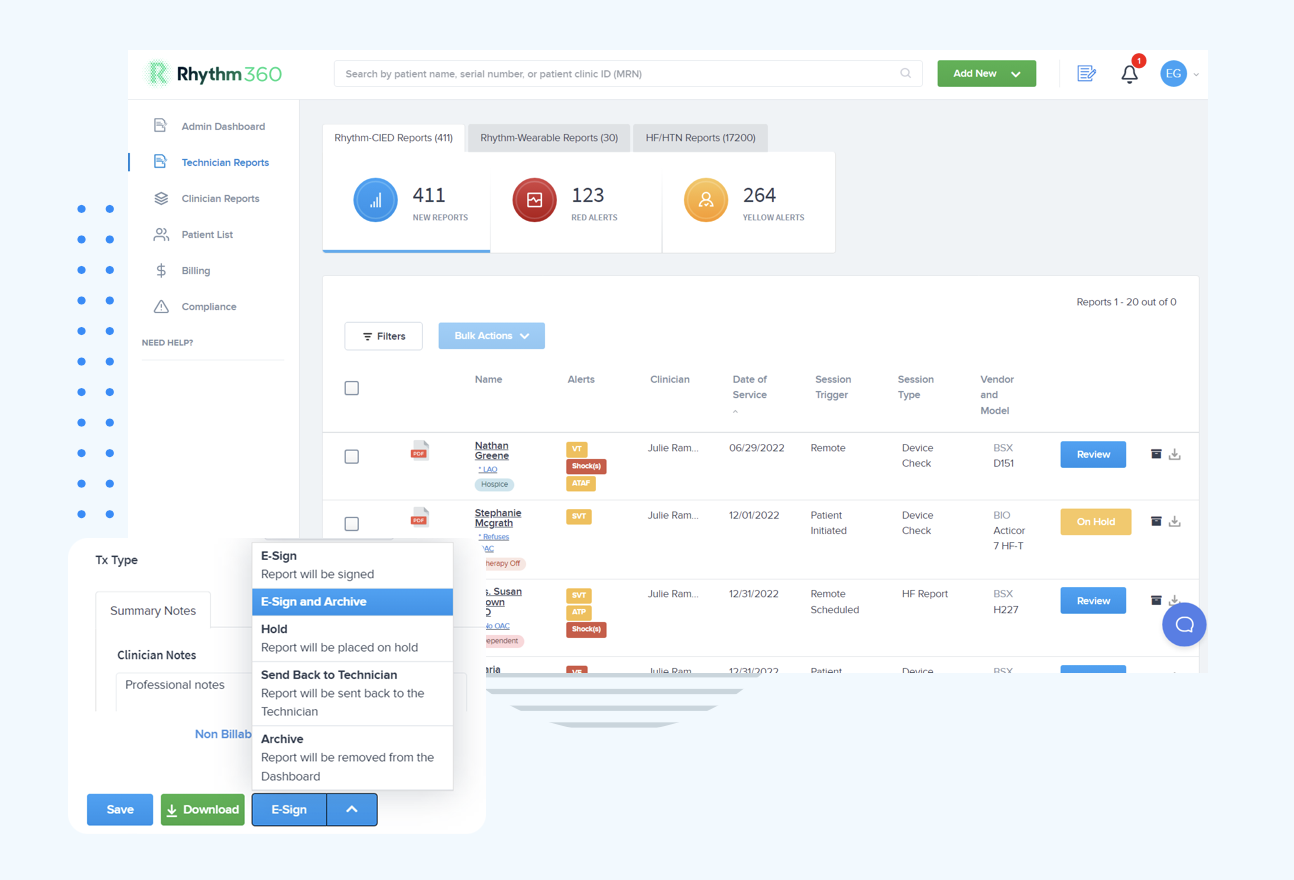
Any CIED platform in 2026 must ingest, normalize, and display data from every major device manufacturer in a single interface. Rhythm360 delivers this through API connections, HL7 feeds, XML parsing, and AI-powered computer vision that processes unstructured PDF reports from OEM portals. The table below shows how this multi-layered architecture supports broad OEM coverage and reliable data flow.
| Capability | Rhythm360 (RhythmScience) |
|---|---|
| OEM coverage | Medtronic, Boston Scientific, Abbott, Biotronik, and others via API, HL7, XML, and PDF parsing |
| Data transmissibility | High data reliability supported by redundant data feeds, computer vision, and AI-powered extrapolation |
| Annual report volume (reference deployment) | Tens of thousands of reports processed annually in high-volume reference deployments |
| Fail-safe mechanism | Redundant data feed system activates if an OEM server is unavailable |
| Device types supported | Pacemakers, ICDs, CRT devices, implantable loop recorders, CCM devices, CardioMEMS pulmonary artery monitors |
Andrew Beaser, MD, Associate Professor of Medicine at University of Chicago Medicine, noted that Rhythm360 enabled clinicians to review more transmissions daily and identify more abnormalities. The platform’s redundant architecture keeps monitoring continuous during OEM server outages, which matters for practices caring for high-risk device populations.
Alert fatigue creates a patient safety problem, not just an operational nuisance. When clinically non-relevant notifications dominate a queue, the chance of a critical event being delayed or missed rises. Rhythm360’s AI triage layer filters non-actionable transmissions before they reach the clinical review queue and surfaces only events that require intervention. The following metrics highlight how this triage approach supports faster action and dependable workflows.
| Metric | Rhythm360 (RhythmScience) |
|---|---|
| Critical alert response-time reduction | Markedly faster response to critical alerts |
| Data reliability underpinning triage | AI-driven triage that reduces alert fatigue while maintaining high data reliability |
| Optional 24/7 oversight | Certified cardiac technicians (CCTs) supervised by physicians available around the clock |
| Mobile alert access | HIPAA-compliant smartphone app; clinicians can review and sign reports from any location |
The clinical impact of faster triage shows up in real cases. A critical arrhythmia flagged on a Saturday morning can lead to anticoagulation initiation or device reprogramming by Saturday afternoon. That outcome depends on the platform detecting and surfacing the event without delay. As one UCM clinician noted, “Decision support, including AI-assisted decision support, will become increasingly important as data volumes grow.” Beyond improving clinical triage, effective CIED platforms must also capture the financial value of that monitoring work.
CIED remote monitoring reimbursement depends on precise documentation across several code families. The 2023 HRS consensus recommends remote monitoring as the primary follow-up mode for CIEDs, with Medicare reimbursement through CPT codes 93294–93298. Two 2026 Medicare updates add both complexity and opportunity.
Manual tracking rarely captures these windows consistently. Rhythm360 automates transmission-day counting, flags patients approaching threshold shortfalls, and generates compliant documentation for each billing period. The table below outlines how this automation affects revenue and audit readiness.
| Billing Outcome | Rhythm360 (RhythmScience) |
|---|---|
| Revenue lift from optimized CPT capture | Up to 300% increase in revenue generation through optimized CPT code capture and improved staff efficiency |
| CPT 99457 capture rate (automated vs. manual) | Automated workflows can improve CPT 99457 capture rates compared to manual processes |
| 99454/99445 auto-selection | Platform supports selection between appropriate codes for varying monitoring periods at period close to prevent revenue leakage |
| Audit documentation | Structured records for device-status logs, device-attribution, and patient-attribution stored per billing period |
| UCM billing outcome | “We have improved billing and accountability for our patients after the integration.” |
Request a billing analysis to quantify your practice’s CPT capture opportunity.
EHR integration determines whether a platform reduces documentation burden or adds extra clicks. Rhythm360 supports bi-directional data exchange with Epic, Cerner, eClinicalWorks, Greenway Health, and others via HL7, with FHIR-based connectivity aligned to the CMS Interoperability and Prior Authorization Final Rule (CMS-0057-F), effective January 1, 2026, which requires FHIR-based APIs for data exchange. The table below highlights how these choices affect implementation complexity and timeline predictability.
| Integration Factor | Rhythm360 (RhythmScience) |
|---|---|
| EHR systems supported | Epic, Cerner, eClinicalWorks, Greenway Health, and others via HL7 |
| Data flow direction | Bi-directional: device data into EHR; EHR orders and patient records into Rhythm360 |
| Integration standard | HL7 with FHIR-aligned architecture |
| Implementation timeline | Typical range from several days to several weeks from contract to go-live |
Standards-based integration using HL7 FHIR is recommended over proprietary interfaces to reduce long-term maintenance burden and improve vendor flexibility. Rhythm360’s implementation approach focuses on clinical workflow alignment and involves physicians, nurses, and device technicians during setup so the integration reflects how the team actually works.
Many CIED patients also live with heart failure and hypertension. Rhythm360 extends beyond CIED monitoring to include turnkey service lines for Heart Failure and Hypertension Remote Physiological Monitoring (RPM), covering CPT codes 99453, 99454, 99457, and 99458 within the same workspace. Practices can launch a new RPM service line for chronic disease patients without adding a separate vendor or workflow, which creates recurring revenue while supporting more comprehensive longitudinal care.
Rhythm360’s SaaS pricing scales with patient volume, so it fits solo practices, mid-size groups, and large health systems. As practices grow, their main bottlenecks shift from individual clinician efficiency to team coordination and then to system capacity, and the platform’s value shifts with those needs.
On-call coverage remains a weak point in many CIED monitoring programs. When critical alerts arrive on weekends or overnight, the ability to review, triage, and act from a smartphone determines whether a patient receives timely intervention. Rhythm360’s HIPAA-compliant mobile application lets clinicians review transmissions, sign reports, and coordinate care from any location.
One UCM clinician described the practical impact directly: “I am more likely to sign off on these while in meetings because I can easily access them on my phone.” Mobile access now functions as a patient safety requirement for any practice providing continuous CIED coverage.
Implementation timelines often slow platform adoption, so Rhythm360 follows a structured process that usually completes within several days to several weeks, depending on deployment complexity. The steps build on one another to move from data connectivity to daily use.
The SaaS pricing model avoids large setup fees and scales with patient volume, which reduces the financial risk usually associated with enterprise clinical software deployments.
Data reliability varies significantly by platform architecture. Rhythm360 maintains high data reliability by combining direct API connections to OEM servers with HL7 feeds, XML parsing, and AI-powered computer vision that processes unstructured PDF reports. A redundant data feed system activates automatically if an OEM server becomes unavailable, so a manufacturer outage does not create a gap in patient monitoring. High-volume users have processed large numbers of reports through the platform without transmission failures attributable to platform design.
AI reduces alert fatigue when it runs on a high-fidelity data foundation. Rhythm360 combines reliable data ingestion with AI-driven classification that filters non-actionable transmissions before they reach the clinical queue. The platform also offers optional 24/7 oversight by certified cardiac technicians supervised by physicians, which provides a human safety net for edge cases the algorithm flags for escalation. Clinicians spend less time reviewing noise and more time acting on events that matter, and a critical arrhythmia detected on a Saturday morning can still lead to same-day anticoagulation or device reprogramming.
Revenue outcomes depend on panel size, current capture rates, and the mix of CIED and RPM patients. As noted in the billing automation section, practices have reported substantial revenue increases, and the specific impact varies by practice profile. Automated tracking of transmission days prevents missed billing windows for CPT 99454 and the new 2026 code CPT 99445, automated time tracking can improve CPT 99457 capture rates compared with manual processes, and structured audit documentation reduces claim denials. These gains compound when combined with CIED-specific codes 93296, 93297, and 93298. Rhythm360 supports the billing documentation process, while practices retain responsibility for revenue cycle management and claim submission.
The implementation range described earlier, from several days to several weeks, varies based on two primary factors: EHR system complexity and data governance requirements. The platform supports Epic, Cerner, eClinicalWorks, Greenway Health, and others via HL7, with FHIR-aligned architecture that meets the CMS Interoperability and Prior Authorization Final Rule requirements effective January 1, 2026. Practices with a single EHR and straightforward governance typically go live near the faster end of the range, while multi-system health networks may require additional configuration time, although the SaaS delivery model removes on-premise infrastructure work.
Fragmented OEM portals create structural problems that individual workflow tweaks cannot solve. The administrative burden of multiple logins, the patient safety risk of manual alert triage, the revenue leakage from missed CPT windows, and the limitations of workstation-bound access all trace back to the absence of a single source of truth for CIED data.
Rhythm360 by RhythmScience addresses these failure points through a vendor-neutral architecture that consolidates device data, applies AI-powered triage, automates billing documentation, and delivers mobile access to on-call clinicians. The University of Chicago Medicine white paper and the platform’s documented outcomes, including high data reliability, faster critical-alert response, and substantial revenue improvement, provide a measurable basis for evaluation.
For cardiology practices managing mixed-OEM CIED populations in 2026, consolidation onto a unified platform now functions as both a clinical and financial requirement under HRS guidance and CMS billing rules. The remaining decision centers on which platform meets all four criteria at once.





