
Claims Management Software for Cardiology Practices
Automate cardiac claims from device to payment. Rhythm360 cuts response times by 80% and boosts clean-claim rates. Schedule a demo today.

Last updated: June 22, 2026
Key Takeaways
- Claims management software automates the full insurance lifecycle from first notice of loss through settlement using AI-driven workflows and unified data pipelines.
- Cardiology practices face unique challenges with multi-OEM cardiac device data that creates silos, delays, and billing errors across fragmented portals.
- AI-powered alert triage and automated CPT documentation reduce critical response times by up to 80% while improving clean-claim rates and revenue capture.
- Cloud-native, vendor-neutral platforms outperform legacy and general-purpose systems by delivering faster implementation, bi-directional EHR integration, and scalable pricing.
- Schedule a demo with Rhythm360 to see how purpose-built cardiac SaaS streamlines claims from device transmission to payment.
This guide uses cardiac device monitoring as a focused example of claims management. Cardiology illustrates every stage of the claims lifecycle while exposing gaps that general-purpose platforms cannot close. The same principles apply across specialty medical billing and other high-complexity claim types.
FNOL in Cardiology: Fixing Multi-Portal Intake
First notice of loss is the intake stage where claim accuracy is either established or compromised. For cardiology practices, FNOL is not a single-channel event, it is a multi-portal retrieval process. A practice implanting devices from Medtronic, Boston Scientific, Abbott, and Biotronik must retrieve transmission data from four separate, non-interoperable OEM portals before a billable event can be documented. This fragmentation creates data silos that delay intake and introduce transcription errors before adjudication can begin.
AI-enabled FNOL capabilities can reduce claim intake time through omnichannel ingestion, zero-touch intake via IoT alerts, and computer-vision parsing of unstructured documents. Rhythm360 applies this model directly to cardiac device data. The platform ingests transmissions via API, HL7, XML, and AI-powered computer vision PDF parsing, then normalizes disparate OEM data streams into a unified record. Redundant data feeds act as a fail-safe when an OEM server is unavailable, sustaining greater than 99.9% transmissibility across the monitored device population. The result is a complete, accurate intake record that supports downstream adjudication without manual re-entry.
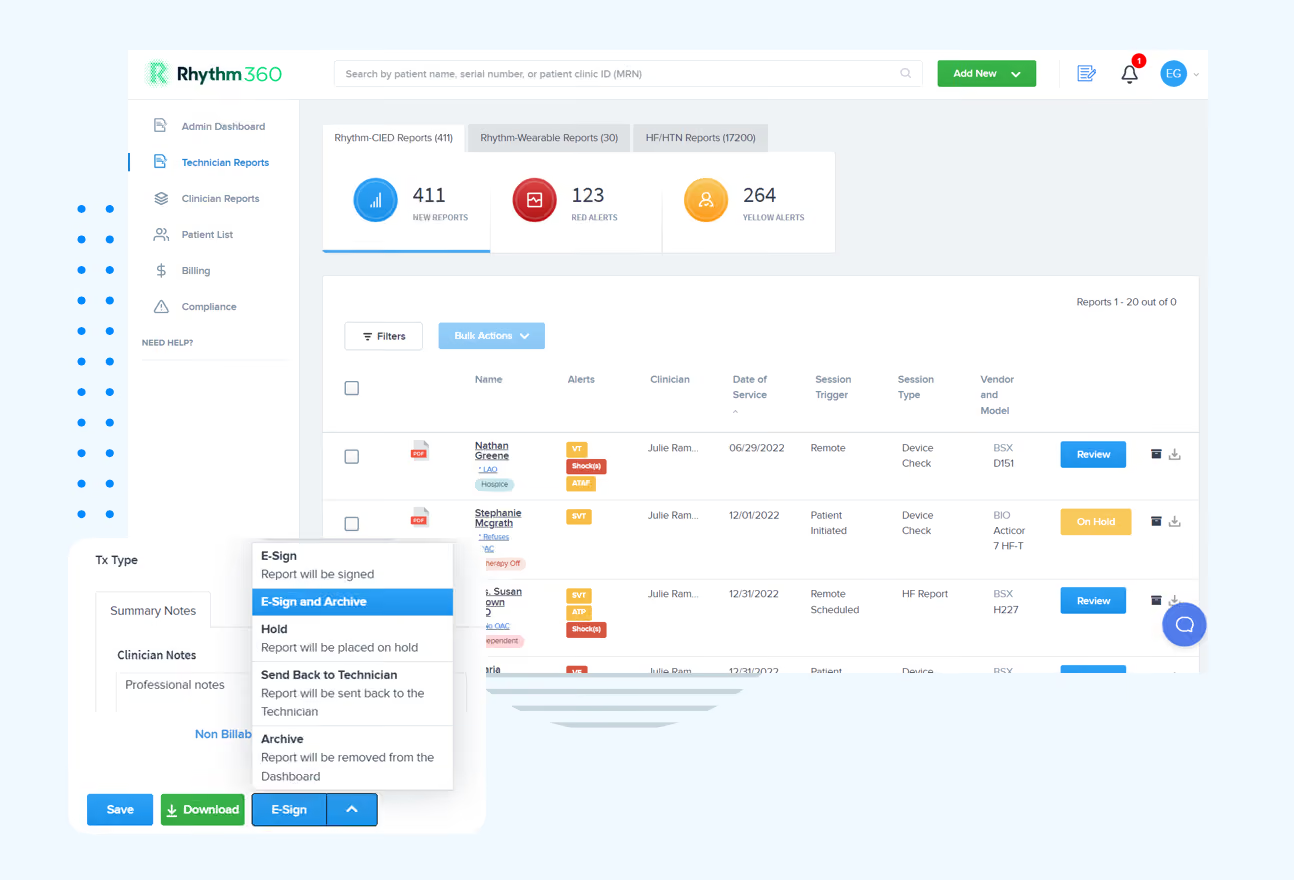
Schedule a demo to see how Rhythm360 eliminates multi-portal intake for your device population.
Adjudication in Cardiology: Routing, Triage, and Documentation
Once intake is complete and device data is normalized, adjudication determines whether the transmission represents a billable event, what it is worth, and how it should be documented. In cardiac device billing, adjudication depends on whether the clinical documentation accurately captures the billable event, such as new-onset atrial fibrillation, ventricular tachycardia, device interrogation, or a remote physiological monitoring threshold crossing. That documentation must then map to the correct CPT code, including 93298, 93299, 99454, 99457, and others.
Manual adjudication workflows fail at this stage because alert volume from legacy OEM portals is high, non-actionable notifications dominate the queue, and staff must manually transcribe device data into the EHR before documentation can be generated. AI triage solves the first two problems by filtering non-actionable alerts and prioritizing clinically significant events. Aviva's deployment of more than 80 AI models across its claims function produced a 23-day reduction in liability determination time on complex cases, validating the impact of AI triage at scale.
Rhythm360 applies AI-powered alert triage to filter non-actionable transmissions and surface clinically significant events in priority order, reducing critical response times by up to 80%. Bi-directional EHR integration with Epic, Cerner, Athenahealth, eClinicalWorks, and Greenway Health removes manual transcription. Automated CPT-code capture generates compliant documentation at the point of the clinical event. This closes the gap between device transmission and billable claim.
Settlement in Cardiology: Payment, Compliance, and Revenue Recovery
Settlement is the stage where documentation quality determines payment. Denied claims in cardiac device billing trace most often to incomplete documentation, missing time-stamps, or CPT codes unsupported by the clinical record. A centralized audit trail that links every transmission, alert, clinician action, and patient communication to a timestamped record resolves all three failure modes. It provides complete documentation, supplies the missing timestamps, and creates the clinical evidence chain that supports each CPT code.
McKinsey estimates that digitizing claims processes can reduce loss adjustment expenses by 25% to 30%, and cloud-native architecture can reduce computing costs and deploy workloads faster. Rhythm360 practices have documented up to 300% revenue uplift through optimized CPT code capture, improved staff efficiency, and the addition of RPM service lines for heart failure and hypertension. These conditions generate recurring monthly billing under codes 99453, 99454, and 99457 when documentation is automated and complete.
AI and Automation Impact Across the Claims Lifecycle
Insurers using AI-powered claims automation resolve claims 75% faster than traditional methods, reducing average resolution time from 30 days to 7.5 days. For simple claims, straight-through processing rates increased from 10–15% to 70–90%, with most completing in 24–48 hours and minimal manual document handling.
The revenue recovery and documentation improvements described in settlement depend on AI automation at every stage, including intake, triage, and payment. AI will not replace clinician oversight in cardiac device monitoring because arrhythmia classification, anticoagulation decisions, and device reprogramming require physician judgment. What AI removes is the administrative layer between device transmission and clinical decision: data normalization, alert triage (which, as noted earlier, cuts critical response times by up to 80%), CPT mapping, documentation generation, and EHR synchronization. Modern AI fraud detection systems analyzing text, imagery, metadata, and behavioral signals can improve fraud detection rates and reduce false positives. The same pattern translates to denial reduction when applied to billing documentation integrity.
Vendor Options for Cardiac Claims Platforms
Understanding what AI can automate clarifies the gap between general-purpose claims platforms and purpose-built cardiac solutions. The comparison below evaluates three platform types across six capabilities that determine whether a system can handle multi-OEM device data, automate CPT documentation, and integrate with existing EHR infrastructure.
Capability Legacy On-Premise General Cloud Suite Vendor-Neutral Cardiac SaaS (Rhythm360) Multi-OEM CIED Ingestion None, single-OEM or manual Limited, requires custom integration Native, API, HL7, XML, computer-vision PDF CPT-Compliant Documentation Manual, error-prone Generic billing modules, not cardiac-specific Automated capture of 93298, 99454, 99457, and others Bi-Directional EHR Integration None or one-directional export Varies by vendor and contract tier Epic, Cerner, Athenahealth, eClinicalWorks, Greenway via HL7 AI Alert Triage None General rules-based routing AI-prioritized, up to 80% reduction in critical response time Mobile Access None Limited, browser-dependent HIPAA-compliant mobile app, review, sign, coordinate from anywhere Pricing Model High upfront license, rigid Per-user or per-claim subscription Usage-based SaaS, scales with clinic size and volume
Decision Framework for Different Healthcare Organizations
The following decision matrix links organization type to primary needs and the platform approach that fits those needs.
Organization Type Primary Need Recommended Approach Large Carrier or TPA High-volume P&C lifecycle management across product lines Enterprise suite (Guidewire, Duck Creek) with AI overlay for fraud Self-Insured Health System Cost containment, EHR integration, population health reporting Cloud-native mid-market platform with HL7 connectivity Specialty Cardiology Practice Multi-OEM CIED data, CPT automation, alert triage, RPM billing Vendor-neutral cardiac SaaS (Rhythm360), fastest ROI path Electrophysiology Clinic Arrhythmia monitoring, critical alert response, mobile clinician access Vendor-neutral cardiac SaaS with AI triage and mobile app
Integration and Implementation for Cardiology Practices
Implementation timelines for general enterprise claims suites consistently run longer than initial vendor estimates, so realistic total cost of ownership planning is essential. Rhythm360's EHR integration and onboarding process takes days to weeks, not months or years, because the platform uses an API-first, cloud-native architecture that connects to existing HL7-capable EHR systems without custom middleware.
Common implementation pitfalls in cardiac device monitoring include data silos from incomplete OEM coverage, alert fatigue from non-prioritized notification queues, and missed CPT revenue from documentation generated after the billing window closes. Rhythm360 addresses all three. Vendor-neutral ingestion, using the multi-format intake described earlier, eliminates OEM gaps. AI triage filters non-actionable alerts. Automated documentation is generated at the point of the clinical event.
Schedule a demo to review integration requirements for your EHR environment.
Pricing Models and ROI for Cardiac Claims Platforms
Cloud-native platforms shift claims management spend from unpredictable capital projects into predictable operating expense, enabling companies to achieve full ROI within the first year through faster claim processing. However, total cost of ownership extends beyond subscription fees. Implementation charges, per-integration fees, data migration, and support tiers can significantly increase effective cost when a general-purpose platform must be adapted to a specialized use case. Purpose-built platforms minimize these hidden costs because integrations and workflows are pre-configured for the target vertical.
Rhythm360 uses a usage-based SaaS model that scales with clinic size and monitored device volume. There are no large upfront license fees. The documented ROI benchmarks, including the 300% revenue uplift detailed in the settlement section and the 80% reduction in critical alert response time, are derived from live practice deployments, not modeled projections.
Frequently Asked Questions
How claims management software supports cardiology billing
Claims management software automates the full lifecycle of a claim from intake through payment using rules-based workflows, AI triage, and integrated data pipelines. In cardiology, the equivalent lifecycle runs from device transmission at FNOL through clinical documentation and CPT code assignment during adjudication to payer submission and payment at settlement. Platforms purpose-built for cardiac device monitoring, like Rhythm360, automate each stage using vendor-neutral data ingestion, AI-powered alert prioritization, and CPT-compliant documentation generation, capabilities that general insurance claims suites do not provide.
How AI improves claims processing accuracy in 2026
AI improves accuracy at three points in the claims lifecycle. At intake, computer vision and natural language processing parse unstructured documents and normalize data from disparate sources, which removes manual transcription errors. At adjudication, machine learning models triage alerts by clinical significance, route claims to the correct workflow, and flag documentation gaps before submission. At settlement, AI-driven audit trail analysis identifies missing CPT support and reduces denial rates. In cardiac device monitoring, these capabilities translate to fewer missed billable events, faster response to critical arrhythmias, and higher clean-claim rates on first submission.
Commonly missed CPT codes without automation
The highest-leakage CPT codes in cardiac device monitoring are those tied to remote interrogation and physiological monitoring. These include 93298 for remote interrogation of implantable cardioverter-defibrillator, 93299 for remote interrogation of pacemaker, 99454 for remote monitoring of physiologic parameter and device supply, and 99457 for remote physiologic monitoring treatment management, first 20 minutes. These codes require time-stamped documentation of the transmission event, clinician review, and patient communication, all within defined billing windows. Without automated documentation triggered at the point of the clinical event, practices routinely miss the window or generate incomplete records that result in denials.
Typical implementation timelines for cardiology practices
Implementation timelines vary significantly by platform type. Enterprise general-purpose claims suites typically require months to years of configuration, data migration, and integration work. Purpose-built cardiac SaaS platforms like Rhythm360 complete EHR integration and onboarding in days to weeks because the OEM data connections, HL7 interfaces, and CPT billing logic are pre-built. The primary variables are EHR system complexity and the number of OEM device manufacturers in the practice's patient population.
ROI from consolidating OEM portals into a unified platform
Practices that consolidate from multiple OEM portals to a unified vendor-neutral platform typically see ROI across three dimensions. Time savings come from eliminating redundant logins and manual transcription. Revenue recovery comes from automated CPT code capture that closes billing gaps. Clinical risk reduction comes from faster critical alert response. Rhythm360 deployments have documented an 80% reduction in critical alert response time and up to 300% revenue uplift through optimized billing and the addition of RPM service lines for heart failure and hypertension. Full ROI is typically realized within the first year of deployment.
Conclusion: Selecting a Cardiac Claims Platform in 2026
The evaluation criteria for claims management software in 2026 are clear. Platforms must support multi-source data ingestion, AI-powered triage, CPT-compliant documentation automation, bi-directional EHR integration, mobile access, and a pricing model that scales with volume rather than penalizing growth. For cardiology practices, those criteria map directly to the operational and financial pain points created by fragmented OEM portals, including data silos, missed critical alerts, manual transcription errors, and revenue leakage from uncaptured device monitoring codes.
General-purpose enterprise claims suites do not address these pain points natively. Rhythm360 was built specifically for this workflow, with vendor-neutral CIED data ingestion, AI alert triage, automated CPT documentation, and EHR integration in a HIPAA-compliant SaaS platform that deploys in weeks. The result is a measurable, documented improvement in response time, compliance posture, and revenue capture, without the implementation complexity or cost of an enterprise suite.
.avif)