Last updated: July 13, 2026
Alert fatigue remains one of the most serious operational challenges in remote cardiac monitoring. When clinicians receive a heavy stream of non-actionable notifications from legacy systems, clinically significant events such as new-onset atrial fibrillation, ventricular tachycardia, or lead malfunction can hide inside the noise.
AI-powered triage changes this pattern by sorting and prioritizing events. In the LINK-HF2 trial, 95% of AI-generated heart failure alerts were reviewed by clinicians within 24 hours, and 26.7% of those alerts led to direct clinical action such as therapy adjustment. A JACC: Advances study across 78 U.S. clinics also found that AI-assisted review identified clinically relevant cardiac device events with higher sensitivity than human readers alone.
Rhythm360 applies AI-driven alert triage to filter non-actionable transmissions and surface only clinically meaningful events, which can reduce critical response times by up to 80%. The platform also offers optional 24/7/365 oversight by IBHRE-certified cardiac technicians supervised by physicians, adding human clinical judgment on top of automated filtering. Andrew Beaser, MD, Associate Professor of Medicine at the University of Chicago Medicine, noted after implementing Rhythm360 that “We are able to address these issues earlier; rather than waiting for a 3-month visit, we can call patients in for evaluation.”
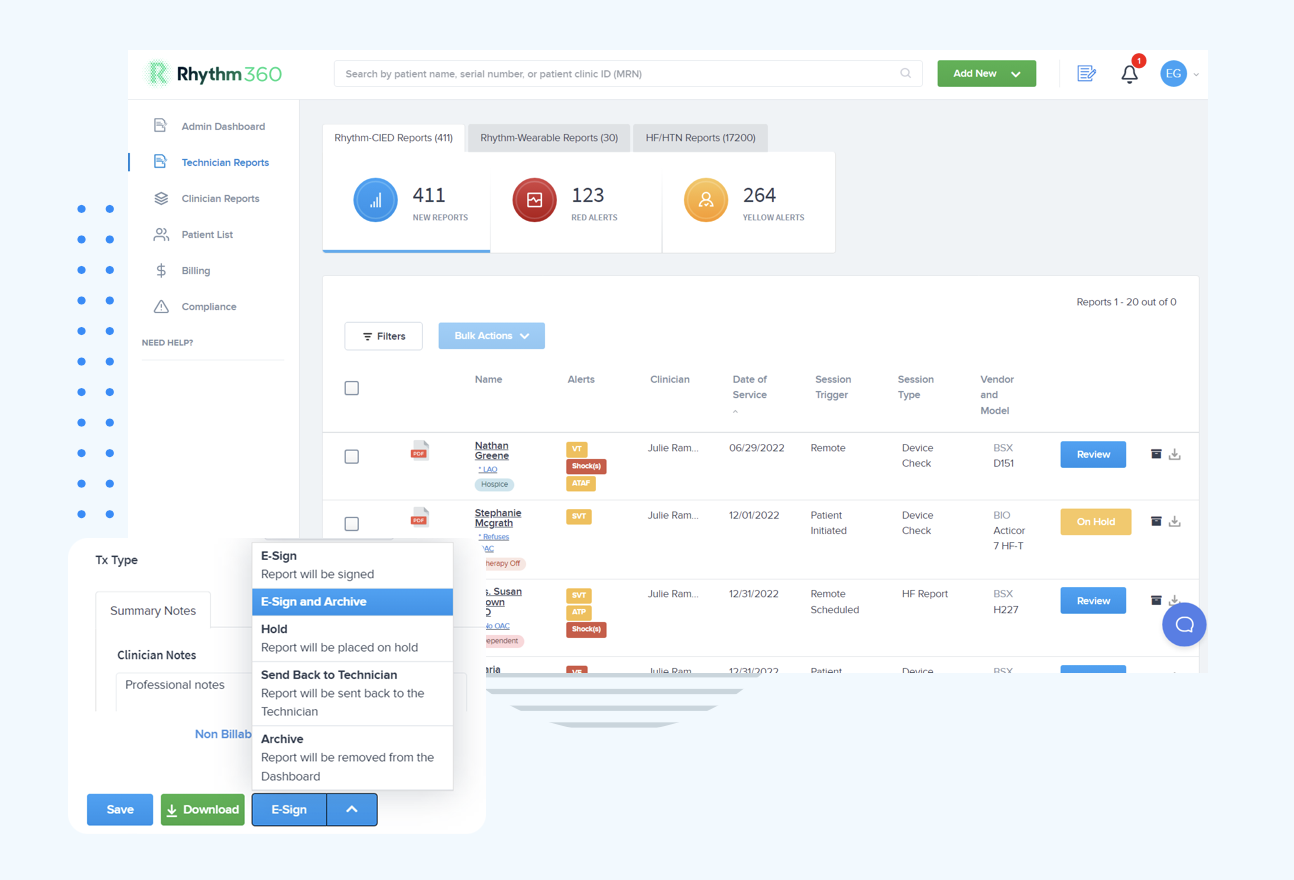
The University of Chicago Medicine reviewed more than 73,000 reports annually through Rhythm360 in calendar year 2025, averaging more than 18,000 reports per quarter. This volume shows that AI-assisted triage can scale in high-volume academic environments while maintaining clinical vigilance.
Once a platform narrows alerts to clinically meaningful events, the next priority is capturing the revenue those interventions generate. The 2026 CPT landscape includes longstanding CIED monitoring codes and newly finalized RPM codes that expand billing flexibility for cardiology practices.
Key codes for arrhythmia and remote physiological monitoring in 2026 include:
A 2026 Medicare patient eligible for RPM, CCM, and BHI can generate significant combined reimbursement per month when all programs are billed concurrently with compliant documentation. Manual workflows rarely capture this revenue consistently. Rhythm360 automates CPT code capture and documentation, helping practices recover missed revenue and increase profitability by as much as 300%. As UCM reported after implementation, “We have improved billing and accountability for our patients after the integration.”
Two-way EHR connectivity is a non-negotiable requirement for any cloud-based arrhythmia monitoring platform in 2026. Healthcare IT integration spending is projected to grow from $5.28 billion in 2025 to $6.1 billion in 2026, driven by chronic disease and remote monitoring programs. Use this checklist as a connected sequence when you evaluate any platform:
Rhythm360 provides deep, two-way integrations with Epic, Cerner, Athenahealth, eClinicalWorks, Greenway Health, and additional systems via HL7. These connections remove manual transcription and support compliant documentation across all monitored service lines.
A realistic onboarding timeline for a cloud-based CIED platform depends on EHR complexity, patient volume, and the number of OEM data feeds that need configuration. Rhythm360 implementations usually complete within a few days to a few weeks. The milestones below apply to most mid-sized cardiology groups.
| Rhythm360 Feature | Metric / Standard | Clinical or Operational Benefit |
|---|---|---|
| Vendor-neutral CIED data ingestion (Medtronic, Boston Scientific, Abbott, Biotronik, and others) | Single unified dashboard; removes multiple OEM portal logins | Breaks down data silos and cuts administrative work across multi-OEM device populations |
| AI-powered alert triage with redundant data feeds and computer vision (OCR) | Greater than 99.9% data transmissibility; high-volume academic use at UCM | Shortens critical alert response times and protects against missed events during OEM server outages |
| Optional 24/7/365 CCT oversight supervised by physicians | IBHRE-certified cardiac technicians; near-real-time report generation | Moves the practice from reactive to proactive patient management and reduces clinician on-call burden |
| Automated CPT documentation across 2026 CIED and RPM codes | Up to 300% revenue increase reported by Rhythm360 clients | Captures billable events that were previously missed and reduces claim rejections from incomplete documentation |
| Two-way EHR connectivity (Epic, Cerner, Athenahealth, eClinicalWorks, Greenway Health, and others via HL7) | Implementation in days to weeks; no manual transcription required | Removes duplicate data entry and auto-populates billing-ready claims with CPT and ICD-10 codes |
| Integrated HF/HTN RPM service lines (Rhythm-CIED and chronic disease management) | Turnkey onboarding checklists; automated billing support for core RPM codes | Enables new recurring revenue streams with limited additional operational overhead |
| HIPAA-compliant mobile application | Secure access for transmission review, report signing, and care coordination from any device | Gives clinicians mobility and supports weekend and on-call response without workstation dependence |
| Integrated Twilio communication hub with full audit trail | Automated and manual patient messaging; all call logs stored in the patient record | Reduces redundant outreach and supports compliant documentation of every patient interaction |
| SaaS-based pricing model | Scales by clinic size and platform usage; no high setup fees | Delivers cost predictability and flexibility for solo practices through large integrated health systems |
Rhythm360 includes a HIPAA-compliant mobile application that allows electrophysiologists, cardiologists, nurse practitioners, and other qualified clinicians to review transmissions, sign reports, and coordinate care from any smartphone. This access is especially valuable for on-call coverage because a clinician can act on a critical arrhythmia alert on a weekend without sitting at a workstation. All mobile activity is logged within the patient record to maintain a complete audit trail.
Rhythm360 is built on HIPAA-compliant infrastructure. All data ingestion, storage, transmission, and communication functions, including the integrated Twilio messaging framework and mobile application, operate within HIPAA-aligned controls. Every patient interaction, from automated messages to manual call logs, is tracked with a full audit trail inside the patient record. Practices can use Rhythm360 to support their own HIPAA compliance obligations for remote monitoring documentation and data security.
Rhythm360 uses a SaaS-based pricing model that scales with clinic size and platform usage. This structure avoids the high upfront setup fees common in legacy on-premise systems and lets practices adjust their investment as patient volume grows or as they add new service lines such as HF and HTN remote physiological monitoring. Pricing supports solo practitioners and electrophysiology clinics as well as large integrated health systems managing thousands of CIED patients.
Rhythm360 is vendor-neutral and supports data ingestion from major CIED manufacturers including Medtronic, Boston Scientific, Abbott, and Biotronik, along with others. The platform also supports specialized sensors such as CardioMEMS pulmonary artery monitors. Data enters the system through APIs, HL7, XML, and unstructured PDF parsing that uses computer vision and AI, which normalizes different data formats into a single unified dashboard. This approach removes the need for staff to log into separate OEM portals to retrieve patient data.
Rhythm360 automates CPT code capture and documentation across both CIED monitoring codes and the 2026 RPM code set. The platform flags billable events in real time, generates compliant documentation, and uses two-way EHR connectivity to auto-populate billing-ready claims with CPT codes, ICD-10 codes, place of service, and provider credentials. This automation reduces manual work for billing staff and helps practices capture revenue that would otherwise be lost to incomplete or late documentation.
Cardiology practices evaluating a cloud-based arrhythmia monitoring platform in 2026 face a crowded market. The criteria that matter most include vendor-neutral data ingestion, AI-powered alert triage, automated CPT documentation, robust two-way EHR connectivity, and a realistic implementation timeline that fits clinical operations.
Rhythm360 delivers a single source of truth for CIED and RPM data, shortens critical alert response times, maintains high data reliability, and helps practices improve billing outcomes by as much as 300%. Implementations complete in days to weeks rather than months, and the platform scales from solo EP clinics to academic medical centers that manage tens of thousands of reports each year.