

Last updated: July 14, 2026
Six capabilities separate a functional platform from a fragmented one. Practices evaluating vendors in 2026 should confirm each of these before signing a contract.
These six capabilities work together rather than in isolation. Talk to our team to see how they function inside a single dashboard.
These capabilities exist because three major guideline bodies now demand them. The Heart Failure Society of America and American Association of Heart Failure Nurses released a joint statement in January 2026 recommending a shift from standalone devices to team-oriented, actionable care systems. The statement calls for intensive monitoring in patients with recent hospitalizations or advanced NYHA classifications, and links adherence rates of 70% or higher to fewer hospitalizations.
The Heart Failure Association of the ESC published a Clinical Consensus Statement in April 2025 on remote pulmonary artery pressure-guided management, backed by large randomized trials showing fewer HF hospitalizations. The iCARDIO Alliance's 2025 Global Implementation Guidelines recommend non-invasive home telemonitoring to lower hospitalization and cardiovascular death risk. All three bodies agree on one point: monitoring must be actionable and interoperable, not siloed in standalone portals.
The clinical case for telemonitoring got stronger through 2026. A meta-analysis by Scholte et al. in npj Digital Medicine reviewed 79 randomized trials covering 31,669 heart failure patients. It found reduced total HF hospitalizations (IRR 0.81), first HF hospitalizations (RR 0.82), and all-cause mortality (RR 0.90) compared with standard care.
The benefits held steady across age, sex, ejection fraction, NYHA class, and region. This supports broad rollout rather than narrow patient selection.
A 2026 review by Szukalska et al. found stronger outcomes in programs that pair telemonitoring with an active clinical response, not passive data collection alone. This is why platform selection should prioritize actionable alert workflows. Raw data means little without AI-powered triage to turn it into a clinical decision.
Strong outcomes depend on three operational pillars: workflow automation, multidisciplinary team coordination, and AI-driven alert management. The 2026 HFSA/AAHFN statement recommends multidisciplinary teams, including nurses, pharmacists, and social workers, for monitoring and patient education.
Workflow automation cuts the administrative load that causes alert fatigue and revenue leakage. When a platform generates reports, maps billable events to CPT codes, and pushes documentation into the EHR automatically, staff spend less time on data entry. University of Chicago Medicine reviewed more than 73,000 reports through Rhythm360 in 2025, proof that automated workflows scale in high-volume environments.
AI-driven alert management tackles alert fatigue directly. The HFSA/AAHFN statement names automation and machine learning as a top research priority for reducing clinician burden. Platforms using these tools now show measurable drops in response time for critical events.
See a live walkthrough of Rhythm360's AI alert workflow for your team.
Administrators comparing platforms need to know where Rhythm360 stands on the factors that affect daily operations and revenue. The table below breaks down four decision points: data sources, EHR integration, alert triage, and billing automation.
| Capability | Rhythm360 Detail | Clinical / Operational Impact |
|---|---|---|
| Data Sources Supported | Vendor-neutral: Medtronic, Boston Scientific, Abbott, Biotronik, CardioMEMS, RPM wearables; ingestion via API, HL7, XML, and PDF computer vision OCR | Eliminates multi-portal logins for a single source of truth on all CIED and HF sensor data |
| EHR Integrations | Bi-directional with Epic, Cerner, Athenahealth, eClinicalWorks, Greenway Health, and others via HL7 | Meets the 2026 HFSA/AAHFN interoperability standard; data flows into existing workflows without separate logins |
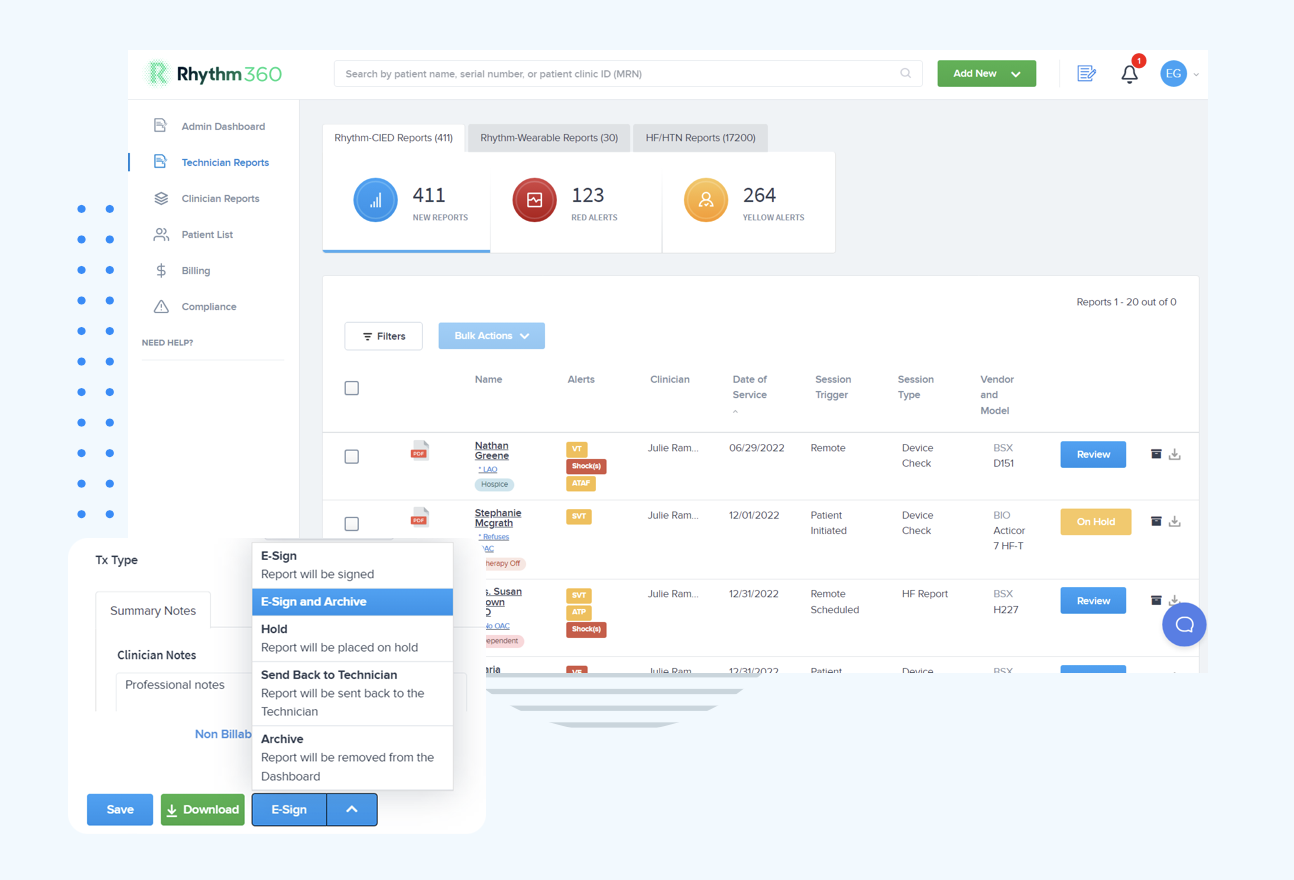
| Alert Triage Capabilities | AI-powered prioritization of clinically significant events; optional 24/7/365 oversight by certified cardiac technicians | Cuts critical alert response times sharply and reduces alert fatigue (detailed below) |
| Billing Documentation Automation | Automated CPT code capture for 99453, 99454, 99457, 93298, 93299 with timestamped audit trails | Practices have increased revenue capture significantly through automated CPT billing |
Compliant billing depends on accurate documentation across both RPM and CIED-specific CPT codes. These are the codes most relevant to cardiology practices managing heart failure patients.
Rhythm360 automates documentation for each of these codes, capturing timestamped transmission data, logging review time, and generating audit-ready records. Getting billing right this way sets up the next step: a smooth implementation.
A structured sequence reduces go-live risk and speeds up time to value.
These ten questions cover the technical, clinical, and financial dimensions that determine whether a platform will actually reduce workload rather than add to it.
A cardiology practice using Rhythm360 receives a transmission on a Saturday morning from a heart failure patient with a CIED. The AI triage system flags a new-onset atrial fibrillation event as critical and routes it to the on-call clinician's mobile app. The clinician reviews device diagnostics, RPM weight and blood pressure trends, and prior alert history without logging into a separate OEM portal.
By Saturday afternoon, the clinician starts anticoagulation therapy based on the full clinical picture in the unified dashboard. The intervention gets documented automatically in the EHR, and the billable event is captured under the correct CPT code. Without a unified platform, this transmission might have sat unreviewed until Monday, leaving a multi-day stroke risk window.
University of Chicago Medicine's implementation let clinicians review more transmissions daily and catch more abnormalities, according to Andrew Beaser, MD, Associate Professor of Medicine at UCM.
This scenario shows what a unified platform delivers in practice, not just on paper. The 2026 standard requires vendor-neutral CIED and RPM data unification, bi-directional EHR integration, AI-powered alert triage, and automated CPT billing, all within HIPAA-compliant infrastructure that works both in-office and on mobile.
Rhythm360 meets each requirement through one platform. As shown by UCM's report volume mentioned earlier, the system scales well, and the response time and revenue gains detailed above hold up in real practice settings.
Ready to see the numbers for your own practice? Get in touch.
A vendor-neutral platform ingests and normalizes data from major cardiac device manufacturers, including Medtronic, Boston Scientific, Abbott, and Biotronik, without separate OEM portal logins. Practices implanting devices from multiple manufacturers avoid managing disconnected systems this way. It also reduces the risk of missed critical events hidden across siloed portals. Rhythm360 achieves this through direct APIs, HL7 feeds, XML parsing, and AI-powered OCR for PDF data, maintaining transmissibility above 99.9% across all connected devices.
Practices managing heart failure patients with CIEDs bill across two code sets. For remote physiologic monitoring, the relevant codes are 99453 for setup, 99454 for device supply with at least 16 days of data per month, and 99457 for the first 20 minutes of monthly clinical staff time. For CIED-specific monitoring, 93298 covers analysis and report, and 93299 covers the professional analysis component. Rhythm360 automates documentation for all five codes by capturing timestamped data, logging review time, and generating audit-ready records.
EHR integration, including bi-directional connections with Epic, Cerner, Athenahealth, eClinicalWorks, and Greenway Health, typically completes within days to a few weeks with no hardware installation. Device onboarding, threshold configuration, staff training, and billing validation follow in sequence. Most practices reach full go-live within three to four weeks, with the onboarding team handling technical integration.
The 2026 evidence base is the strongest to date. A meta-analysis of 79 randomized trials covering more than 31,000 patients found reduced total HF hospitalizations (IRR 0.81), first hospitalizations (RR 0.82), and all-cause mortality (RR 0.90) versus standard care. These benefits held across age, sex, ejection fraction, NYHA class, and region. Invasive hemodynamic monitoring, including CardioMEMS, ranked highest for reducing total hospitalizations. The HFSA/AAHFN statement reinforces this by recommending interoperable, team-based, actionable monitoring over passive data collection.
Alert fatigue happens when staff face high volumes of non-actionable notifications and start missing genuinely critical events. Rhythm360's AI triage filters transmissions and elevates only clinically significant events, such as new-onset atrial fibrillation or lead malfunction, to the top of the queue. Routine transmissions get processed and documented automatically. Optional 24/7/365 oversight by certified cardiac technicians adds a human layer for practices needing after-hours coverage. Together, these features shift clinical teams from reactive to proactive care, as noted in the response time improvements described earlier.





