Remote monitoring in cardiology can improve patient outcomes and create a meaningful revenue stream, but only when CPT rules are applied correctly. The RPM codes 99453, 99454, 99457, and 99458 have specific requirements for consent, data volume, interactive communication, and clinical time. Errors in any of these areas can cause revenue loss, denials, and greater audit exposure. Clear processes and the right technology help practices capture appropriate revenue while maintaining compliance.
Error: Some practices bill for RPM, including initial setup with CPT 99453, without obtaining and documenting explicit patient consent. All RPM services require documented patient consent before the service begins. Missing consent can lead to denials and audit issues.
Prevention strategy: Build consent into every RPM enrollment workflow. Use a concise form that explains services, billing, and privacy, and have patients sign and date it before monitoring starts. Store the consent in the patient record where staff can access it quickly.
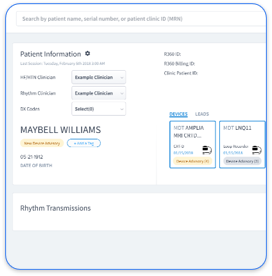
Rhythm360 solution: Rhythm360 includes digital onboarding and consent tools that capture, timestamp, and store consent within the patient record, creating an auditable trail before any RPM billing occurs.
Error: Some teams bill CPT 99454 when the device has not transmitted enough data. CPT 99454 covers remote monitoring of physiological parameters and requires automatic data uploads on at least 16 days within a 30-day period. Manual entry or fewer than 16 days of data usually results in denial.
Prevention strategy: Use tools that track data transmission days for each patient and flag when the 16-day minimum is not met. Staff can then work with patients on adherence or adjust billing so claims match actual device use.
Rhythm360 solution: Rhythm360 monitors device transmission in real time and flags patients who do not meet the 16-day threshold for CPT 99454, helping teams bill only when requirements are satisfied.
Error: CPT 99457 and add-on code 99458 are sometimes billed without documented, interactive communication. CPT 99457 requires at least one real-time, two-way audio or video communication with the patient or caregiver per calendar month. Standard text messages and emails usually do not qualify as interactive for this code. Claims are vulnerable if the live interaction is not clearly recorded.
Prevention strategy: Document each qualifying interaction with the communication type, date, participants, and duration. Align internal templates and workflows with CPT language so staff capture the needed detail during or immediately after each contact.
Rhythm360 solution: Rhythm360 offers an integrated communication hub that logs and timestamps calls and video visits, linking them to the patient record to support CPT 99457 and 99458 billing with less manual effort.
Error: Clinical time spent on RPM care management is sometimes undercounted, overcounted, or not well described. CPT 99457 requires at least 20 minutes of clinical staff time per month, and CPT 99458 covers each additional 20 minutes. Vague notes, lumped time, or double-counted minutes can cause denials or audit concerns.
Prevention strategy: Track time at the activity level and connect it directly to patient care tasks such as reviewing data, adjusting treatment plans, or conducting interactive calls. Use concise descriptions that show how each time block supported clinical decision-making.
Rhythm360 solution: Rhythm360 automatically tracks time spent on RPM care management activities and links those minutes to specific patients, creating clear, auditable support for CPT 99457 and 99458.
Error: CPT 99453 is sometimes treated as a recurring code. CPT 99453 applies to the initial setup and patient education for RPM devices and is generally billed once per patient per episode of care. Repeating this code or failing to document education can lead to rejections.
Prevention strategy: Educate staff that CPT 99453 covers one-time onboarding activities, including device setup and training. Document what was taught, who provided the education, and when it occurred.
Rhythm360 solution: Rhythm360 separates initial setup workflows from ongoing monitoring tasks, helping prevent duplicate billing for CPT 99453 while capturing the education details needed to support the claim.
Error: Some teams confuse the requirements for CPT 99454 with those for CPT 99457 and 99458. CPT 99454 focuses on device supply and data transmission, while CPT 99457 and 99458 require interactive communication and care management time. Using 99457 when only device data was reviewed, or using 99454 when interactive care management occurred, can misalign billing with services.
Prevention strategy: Create simple internal reference guides that list the core requirement for each RPM code. Align documentation prompts with those requirements so staff select codes based on the actual work performed.
Rhythm360 solution: Rhythm360 provides distinct workflows for CPT 99454 and CPT 99457/99458, guiding users to the correct code based on device data review, interactive communication, and recorded time.
Error: RPM time is sometimes counted on the same day as other Evaluation and Management services, such as office or inpatient visits. Time billed for RPM cannot overlap with time billed for other E/M services on the same day. Overlap can result in denied or adjusted claims.
Prevention strategy: Separate documentation for RPM and other E/M services. Note dates and times clearly so billing staff can avoid overlap and ensure each minute is only billed once.
Rhythm360 solution: Rhythm360 centralizes RPM activities and logs them separately from other care encounters, helping staff distinguish remote monitoring time from E/M services and reduce conflicts in billing.
Billing Aspect | Manual Process (Challenges) | Rhythm360 (Solution/Benefit) | Impact on Practice |
Patient Consent | Paper forms, inconsistent documentation, manual tracking of consent status, and higher risk of missing consent. | Digital consent forms with automated capture and secure storage in an auditable record. | Improved compliance, lower audit risk, and faster RPM enrollment. |
Data Transmission Tracking | Manual review of device portals and difficulty verifying the 16-day minimum for CPT 99454. | Automated monitoring of device data transmission with alerts for insufficient days. | More accurate CPT 99454 billing, fewer denials, and better revenue capture. |
Interactive Communication Documentation | Manual call logs with inconsistent detail, making it difficult to prove interactive communication. | Integrated communication hub with automatic timestamping and logging of calls and video visits. | Stronger support for CPT 99457 and 99458 and reduced documentation burden on staff. |
Time Tracking | Manual time entry with a higher chance of incomplete, inaccurate, or hard-to-justify records. | Automated tracking of clinical time tied directly to RPM care management activities. | Audit-ready CPT 99457 and 99458 billing, improved revenue realization, and fewer disputes. |
Consistent processes and the right technology can help prevent small RPM billing errors from accumulating into substantial revenue loss. Schedule a demo to see how Rhythm360 supports accurate RPM billing at scale.
CPT 99454 requires at least 16 days of automatic data transmission within a 30-day period. If the device reports only 10 days of data, CPT 99454 should not be billed. CPT 99457 may still be appropriate if the clinical time and interactive communication requirements are met for that code.
CPT 99457 defines interactive communication as real-time, two-way audio or video between the provider and the patient or caregiver. Standard texts or emails usually do not meet this standard because they are not synchronous. Documented phone calls or video visits are the safest choices for meeting the requirement.
CPT 99453 covers the initial RPM setup and patient education and is typically billed once per patient per episode of care. It does not function as a recurring monthly service. Documentation should show the training provided and the date setup occurred.
CPT 99457 and 99458 are not device-specific. These codes describe total clinical time spent on RPM care management for a patient in a calendar month, across all monitored parameters and devices. If the required time and interactive communication are met, CPT 99457 is billed once, with CPT 99458 added for each additional 20-minute block.
RPM time cannot overlap with time already counted for an office visit or other E/M service on the same day. If a patient has an in-person visit, any RPM work performed that day must be separate and clearly documented. Distinct notes and time records help avoid dual billing issues.
Avoiding common RPM billing errors supports both financial performance and regulatory compliance. Clear consent procedures, reliable data transmission tracking, documented interactive communication, and accurate time logs make it easier to bill CPT 99453, 99454, 99457, and 99458 correctly.
Rhythm360 gives cardiology practices structured workflows, centralized data, and automated checks that simplify RPM billing and make documentation more consistent. Some clients report revenue increases of up to 300 percent through improved CPT capture and reduced administrative workload.
Practices that want to reduce denials, recover missed revenue, and run a more reliable RPM program can benefit from a dedicated platform. Schedule a demo of Rhythm360 today to see how the platform can support your remote monitoring operations and help ensure that eligible services are billed accurately.