Last updated: July 13, 2026
Cardiology practices that manage patients with implantable devices from multiple manufacturers face a structural problem. Each CIED manufacturer has developed proprietary nomenclature, technical standards, and communication protocols, which creates a barrier to unified data management. Staff log into separate portals for Medtronic, Boston Scientific, Abbott, Biotronik, and others, which compounds administrative burden, increases error risk, and fragments the patient record.
The clinical impact shows up in daily workflows. A cross-manufacturer analysis of 2,659 rhythm episodes from 1,710 patients found that even AI-equipped implantable cardiac monitors still generated 32.9% non-actionable episodes. Clinicians spend significant time reviewing alerts that require no intervention. At scale, this alert fatigue erodes clinical vigilance and makes staff retention harder.
The financial pressure is just as real. A September 2024 OIG review found that roughly 43% of RPM enrollees did not receive all three required service components (device supply, data transmission, and treatment management). That gap signals widespread billing compliance risk that automated platforms can address.
The University of Chicago Medicine (UCM) experienced these pressures directly. Gaurav A. Upadhyay, MD, FACC, FHRS, Professor of Medicine and Director of the Pacing & Defibrillation Device Clinic at UCM, stated: "Staffing was always an issue for our center, because our device clinic — like many other medical centers — had struggled with technician turnover and timely weekend coverage." Andrew Beaser, MD, Associate Professor of Medicine at UCM, described pre-implementation workflows as "a major challenge and incredibly difficult."
These challenges, including fragmented portals, alert fatigue, billing gaps, and staffing pressures, point to five specific capabilities that practices now prioritize when evaluating workflow automation platforms.
Cardiology practices evaluating workflow automation platforms in 2026 consistently apply five criteria when assessing fit.
The sections below focus on how Rhythm360 performs across all five criteria.
See how Rhythm360 addresses each of these five criteria in your specific clinical environment.
| Evaluation Criterion | Metric | Rhythm360 Value |
|---|---|---|
| Vendor Neutrality & OEM Coverage | Manufacturers supported | Medtronic, Boston Scientific, Abbott, Biotronik, and others via API, HL7, XML, and AI-powered PDF parsing |
| Data Transmissibility | Transmissibility rate | >99.9% via redundant data feeds, computer vision, and AI-powered extrapolation; UCM reviewed more than 73,000 reports annually through Rhythm360 |
| AI-Powered Alert Triage | Critical response time reduction | Up to 80% reduction in response times for critical alerts |
| EHR Connectivity | Supported systems | Epic, Cerner, Athenahealth, eClinicalWorks, Greenway Health, and others via HL7 |
| CPT Billing Automation | Revenue impact | Up to 300% increase in revenue through optimized CPT code capture and documentation |
| Implementation Timeline | Time to go-live | Days to weeks, including EHR integration setup |
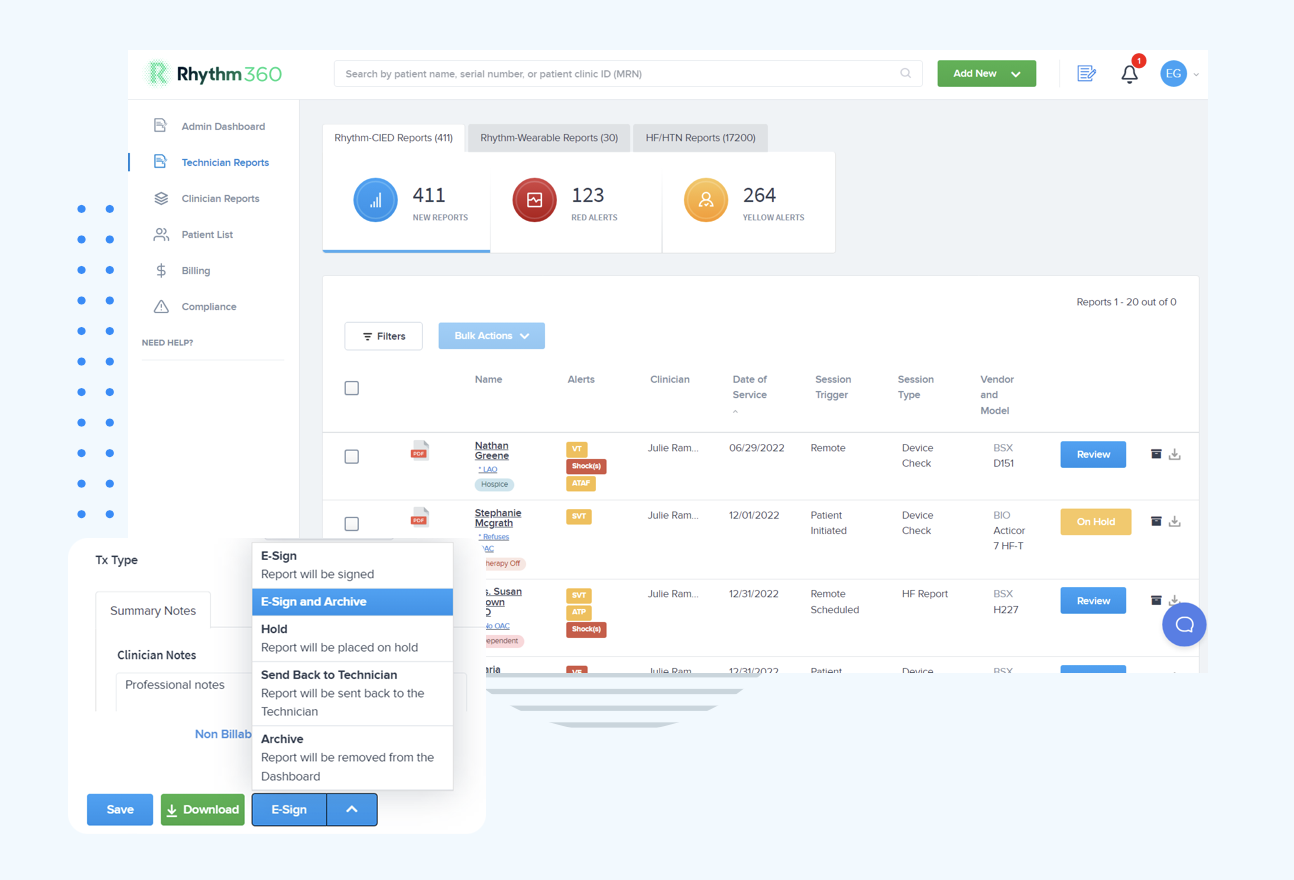
Rhythm360 runs two distinct but integrated service lines within a single login environment. The Rhythm-CIED service line manages data from pacemakers, ICDs, implantable loop recorders, CRT/CCM devices, and CardioMEMS pulmonary artery monitors. The HF/HTN service line supports remote physiological monitoring for heart failure and hypertension patients, including automated patient onboarding checklists and billing support for applicable RPM codes.
Gaurav A. Upadhyay, MD, at UCM, stated: "That was a big piece for us, to have an integrated review of data from trained personnel." That integration across device types, manufacturers, and chronic condition monitoring comes through a single platform and login with Rhythm360.
Evidence from AI-driven HF monitoring supports this integrated approach. The ASSIST-HF trial showed that supervised generative-AI-supported workflows enabled more intensive guideline-directed medical therapy optimization after 12 weeks, with significant reductions in NT-proBNP levels and fewer hospitalizations compared with standard care.
The 2026 CPT landscape for cardiovascular RPM has expanded significantly. For CIED monitoring, the core professional codes remain:
For RPM service lines covering HF/HTN patients, CMS finalized two new codes effective January 1, 2026 under the CY 2026 Physician Fee Schedule Final Rule: CPT 99445 for device supply covering 2–15 days within a 30-day period, and CPT 99470 for the first 10 minutes of RPM treatment management. Because these codes are mutually exclusive with their existing counterparts, practices must choose the appropriate code pair for each billing period. They select either 99445 or 99454 for device supply, and either 99470 or 99457 for treatment management, based on the monitoring window and service intensity documented.
CMS has established 2026 national non-facility rates for RPM codes 99453, 99454, 99457, and 99458. Rhythm360 automates the documentation required for each code, including monitoring period dates, device type, transmission counts, and clinician interpretation notes. This automation reduces the compliance risk that has drawn heightened scrutiny from CMS, OIG, and DOJ auditors.
When an EHR cannot receive structured reporting from device monitoring systems, staff must re-enter interpreted results manually, creating billing risk and continuity of care problems. Rhythm360 closes this gap through two-way HL7 connectivity with Epic, Cerner, Athenahealth, eClinicalWorks, Greenway Health, and additional systems.
Data flows in both directions. Device transmissions and clinical interpretations push into the patient’s longitudinal EHR record in structured format. Patient demographics and scheduling data pull from the EHR into Rhythm360. This approach removes duplicate data entry, supports accurate CPT documentation, and ensures that incoming results trigger appropriate follow-up automatically instead of sitting unreviewed in a separate portal.
Weekend and after-hours coverage represents one of the highest-risk gaps in CIED monitoring. UCM’s pre-implementation challenge with timely weekend coverage is common across device clinics of all sizes.
Rhythm360’s HIPAA-compliant mobile application allows clinicians to review transmissions, sign reports, and coordinate care from their smartphones. When the platform flags a critical arrhythmia, such as new-onset AFib, ventricular tachycardia, or a low-battery indicator, on a Saturday morning, the on-call clinician receives a prioritized notification. That clinician can initiate anticoagulation protocols or arrange device reprogramming before the patient deteriorates. Andrew Beaser, MD, at UCM, explained: "We are able to address these issues earlier; rather than waiting for a 3-month visit, we can call patients in for evaluation."
The platform also offers optional 24/7/365 oversight by certified cardiac technicians (CCTs) supervised by physicians. This service provides an additional layer of triage for practices that need continuous monitoring support.
Rhythm360 uses a SaaS-based pricing model that scales with clinic size and platform usage. This structure avoids the high upfront fees associated with legacy on-premise systems. Implementation, including EHR connectivity setup, typically takes from a few days to a few weeks, which limits disruption to existing clinical workflows.
The platform’s centralized architecture reduces dependence on a single “super-user” and supports continuity when staff turn over. Andrew Beaser, MD, at UCM, noted: "Decision support, including AI-assisted decision support, will become increasingly important as data volumes grow." Rhythm360’s infrastructure is designed to scale from solo practices to health systems managing thousands of patients, as demonstrated by UCM’s annual volume mentioned earlier.
The right cardiovascular RPM platform for a given practice depends on device population complexity, EHR environment, billing compliance requirements, and on-call coverage structure. The following questions guide the evaluation.
Practices that answer “no” to two or more of these questions are experiencing measurable revenue leakage and clinical risk that a unified, vendor-neutral platform can address directly.
A vendor-neutral platform in 2026 supports the full range of cardiac implantable electronic devices, including single-chamber and dual-chamber pacemakers, implantable cardioverter-defibrillators (ICDs), cardiac resynchronization therapy devices (CRT-P and CRT-D), cardiac contractility modulation (CCM) devices, implantable loop recorders (ILRs), and implantable hemodynamic monitors such as CardioMEMS pulmonary artery pressure sensors. Rhythm360 ingests data from all major manufacturers, including Medtronic, Boston Scientific, Abbott, and Biotronik, using a combination of API connections, HL7 feeds, XML parsing, and AI-powered computer vision for unstructured PDF reports. This multi-method ingestion approach achieves greater than 99.9% transmissibility by maintaining redundant data feeds that remain active even when an OEM’s server experiences downtime.
AI-powered alert triage reduces alert fatigue by filtering non-actionable transmissions before they reach the clinical queue and surfacing only events that meet predefined clinical significance thresholds. Instead of presenting every OEM-generated alert for manual review, the system applies machine learning models to distinguish routine device checks, minor parameter variations, and sensor artifacts from actionable findings such as new-onset atrial fibrillation, ventricular tachycardia, lead impedance changes, or battery depletion indicators. Rhythm360’s AI triage layer reduces critical response times by up to 80%, which allows device technicians and clinicians to focus on transmissions that require intervention. The platform also offers optional oversight by certified cardiac technicians supervised by physicians, providing a human review layer for practices that require it. This combination of automated filtering and expert oversight shifts the clinical team from reactive, volume-driven review to proactive, priority-driven management.
The 2026 CPT updates introduced two new remote physiologic monitoring codes, 99445 for device supply covering 2 to 15 days of data within a 30-day period and 99470 for the first 10 to 19 minutes of treatment management, alongside the existing codes 99453, 99454, 99457, and 99458. These new codes are mutually exclusive with their counterparts, so practices bill either 99445 or 99454 for device supply and either 99470 or 99457 for treatment management in any given billing period. The 16-day minimum data transmission threshold previously required to bill 99454 was eliminated, which allows reimbursement for shorter intensive monitoring windows such as post-discharge or post-ablation periods. For CIED-specific billing, the core codes remain 93294 for pacemaker professional interpretation (once per 90 days), 93295 for ICD professional interpretation (once per 90 days), 93296 for the technical component of pacemaker and ICD monitoring, and 93298 for subcutaneous cardiac rhythm monitor interrogation (once per 30 days). Billing any of these codes inside the applicable lookback window triggers a CO-18 duplicate denial, which makes automated tracking of monitoring periods a compliance requirement rather than an operational convenience. Rhythm360 automates the documentation required for each code, including monitoring period dates, device type and manufacturer, transmission counts, and clinician interpretation notes.
Yes. Rhythm360 provides two distinct but integrated service lines, Rhythm-CIED for implantable device monitoring and HF/HTN for remote physiological monitoring of heart failure and hypertension patients, accessible through a single login and unified dashboard. The CIED service line manages transmissions, alert triage, and documentation for pacemakers, ICDs, loop recorders, and hemodynamic monitors. The HF/HTN service line supports patient onboarding, automated data collection from connected devices such as scales and blood pressure cuffs, and billing documentation for applicable RPM codes including 99453, 99445, 99454, 99457, and 99470. Practices can launch the HF/HTN service line alongside an existing CIED program without additional portals, separate staff training environments, or duplicate patient records. All patient communications, including automated reminders, manual outreach, and call logs, are tracked within a single audit trail through the platform’s integrated Twilio-powered messaging framework.
Fragmented OEM portals, manual data entry, alert fatigue, and billing compliance gaps are interconnected symptoms of a workflow architecture that does not match the volume and complexity of modern cardiovascular remote monitoring. Rhythm360 addresses all four simultaneously. A single vendor-neutral dashboard replaces multiple OEM portals, AI-powered triage reduces critical response times by up to 80%, automated CPT documentation captures revenue that manual workflows miss, and structured EHR connectivity removes redundant data entry across Epic, Cerner, Athenahealth, and other systems.
The results are documented. UCM processed more than 73,000 reports annually through Rhythm360 with stable dismissal rates and earlier clinical interventions. Practices implementing Rhythm360 have achieved up to a 300% increase in revenue through optimized CPT code capture and improved staff efficiency. Implementation takes days to weeks, not months.