Last updated: July 13, 2026
Once a practice implants devices from more than one OEM, staff must manage separate, non-interoperable portals to retrieve patient data. This fragmentation creates administrative silos, increases the probability of missed critical alerts, and generates documentation gaps that translate directly into lost revenue.
Industry analysts estimate that manual RPM workflows lose approximately 30% of available revenue due to administrative overhead, missed transmissions, and documentation gaps. The financial stakes are substantial. A stacked CCM and RPM workflow on a complex cardiac patient can generate significant monthly revenue per patient when key CPT codes are captured accurately.
The OIG announced a formal audit of Medicare Part B RPM in December 2024, with Medicare RPM payments reaching $536 million in 2024. Documentation gaps around the 16-day transmission requirement for CPT 99454 and the 20-minute time requirement for CPT 99457 are primary audit triggers. Automated, auditable documentation now functions as a compliance necessity rather than a convenience.
On the clinical side, up to 88.8–90% of arrhythmia alarms in ICU environments are false positives, which illustrates the alert fatigue problem facing monitoring teams across care settings. The Heart Rhythm Society's April 2026 Scientific Statement on AI Integration into Clinical Electrophysiology Workflows identifies data interoperability across devices, platforms, and EHRs as a foundational requirement for safe and effective AI adoption in electrophysiology practice.
Given these operational pressures, including portal fragmentation, revenue leakage, alert fatigue, and compliance risk, procurement teams have converged on seven evaluation criteria that directly address these challenges. The following criteria represent the evaluation dimensions most frequently applied by enterprise cardiology programs when selecting a heart rhythm monitoring platform. The table below presents Rhythm360's documented performance against each criterion.
| Evaluation Criterion | Rhythm360 Performance | Supporting Evidence |
|---|---|---|
| Multi-OEM Data Consolidation | Supports Medtronic, Boston Scientific, Abbott, Biotronik, and others in a single workspace | Platform ingests API, HL7, XML, and unstructured PDFs via computer vision and AI normalization |
| AI Alert Triage Performance | 80% reduction in critical alert response times | AI-powered triage filters non-actionable alerts and prioritizes clinically significant events, with >99.9% data transmissibility via redundant feeds |
| Bi-Directional EHR Integration | Epic, Cerner, Athenahealth, eClinicalWorks, Greenway Health, and others via HL7 | University of Chicago Medicine confirmed improved billing and accountability following integration |
| Automated CPT Documentation | Automated documentation and billing for CIED codes 93298 and 93299 and RPM codes 99453, 99454, and 99457 | Automated workflows can improve CPT 99457 capture rates compared to manual processes |
| Implementation Timeline | A few days to a few weeks, including EHR integration setup | SaaS-based architecture with pre-built OEM connectors accelerates deployment |
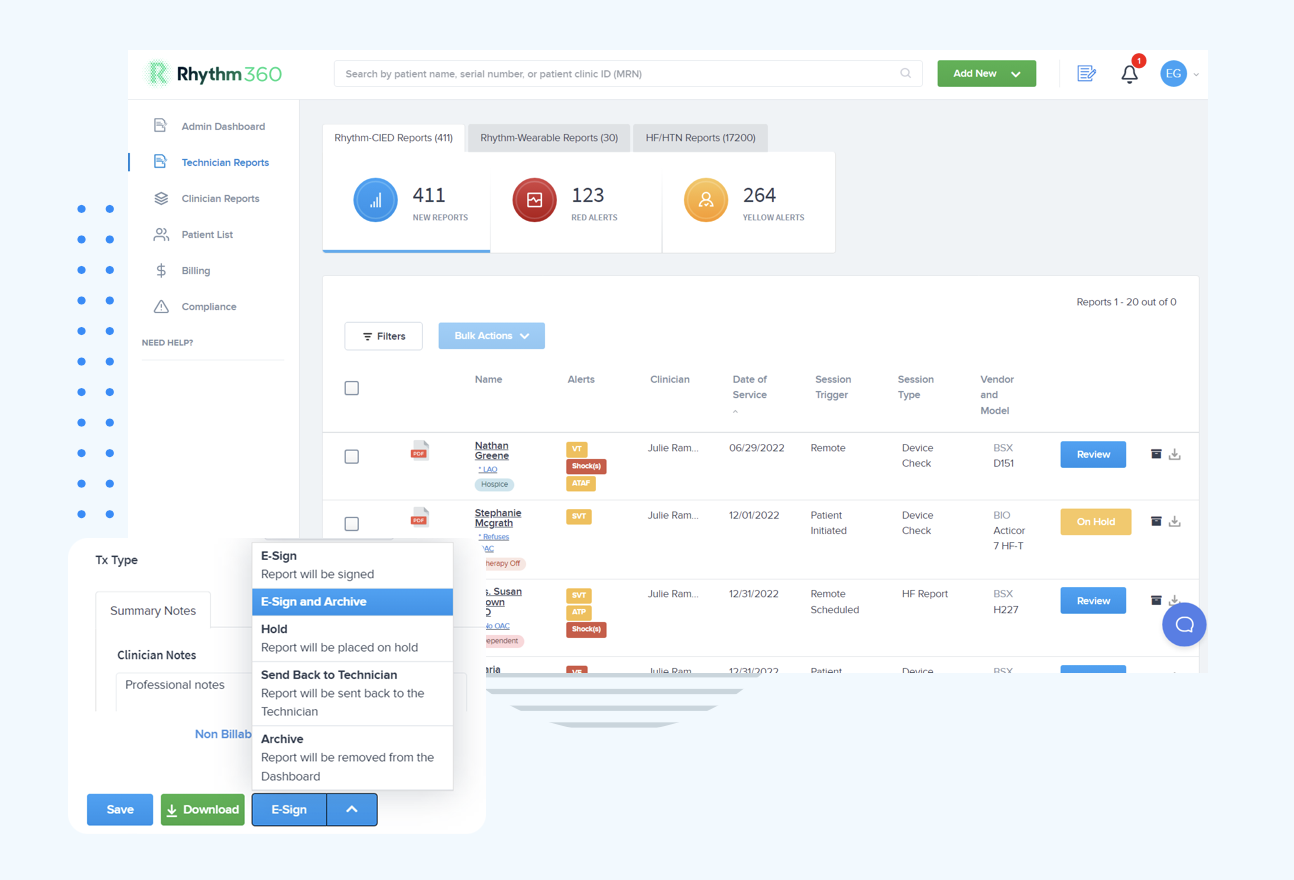
| Secure Mobile Access | HIPAA-compliant mobile app for transmission review, report signing, and care coordination | Andrew Beaser, MD, at UCM: "I am more likely to sign off on these while in meetings because I can easily access them on my phone." |
| Quantified Revenue Outcomes | Up to 300% increase in revenue generation through improved CPT capture and RPM service line expansion | Documented client outcomes; Gaurav A. Upadhyay, MD, at UCM: "We have improved billing and accountability for our patients after the integration." |
Procurement teams should evaluate platforms against these seven criteria using their own patient volume, OEM mix, and EHR environment as the baseline.
University of Chicago Medicine processed more than 73,000 reports annually through Rhythm360 in calendar year 2025, averaging more than 18,000 reports per quarter, which demonstrates the platform's capacity for high-volume enterprise programs. Andrew Beaser, MD, noted: "Decision support, including AI-assisted decision support, will become increasingly important as data volumes grow."
Most health systems now weigh internal builds against purpose-built SaaS platforms for CIED monitoring. Bidirectional EHR integration with a single EHR vendor typically costs $15,000–$150,000 and takes 2–5 months, while multi-EHR integration projects typically cost $30,000–$300,000 (up to $1.2M per EHR) and take 8–20 weeks, and custom HL7 suites can require 6–18 months. For most cardiology practices, a SaaS platform with pre-existing OEM connectors and EHR adapters delivers faster time-to-value at lower total cost.
Alert fatigue creates a distinct scalability risk as panel sizes grow. An EHRA 2026 analysis found that even in AI-equipped ILR devices, 32.9% of episodes remained non-actionable and another 30.6% were deemed indeterminate due to guideline-based interpretation gaps and signal-detection issues. Platforms that layer a cloud-based AI triage engine on top of manufacturer algorithms address this residual false-positive burden. A 2026 study published in Applied Clinical Informatics found that machine learning alarms can reduce alarm burden compared to traditional threshold alarms in acutely ill patients.
Scalability requirements differ materially between a solo EP group managing 200 patients and an integrated health system managing thousands. Rhythm360's SaaS pricing scales with clinic size and platform usage. Its optional 24/7/365 oversight by certified cardiac technicians supervised by physicians provides a staffing model that does not require proportional headcount growth as patient panels expand.
Successful platform deployment depends on stakeholder alignment and data quality before the first integration call. Stakeholder alignment requires early identification of clinical champions and IT leads, while data quality depends on accurate inventories of devices, credentials, and system endpoints. Procurement teams should complete the following readiness checklist to address both dimensions before engaging any vendor:
EHR integration projects in 2026 commonly require three to six months from kickoff to live patient data in production, with security reviews, BAA negotiations, and health-system IT coordination often accounting for half the calendar time rather than the technical build itself. The accelerated timeline mentioned in the evaluation framework reflects Rhythm360's pre-built adapter architecture, which reuses established integration patterns across EHR instances and reduces the custom engineering burden on health-system IT teams.
The 2026 HRS Scientific Statement recommends integrating AI into existing EP workflows through implementation science and user-centered design while establishing governance structures to monitor performance, safety, and unintended consequences. A phased rollout that begins with CIED monitoring and then expands to HF and HTN RPM service lines allows clinical staff to build platform fluency before patient panel volumes scale.
Enterprise implementations that underperform typically share a recognizable set of failure patterns. Procurement teams should evaluate vendor proposals against the following risk factors:
Platform value is measurable across clinical, operational, and revenue domains. Practices should establish baseline values before go-live and track the following metrics at 30, 90, and 180 days post-implementation.
Clinical metrics:
Operational metrics:
Revenue metrics:
Andrew Beaser, MD, at UCM observed: "We are able to address these issues earlier; rather than waiting for a 3-month visit, we can call patients in for evaluation." Earlier intervention functions as both a clinical outcome and an operational efficiency gain, because it reduces downstream hospitalization costs and documents the clinical value of the monitoring program to payers and administrators.
Schedule a demo to review Rhythm360's outcome benchmarks for your patient panel size and OEM mix.
A vendor-neutral heart rhythm monitoring platform ingests and normalizes data from all major cardiac device manufacturers, including Medtronic, Boston Scientific, Abbott, and Biotronik, within a single clinical workspace, without requiring staff to authenticate into separate OEM portals. True neutrality requires support for multiple data ingestion methods, including direct API connections, HL7 feeds, XML parsing, and unstructured PDF extraction via computer vision, because OEMs do not use uniform data formats. Rhythm360 achieves greater than 99.9% data transmissibility through redundant data feeds and AI-powered gap-filling, so a server outage at one OEM does not create a blind spot in the patient record. Neutrality also extends to EHR compatibility, because a platform that integrates with only one EHR system creates a different form of fragmentation for multi-site health systems running heterogeneous EHR environments.
Integration timelines vary based on EHR vendor, health-system IT security review processes, and the complexity of the bidirectional write-back requirements. Generic EHR integration projects in 2026 commonly require three to six months from kickoff to live production data, with institutional security reviews and BAA negotiations accounting for a substantial portion of that timeline rather than the technical build itself. Rhythm360's implementation timeline of a few days to a few weeks is achievable because the platform uses pre-built adapter layers for Epic, Cerner, Athenahealth, eClinicalWorks, Greenway Health, and others via HL7, reusing established integration patterns rather than building custom connections from scratch for each deployment. Practices should confirm during vendor evaluation whether the quoted timeline includes EHR integration setup or refers only to platform access provisioning, because these scopes differ materially.
Revenue outcomes from automated CPT billing in enterprise CIED and RPM programs depend on patient panel size, OEM mix, compliance rates, and the specific code families being captured. A 500-patient panel combining RPM, CCM, and APCM can generate approximately $963,000 in recurring annual revenue. Automated workflows can improve CPT 99457 capture rates compared to manual processes. The CPT 93296 relative value unit increased approximately 60% on January 1, 2026, from 0.60 to 0.95 RVU, so a 200-patient CIED program gains approximately $25,600 per year when the 90-day billing window is tracked automatically. Rhythm360 clients have documented up to a 300% increase in revenue generation through improved CPT code capture, better staff efficiency, and the addition of HF and HTN RPM service lines. The University of Chicago Medicine confirmed improved billing and accountability following Rhythm360 integration.
AI alert triage in enterprise cardiac monitoring platforms operates by layering a cloud-based classification engine on top of manufacturer-embedded algorithms, which addresses the residual false-positive burden that persists after device-level filtering. Even with manufacturer-embedded AI filtering, studies presented at HRS 2026 found that a substantial portion of episodes remained non-actionable or indeterminate, which confirms the need for a second cloud-based classification layer in high-volume programs. Rhythm360's AI-powered triage system filters non-actionable noise and prioritizes clinically significant events, including new-onset atrial fibrillation, ventricular tachycardia, lead malfunction, and ERI or RRT indicators, resulting in an 80% reduction in critical alert response times for monitored patients. The platform also offers optional 24/7/365 oversight by certified cardiac technicians supervised by physicians, which provides a human review layer for ambiguous cases that AI classification flags as indeterminate. Maintaining sensitivity while reducing false positives requires both strong algorithmic performance and a defined escalation protocol, so practices should evaluate both dimensions when comparing platforms.
Enterprise heart rhythm monitoring platform selection in 2026 functions as a procurement decision with direct consequences for patient safety, staff retention, compliance posture, and revenue capture. The seven criteria outlined in this guide, including multi-OEM data consolidation, AI alert triage performance, bi-directional EHR integration depth, automated CPT documentation, implementation timeline, secure mobile access, and quantified revenue outcomes, provide a structured framework for comparing platforms against the operational realities of a multi-OEM cardiology program.
Rhythm360 by RhythmScience is purpose-built to address each of these criteria within a single, HIPAA-compliant, cloud-based platform. From the high-volume enterprise deployment at University of Chicago Medicine to the documented revenue and response-time improvements across client programs, the platform's outcomes provide a measurable baseline for procurement teams evaluating their options.