Last updated: September 24, 2026
Talk With Rhythm360 About Your Monitoring Workflow
These five questions serve as the evaluation spine for the rest of this guide, and each section ties back to one or more of them.
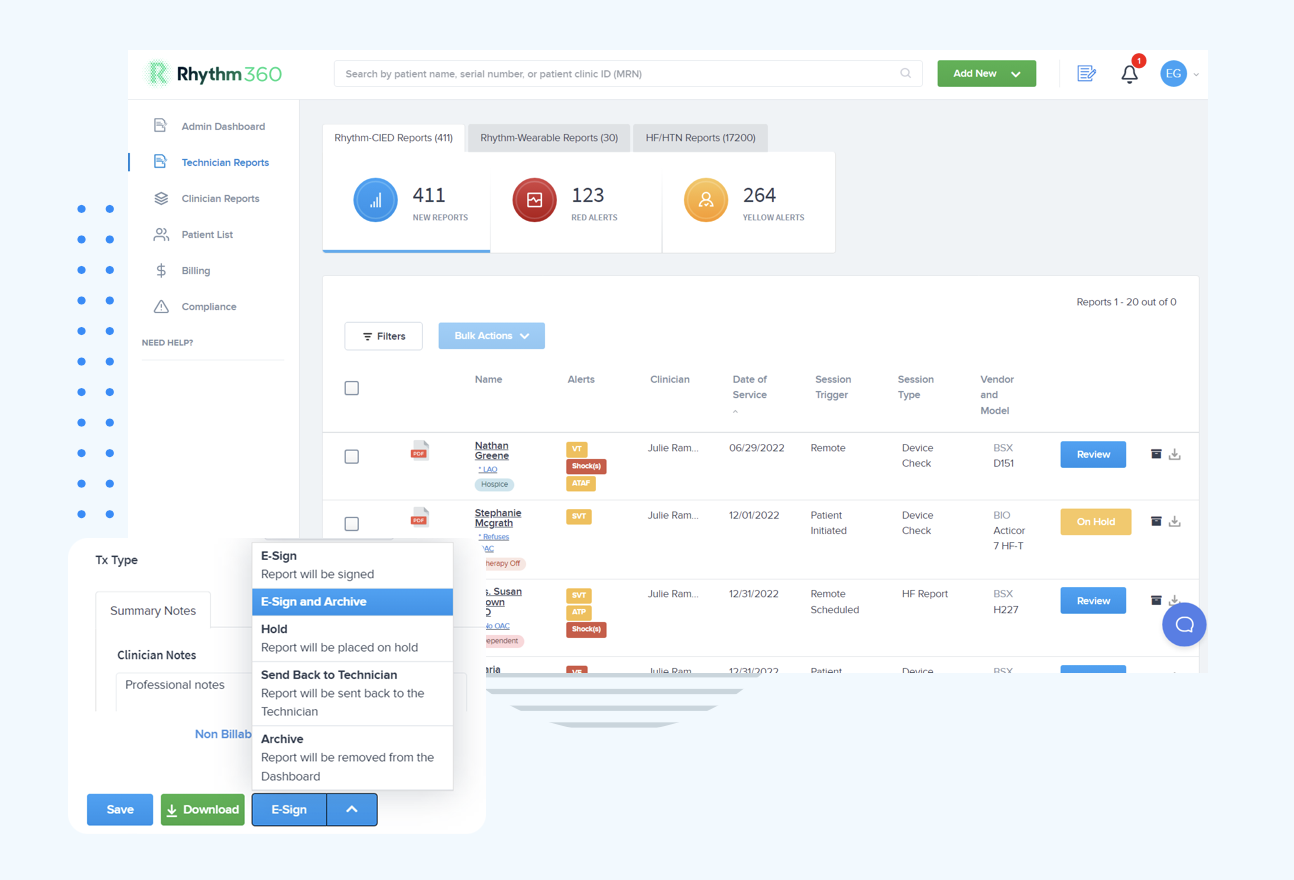
A vendor-neutral aggregator replaces the daily four-portal login with a single workspace. The platform ingests device data from all major OEMs and normalizes it into a consistent format. Every clinician sees a unified population view regardless of which manufacturer implanted the device.
Rhythm360 is a strong choice for cardiology practices managing mixed-manufacturer fleets. It ingests and normalizes data via API, HL7, XML, and computer-vision PDF parsing. Redundant data feeds and AI-powered extrapolation push transmissibility above 99.9%. That scalability shows up in practice: the University of Chicago Medicine reviewed more than 73,000 reports annually through Rhythm360 in calendar year 2025, averaging more than 18,000 reports per quarter.
The trade-off is straightforward. Vendor-neutral SaaS requires initial workflow configuration and a subscription investment, so practices should factor implementation time and ongoing platform costs into total value of ownership.
See How Rhythm360 Consolidates Your OEM Portals
Manufacturer-specific systems such as Medtronic CareLink, Abbott Merlin.net, Boston Scientific LATITUDE, and Biotronik Home Monitoring are built around a single OEM ecosystem. Each platform is designed for its own implants and does not extend native support to devices from other OEMs. A practice that manages patients across multiple manufacturers must maintain separate logins, reconcile disparate data formats, and build parallel workflows with no single population view or consolidated alert queue.
This structural limitation comes from the single-OEM portal model itself. Work done inside a manufacturer portal produces no record in the chart unless somebody re-enters it, which separates clinical work from the documentation that supports billing. For practices with a homogeneous device population, this category can be operationally viable. Mixed-manufacturer fleets usually need a different structure.
Full-service managed programs outsource triage, patient enrollment, and transmission review to a third-party clinical team. The primary benefit is reduced internal staffing load because the monitoring work happens outside the practice. The trade-off is loss of direct control over triage workflows and escalation decisions. When a critical arrhythmia alert arrives on a Saturday morning, the clinical response chain runs through an external team rather than the practice’s own clinicians.
Other platforms in this space include Murj, Implicity, Rhythm Management Group, and Octagos. Practices evaluating this category should ask how escalation decisions are made, who owns the clinical relationship during an after-hours event, and how documentation flows back into the EHR.
Before comparing platforms further, it helps to clarify what these platforms actually monitor. CIED remote interrogation and generic remote patient monitoring (RPM) are two distinct service categories with different clinical purposes, CPT code families, and billing rules. CIED remote interrogation is tied to implanted cardiac devices such as pacemakers, ICDs, and implantable loop recorders, while RPM is tied to home physiologic data collection from connected devices.
CIED interrogation focuses on device diagnostics such as arrhythmia detection, lead integrity, battery status, therapy delivery history, and stored electrograms. Generic RPM focuses on physiologic measurements such as weight trends, blood pressure readings, and symptom data. RPM functions as a general telehealth and physiologic monitoring model spanning many conditions and metrics, while CIED interrogation focuses specifically on implanted cardiac device data and follow-up.
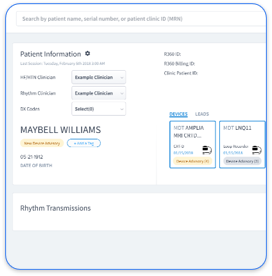
Rhythm360 supports both through distinct but integrated service lines, Rhythm-CIED and HF/HTN RPM, so practices can manage rhythm disorders, heart failure, and hypertension in a single workspace.
The fourth question on the evaluation spine, how a platform supports revenue-cycle outcomes, comes down to CPT code mechanics. CPT code selection in CIED remote monitoring is device-specific, and billing errors in this code family are among the most common causes of claim denial.
For pacemakers and ICDs, the service period is 90 days. CPT 93294 is the professional component for pacemaker systems, CPT 93295 is the professional component for implantable defibrillator systems, and CPT 93296 is the technical component for pacemaker and ICD remote monitoring, each billable once per 90-day period regardless of how many transmissions occur within that window.
For implantable cardiovascular physiologic monitors and subcutaneous cardiac rhythm monitors, the service period is 30 days. CPT 93297 covers remote interrogation of an implantable cardiovascular physiologic monitor, while CPT 93298 covers remote interrogation of a subcutaneous cardiac rhythm monitor, including implantable loop recorders. These are device-specific codes, each billable once per 30 days and each billable global, with modifier -26, or with modifier -TC. Per-transmission billing is incorrect under either code.
Rhythm360 automatically tracks device-specific CPT pairings to prevent device-type mismatch denials and unbilled technical components. That automation matters because missed technical component claims are a silent source of revenue loss, and practices that implement automated documentation support improve billing accuracy and recover that revenue. Even with automation, practices should confirm coverage rules with their Medicare Administrative Contractor and refer to CMS billing guidance and the applicable LCD for ICD remote interrogation in their jurisdiction.
Pricing models in this market fall into two general structures. Some platforms use subscription or SaaS pricing that scales with clinic size and platform usage. Others use bundled managed-service pricing that packages clinical oversight with the technology.
Cost drivers include patient volume, number of service lines activated, and EHR integration scope. Rhythm360 uses a SaaS-based pricing model that scales with clinic size and platform usage. Practices should evaluate total cost of ownership, including implementation complexity, training requirements, and ongoing maintenance, rather than focusing only on line-item feature costs.
The third evaluation question focuses on EHR integration depth, and the word “integrated” covers a wide range of capabilities. A practical test is whether a device transmission arrives as discrete data that can be trended, queried, and attached to a billing period, or arrives as a PDF, which simply moves the filing problem.
Rhythm360 offers bi-directional integrations via HL7. Bi-directional means data flows in both directions. Transmission findings and billing documentation push into the EHR, and current patient data such as medications, visit notes, and device history is available within the monitoring platform without a separate login. Onboarding, including integration setup, typically takes a few days to a few weeks. This structure eliminates manual data transcription and redundant logins that fragment clinical workflows in practices relying on manufacturer-specific portals.
The first evaluation question centers on alert burden and how a platform handles critical events. A critical arrhythmia is flagged on a Saturday morning. The patient is on anticoagulants or may be reprogrammed by that afternoon. This scenario separates platforms with real alert triage from those that simply forward every transmission to a clinician’s inbox. Research in clinical alarm management consistently identifies alert fatigue as a contributing factor in delayed response to significant cardiac events, creating patient safety risk in device clinics where a missed ventricular arrhythmia, undetected lead failure, or delayed response to battery depletion carries real clinical consequences.
High dismissal rates in CIED monitoring at UCM were observed alongside stable dismissal rates, which makes intelligent triage a clinical necessity rather than a convenience feature.
Rhythm360’s AI-powered alert triage filters non-actionable noise and prioritizes clinically significant events, reducing critical alert response times by up to 80% (vendor-reported). The platform also offers optional 24/7/365 oversight by certified cardiac technicians supervised by physicians, so after-hours events follow a defined escalation path to the right clinician.
The fifth evaluation question focuses on scope of monitoring. Some platforms handle only CIED data. Others extend into heart failure and hypertension RPM. A practice that manages heart failure patients with both implanted devices and home monitoring programs needs either two separate platforms or one platform that handles both.
Rhythm360 provides turnkey HF/HTN RPM service lines with patient onboarding checklists and automated billing support for relevant CPT codes including 99453, 99454, and 99457. This multi-modality approach gives practices a single centralized workspace for rhythm disorders, heart failure, and hypertension, which reduces the vendor management overhead that comes with running parallel monitoring programs.
Use this checklist during every vendor demonstration and share it with stakeholders beforehand.
Get A Live Walkthrough Of Rhythm360
Platform fit varies by practice size, staffing model, and operational complexity.
A solo practitioner or small EP clinic benefits most from low administrative overhead and quick onboarding. The priority is a platform that removes manual portal logins and generates compliant documentation without requiring a dedicated device technician to manage the system.
A mid-sized cardiology practice managing a mixed-manufacturer fleet needs strong revenue-cycle outcomes and staff retention. A device clinic staffed by two people who know all four manufacturer portals is two absences away from a backlog. A centralized platform that reduces reliance on a single “super-user” becomes a business continuity requirement.
A large integrated health system managing thousands of CIED patients needs scalability, redundant data feeds, and centralized population dashboards. University of Chicago Medicine’s implementation of Rhythm360 enabled clinicians to review more transmissions daily and identify more abnormalities, with one clinician noting, “We are able to address these issues earlier; rather than waiting for a 3-month visit, we can call patients in for evaluation.”
Rhythm360’s streamlined implementation, including EHR integration, typically takes only a few days to a few weeks, which helps practices that cannot absorb a months-long onboarding disruption.
Practices managing a mixed-manufacturer CIED fleet need a platform that normalizes data across all OEMs without parallel portal workflows. Manufacturer-specific systems cannot meet this requirement by design. Full-service managed programs can address it operationally but at the cost of direct clinical control. Vendor-neutral aggregators resolve the structural problem at the platform level.
Practices that also need HF/HTN RPM should confirm whether a platform supports both service lines in a single workspace or whether adding RPM requires a second vendor relationship and billing workflow.
Practices with complex EHR environments should verify that integrations are live and bi-directional, not roadmap items or one-way PDF feeds. Practices that need after-hours triage coverage should ask how the platform handles critical alerts outside business hours and whether that coverage is built into the platform or requires a separate managed-service contract.
Rhythm360 brings together vendor-neutral data aggregation, AI-powered alert triage with optional 24/7/365 certified technician oversight, bi-directional EHR integration, automated CPT documentation, mobile access via a HIPAA-compliant app, and scalable SaaS pricing. This combination supports practices at any scale, from a single-physician EP clinic to a large integrated health system.
The core problem for cardiology practices managing a mixed-manufacturer CIED fleet is structural. Multiple OEM portals, fragmented data formats, no unified population view, and billing workflows that require manual reconciliation all increase alert burden and revenue risk. Choosing a platform is a decision about alert burden, interoperability, EHR workflow, revenue capture, and scope of monitoring. The wrong structure compounds each of these problems.
Rhythm360 addresses that structure at the platform level. Vendor-neutral aggregation, intelligent alert triage, bi-directional EHR integration, automated CPT documentation, and scalable SaaS pricing give practices a single, accountable system for device monitoring. “We have improved billing and accountability for our patients after the integration,” as one Rhythm360 implementation demonstrated at scale.
Discuss Your CIED Monitoring Strategy With Rhythm360