Last updated: September 28, 2026
Vendor-neutral remote monitoring platforms bring device data from Medtronic, Abbott, Boston Scientific, and BIOTRONIK into one dashboard. They replace separate OEM logins with a single workflow for alert triage, documentation, and billing. These platforms sit above manufacturer portals, normalize different data formats, and connect to EHR systems. Practices can then manage their entire CIED population from one interface.
Four criteria show whether a vendor-neutral platform delivers on this promise:
Layer 1: OEM Portals. Every practice implanting CIEDs must use the manufacturer’s own remote monitoring system. Medtronic’s CareLink Network uses the MyCareLink Home communicator with BlueSync technology, transmitting data via Wi-Fi or cellular to the CareLink portal, where clinicians access it through a password-protected website. Abbott operates Merlin.net with the Merlin@home transmitter. Boston Scientific runs LATITUDE with LATITUDE NXT. BIOTRONIK provides Home Monitoring with CardioMessenger.
In a mixed-device clinic, each portal operates independently. A practice with patients across all four manufacturers maintains separate login credentials, separate alert queues, and separate documentation trails for each system. The 2023 HRS/EHRA/APHRS/LAHRS Expert Consensus Statement on Practical Management of the Remote Device Clinic identifies manufacturer differences in hardware, connectivity, nomenclature, accessibility, and web platforms as an operational challenge. It also notes that as the number of remotely monitored patients grows, proper management becomes difficult without specialized staff and other personnel.
Layer 2: The Clinic Operations Platform. The buying decision happens at this layer. A Layer 2 platform aggregates data from all OEM portals into a single dashboard, automates CPT capture, connects bi-directionally with the EHR, and manages alert triage across manufacturers. OEM portals remain mandatory systems. The Layer 2 platform is where practices choose how they will run daily operations.
A practice managing Medtronic, Abbott, Boston Scientific, and BIOTRONIK patients runs four separate logins, four alert queues, and four documentation trails. Staff cycle between portals to check transmission status, troubleshoot disconnected patients, and compile documentation for billing. This workload grows with every additional device implanted from a different manufacturer.
The operational consequences compound. Because no single system tracks cross-manufacturer compliance, disconnected patients go unnoticed. Staff then spend more clicks per transmission chasing them. Unreviewed transmissions age into both clinical risk and billing gaps. Staffing was always an issue for University of Chicago Medicine’s device clinic, which had struggled with technician turnover and timely weekend coverage before implementing Rhythm360. After implementation, UCM reviewed more than 73,000 reports annually through Rhythm360 in calendar year 2025, averaging more than 18,000 reports per quarter. Stable dismissal rates in this high-volume environment showed that centralized aggregation can scale while preserving clinical rigor.
Every vendor conversation benefits from the same objective criteria. The following scorecard applies regardless of which platforms a practice evaluates:
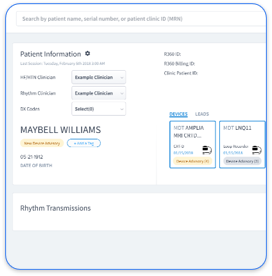
Rhythm360, developed by RhythmScience, is a vendor-neutral, HIPAA-compliant platform that ingests and normalizes data from all major CIED manufacturers. It reaches greater than 99.9% transmissibility through redundant data feeds, computer vision, and AI-powered extrapolation. The platform provides a single source of truth via API, HL7, XML, and PDF parsing.
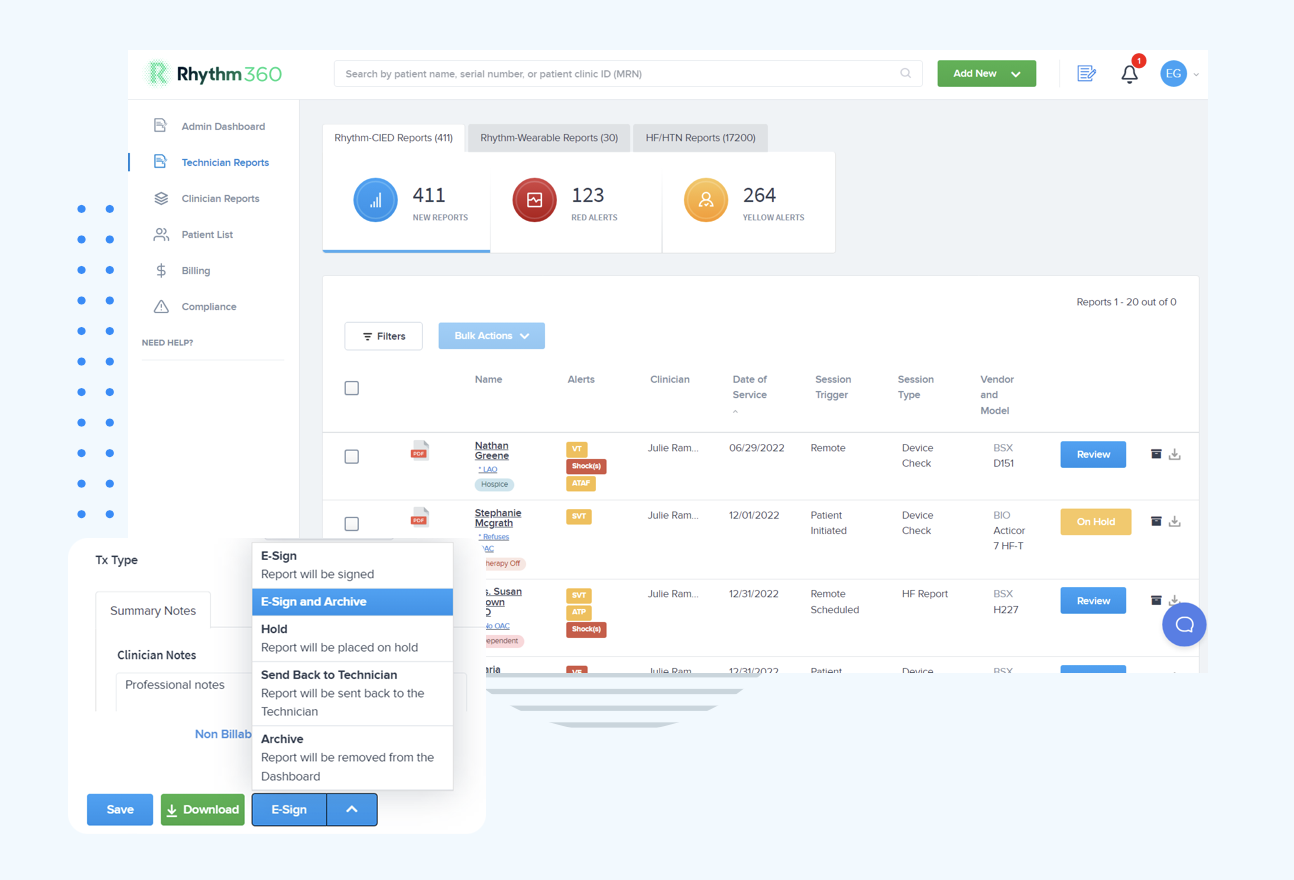
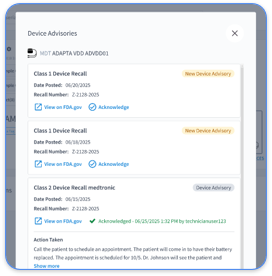
Rhythm360 integrates bi-directionally with Epic, Cerner, athenahealth, eClinicalWorks, and Greenway Health. Its AI-powered alert triage system filters non-actionable transmissions and prioritizes clinically significant events. A secure, HIPAA-compliant mobile app lets clinicians review transmissions, sign reports, and coordinate care from anywhere. Practices that need additional support can add 24/7/365 oversight by certified cardiac technicians supervised by physicians.
UCM’s implementation of Rhythm360 enabled clinicians to review more transmissions daily and identify more abnormalities, and the institution reported that billing and accountability for patients improved after the integration. Across its client base, Rhythm360 has reduced critical alert response times by up to 80% and helped practices increase revenue capture by as much as 300%.
Other Layer 2 platforms exist in this market, and practices should evaluate any option against the scorecard criteria above.
EHR integration depth shapes staff workload more than any other platform feature. True bi-directional integration via HL7 or API means completed reports and documentation flow automatically into the patient record. Patient demographic and scheduling data then flow back into the monitoring platform. This setup removes manual transcription in both directions.
PDF download and upload workflows require staff to retrieve reports from OEM portals, save them locally, and upload them into the EHR manually. This process introduces transcription errors and delays documentation. It also adds clicks per transmission that compound across a large patient panel.
Rhythm360 supports bi-directional integration with the EHR systems listed above, as well as additional systems via HL7. Practices evaluating any platform should confirm whether integration is truly bi-directional, which EHR systems are supported natively, and whether the vendor manages integration in-house or through third-party implementation partners.
Remote CIED monitoring billing runs on two distinct cycles, and device-type mismatch between cycle and code frequently drives claim denials.
The 90-day cycle covers pacemakers and ICDs. CPT 93294 is the professional-component code for remote interrogation of pacemaker systems. CPT 93295 is the professional-component code for remote interrogation of implantable defibrillator systems, including CRT-D. CPT 93296 is the technical-component code covering remote data acquisition, receipt of transmissions, technician review, technical support, and distribution of results for both pacemaker and defibrillator systems. It is reportable once per device per 90-day period.
The 30-day cycle covers two device-specific codes that are not a professional and technical pair. CPT 93297 is a global code for remote interrogation of an implantable cardiovascular physiologic monitor such as CardioMEMS. It is billable once per 30-day period and can be split into professional (-26) and technical (-TC) components. CPT 93298 is a standalone global code for remote interrogation of a subcutaneous cardiac rhythm monitor or implantable loop recorder. It is also billable once per 30 days and splittable into -26 and -TC components. Applying 93297 to a loop recorder or 93298 to a physiologic monitor is a leading denial driver in cardiac device billing.
Rhythm360 automatically tracks device-specific CPT pairings, matches device type to the correct code family, and generates compliant documentation. This automation prevents device-type mismatch denials and unbilled technical components.
A test-dataset methodology gives practices an objective basis for comparing Layer 2 platforms. Structure the RFP dataset with 500 pacemakers, 200 ICD/CRT devices, four manufacturers, and 5–10% disconnected patients. Ask each vendor to demonstrate how their platform handles this dataset end-to-end.
Include these qualitative questions in every vendor conversation:
This methodology surfaces operational differences that feature lists do not reveal. A platform that handles 500 pacemakers cleanly but fails on disconnected-patient workflows or cross-manufacturer documentation will recreate the same fragmentation problems as the OEM portals it was meant to replace.
Before sending the RFP, it helps to know who is actually in the market.
The remote cardiac monitoring landscape divides into two layers. Layer 1 consists of OEM portals: Medtronic CareLink, Abbott Merlin.net, Boston Scientific LATITUDE, and BIOTRONIK Home Monitoring. These are manufacturer-specific systems that practices must use for device transmissions. Layer 2 consists of clinic operations platforms designed to aggregate cross-manufacturer data into a single workflow. Rhythm360 is one such platform, and practices should evaluate any Layer 2 option against the scorecard criteria above.
Remote interrogation of pacemakers, ICDs, and other CIEDs now represents the standard of care. The 2023 HRS/EHRA/APHRS/LAHRS Expert Consensus Statement confirms that remote monitoring can safely replace most routine outpatient visits and facilitate early detection of clinically actionable events without compromising patient safety, with scheduled and unscheduled hospital visits reduced by approximately 50% in remote monitoring groups. Device data transmits through manufacturer systems and then flows into vendor-neutral Layer 2 platforms for triage, documentation, and billing.
The per-patient fee represents only part of the cost. Implementation complexity, training requirements, ongoing maintenance, and scalability all shape what a Layer 2 platform costs over time. Rhythm360’s onboarding process, including EHR integration, typically takes a few days to a few weeks. SaaS-based pricing scales with clinic size and platform usage, which supports both solo EP practices and large integrated health systems.
Practices should evaluate any platform on the time from contract to full deployment, the training burden on device technicians and clinical staff, and whether the vendor manages EHR integration in-house or through third parties. Third-party implementation adds timeline variability and ongoing dependency.
The table below summarizes how Rhythm360 performs against the evaluation criteria discussed above so practices can map each capability to their own operational profile.
Vendor neutrality: Rhythm360 ingests and normalizes data from Medtronic, Abbott, Boston Scientific, and BIOTRONIK via API, HL7, XML, and PDF parsing with computer vision.
Data transmissibility: The platform maintains greater than 99.9% data transmissibility through redundant data feeds, computer vision, and AI-powered extrapolation.
EHR integration: Rhythm360 integrates bi-directionally with the EHR systems listed earlier and supports additional systems via HL7.
Alert response and revenue impact: Practices using Rhythm360 have seen the 80% alert-response improvement and 300% revenue capture increase cited above.
High-volume performance: The UCM volume cited earlier demonstrates that the platform can support more than 73,000 reports annually while maintaining stable dismissal rates.
Staffing and deployment: Rhythm360 supports in-house review, offers optional 24/7/365 CCT oversight, and typically deploys within weeks on a SaaS-based, scalable pricing model. A secure mobile app supports HIPAA-compliant remote review and care coordination.
The right Layer 2 platform depends on the practice’s operational profile. The following decision criteria map practice characteristics to platform requirements:
Rhythm360 addresses each of these criteria within a single platform. Practices that match three or more of the above profiles are strong candidates for a Rhythm360 demonstration.
Rhythm360’s onboarding process, including EHR integration setup, typically takes a few days to a few weeks. Timelines depend on the complexity of the practice’s environment and the EHR systems involved. RhythmScience manages integration in-house, which reduces timeline variability compared with implementations that rely on third-party partners. Training follows a structure that minimizes disruption to existing device clinic workflows.
Rhythm360 does not replace OEM portals. It operates as a Layer 2 platform above them. Medtronic CareLink, Abbott Merlin.net, Boston Scientific LATITUDE, and BIOTRONIK Home Monitoring remain the source of device transmission data. Rhythm360 aggregates that data into a single dashboard, so staff no longer need to log into each portal separately for triage, documentation, and billing. The OEM portals continue to function as the data source, and Rhythm360 serves as the clinical operations layer.
Rhythm360 tracks transmission compliance across all manufacturers in a single dashboard and flags patients who have not transmitted within the expected window, regardless of which OEM portal their device uses. The platform’s integrated communication hub, powered by Twilio, supports automated patient messaging and logs all outreach attempts with a full audit trail. Staff can review the history of automated reminders before making a personal call. This approach avoids redundant contact and helps ensure no disconnected patient goes unnoticed.
Rhythm360 automatically tracks billable events across the full remote CIED monitoring code set. For the 90-day cycle, the platform captures CPT 93294 (pacemaker professional), 93295 (ICD professional), and 93296 (pacemaker/ICD technical). For the 30-day cycle, it captures CPT 93297 for implantable cardiovascular physiologic monitors such as CardioMEMS and CPT 93298 for subcutaneous cardiac rhythm monitors and implantable loop recorders. Each 30-day code is billable once per 30 days and splittable into professional (-26) and technical (-TC) components. The platform matches device type to the correct code family automatically and prevents the device-type mismatch denials that often drive remote monitoring claim rejections.
OEM portals are a structural reality of CIED care. The buying decision happens at Layer 2, where a clinic operations platform either consolidates fragmented data from the four OEM portals described earlier into a single actionable workflow or leaves staff cycling between multiple systems indefinitely. A vendor-neutral platform with true bi-directional EHR integration, AI-powered alert triage, automated CPT capture across the 90-day and 30-day code families, and optional certified cardiac technician oversight directly addresses the multiple-portal problem.
Rhythm360 is built for multi-manufacturer cardiology practices. With the 80% alert-response improvement and 300% revenue capture increase cited earlier, plus an implementation timeline measured in weeks, it aligns with the criteria that matter most for practices managing CIEDs across manufacturers.