Modern cardiology practices manage fragmented multi-vendor environments and aging monitoring systems. Devices from multiple Original Equipment Manufacturers (OEMs) often create data silos across separate portals, so clinical staff must navigate several systems to review a single patient's information.
These fragmented workflows can delay detection of critical events, reduce billing accuracy, and contribute to alert fatigue that affects clinical decisions. Manual data entry and portal management consume hours of staff time each day and lower overall productivity and job satisfaction.
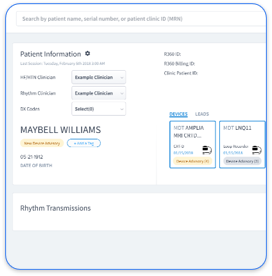
Rhythm360 addresses these challenges with a consolidated platform that unifies cardiac device data and automates routine tasks. The system reduces data silos, streamlines clinical review, and supports more consistent remote cardiac care. Schedule a demo to see how Rhythm360 can support your existing workflows.
Clear evaluation criteria help practices compare platforms in a structured way and align technology choices with clinical and financial goals.
This section compares Rhythm360 and PaceMate across these criteria to clarify how each platform supports remote CIED monitoring.
Rhythm360 provides vendor-neutral interoperability for CIED and remote patient monitoring (RPM) data. The platform aggregates information from major device manufacturers using APIs, HL7, XML, and computer vision, with redundant data feeds that support more than 99.9 percent data reliability.
The platform applies AI to prioritize clinically important events. Rhythm360's alert triage tools filter routine transmissions and focus attention on higher-risk findings, with reported reductions in critical alert response times of up to 80 percent. This approach supports faster intervention and can reduce clinician alert fatigue.
Rhythm360 extends beyond CIED monitoring to manage heart failure and hypertension programs from the same interface. This multi-modality structure supports more comprehensive cardiac care and allows practices to centralize remote monitoring operations.
Revenue cycle tools within Rhythm360 help capture and document CPT codes for CIED and multi-modality RPM services. Automated identification and tracking of billable events have supported reported revenue increases of up to 300 percent in some practices that previously underbilled remote monitoring services.
PaceMate offers cloud-based CIED monitoring with device data integration and workflow tools for cardiology practices. The platform focuses on managing alerts and organizing remote monitoring tasks for care teams.
Available information indicates that vendor-neutral integration in PaceMate centers primarily on CIED data. Support for additional cardiac RPM modalities, such as heart failure or hypertension, appears more limited and may require separate tools or workflows.
Feature | Rhythm360 | PaceMate |
Data Integration and Vendor-Neutrality | Aggregates major CIED and RPM data via APIs, HL7, XML, and computer vision, with greater than 99.9 percent reliability and redundant feeds | Cloud-based CIED monitoring solution that integrates multiple device data sources, with integration depth varying by OEM |
AI-Supported Insights and Alert Triage | AI filtering reduces noise, prioritizes critical alerts, and can reduce response times by up to 80 percent, with optional certified cardiac technician oversight | Emphasizes workflow and alert management with varying levels of AI-based filtering and prioritization |
Comprehensive RPM and Multi-Modality Support | Single platform for CIEDs, heart failure, and hypertension, including integrated workflows and automated billing support | Core focus on CIEDs, with multi-modality RPM features that may be less integrated |
Revenue Cycle Management and Billing | Automated CPT capture and documentation tools that have supported revenue increases of up to 300 percent through improved billing accuracy | Billing support features with varying automation levels and revenue impact across practices |
Practices that want to explore Rhythm360 in more detail can request a Rhythm360 demo and review specific use cases.
Rhythm360 automation tools create operational efficiencies for care teams. The platform centralizes device data, automates routine documentation, and reduces time spent managing portals, which can lower burnout risk and allow staff to focus more on direct patient care.
Patient safety benefits from faster access to reliable data. Shorter response times to critical alerts, combined with data transmissibility greater than 99.9 percent, support earlier interventions for at-risk patients and reduce the chance of missed events.
Financial performance can improve through structured revenue capture. Automated and compliant billing workflows for both CIED monitoring and multi-modality RPM help practices identify and document billable activity that may have been overlooked, supporting reported revenue gains of up to 300 percent.
Scalable architecture allows Rhythm360 to adapt as practices add new devices, service lines, or locations, helping avoid repeated platform changes or costly system replacements.
Rhythm360 combines vendor-neutral data integration, AI-supported insight, multi-modality RPM, and embedded revenue cycle tools in a single environment. This structure supports three core practice objectives: higher efficiency, more consistent safety, and more reliable revenue capture from remote monitoring programs.
Q: How does Rhythm360 ensure data accuracy and reliability from all device manufacturers?
A: Rhythm360 uses APIs, HL7 interfaces, XML parsing, and optical character recognition to ingest and normalize data from major CIED manufacturers such as Medtronic, Boston Scientific, Abbott, and Biotronik. Redundant data feeds and AI validation checks support data transmissibility rates above 99.9 percent.
Q: Can Rhythm360 improve a practice's revenue for remote monitoring?
A: Rhythm360 supports revenue improvement by automating CPT code capture and documentation across CIED and multi-modality RPM programs. Practices using these tools have reported revenue growth of up to 300 percent when compared with previous manual billing approaches that missed eligible services.
Q: Is Rhythm360 compatible with existing EHR systems?
A: Rhythm360 integrates with leading EHR platforms through HL7 and APIs. Current connections include Epic, Cerner, Athenahealth, eClinicalWorks, Greenway Health, and additional systems, with implementation timelines that typically range from several days to a few weeks.
Q: How does Rhythm360 help address clinician alert fatigue?
A: Rhythm360's AI-driven alert triage filters non-actionable data and highlights clinically meaningful events. This process can reduce the number of alerts that require review and shorten response times for higher-priority notifications, which can ease alert burden for clinicians.
Q: What distinguishes Rhythm360's implementation process?
A: Rhythm360 follows an implementation model designed for rapid deployment, including technical integration, staff training, and workflow configuration within days to weeks instead of months for most practices.
Rhythm360 addresses key requirements for modern remote CIED monitoring by offering vendor-neutral data integration, AI-supported clinical insight, multi-modality RPM capabilities, and structured revenue optimization. Practices have reported up to 80 percent faster responses to critical alerts, data transmissibility above 99.9 percent, and revenue improvements of up to 300 percent when using the platform to replace manual processes.
Cardiology groups that want to strengthen clinical outcomes, reduce administrative burden, and improve remote monitoring revenue can schedule a Rhythm360 demo and review how the platform fits their operational and performance goals.