

Last updated: September 22, 2026
Talk With Rhythm360 About Cardiac Device RCM
Compliant automated RCM for cardiac device billing functions as a clinical billing control system. Each control in this framework names the CPT family it governs, the payer edit it satisfies, and the audit artifact it produces.
This guide focuses on CIED (9329x) and cardiac RPM (994xx) compliance controls and lays out a prescriptive, code-specific implementation sequence. The seven controls below form that sequence, and each section that follows covers one of them in order:
Before walking through the seven controls, it helps to know who governs these claims. The governing ecosystem for CIED and cardiac RPM claims includes CMS, MACs, NCCI Procedure-to-Procedure (PTP) edits, and Local Coverage Determinations. CMS Billing Article A56602 governs cardiac rhythm device evaluation coding under Medicare. The A56602 LCD addresses cardiac rhythm device evaluation for codes 93293 through 93296. CMS MLN901705 is the primary Medicare reference for telehealth and remote monitoring billing guidance.
Manual compliance breaks down as practices manage multiple OEM portals, including Medtronic, Boston Scientific, Abbott, Biotronik, and others, each formatting transmission reports differently. That fragmentation matters because device monitoring denials are almost always a frequency-edit or device-type matching problem, with the 30-day minimum monitoring window for CPT 93293–93296 being a hard cutoff that results in denial regardless of clinical circumstances, and both error types are correctable once the specific error is identified. When the underlying data is scattered across portals, neither error type is easy to catch before submission, so traditional manual approaches no longer support audit-defensible automated RCM.
Other platforms in this space include Murj, Implicity, Rhythm Management Group, and Octagos. Rhythm360 is a vendor-neutral, HIPAA-compliant platform that supports compliant billing workflows.
With that landscape in view, the first control addresses the most common denial driver. Control 1 prevents device-type mismatch denials by validating the device against the billed code before claim release.
Validation inputs are device type, implant date, and monitoring status. On mismatch, the claim is blocked before submission. The CPT mapping is as follows:
Codes 93297 and 93298 are device-specific and can each be billed globally or split into professional (-26) and technical (-TC) components. Billing 93298 for a defibrillator patient, or applying 93297 to a loop recorder, creates a device-type mismatch because 93297 maps to implantable cardiovascular physiologic monitors and 93298 maps to subcutaneous cardiac rhythm monitors or loop recorders. Device monitoring denials for CPT 93279–93298 are frequently caused by frequency-edit or device-type matching problems, though documentation gaps, medical necessity, and modifier or component errors are also common denial drivers.
Audit artifact: A validation log linking device serial number to billed code.
Control 2 tracks the calendar rules for each code family to prevent early or duplicate billing.
90-Day Cycle Codes:
30-Day Cycle Codes:
Cardiac RPM Codes:
Audit artifact: A monitoring-period ledger with start and end dates per patient per code.
Control 3 blocks claim combinations that NCCI edits or payer mutual-exclusivity rules prohibit.
CMS NCCI PTP edit files are the authoritative source for pair-level bundling rules. Each edit carries a Correct Coding Modifier Indicator (CCMI) of 0, 1, or 9. A CCMI of 0 means no NCCI PTP-associated modifier can bypass the edit. A CCMI of 1 means an appropriate NCCI PTP-associated modifier may bypass the edit. A CCMI of 9 means there is no active edit for the code pair. When an edit applies, the Column Two code is denied unless a clinically appropriate NCCI PTP-associated modifier is allowed and reported.
A patient whose loop recorder or implanted pressure sensor is already being billed for remote interrogation in a given period generally cannot also generate a home monitoring device supply claim (99454) for that same period, because the specific cardiac monitoring codes exclude the general home monitoring codes.
CPT 99445 and 99454 are mutually exclusive within the same 30-day period, and 99470 and 99457 are mutually exclusive within the same calendar month. Automated enforcement prevents these combinations before claim submission.
Audit artifact: A denial-prevention log showing blocked code pairs and the edit applied.
Control 4 requires specific documentation elements before a cardiac device claim can be released.
Required gates before release:
CPT 93298 requires a signed physician interpretation and report; device vendor printouts alone do not satisfy the interpretation requirement, and unsigned reports draw recoupment audits even after the claim pays. Missing or vague consent documentation is consistently cited as a major audit red flag and a common reason RPM claims fail audit review, even when the clinical service was actually provided. It is one of several high-risk documentation areas. Auditors often require signed beneficiary consent forms, even though CMS regulations permit verbal consent documented in the medical record.
Automated gating prevents release until each element is confirmed present. This approach eliminates the most common audit failure points before submission.
Audit artifact: A pre-release checklist with timestamps and user identifiers.
See How Rhythm360 Enforces Documentation Gates
Control 5 applies a modifier decision sequence so modifiers are rule-based and claim-specific rather than user-decided at submission.
The modifier decision sequence for cardiac device claims:
Before adding a modifier, identify the coding rule that makes the modifier appropriate. In cardiology, that extra step can mean the difference between a clean claim and a denial.
Audit artifact: A modifier justification note linked to the claim.
Control 6 turns denial data into corrective configuration changes.
Cardiology's top denial reasons map to specific CARCs: CO-50 (medical necessity vs. LCD), CO-97 (bundled into another service), CO-4 (modifier missing or invalid), CO-151 (payment adjusted after review, often a downcoding or unbundling issue), and CO-18 (duplicate professional or global billing). For a CO-97 denial driven by an NCCI Procedure-to-Procedure edit, the pair is appealable only when the NCCI modifier indicator is 1. An indicator of 0 represents a hard bundle that no modifier can override, though a denial may still be appealable if it stems from a payer-specific medical policy rather than NCCI or if the edit was applied to the wrong codes.
Denial reasons are categorized by root cause, fed back into validation and gating rules, and used to prevent recurrence. For Noridian JD DME claims, repeated CO-151 (Reason Code 151 / Remark Code N115) denials for a service like 93294 most often reflect frequency-limit or date-span overlap issues rather than documentation gaps. Noridian's corrective path is to review prior claim date spans and LCD frequency limits, then adjust the date span via a self-service reopening. Staff retraining does not resolve that specific pattern. This contractor-specific route does not apply automatically to every CO-151 claim, which can also stem from unit, coding, or documentation problems.
Audit artifact: A denial trend report with root-cause categories and corrective actions.
Control 7 creates defensible records for every automated billing action.
Audit trail elements include user actions, timestamps, rule versions applied, and claim status changes at each stage. RACs conduct post-payment reviews to identify and correct Medicare improper payments and are paid on a contingency fee basis, which opponents argue creates an incentive for RACs to audit and deny claims aggressively, though RACs must now return contingency fees for overpayments overturned on appeal. Governance policies assign ownership for reviewing audit trails and updating controls when NCCI edit versions change. These versions update quarterly under CMS's release schedule.
CMS compliance controls must distinguish the date edits apply to dates of service from the date contractors must process claims under the new file. Version-aware audit trail documentation supports that distinction.
Audit artifact: An exportable audit log and a governance review schedule.
The CY 2026 Medicare Physician Fee Schedule final rule (CMS-1832-F), issued by CMS on October 31, 2025 and effective January 1, 2026, added two new RPM codes (CPT 99445 and 99470) while retaining the existing RPM code framework. CMS MLN901705 and CMS Billing Article A56602 remain the primary Medicare references governing these services.
Cardiac RPM Codes And 2026 Thresholds:
CIED Codes And 2026 Thresholds:
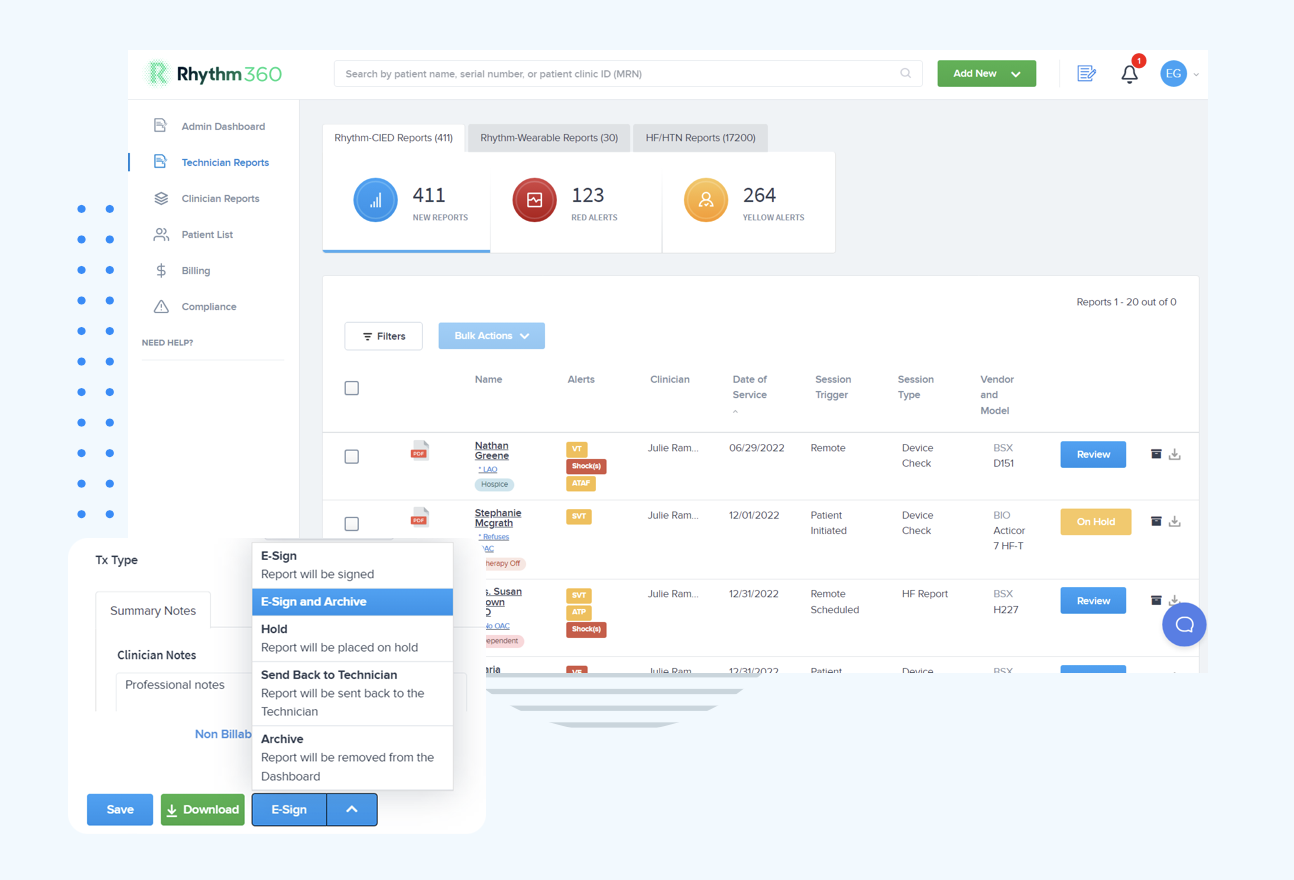
Rhythm360 is a vendor-neutral, HIPAA-compliant, cloud-based platform that unifies CIED and RPM data from Medtronic, Boston Scientific, Abbott, Biotronik, and others into a single source of truth. It operationalizes all seven controls described in this framework:
Rhythm360 offers bi-directional EHR integration with Epic, Cerner, Athenahealth, eClinicalWorks, Greenway Health, and others via HL7. Practices using Rhythm360 have reduced critical alert response times by up to 80% and increased revenue capture or profitability by as much as 300%.
Explore Rhythm360 For Cardiac Device Billing
Organizational readiness for automated RCM controls depends on four factors. These factors are data sources, staff roles, EHR integration status, and audit preparation maturity. Data sources include which OEM portals are active and whether API or HL7 feeds are available. Staff roles define who owns claim release and who reviews audit trails. Audit preparation maturity reflects whether monitoring-period ledgers and denial logs currently exist in any form.
Recommended implementation sequence:
Capable cardiology practices make predictable mistakes when automating cardiac device billing compliance. The most consequential pitfalls include the following patterns.
The CY 2026 Medicare Physician Fee Schedule (CMS-1832-F), effective January 1, 2026, added two new RPM codes: 99445 and 99470. Existing codes 99453, 99454, 99457, and 99458 remain in effect with updated thresholds described earlier in this article. As covered above, 99454 and 99445 are mutually exclusive within a 30-day period, and 99457 and 99470 are mutually exclusive within a calendar month. CMS MLN901705 and CMS Billing Article A56602 remain the primary Medicare references governing these services, and CIED cycle rules for 93294 through 93298 continue to apply.
Yes. Medicare requires modifier KX on claims for CPT 33208 when the implant is for a nationally covered diagnosis (Group I or II, such as non-reversible symptomatic bradycardia), as an attestation that documentation on file shows the patient meets NCD 20.8.3 coverage criteria. Claims without KX are returned as unprocessable, while modifier SC is used for medically necessary pacemakers for conditions not addressed by the NCD. For Medicare claims for CPT 33208, contractors return the claim line as unprocessable when modifier KX is absent, using CARC 4 and RARC N517. CPT 33208 carries a 90-day global period. Modifier 57 attaches to the E/M at which the decision for surgery was made, not to 33208 itself. Modifier 24 applies to an unrelated E/M during the global period. Modifier 78 applies to an unplanned return to the OR for a related complication. Modifier 59 or XS may apply to companion codes only after verifying the NCCI edit pair, because basic electrophysiologic recording and other integral services bundle into 33208 and no modifier makes them separately payable.
CPT 93270 does not carry a universal modifier requirement, but modifier 59 or an appropriate X-modifier (XE, XS, XP, XU) may be appended only when the service is distinct and clinically justified from other services billed on the same date. Because 93270 is a global code encompassing the device, monitoring, and interpretation, it is generally not appropriate to bill it alongside separate technical or professional component codes for the same monitoring episode. Payer-specific policies, including Blue Cross NC's ambulatory event monitors policy, list 93270 among applicable codes and state that inclusion does not guarantee reimbursement. Providers must verify current NCCI PTP edit pairs and payer-specific coverage rules before appending any modifier. The NCCI modifier indicator for the specific code pair determines whether a modifier can bypass the edit.
Automated RCM for remote cardiac monitoring validates device type, transmission date, and 90-day monitoring period status against the billed CPT code, pairing technical component 93296 or 93297 with physician interpretation 93294 or 93295 and separately tracking 93298 for loop recorders, before claim release. If the device on file is a subcutaneous cardiac rhythm monitor, the system maps to 93298. If the device is an implantable cardiovascular physiologic monitor such as CardioMEMS, the system maps to 93297. A mismatch blocks the claim and generates a validation log linking the device serial number to the billed code. This log serves as the primary audit artifact for defending device-to-code accuracy to a MAC or RAC.
A HIPAA-compliant automated RCM audit log should capture seven named fields per OCR enforcement under 45 CFR § 164.312(b): user ID and role, action verb, resource type and ID, UTC timestamp, source IP and user agent, status code, and purpose-of-use. The regulation itself does not dictate specific fields. The first four are effectively non-negotiable, and missing any of them fails an OCR audit. The remaining three are strongly recommended and required for applications handling non-trivial PHI volume.





